Question
A capacitor is a device to store energy. The process of charging up a capacitor involves the transferring of electric charges from its one place to another. This work done in charging the capacitor is stored as its electrical potential energy.
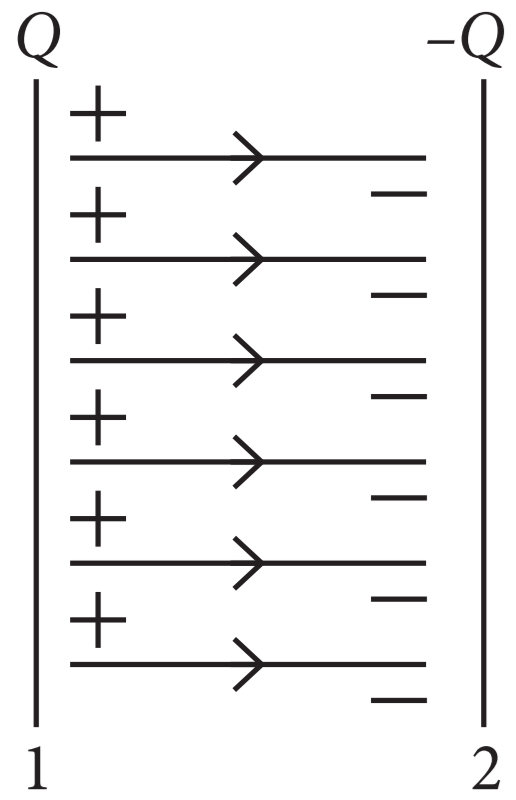
If q is the charge and V is the potential difference across a capacitor at any instant during its charging, then small work done in storing an additional small charge dq against the repulsion of charge q already stored on it is $\text{dW}=\text{V.dq}=(\frac{\text{q}}{\text{C}})\text{dq}.$

  1. A system of 2 capacitors of capacitance $2\mu\text{F}$ and $4\mu\text{F}$ is connected in series across a potential difference of 6 V. The energy stored in the system is:
  1. $3\mu\text{J}$
  2. $24\mu\text{J}$
  3. $30\mu\text{J}$
  4. $108\mu\text{J}$
  1. A capacitor of capacitance of $10\mu\text{F}$ is charged to 10V. The energy stored in it is:
  1. $100\mu\text{J}$
  2. $500\mu\text{J}$
  3. $1000\mu\text{J}$
  4. $1\mu\text{J}$
  1. A parallel plate air capacitor has capacity C farad, potential V volt and energy E joule. When the gap between the plates is completely filled with dielectric:
  1. Both V and E increase.
  2. Both V and E decrease.
  3. V decreases, E increases.
  4. V increases, E decreases.
  1. A capacitor with capacitance $5\mu\text{F}$ s charged to $5\mu\text{C}.$ If the plates are pulled apart to reduce the capacitance to $2\mu\text{F},$ how much work is done?
  1. 6.25 × 10-6J
  2. 3.75 × 10⁻⁶J
  3. 2.16 × 10⁻⁶J
  4. 2.55 × 10⁻⁶J
  1. A metallic sphere ofradius 18cm has been given a charge of 5 × 10-6C. The energy of the charged conductor is:
  1. 0.2J
  2. 0.6J
  3. 1.2J
  4. 2.4J

Answer

  1. (b) $24\mu\text{J}$

Explanation:

As, $\text{C}_1=2\mu\text{F},\text{C}_2=4\mu\text{F}$

ln series combination, the equivalent capacitance will be, 

$\text{C}=\frac{\text{C}_1\text{C}_2}{\text{C}_1+\text{C}_2}=\Big(\frac{2\times4}{2+4}\Big)\mu\text{F}$

$=\frac{4}{3}\mu\text{F}$

Potential difference applied, V = 6V

Energy stored in the system, $\text{U}=\frac{1}{2}\text{CV}^2$

$=\frac{1}{2}\times\frac{4}{3}\times10^{-6}\times(6)^2$

$\text{J}=24\mu\text{J}.$

  1. (b) $500\mu\text{J}$

​​​​​​​​​​​​​​Explanation:

The energy stored in a capacitor is

$\text{U}=\frac{1}{2}\text{CV}^2$

$=\frac{1}{2}\times(10\times10^{-6})(10)^2=500\mu\text{J}.$

  1. (b) Both V and E decrease.

​​​​​​​​​​​​​​​​​​​​​Explanation:

When the gap between the plates is completely filled with dielectric of dielectric constant K, then potential is:

$\text{V}=\frac{\text{Qd}}{\text{A}\in_0\text{K}}$ (i)

and electric field is

$\text{E}=\frac{\text{Q}}{\text{A}\in_0\text{K}}$ (ii)

From equations (i) and (ii), both electric field and potential decrease.

  1. (b) 3.75 × 10⁻⁶J

​​​​​​​​​​​​​​​​​​​​​​​​​​​​Explanation:

Work done $=\text{U}_\text{f}-\text{U}_\text{i}=\frac{1}{2}\frac{\text{q}^2}{\text{C}_\text{f}}-\frac{1}{2}\frac{\text{q}^2}{\text{C}_\text{i}}$

$=\frac{\text{q}^2}{2}\Big[\frac{1}{\text{C}_\text{f}}-\frac{1}{\text{C}_\text{i}}\Big]$

$=\frac{(5\times10^{-6})^2}{2}\Big[\frac{1}{2\times10^{-6}}-\frac{1}{5\times10^{-6}}\Big]$

= 3.75 × 10⁻⁶J

  1. (b) 0.6J

​​​​​​​​​​​​​​​​​​​​​​​​​​​​​​​​​​​Explanation:

Here r = 18cm = 18 × 10-2m, q = 5 × 10⁻⁶C

As, $\text{C}=4\pi\in_0\text{r}=\frac{18\times10^{-2}}{9\times10^9}=2\times10^{-11}\text{F}$

Energy of charged conductor is

$\text{U}=\frac{\text{q}^2}{\text{2C}}=\frac{(5\times10^{-6})^2\text{C}}{2\times2\times10^{-11}\text{F}}=0.625\text{J}.$

Need a full question paper?

Generate a complete, print-ready paper with questions like this in minutes — across 16+ boards, with answer keys.

Start Generating Free

Similar questions

Draw a block diagram of a generalized communication system. Write the functions of each of the following:
(a) Transmitter, (b) Channel, (c) Receiver.
A car driver going at some speed v suddenly finds a wide wall at a distance r. Should he apply brakes or turn the car in a circle of radius r to avoid hitting the wall?
A stationary charge produces only an electrostatic field while a charge in uniform motion produces a magnetic field, that does not change with time. An oscillating charge is an example of accelerating charge. It produces an oscillating magnetic field, which in turn produces an oscillating electric fields and so on. The oscillating electric and magnetic fields regenerate each other as a wave which propagates through space.

Magnetic field in a plane electromagnetic wave is given by $\vec{\text{B}}=\text{B}_0\sin(\text{kx}+\omega\text{t}) \hat{\text{j}}\text{T}.$
  1. Expression for corresponding electric field will be (Where c is speed of light).
  1. $\vec{\text{E}}=-\text{B}_0\text{c}\sin(\text{kx}+\omega\text{t}) \hat{\text{k}}\frac{\text{V}}{\text{m}}$
  2. $\vec{\text{E}}=\text{B}_0\text{c}\sin(\text{kx}-\omega\text{t}) \hat{\text{k}}\frac{\text{V}}{\text{m}}$
  3. $\vec{\text{E}}=\frac{\text{B}_0}{\text{c}}\sin(\text{kx}+\omega\text{t}) \hat{\text{k}}\frac{\text{V}}{\text{m}}$
  4. $\vec{\text{E}}=\text{B}_0\text{c}\sin(\text{kx}+\omega\text{t}) \hat{\text{k}}\frac{\text{V}}{\text{m}}$
  1. The electric field component ofa monochromatic radiation is given by $\vec{\text{E}} = 2\in_0\hat{\text{i}}\cos\text{kz}\cos\omega\text{t}.$ Its magnetic field $\vec{\text{B}}$ is then given by:
  1. $\frac{2\in_0}{\text{c}}\hat{\text{j}}\cos\text{kz}\cos\omega\text{t}$
  2. $\frac{2\in_0}{\text{c}}\hat{\text{j}}\sin\text{kz}\cos\omega\text{t}$
  3. $\frac{2\in_0}{\text{c}}\hat{\text{j}}\sin\text{kz}\sin\omega\text{t}$
  4. $-\frac{2\in_0}{\text{c}}\hat{\text{j}}\sin\text{kz}\sin\omega\text{t}$
  1. A plane em wave of frequency 25MHz travels in a free space along x-direction. At a particular point in space and time, $\text{E}=(6.3\ \hat{\text{j}})\frac{\text{V}}{\text{m}}.$ What is magnetic field at that time?
  1. $0.095\mu\text{T}$
  2. $0.124\mu\text{T}$
  3. $0.089\mu\text{T}$
  4. $0.021\mu\text{T}$
  1. A plane electromagnetic wave travelling along the x-direction has a wavelength of 3mm. The variation in the electric field occurs in they-direction with an amplitude 66Vm1. The equations for the electric and magnetic fields as a function of x and tare respectively.
  1. $\text{E}_\text{y}=33\cos\pi\times10^{11}\Big(\text{t}-\frac{\text{x}}{\text{c}}\Big),\\\text{B}_\text{z}=1.1\times10^{-7}\cos\pi\times10^{11}\Big(\text{t}-\frac{\text{x}}{\text{c}}\Big)$
  2. $\text{E}_\text{y}=11\cos2\pi\times10^{11}\Big(\text{t}-\frac{\text{x}}{\text{c}}\Big),\\\text{B}_\text{y}=11\times10^{-7}\cos2\pi\times10^{11}\Big(\text{t}-\frac{\text{x}}{\text{c}}\Big)$
  3. $\text{E}_\text{x}=33\cos\pi\times10^{11}\Big(\text{t}-\frac{\text{x}}{\text{c}}\Big),\\\text{B}_\text{x}=11\times10^{-7}\cos\pi\times10^{11}\Big(\text{t}-\frac{\text{x}}{\text{c}}\Big)$
  4. $\text{E}_\text{y}=66\cos2\pi\times10^{11}\Big(\text{t}-\frac{\text{x}}{\text{c}}\Big),\\\text{B}_\text{z}=2.2\times10^{-7}\cos2\pi\times10^{11}\Big(\text{t}-\frac{\text{x}}{\text{c}}\Big)$
  1. A plane electromagnetic wave travels in free space along x-axis. At a particular point in space, the electric field along y-axis is 9.3Vm-1. The magnetic induction (B) alongz-axis is:
  1. 3.1 × 10-8T
  2. 3 × 10⁻⁵T
  3. 3 × 10⁻⁶T
  4. 9.3 × 10-6T
While watering a distant plant, a gardener partially water than in fresh closes the exit hole of the pipe by putting his finger on it. Explain why this results in the water stream goirig to a larger distance.
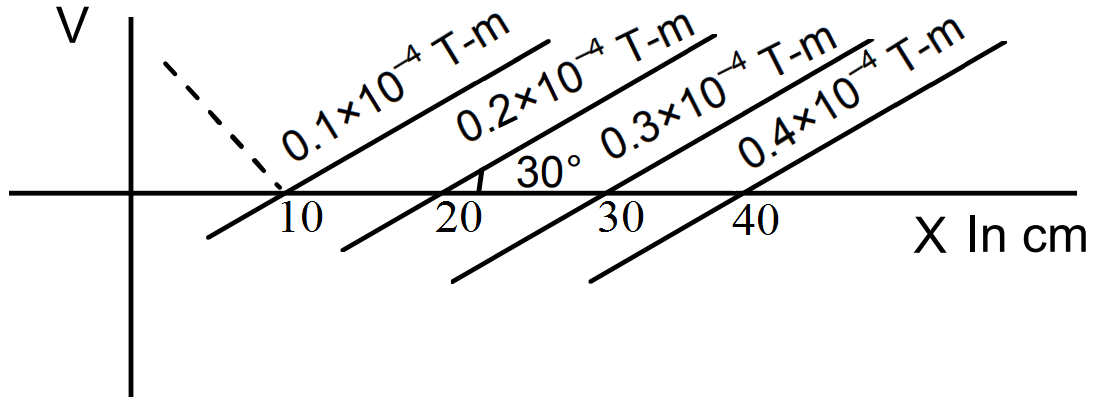
Figure shows some of the quipotential surfaces of the magnetic scalar potential. Fmd the magnetic field B at a point in the region.

The entering flux from a closed surface is $2 \times 10^3$ Newton-metre ${ }^2 /$ Coulomb and the emerging flux is $8 \times 10^3$ Newton-metre ${ }^2 /$ Coulomb. Find the value of charge enclosed in the surface.
A player hits a baseball at some angle. The ball goes high up in space. The player runs and catches the ball before it hits the ground. Which of the two (the player or the ball) has greater displacement?
A 4.0kg block is suspended from the ceiling of an elevator through a, string having a linear mass density of 19.2 × 10-3kg/m. Find the speed (with respect to the string) with which a wave pulse can proceed on the string if the elevator accelerates up at the rate of 2.0m/s2. Take g = 10m/s2.
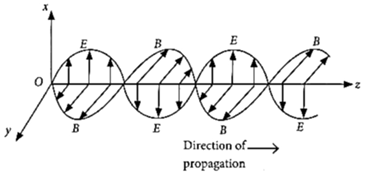
A stationary charge produces only an electrostatic field while a charge in uniform motion produces a magnetic field, that does not change with time. An oscillating charge is an example of accelerating charge. It produces an oscillating magnetic field, which in turn produces an oscillating electric fields and so on. The oscillating electric and magnetic fields regenerate each other as a wave which propagates through space.
Image
(i). Magnetic field in a plane electromagnetic wave is given by $\vec{B}= B _0 \sin ( kx +\omega t ) \hat{j} T$Expression for corresponding electric field will be (Where c is speed of light.)
(a) $\vec{E}= B _0 c \sin ( kx +\omega t ) \hat{k} V / m$
(b) $\vec{E}=- B _0 c \sin ( kx -\omega t ) \hat{k} V / m$
(c) $\vec{E}=- B _0 c \sin ( kx +\omega t ) \hat{k} V / m$
(d) $\vec{E}=\frac{B_0}{c} \sin ( kx +\omega t ) \hat{k} V / m$

(ii) The electric field component of a monochromatic radiation is given by $\vec{E}=2 E _0 \hat{i} \cos kz \cos \omega t$. Its magnetic field $\vec{B}$ is then given by
(a) $-\frac{2 E_0}{c} \hat{j} \sin kz \sin \omega t$
(b) $\frac{2 E_0}{c} \hat{j} \sin kz \sin \omega t$
(c) $\frac{2 E_0}{c} \hat{j} \sin kz \cos \omega t$
(d) $\frac{2 E_0}{c} \hat{j} \cos kz \cos \omega t$

(iii) A plane em wave of frequency 25 MHz travels in a free space along x -direction. At a particular point in space and time, $E =(6.3 \hat{j}) V / m$. What is magnetic field at that time?
(a) $0.089 \mu T$
(b) $0.124 \mu T$
(c) $0.021 \mu T$
(d) $0.095 \mu T$

OR

A plane electromagnetic wave travels in free space along $x$-axis. At a particular point in space, the electric field along $y$-axis is $9.3 V m ^{-1}$. The magnetic induction (B) along z -axis is
(a) $3.1 \times 10^{-8} T$
(b) $3 \times 10^{-5} T$
(c) $3 \times 10^{-6} T$
(d) $9.3 \times 10^{-6} T$

(iv) A plane electromagnetic wave travelling along the $x$-direction has a wavelength of 3 mm . The variation in the electric field occurs in the $y$-direction with an amptitude $66 V m ^{-1}$. The equations for the electric and magnetic fields as a function of $x$ and $t$ are respectively
$\begin{aligned} \text { a) } E_y & =11 \cos 2 \pi \times 10^{11}\left(t-\frac{x}{c}\right), & \text { b) } E_y & =66 \cos 2 \pi \times 10^{11}\left(t-\frac{x}{c}\right), \\ B_y & =11 \times 10^{-7} \cos 2 \pi \times 10^{11}\left(t-\frac{x}{c}\right) & B_z & =2.2 \times 10^{-7} \cos 2 \pi \times 10^{11}\left(t-\frac{x}{c}\right) \\ \text { c) } E_x & =33 \cos \pi \times 10^{11}\left(t-\frac{x}{c}\right), & \text { d) } E_y & =33 \cos \pi \times 10^{11}\left(t-\frac{x}{c}\right), \\ B_x & =11 \times 10^{-7} \cos \pi \times 10^{11}\left(t-\frac{x}{c}\right) & B_z & =1.1 \times 10^{-7} \cos \pi \times 10^{11}\left(t-\frac{x}{c}\right)\end{aligned}$
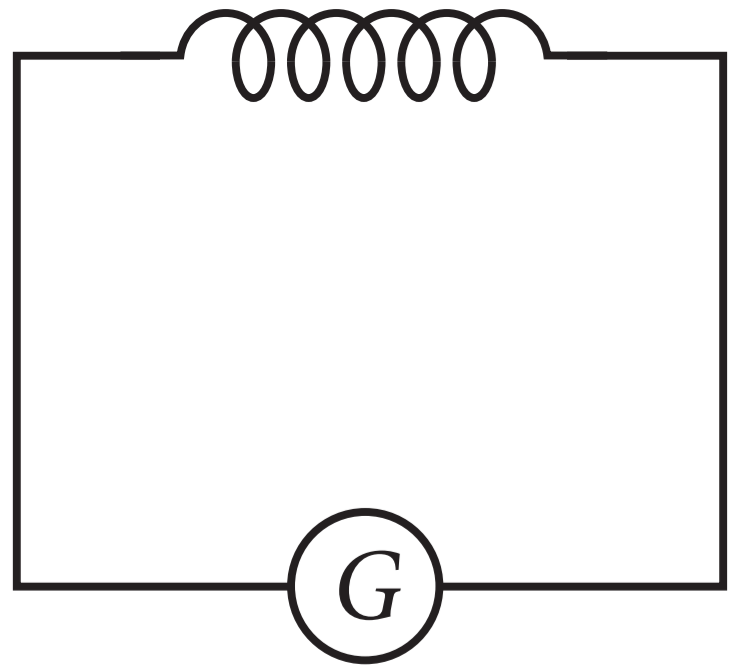
When a current/ flows through a coil, flux linked with it is $\phi=\text{LI},$ where L is a constant known as self inductance of the coil. Any change in current sets up an induced emf in the coil. Tims, self inductance of a coil is the induced emf set up in it when the current passing through it changes at the unit rate. It is a measure of the opposition to the growth or the decay of current flowing through the coil. Also, value of self inductance depends on the number of turns in the solenoid, its area of cross-section and the relative permeability of its core material.

  1. The inductance in a coil plays the same role as:
  1. Inertia in mechanics.
  2. Energy in mechanics.
  3. Momentum in mechanics.
  4. Force in mechanics.
  1. A current of 2.5A flows through a coil of inductance 5H. The magnetic flux linked with the coil is:
  1. 0.5Wb
  2. 12.5Wb
  3. Zero
  4. 2Wb
  1. The inductance L of a solenoid depends upon its radius R as:
  1. $\text{L}\propto\text{R}$

  2. $\text{L}\propto\frac{1}{\text{R}}$

  3. $\text{L}\propto\text{R}^2$

  4. $\text{L}\propto\text{R}^3$

  1. The unit of self-inductance is:
  1. Weber ampere
  2. Weber-1 ampere
  3. Ohm second
  4. Farad
  1. The induced e.m.f. in a coil of 10 henry inductance in which current varies from 9A to 4A in 0.2 second is:
  1. 200V
  2. 250V
  3. 300V
  4. 500V