MCQ
A capacitor is a perfect insulator for
  • A
    Alternating currents
  • Direct currents
  • C
    Both $ac$ and $dc$
  • D
    None of these

Answer

Correct option: B.
Direct currents
b
(b)  ${X_C} = \frac{1}{{\omega C}} = \frac{1}{{2\pi \nu \,C}}$; For $dc$ $\nu = 0,\,\,\,\therefore \,\,{X_C} = \infty $

Need a full question paper?

Generate a complete, print-ready paper with questions like this in minutes — across 16+ boards, with answer keys.

Start Generating Free

Similar questions

Lenz’s law is expressed by the following formula (here $e$ = induced $e.m.f$., $\phi$ = magnetic flux in one turn and $N$ = number of turns)
Two coils have a mutual inductance $0.005 \,H$. The current changes in the first coil according to equation $I = {I_0}\sin \omega \,t$, where ${I_0} = 10\,A$ and $\omega =100\pi\; radian/sec$. The maximum value of $e.m.f$. in the second coil is
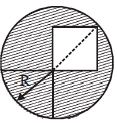
From a circular disc of radius $R$, a square is cut out with a radius as its diagonal. The center of mass of remainder part is at a distance (from the centre)
Given that: $\lambda  = a\,\cos \,\left( {\frac{t}{p} - qx} \right)$ , where $t$ represents time in second and $x$ represents distance in metre. Which of the following statements is true?
The radius of nucleus of silver (atomic number $=$ $47$) is $3.4 \times {10^{ - 14}}\,m$. The electric potential on the surface of nucleus is $(e = 1.6 \times {10^{ - 19}}\,C)$
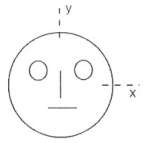
Look at the drawing given in the figure which has been drawn with ink of uniform line-thickness. The mass of ink used to draw each of the two inner circles, and each of the two line segments is $m$. The mass of the ink used to draw the outer circle is $6 \mathrm{~m}$. The coordinates of the centres of the different parts are: outer circle $(0,0)$, left inner circle $(-a, a)$, right inner circle $(a, a)$, vertical line $(0,0)$ and horizontal line $(0,-a)$. The $y$-coordinate of the centre of mass of the ink in this drawing is
Let $\vec A\, = \,(\hat i\, + \,\hat j)\,$  and $\vec B\, = \,(2\hat i\, - \,\hat j)\,.$  The magnitude of a coplanar vector $\vec C$ such that  $\vec A\cdot \vec C\, = \,\vec B\cdot \vec C\, = \vec A\cdot \vec B$ is given by
According to kinetic theory of gases, which of following statement will be true.
A candle flame of $3\, cm$ is placed at $3\, m$ from a wall. A concave mirror is kept at distance $x$ from the wall in such a way that image of the flame on the wall is $9\, cm$. Then $x$ is......$cm$
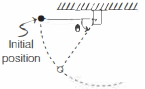
Figure below shows a small mass connected to a string, which is attached to a vertical post. If the ball is released, when the string is horizontal as shown below. The magnitude of the total acceleration (including radial and tangential) of the mass as a function of the angle $\theta$ is