The radius of nucleus of silver (atomic number $=$ $47$) is $3.4 \times {10^{ - 14}}\,m$. The electric potential on the surface of nucleus is $(e = 1.6 \times {10^{ - 19}}\,C)$
Easy


Download our appand get started for free
Experience the future of education. Simply download our apps or reach out to us for more information. Let's shape the future of learning together!No signup needed.*
Similar Questions
- 1A condenser of capacitance $10\,\mu F$ has been charged to $100\,volts$. It is now connected to another uncharged condenser in parallel. The common potential becomes $40\,volts$. The capacitance of another condenser is......$\mu F$View Solution
- 2Choose the $CORRECT$ optionView Solution
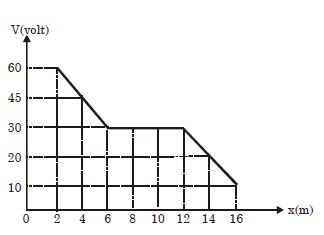
- 3The variation of potential with distance $x$ from a fixed point is as shown in figure. The electric field at $x =13\,m$ is......$volt/meter$View Solution
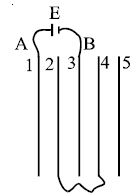
- 4Five conducting parallel plates having area $A$ and separation between them $d$, are placed as shown in the figure. Plate number $2$ and $4$ are connected wire and between point $A$ and $B$, a cell of emf $E$ is connected. The charge flown through the cell isView Solution
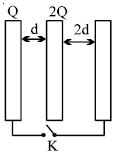
- 5Three large plates are arranged as shown. How much charge will flow through the key $k $ if it is closed?View Solution
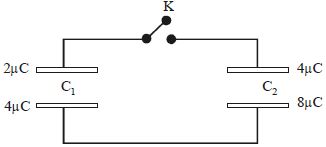
- 6Assertion : Charges are given to plates of two plane parallel plate capacitors $C_1$ and $C_2$ (such that $C_2 = 2C_1$ ) as shown in figure. Then the key $K$ is pressed to complete the circuit. Finally the net charge on upper plate and net charge the circuit. Finally the net charge on upper plate and net charge on lower plate of capacitor $C_1$ is positive.View Solution
Reason : In a parallel plate capacitor both plates always carry equal and opposite charge.
- 7An electric charge ${10^{ - 3}}\,\mu \,C$ is placed at the origin $(0, 0)$ of $X -Y$ co-ordinate system. Two points $A$ and $B$ are situated at $\left( {\sqrt {2\,} \,,\,\,\sqrt 2 } \right)$ and $(2, 0)$ respectively. The potential difference between the points $A$ and $B$ will be......$volt$View Solution
- 8View SolutionEqual charges are given to two spheres of different radii. The potential will
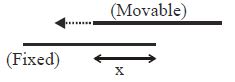
- 9A parallel-plate capacitor consists of a fixed plate and a movable plate that is allowed to slide in the direction parallel to the plates. Let $x$ be the distance of overlap, as shown in the figure. The separation between the plates is fixed. Assume that the plates are electrically isolated, so that their charges $±Q$ are constant. Force on the movable plate is proportional toView Solution
- 10An electric dipole with dipole moment $\vec p = (3i + 4j) \times 10^{-30} C-m$ is placed in an electric field $\vec E = 4000 \hat i (N/C).$ An external agent turns the dipole slowly until its electric dipole moment becomes $(-4 \hat i + 3 \hat j) ×10^{-30}C-m.$ The work done by the external agent is equal to :-View Solution