MCQ
A capacitor is a system of two conductors separated by _____.
- AConductors.
- BDielectrics.
- CAn insulators.
- DNone.
Generate a complete, print-ready paper with questions like this in minutes — across 16+ boards, with answer keys.
The mean electric energy density between the plates of a charged capacitor is (here q = charge on the capacitor and A = area of the capacitor plate)
|
(a) |
(b) |
(c) |
(d) None of the above |
In Young's double slit experiment, the intensity on the screen at a point where path difference is l is K. What will be the intensity at the point where path difference is λ/4
|
(a) |
(b) |
(c) K |
(d) Zero |
The maximum focal length of the eye-lens of a person is greater than its distance from the retina. The eye is:
The energy of a photon of characteristic X-rays from a Coolidge tube comes from
| (a) The kinetic energy of the striking electron |
| (b) The kinetic energy of the free electrons of the target |
| (c) The kinetic energy of the ions of the target |
| (d) An electronic transition of the target atom |
If two conducting spheres are separately charged and then brought in contact
|
(a) The total energy of the two spheres is conserved |
|
(b) The total charge on the two spheres is conserved |
|
(c) Both the total energy and charge are conserved |
|
(d) The final potential is always the mean of the original potentials of the two spheres |
If the following input signal is sent through a PN-junction diode, then the output signal across RL will be
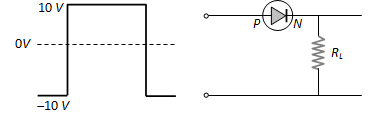
(a)
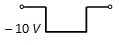
|
(b)
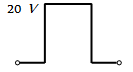
|
(c)

|
(d)
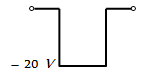
|
The distance between the plates of a parallel plate capacitor is d. A metal plate of thickness d/2 is placed between the plates. The capacitance would then be
|
(a) Unchanged |
(b) Halved |
(c) Zero |
(d) Doubled |
There are certain types of stars called visible stars which undergo periodic change in their light output. If such a star quadruple it's light output, how much does it's magnitude change
|
(a) – 1.25 |
(b) – 1.5 |
(c) – 1.75 |
(d) – 2 |


