A capacitor is charged by using a battery which is then disconnected. A dielectric slab is introduced between the plates which results in
AIIMS 2010, Medium
Download our app for free and get started
If a dielectric slab of dielectric constant $K$ is filled in between the plates of a capacitor after charging the capacitor (i.e., after removing the connection of battery with the plates of capacitor) the potential difference between the plates reduces to $\frac {1}{K}$ times and the potential energy of capacitor reduces to $\frac {1}{K}$ times but there is no change in the charge on the plates.

Download our appand get started for free
Experience the future of education. Simply download our apps or reach out to us for more information. Let's shape the future of learning together!No signup needed.*
Similar Questions
- 1In the circuit diagram shown in the adjoining figure, the resultant capacitance between $P$ and $Q$ is........$\mu F$View Solution
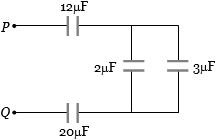
- 2The plates of a parallel plate capacitor with no dielectric are connected to a voltage source. Now a dielectric of dielectric constant $K $ is inserted to fill the whole space between the plates with voltage source remaining connected to the capacitor.View Solution
- 3In the given circuit if point $C$ is connected to the earth and a potential of $ + \,2000\,V$ is given to the point $A$, the potential at $B$ is.....$V$View Solution
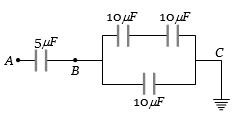
- 4A hollow conducting sphere is placed in an electric field produced by a point charge placed at $P$ as shown in figure. Let ${V_A},{V_B},{V_C}$ be the potentials at points $A,B$ and $C$ respectively. ThenView Solution
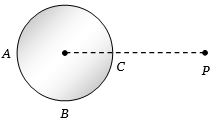
- 5Two identical capacitors are joined in parallel, charged to potential $V$, separated and then, connected in series, $i.e.$, the positive plate of one is connected to the negative plate of the other. ThenView Solution
- 6A parallel plate capacitor having capacitance $12\, pF$ is charged by a battery to a potential difference of $10\, V$ between its plates. The charging battery is now disconnected and a porcelain slab of dielectric constant $6.5$ is slipped between the plates. The work done by the capacitor on the slab is.......$pJ$View Solution
- 7Two capacitors of capacities ${C_1}$ and ${C_2}$ are charged to voltages ${V_1}$ and ${V_2}$ respectively. There will be no exchange of energy in connecting them in parallel, ifView Solution
- 8Two charged particles of masses $m$ and $2m$ have charges $+2q$ and $+q$ respectively. They are kept in uniform electric field and allowed to move for some time. The ratio of their kinetic energies will beView Solution
- 9Two metallic spheres of radii $1\,\, cm$ and $3\,\, cm$ are given, charges of $-1$$ \times {10^{ - 2}}$ $C$ and $5$$ \times {10^{ - 2}}\,C$ respectively. If these are connected by a conducting wire, the final charge on the bigger sphere isView Solution
- 10Minimum number of capacitors of $2\,\mu F$ capacitance each required to obtain a capacitor of $5\,\mu F$ will beView Solution