The plates of a parallel plate capacitor with no dielectric are connected to a voltage source. Now a dielectric of dielectric constant $K $ is inserted to fill the whole space between the plates with voltage source remaining connected to the capacitor.
Diffcult
Download our app for free and get started
$U_{i}=\frac{1}{2} C V^{2} \& U_{f}=\frac{1}{2}(K C) V^{2}$
$U_{f}=K U_{i}$
Since charge on each plate increase to $k$ times so force increase to $k^{2}$ times
$Q_{i}=C V \& Q_{f}=(K C) V$

Download our appand get started for free
Experience the future of education. Simply download our apps or reach out to us for more information. Let's shape the future of learning together!No signup needed.*
Similar Questions
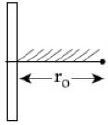
- 1A positive point charge is released from rest at a distance $r_0$ from a positive line charge with uniform density. The speed $(v)$ of the point charge, as a function of instantaneous distance $r$ from line charge, is proportional toView Solution
- 2Two capacitors each of capacity $2\,\mu F$ are connected in parallel. This system is connected in series with a third capacitor of $12\,\mu F$ capacity. The equivalent capacity of the system will be......$\mu F$View Solution
- 3Which of the following statement$(s)$ is/are correct?View Solution
$(A)$ If the electric field due to a point charge varies as $r^{-25}$ instead of $r^{-2}$, then the Gauss law will still be valid.
$(B)$ The Gauss law can be used to calculate the field distribution around an electric dipole.
$(C)$ If the electric field between two point charges is zero somewhere, then the sign of the two charges is the same.
$(D)$ The work done by the external force in moving a unit positive charge from point $A$ at potential $V_A$ to point $B$ at potential $V_B$ is $\left(V_B-V_A\right)$.
- 4A hollow metal sphere of radius $5\, cm$ is charged so that the potential on its surface is $10\, V$. The potential at the centre of the sphere isView Solution
- 5The electric field between the plates of a parallel plate capacitor when connected to a certain battery is ${E_0}$. If the space between the plates of the capacitor is filled by introducing a material of dielectric constant $K$ without disturbing the battery connections, the field between the plates shall beView Solution
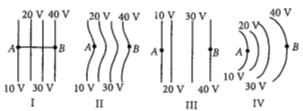
- 6The diagrams below show regions of equipotentials.A positive charge is moved from $A$ to $B$ in each diagram.View Solution
- 7Two charged spheres of radii $10\, cm$ and $15\, cm$ are connected by a thin wire. No current will flow, if they haveView Solution
- 8Two capacitances of capacity ${C_1}$ and ${C_2}$ are connected in series and potential difference $V$ is applied across it. Then the potential difference across ${C_1}$ will beView Solution
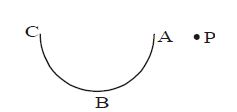
- 9In the following diagram the work done in moving a point charge from point $P$ to point $A, B$ and $C$ is respectively as $W_A,\, W_B$ and $W_C$, then (there is no charge nearby)View Solution
- 10The charge given to a hollow sphere of radius $10\, cm$ is $3.2×10^{-19}\, coulomb$. At a distance of $4\, cm$ from its centre, the electric potential will beView Solution