Question
A capacitor is connected to an alternating-current source. Is there a magnetic field between the plates?

Answer

When an alternating-current source is connected to a capacitor, the electric field between the plates of the capacitor keeps on changing with the applied voltage. Due to the changing electric field, a magnetic field exists in between the plates of the capacitor.

Need a full question paper?

Generate a complete, print-ready paper with questions like this in minutes — across 16+ boards, with answer keys.
Start Generating Free

Similar questions

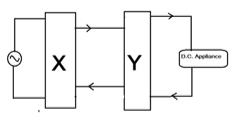
(I) Identify the circuit elements X and Y as shown in the given block diagram and draw the output waveforms of X and Y.

Image

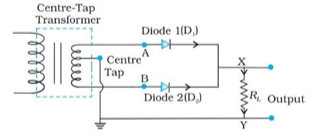
(II) If the centre tapping is shifted towards Diode D1 as shown in the diagram, draw the output waveform of the given circuit.

Image
Define polarization.
The magnifying power of a simple microscope is given by $1+\frac{\text{D}}{\text{f}},$ where D is the least distance for clear vision. For farsighted persons, D is greater than the usual. Does it mean that the magnifying power of a simple microscope is greater for a farsighted person as compared to a normal person? Does it mean that a farsighted person can see an insect more clearly under a microscope than a normal person?
A block of mass 5.0kg is suspended from the end of a vertical spring which is stretched by 10cm under the load of the block. The block is given a sharp impulse from below so that it acquires an upward speed of 2.0m/s. How high will it rise? Take $g = 10m/s^2.$
A ball is projected vertically upward with a speed of 50m/s. Find:
  1. The maximum height.
  2. The time to reach the maximum height.
  3. The speed at half the maximum height. Take $g = 10m/s^2.$
The absolute refractive index of air is 1.0003 and the wavelength of yellow light in a vacuum is $6000 \stackrel{\circ}{A}$ . Find the thickness of air column which will contain one more wavelength of yellow light than in the same thickness of vacuum.
  1. Describe briefly three experimentally observed features in the phenomenon of photoelectric effect.
  2. Discuss briefly how wave theory of light cannot explain these features.
In the Bohr model of hydrogen atom, the electron is treated as a particle going in a circle with the centre at the proton. The proton it self is assumed to be fixed in an inertial frame. The centripetal force is provided by the Coloumb attraction. In the ground state, the electron goes round the proton in a circle of radius $5.3 \times 10^{-11}m.$ Find the speed of the electron in the ground state. Mass of the electron $= 9.1 \times 10^{-31}kg$ and charge of the electron $= 1.6 \times 10^{-19}C.$
The current in a long solenoid of radius R and having n turns per unit length is given by $\text{i}=\text{i}_0\sin\omega\text{t}.$ A coil having N turns is wound around it near the centre. Find
  1. The induced emf in the coil.
  2. The mutual inductance between the solenoid and the coil.
i. Define mutual inductance.
ii. A pair of adjacent coils has a mutual inductance of 1.5 H. If the current in one coil changes from 0 to 20 A in 0.5 s, what is the change of flux linkage with the other coil?