- Describe briefly three experimentally observed features in the phenomenon of photoelectric effect.
- Discuss briefly how wave theory of light cannot explain these features.
CBSE OUTSIDE DELHI - SET 1 DEHRADUN 2015
Download our app for free and get started
- There is no emission of photoelectrons i.e. no current if the frequency of the incident radiation is below a certain minimum value however large may be the intensity of the light.
- The current varies directly with the intensity of the incident radiation.
- The current becomes zero at a certain value of negative potential, applied at the anode , this is known as stopping potential.
- The value of stopping potential increases with the increase in the frequency of the incident radiation.
- Maximum kinetic energy of the photo electrons does not depend upon intensity of light.
- Maximum kinetic energy of photoelectron increases with the frequency of the incident radiation.
- The process of photoelectric emission is instantaneous.
- It fails to explain why:
- The photo electric emmission is instantaneous.
- There exists a threshold frequency for a given metal.
- The maximim KE of photoelectrons is independent of the intensity of incident radiation.

Download our appand get started for free
Experience the future of education. Simply download our apps or reach out to us for more information. Let's shape the future of learning together!No signup needed.*
Similar Questions
- 1Derive an expression for the electric field intensity at a point on the equatorial line of an electric dipole of dipole moment $\overrightarrow{\text{P}}$and length 2a. What is the direction of this field?View Solution
- 2An inductor 200mH, a capacitor $100\mu\text{F}$ and a resistor $10\Omega$ are connected in series to an a.c. source of 100V, having variable frequency.View Solution
- At what frequency of the applied voltage will the power factor of the circuit be 1?
- What will be the current amplitude at this frequency?
- Calculate the Q-factor of the circuit.
- 3View Solution
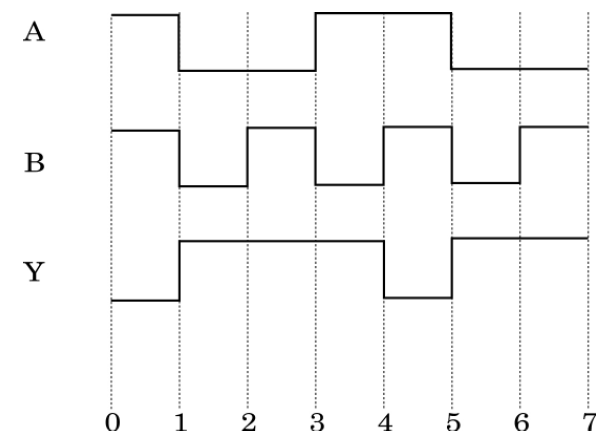
- Distinguish between a conductor and a semi conductor on the basis of energy band diagram.
- The following figure shows the input waveforms (A, B) and the output waveform (Y) of a gate. Identify the gate, write its truth table and draw its logic symbol.
- 4View Solution
- Define the term intensity of radiation' in photon picture.
- Plot a graph showing the variation of photo current vs collector potential for three different intensities $I_1 > I_2 > I_3$, two of which $(I_1$ and $I_2)$ have the same frequency v and the third has frequency $v_1 > v.$
- Explain the nature of the curves on the basis of Einstein's equation.
- 5View Solution
- What are the three basic units in communication systems? Write briefly the function of each of these.
- Write any three applications of the internet used in communication systems.
- 6View Solution
- Define the term ‘intensity of radiation’ in terms of photon picture of light.
- Two monochromatic beams, one red and the other blue, have the same intensity. In which case (i) The number of photons per unit area per second is larger, (ii) The maximum kinetic energy of the photoelectrons is more? Justify your answer.
- 7View SolutionObtain the answers (a) to (b) in Exercise 7.13 if the circuit is connected to a high frequency supply (240V, 10kHz). Hence, explain the statement that at very high frequency, an inductor in a circuit nearly amounts to an open circuit. How does an inductor behave in a dc circuit after the steady state?
- 8View Solution
- A screen is placed at a distance of 100 cm from an object. The image of the object is formed on the screen by a convex lens for two different locations of the lens separated by 20 cm. Calculate the focal length of the lens used.
- A converging lens is kept coaxially in contact with a diverging lens - both the lenses being of equal focal length. What is the focal length of the combination?
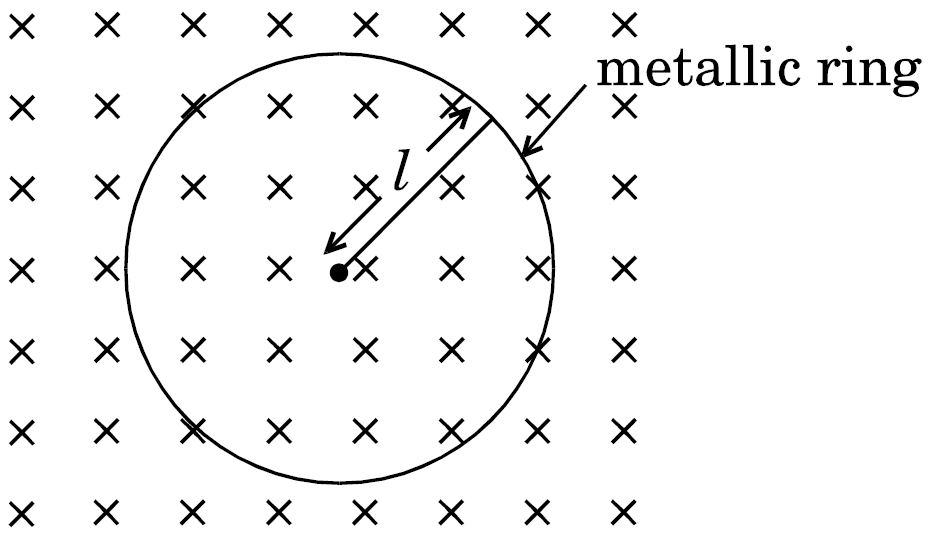
- 9View SolutionA metallic rod of length ‘l’ is rotated with a frequency ‘v’, with one end hinged at the centre and the other end at the circumference of a circular metallic ring, about an axis passing through the centre and perpendicular to the plane of the ring. A constant and uniform magnetic field B parallel to the axis is present everywhere.
- Obtain the expression for the emf induced between the centre and the ring.
- Given that the rod has resistance ‘R’, then how much power will be generated?
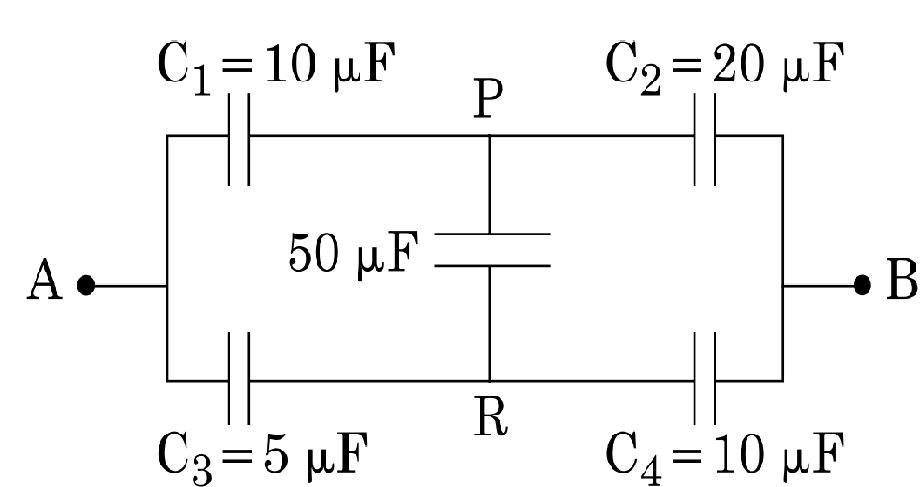
- 10View SolutionCalculate the equivalent capacitance between points A and B in the circuit below. If a battery of 10 V is connected across A and B, calculate the charge drawn from the battery by the circuit.