MCQ
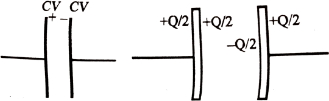
A capacitor of capacitance $C$ is charged to a potential difference $V$ from a cell and then disconnected from it. A charge $+Q$ is now given to its positive plate. The potential difference across the capacitor is now $Q$

 if $V < CV$

  • A
    $V$
  • B
    $V + \frac{Q}{C}$
  • $V + \frac{Q}{{2C}}$
  • D
    $V - \frac{Q}{C}$ ,

Answer

Correct option: C.
$V + \frac{Q}{{2C}}$
c
After redistribution half of total charge remains on outer surface and then apply

conservation of charge on each plate.

Charge on outer plates $=\frac{Q+C V-C V}{2}=\frac{Q}{2}$

Charge of innerface of first plate,

$=Q+C V-\frac{Q}{2}=\frac{Q}{2}+C V$

Charge on innerface of second plate $=-\left(\frac{Q}{2}+C V\right)$

$V^{\prime}=\frac{Q / 2+C V}{C}=V+\frac{Q}{2 C}$

Need a full question paper?

Generate a complete, print-ready paper with questions like this in minutes — across 16+ boards, with answer keys.

Start Generating Free

Similar questions

The isothermal bulk modulus of a perfect gas at normal pressure is
Heat energy of $735\,J$ is given to a diatomic gas allowing the gas to expand at constant pressure. Each gas molecule rotates around an internal axis but do not oscillate. The increase in the internal energy of the gas will be $..........\,J$
To what temperature should the hydrogen at room temperature $(27°C)$ be heated at constant pressure so that the $R.M.S.$ velocity of its molecules becomes double of its previous value ....... $^oC$
A mass $M$ is suspended from a spring of negligible mass. The spring is pulled a little and then released so that the mass executes simple harmonic oscillations with a time period $T$. If the mass is increased by m then the time period becomes $\left( {\frac{5}{4}T} \right)$. The ratio of $\frac{m}{{M}}$ is
Two bodies with kinetic energies in the ratio of $4 : 1$ are moving with equal linear momentum. The ratio of their masses is
Image
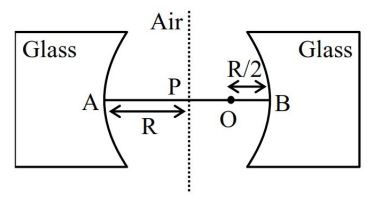
Two concave refracting surfaces of equal radii of curvature and refractive index 1.5 face each other in air as shown in figure. A point object O is placed midway, between P and B. The separation between the images of O , formed by each refracting surface is :
A nucleus of uranium decays at rest into nuclei of thorium and helium. Then :
The de-Broglie wavelength of a particle having kinetic energy $E$ is $\lambda$. How much extra energy must be given to this particle so that the de-Broglie wavelength reduces to $75 \,\%$ of the initial value ?
A radioactive substance has a half-life of $1$ year. The fraction of this material, that would remain after $5$ years will be
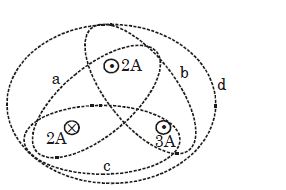
Rank the value of $\oint {\vec B.\overrightarrow {dl} } $ for the closed paths shown in figure from the smallest to largest