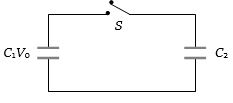
A capacitor of capacity ${C_1}$ is charged to the potential of ${V_o}$. On disconnecting with the battery, it is connected with a capacitor of capacity ${C_2}$ as shown in the adjoining figure. The ratio of energies before and after the connection of switch $S$ will be
Medium


Download our appand get started for free
Experience the future of education. Simply download our apps or reach out to us for more information. Let's shape the future of learning together!No signup needed.*
Similar Questions
- 1The electric potential at the surface of an atomic nucleus $(Z = 50)$ of radius $9.0×{10^{ - 13}}\, cm$ isView Solution
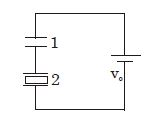
- 2Two identical capacitors $1$ and $2$ are connected in series. The capacitor $2$ contains a dielectric slab of constant $K$ as shown. They are connected to a battery of emf $V_0\ volts$ . The dielectric slab is then removed. Let $Q_1$ and $Q_2$ be the charge stored in the capacitors before removing the slab and $Q'_1$ , and $Q'_2$ be the values after removing the slab. ThenView Solution
- 3View SolutionA parallel plate capacitor has a parallel sheet of copper inserted between and parallel to the two plates, without touching the plates. The capacity of the capacitor after the introduction of the copper sheet is :
- 4The force between the plates of a parallel plate capacitor of capacitance $C$ and distance of separation of the plates $d$ with a potential difference $V$ between the plates, isView Solution
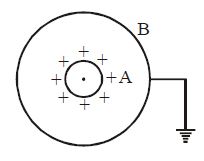
- 5$A$ and $B$ are concentric conducting spherical shells. $A$ is given a positive charge while $B$ is earthed. Then :-View Solution
- 6Three capacitors of capacity ${C_1},\;{C_2}\;{C_3}$ are connected in series. Their total capacity will beView Solution
- 7View SolutionA parallel plate capacitor is charged to a certain potential and the charging battery is then disconnected. Now, if the plates of the capacitor are moved apart then:
- 8Given below are two statements: one is labelled as Assertion $A$ and the other is labelled as Reason $R$.View Solution
Assertion $A$: The potential ( $V$ ) at any axial point, at $2 \mathrm{~m}$ distance ( $r$ ) from the centre of the dipole of dipole moment vector $\vec{P}$ of magnitude, $4 \times 10^{-6} \mathrm{C} \mathrm{m}$, is $\pm 9 \times 10^3 \mathrm{~V}$.
(Take $\frac{1}{4 \pi \in_0}=9 \times 10^9 \mathrm{Sl}$ units)
Reason $R$: $V= \pm \frac{2 P}{4 \pi \in_0 r^2}$, where $r$ is the distance of any axial point, situated at $2 \mathrm{~m}$ from the centre of the dipole.
In the light of the above statements, choose the correct answer from the options given below:
- 9Find the potential $V$ of an electrostatic field $\vec E = a\left( {y\hat i + x\hat j} \right)$, where $a$ is a constant.View Solution
- 10View SolutionA parallel plate capacitor is first charged and then a dielectric slab is introduced between the plates. The quantity that remains unchanged is