A capacitor of capacity ${C_1}$ is charged upto $V$ volt and then connected to an uncharged capacitor of capacity ${C_2}$. Then final potential difference across each will be
AIPMT 2002, Medium


Download our appand get started for free
Experience the future of education. Simply download our apps or reach out to us for more information. Let's shape the future of learning together!No signup needed.*
Similar Questions
- 1A proton of mass $m$ and charge $e$ is projected from a very large distance towards an $\alpha$-particle with velocity $v$. Initially $\alpha$-particle is at rest, but it is free to move. If gravity is neglected, then the minimum separation along the straight line of their motion will beView Solution
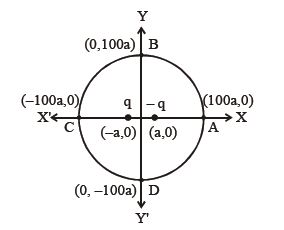
- 2An electric dipole is placed on the $x-$axis as shown in the figure. Consider a spherical closed surface around it. ThenView Solution
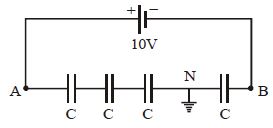
- 3Four identical capacitors are connected in series with a $10\,V$ battery as shown. The point $N$ is earthed. The potentials of points $A$ and $B$ areView Solution
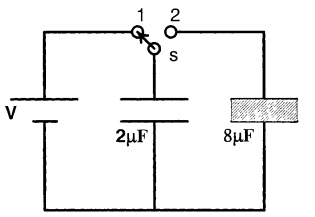
- 4A $2 \ \mu F$ capacitor is charged as shown in figure. The percentage of its stored energy dissipated after the switch $S$ is turned to position $2$ isView Solution
- 5The electric potential at the surface of an atomic nucleus $(Z = 50)$ of radius $9.0×{10^{ - 13}}\, cm$ isView Solution
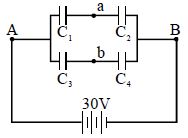
- 6Four capacitors with capacitances $C_1 = 1\,\mu F, C_2 = 1.5\,\mu F, C_3 = 2.5\,\mu F$ and $C_4 = 0.5\,\mu F$ are connected as shown and are connected to a $30\, volt$ source. The potential difference between points $a$ and $b$ is.....$V$View Solution
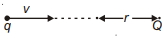
- 7The charge $q$ is fired towards another charged particle $Q$ which is fixed, with a speed $v$. It approaches $Q$ upto a closest distance $r$ and then returns. If $q$ were given a speed $2 v$, the closest distance of approach would beView Solution
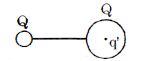
- 8Two conducting hollow sphere of radius $R$ and $3R$ are found to have $Q$ charge on outer surface when both are connected with a long wire and $q'$ charge is kept at the centre of bigger sphere. Then which one is trueView Solution
- 9A capacitor is discharging through a resistor $R$. Consider in time $t _{1}$, the energy stored in the capacitor reduces to half of its initial value and in time $t_{2}$, the charge stored reduces to one eighth of its initial value. The ratio $t_{1} / t_{2}$ will be ................View Solution
- 10View SolutionIf eight identical drops are joined to form a bigger drop, the potential on bigger as compared to that on smaller drop will be