Question
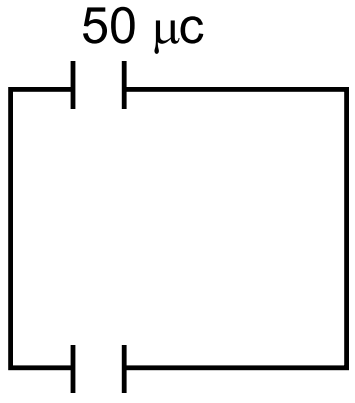
A capacitor stores $50\mu\text{C}$ charge when connected across a battery. When the gap between the plates is filled with a dielectric, a charge of $100\mu\text{C}$ flows through the battery. Find the dielectric constant of the material inserted.

Answer


Initial charge stored $=50\mu\text{c}$

Let the dielectric constant of the material induced be ‘k’.

Now, when the extra charge flown through battery is 100.

So, net charge stored in capacitor $=150\mu\text{c}$

Now, $\text{C}_1=\frac{\in_0\text{A}}{\text{d}}$ or $\frac{\text{q}_1}{\text{V}}=\frac{\in_0\text{A}}{\text{d}}\ \dots(1)$

$\text{C}_2=\frac{\in_0\text{Ak}}{\text{d}}$ or $\frac{\text{q}_2}{\text{V}}=\frac{\in_0\text{Ak}}{\text{d}}\ \dots(2)$

Dividing (1) and (2) we get $\frac{\text{q}_1}{\text{q}_2}=\frac{1}{\text{k}}$

$\Rightarrow\frac{50}{150}=\frac{1}{\text{k}}$

$\Rightarrow\text{k}=3$

Need a full question paper?

Generate a complete, print-ready paper with questions like this in minutes — across 16+ boards, with answer keys.

Start Generating Free

Similar questions

Can the instantaneous power output of an ac source ever be negative? Can the average power output be negative?
With the help of a neat and labelled diagram, explain the underlying principle and working of a moving coil galvanometer. What is the function of:

  1. Uniform radial field.
  2. Soft iron core in.

In such a device?

Two particles A and B having charges q and 2q respectively are placed on a smooth table with a separation d. A third particle C is to be clamped on the table in such a way that the particles A and B remain at rest on the table under electrical forces. What should be the charge on C and where should it be clamped?
An angular magnification (magnifying power) of 30X is desired using an objective of focal length 1.25 cm and an eyepiece of focal length 5 cm. How will you set up the compound microscope?
A capacitor of capacitance $8.0\mu\text{F}$ is connected to a battery of emf 6.0V through a resistance of $24\Omega.$ Find the current in the circuit (a) just after the connections are made and (b) one time constant after the connections are made.
State the Biot-Savart law for the magnetic field due to a current carrying element. Use this law to obtain a formula for magnetic field at the centre of a circular loop of radius R carrying a steady current I. Sketch the magnetic field lines for a current loop clearly indicating the direction of the field.
Two vessels A and B of equal volume V0 are connected by a narrow tube that can be closed by a valve. The vessels are fitted with pistons that can be moved to change the volumes. Initially, the valve is open and the vessels contain an ideal gas $\Big(\frac{\text{C}_\text{P}}{\text{C}_\text{V}}=\gamma\Big)$ at atmospheric pressure p0 and atmospheric temperature T0. The walls of vessel A are diathermic and those of B are adiabatic. The valve is now closed and the pistons are slowly pulled out to increase the volumes of the vessels to double the original value.
  1. Find the temperatures and pressures in the two vessels.
  2. The valve is now opened for sufficient time so that the gases acquire a common temperature and pressure. Find the new values of the temperature and pressure.
A thin lens made of a material of refractive index $\mu_2$ has a medium of refractive index $\mu_1$ on one side and a medium of refractive index $\mu_3$ on the other side. The lens is biconvex and the two radii of curvature have equal magnitude R. A beam of light travelling parallel to the principal axis is incident on the lens. Where will the image be formed if the beam is incident from:
  1. The medium $\mu_1$
  2. From the medium $\mu_3?$
A source of sound operates at 2.0kHz, 20W emitting sound uniformly in all directions. The speed of sound in air is 340m/s and the density of air is 1.2kg/m3.
  1. What is the intensity at a distance of 6.0m from the source?
  2. What will be the pressure amplitude at this point?
  3. What will be the displacement amplitude at this point ?
There are two coils A and B seperated by some distance. If a current of 2A flows through A, a magnetic flux of 10-2Wb passes through B (no current through B). If no current passes through A and a current of 1A passes through B, what is the flux through A?