Question types

Capacitors question types

95 questions across 6 question groups — pick any mix to generate a Physics paper with step-by-step answer keys.

95
Questions
6
Question groups
5
Question types
Sample Questions

Capacitors questions

One sample from each question group in this chapter. Select any group above to see the full set with answer keys.
A 100pF capacitor is charged to a potential difference of 24V. It is connected to an uncharged capacitor of capacitance 20pF. What will be the new potential difference across the 100pF capacitor?
View full solution
Two conducting spheres of radii R1 and R2 are kept widely separated from each other. What are their individual capacitances? If the spheres are connected by a metal wire, what will be the capacitance of the combination? Think in terms of series-parallel connections.
View full solution
A cylindrical capacitor is constructed using two coaxial cylinders of the same length 10cm and of radii 2mm and 4mm:
  1. Calculate the capacitance.
  2. Another capacitor of the same length is constructed with cylinders of radii 4mm and 8mm. Calculate the capacitance.
View full solution
A charge of +2.0 × 10⁻⁸C is placed on the positive plate and a charge of -1.0 × 10⁻⁸C on the negative plate of a parallel-plate capacitor of capacitance $1.2\times10^{-3}\mu\text{F}.$ Calculate the potential difference developed between the plates.
View full solution
Suppose, one wishes to construct a 1.0 farad capacitor using circular discs. If the separation between the discs be kept at 1.0mm, what would be the radius of the discs?
View full solution
A metal sphere of radius R is charged to a potential V:
  1. Find the electrostatic energy stored in the electric field within a concentric sphere of radius 2R.
  2. Show that the electrostatic field energy stored outside the sphere of radius 2R equals that stored within it.
View full solution
A large conducting plane has a surface charge density $1.0\times10^{-4}\text{Cm}^{-2}.$ Find the electrostatic energy stored in a cubical volume of edge 1.0cm in front of the plane.
View full solution
Q 103 Marks Question3 Marks
When 1.0 × 10¹² electrons are transferred from one conductor to another, a potential difference of 10V appears between the conductors. Calculate the capacitance of the two-conductor system.
View full solution
A capacitor with stored energy 4.0J is connected with an identical capacitor with no electric field in between. Find the total energy stored in the two capacitors.
View full solution
The plates of a parallel-plate capacitor are given equal positive charges. What will be the potential difference between the plates? What will be the charges on the facing surfaces and on the outer surfaces?
View full solution
When a dielectric slab is gradually inserted between the plates of an isolated parallel-plate capacitor, the energy of the system decreases. What can you conclude about the force on the slab exerted by the electric field?
View full solution
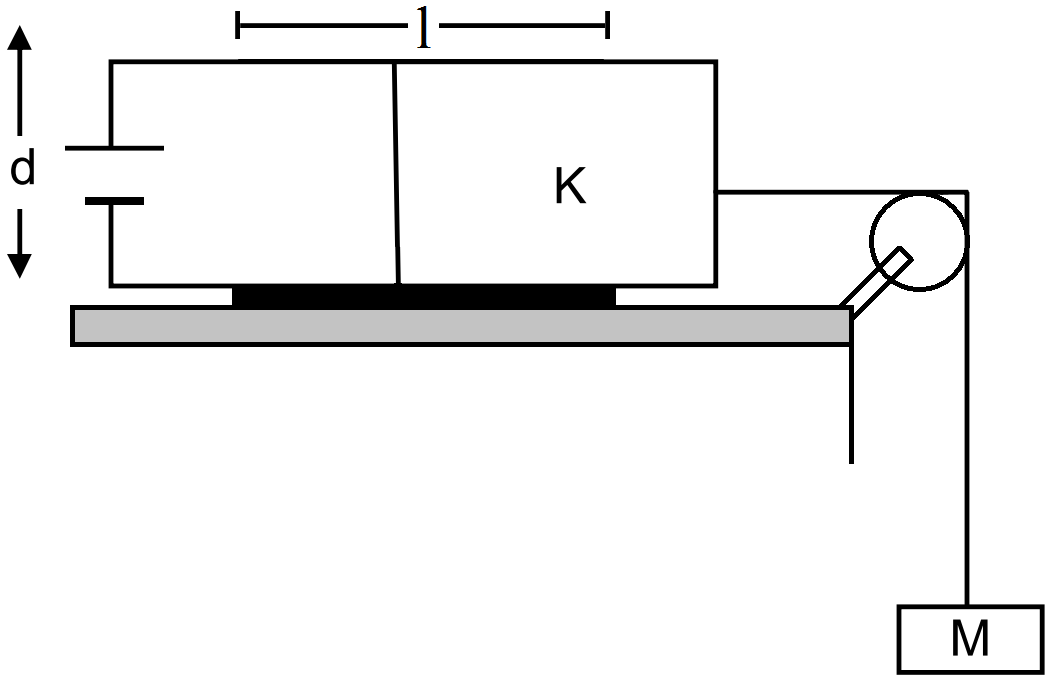
Consider the situation shown in figure. The width of each plate is b. The capacitor plates are rigidly clamped in the laboratory and connected to a battery of emf $\in.$ All surfaces are frictionless. Calculate the value of M for which the dielectric slab will stay in equilibrium.

View full solution
Q 17M.C.Q (1 Marks)1 Mark
Two metal spheres of capacitances C1 and C2 carry some charges. They are put in contact and then separated. The final charges Q1 and Q2 on them will satisfy:
  1. $\frac{\text{Q}_1}{\text{Q}_2}<\frac{\text{C}_1}{\text{C}_2}$
  2. $\frac{\text{Q}_1}{\text{Q}_2}=\frac{\text{C}_1}{\text{C}_2}$
  3. $\frac{\text{Q}_1}{\text{Q}_2}>\frac{\text{C}_1}{\text{C}_2}$
  4. $\frac{\text{Q}_1}{\text{Q}_2}=\frac{\text{C}_2}{\text{C}_1}$
View full solution
Q 18M.C.Q (1 Marks)1 Mark
A parallel-plate capacitor has plates of unequal area. The larger plate is connected to the positive terminal of the battery and the smaller plate to its negative terminal. Let Q+ and Q- be the charges appearing on the positive and negative plates respectively:
  1. Q+ > Q-
  2. Q= Q-
  3. Q+ < Q-
  4. The information is not sufficient to decide the relation between Q+ and Q-.
View full solution
Q 20M.C.Q (1 Marks)1 Mark
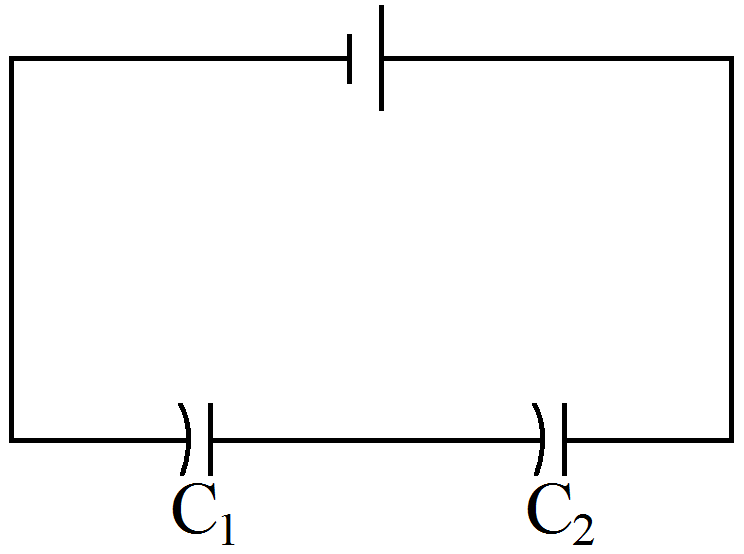
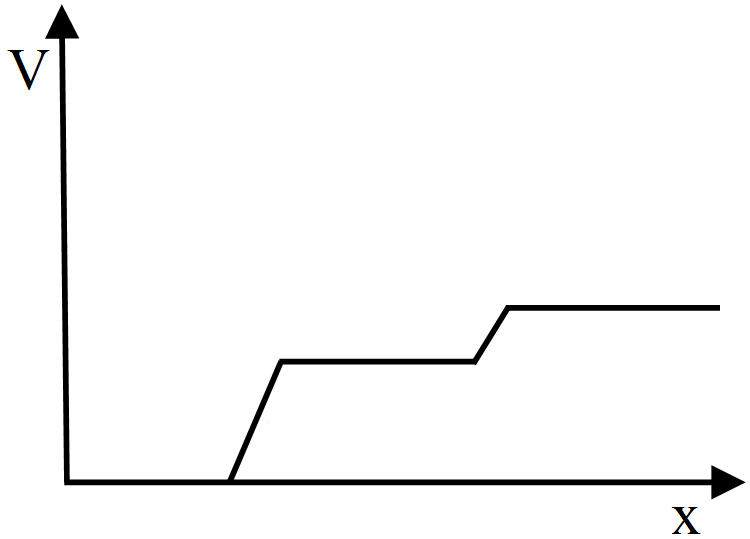
Figure shows two capacitors connected in series and joined to a battery. The graph shows the variation in potential as one moves from left to right on the branch containing the capacitors:


  1. C1 > C2
  2. C1 = C2
  3. C1 < C2
  4. The information is not sufficient to decide the relation between C1 and C2.
View full solution
Q 21M.C.Q (1 Marks)1 Mark
A dielectric slab is inserted between the plates of an isolated charged capacitor. Which of the following quantities will remain the same?
  1. The electric field in the capacitor.
  2. The charge on the capacitor.
  3. The potential difference between the plates.
  4. The stored energy in the capacitor.
View full solution
An air-filled parallel-plate capacitor is to be constructed which can store $12\mu\text{C}$ of charge when operated at 1200V. What can be the minimum plate area of the capacitor? The dielectric strength of air is 3 × 10⁶Vm-1.
View full solution
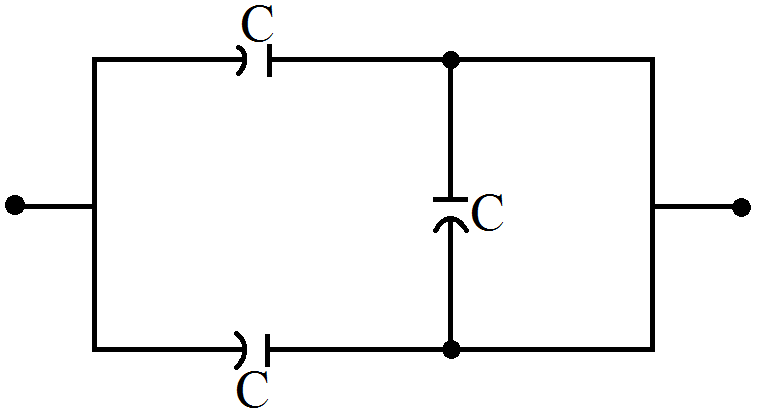
It is required to construct a $10\mu\text{F}$ capacitor which can be connected across a 200V battery. Capacitors of capacitance $10\mu\text{F}$ are available but they can withstand only 50V. Design a combination which can yield the desired result.
View full solution
If the above capacitor is connected across a 6.0V battery, find:
  1. The charge supplied by the battery.
  2. The induced charge on the dielectric.
  3. The net charge appearing on one of the coated surfaces.
View full solution
A capacitor of capacitance $2.0\mu\text{F}$ is charged to a potential difference of 12V. It is then connected to an uncharged capacitor of capacitance $4.0\mu\text{F}$ as shown in figure. Find:
  1. The charge on each of the two capacitors after the connection.
  2. The electrostatic energy stored in each of the two capacitors.
  3. The heat produced during the charge transfer from one capacitor to the other.

View full solution

Generate a Capacitors paper free

Pick question groups from the list above, set marks and difficulty, and export a branded PDF with step-by-step answer keys. First 3 chapters free — no signup.

Download App