Question
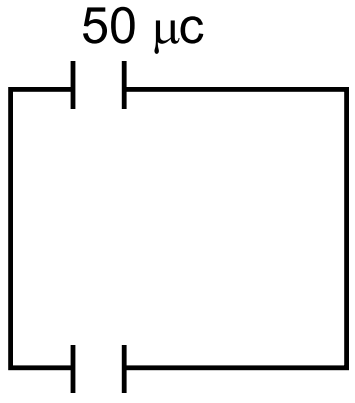
A capacitor stores $50\mu\text{C}$ charge when connected across a battery. When the gap between the plates is filled with a dielectric, a charge of $100\mu\text{C}$ flows through the battery. Find the dielectric constant of the material inserted.

Answer


Initial charge stored $=50\mu\text{c}$

Let the dielectric constant of the material induced be ‘k’.

Now, when the extra charge flown through battery is 100.

So, net charge stored in capacitor $=150\mu\text{c}$

Now, $\text{C}_1=\frac{\in_0\text{A}}{\text{d}}$ or $\frac{\text{q}_1}{\text{V}}=\frac{\in_0\text{A}}{\text{d}}\ \dots(1)$

$\text{C}_2=\frac{\in_0\text{Ak}}{\text{d}}$ or $\frac{\text{q}_2}{\text{V}}=\frac{\in_0\text{Ak}}{\text{d}}\ \dots(2)$

Dividing (1) and (2) we get $\frac{\text{q}_1}{\text{q}_2}=\frac{1}{\text{k}}$

$\Rightarrow\frac{50}{150}=\frac{1}{\text{k}}$

$\Rightarrow\text{k}=3$
Need a full question paper?

Generate a complete, print-ready paper with questions like this in minutes — across 16+ boards, with answer keys.

Start Generating Free

Similar questions

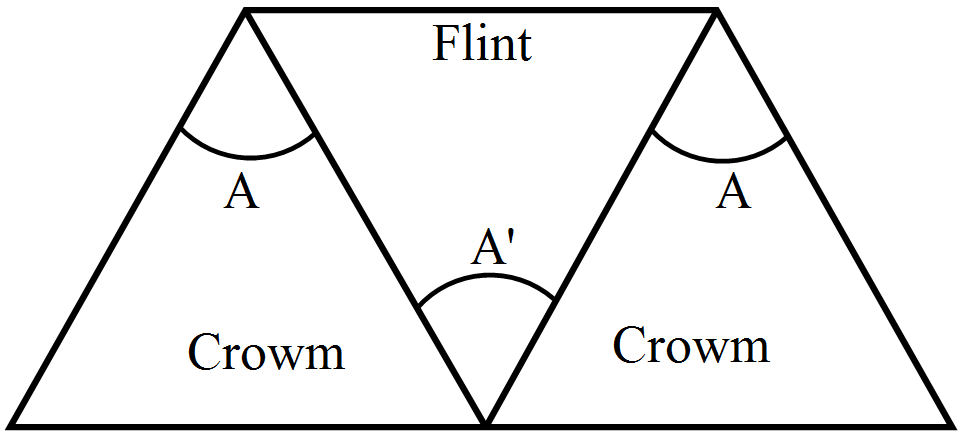
Three thin prisms are combined as shown in figure. The refractive indices of the crown glass for red, yellow and violet rays are $\mu_\text{r},\mu_\text{y}$ and $\mu_\text{v}$ respectively and those for the flint glass are $\mu'_\text{r},\mu'_\text{y}$ and $\mu'_\text{v}$ respectively. Find the ratio $\frac{\text{A}'}{\text{A}}$ for which.

  1. There is no net angular dispersion.
  2. There is no net deviation in the yellow ray.
The refractive index of a material M1 changes by 0.014 and that of another material M2 changes by 0.024 as the colour of the light is changed from red to violet. Two thin prisms one made of M1(A = 5.3°) and other made of M2(A = 3.7°) are combined with their refracting angles oppositely directed.
  1. Find the angular dispersion produced by the combination.
  2. The prisms are now combined with their refracting angles similarly directed. Find the angular dispersion produced by the combination.
A solenoid is connected to a battery so that a steady current flows through it. If an iron core is inserted into the solenoid, will the current increase or decrease? Explain.
a. Show that an ideal inductor does not dissipate power in an ac circuit.
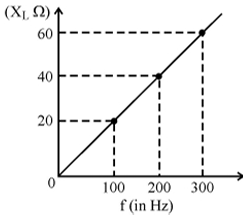
b. The variation of inductive reactance $\left( X _{ L }\right)$ of an inductor with the frequency ( $f$ ) of the ac source of 100 V and variable frequency is shown in the fig.
Image

i. Calculate the self-inductance of the inductor.
ii. When this inductor is used in series with a capacitor of unknown value and a resistor of $10 \Omega$ at $300 s^{-1}$, maximum power dissipation occurs in the circuit. Calculate the capacitance of the capacitor.
A mercury lamp is a convenient source for studying frequency dependence of photoelectric emission, since it gives a number of spectral lines ranging from the UV to the red end of the visible spectrum. In our experiment with rubidium photo-cell, the following lines from a mercury source were used:
$\lambda_1=3650\ \mathring{\text{A}},\ \lambda_2=4047\ \mathring{\text{A}},\ \lambda_3=4358\ \mathring{\text{A}},\ \lambda_4=5461\ \mathring{\text{A}},\ \lambda_5=6907\ \mathring{\text{A}},$
The stopping voltages, respectively, were measured to be:
V01 = 1.28 V, V02 = 0.95 V, V03 = 0.74 V, V04 = 0.16 V, V05 = 0 V
Determine the value of Planck’s constant h, the threshold frequency and work function for the material.
[Note: You will notice that to get h from the data, you will need to know e (which you can take to be 1.6 × 10–19 C). Experiments of this kind on Na, Li, K, etc. were performed by Millikan, who, using his own value of e (from the oil-drop experiment) confirmed Einstein’s photoelectric equation and at the same time gave an independent estimate of the value of h.]
Find the mass, the kinetic energy and the momentum of an electron moving at O.8c.
A uniform magnetic field B exist in a region. An electron projected perpendicular to the field goes in a circle. Assuming Bohr's quantization rule for angular momentum, calculate (a) the smallest possible radius of the electron (b) the radius of the nth orbit and (c) the minimum possible speed of the electron.
(a) Prove that the peak value ( $I_m$ ) of an alternating current is $\sqrt{2}$ times its root mean square ( rms ) value.(b) If alternating current $I=4 sin \omega t$ of and voltage $V =200 \sin (\omega t+\pi / 3)$, calculate the dissipated average power in the circuit.
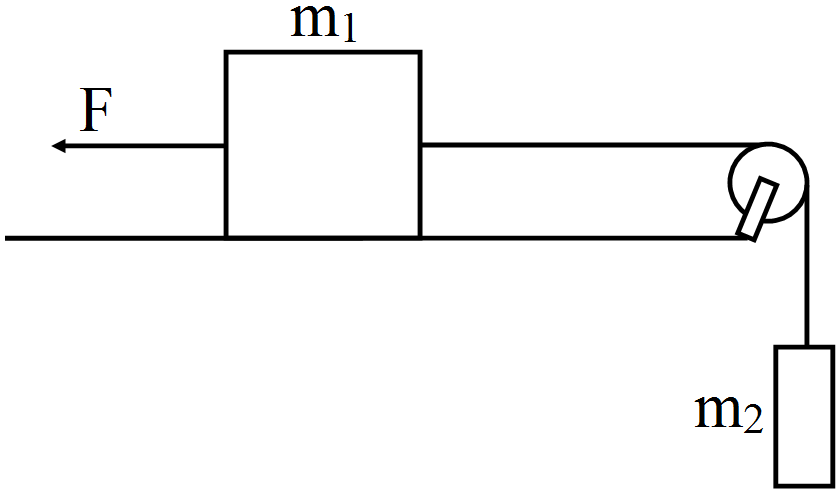
A constant force $\text{F}=\frac{\text{m}_2\text{g}}{2}$ is applied on the block of mass m1 as shown in figure. The string and the pulley are light and the surface of the table is smooth. Find the acceleration of m1.

Explain Hertz experiment for communication of electromagnetic waves. Draw labelled diagram of apparatus used in the experiment.
$(or)$
Explain Hertz experiment related with electromagnetic waves and also explain experiments of Jagdish Chandra Basu and Marconi.
$(or)$
Critically evaluate Hertz experiment of production and communication of electromagnetic waves.