Question
A mercury lamp is a convenient source for studying frequency dependence of photoelectric emission, since it gives a number of spectral lines ranging from the UV to the red end of the visible spectrum. In our experiment with rubidium photo-cell, the following lines from a mercury source were used:
$\lambda_1=3650\ \mathring{\text{A}},\ \lambda_2=4047\ \mathring{\text{A}},\ \lambda_3=4358\ \mathring{\text{A}},\ \lambda_4=5461\ \mathring{\text{A}},\ \lambda_5=6907\ \mathring{\text{A}},$
The stopping voltages, respectively, were measured to be:
V01 = 1.28 V, V02 = 0.95 V, V03 = 0.74 V, V04 = 0.16 V, V05 = 0 V
Determine the value of Planck’s constant h, the threshold frequency and work function for the material.
[Note: You will notice that to get h from the data, you will need to know e (which you can take to be 1.6 × 10–19 C). Experiments of this kind on Na, Li, K, etc. were performed by Millikan, who, using his own value of e (from the oil-drop experiment) confirmed Einstein’s photoelectric equation and at the same time gave an independent estimate of the value of h.]
Answer

Einstein's photoelectric equation is given as:

$\text{eV}_\circ=\text{hv}-\phi_\circ$

$\text{V}_\circ=\frac{\text{h}}{\text{e}}\text{v}-\frac{\phi_\circ}{\text{e}}....(1)$

Where,

$\text{V}_\circ$ = Stopping potential

h = Planck's constant

e = Charge on an electron

$\phi_\circ$ = Work function of a material

It can be concluded from equation (1) that potential $\text{V}_\circ$ is directly proportional to frequency v.

Frequency is also given by the relation:

$\text{v}=\frac{\text{Speed of light (c)}}{\text{Wavelength}\ (\lambda)}$

This relation can be used to obtain the frequencies of the various lines of the given wavelengths.

$\text{v}_1=\frac{\text{c}}{\lambda_1}=\frac{3\times10^8}{3650\times10^{-10}}=8.219\times10^{14}\ \text{Hz}$

$\text{v}_2=\frac{\text{c}}{\lambda_2}=\frac{3\times10^8}{4047\times10^{-10}}=7.412\times10^{14}\ \text{Hz}$

$\text{v}_3=\frac{\text{c}}{\lambda_3}=\frac{3\times10^8}{4358\times10^{-10}}=6.884\times10^{14}\ \text{Hz}$

$\text{v}_4=\frac{\text{c}}{\lambda_4}=\frac{3\times10^8}{5461\times10^{-10}}=5.493\times10^{14}\ \text{Hz}$

$\text{v}_5=\frac{\text{c}}{\lambda_5}=\frac{3\times10^8}{6907\times10^{-10}}=4.343\times10^{14}\ \text{Hz}$

The given quantities can be listed in tabular form as:

Frequency × 1014 Hz8.2197.4126.8845.4934.343
Stopping potential $\text{V}_\circ$1.280.950.740.160

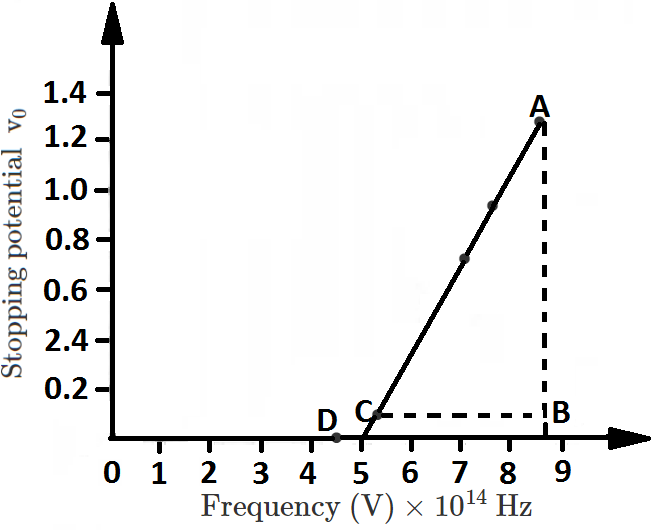
The following figure shows a graph between vand $\text{V}_\circ.$

It can be observed that the obtained curve is a straight line. It intersects the v-axis at 5 × 1014 Hz, which is the threshold frequency $(\text{V}_\circ)$ of the material. Point D corresponds to a frequency less than the threshold frequency. Hence, there is no photoelectric emission for the $\lambda_{5}$ line, and therefore, no stopping voltage is required to stop the current.

Slope of the straight line $=\frac{\text{AB}}{\text{CB}}=\frac{1.28-0.16}{(8.214-5.493)\times10^{14}}$

From equation (1), the slope $\frac{\text{h}}{\text{e}}$ can be written as:

$\frac{\text{h}}{\text{e}}=\frac{1.28-0.16}{(8.214-5.493)\times10^{14}}$

$\therefore\ \text{h}=\frac{1.12\times1.6\times10^{19}}{2.726\times10^{14}}$

= 6.573 × 10-34 Js

The work function of the metal is given as:

$\phi_\circ=\text{hv}_\circ$

= 6.573 × 10-34 × 5 × 1014

= 3.286 × 10-19 J

$=\frac{3.286\times10^{-19}}{1.6\times10^{-18}} $

= 0.054 eV

Need a full question paper?

Generate a complete, print-ready paper with questions like this in minutes — across 16+ boards, with answer keys.

Start Generating Free

Similar questions

Define the term magnetic moment of a current loop. Write the expression for the magnetic moment when an electron revolves at a speed v around an orbit of radius ‘r’ in hydrogen atom.
Describe the procedure for obtaining V-I characteristic curve in forward bias of P-N junction diode. Make a circuit diagram of the experimental arrangement.
A block of mass m slips on a rough horizontal table under the action of a horizontal force applied to it. The coefficient of friction between the block and the table is $\mu.$ The table does not move on the floor. Find the total frictional force applied by the floor on the legs of the table. Do you need the friction coefficient between the table and the floor or the mass of the table?
A solenoid 60 cm long and of radius 4.0 cm has 3 layers of windings of 300 turns each. A 2.0 cm long wire of mass 2.5 g lies inside the solenoid (near its centre) normal to its axis; both the wire and the axis of the solenoid are in the horizontal plane. The wire is connected through two leads parallel to the axis of the solenoid to an external battery which supplies a current of 6.0 A in the wire. What value of current (with appropriate sense of circulation) in the windings of the solenoid can support the weight of the wire? g = 9.8 m s–2.
Suppose the second charge in the previous problem is -1.0 × 10-6C. Locate the position where a third charge will not experience a net force.
A 12pF capacitor is connected to a 50V battery. How much electrostatic energy is stored in the capacitor?
Consider a metal ring kept on top of a fixed solenoid (say on a carboard) (Fig). The centre of the ring coincides with the axis of the solenoid. If the current is suddenly switched on, the metal ring jumps up. Explain.

Consider the situation shown in figure. Both the pulleys and the string are light and all the surfaces are frictionless.
  1. Find the acceleration of the mass M.
  2. Find the tension in the string.
  3. Calculate the force exerted by the clamp on the pulley A in the figure.
​​​​​​​
Explain equations of Maxwell in detail.
Obtain expression for root mean square value of alternating emf. Draw graph between $E$ and t and $E ^2$ and $t$ and prove that average rate of heat produced for alternating current in one complete cycle is $H = I _{\text {max }}^2 R$.