Question
A capacitor stores $50\mu\text{C}$ charge when connected across a battery. When the gap between the plates is filled with a dielectric, a charge of $100\mu\text{C}$ flows through the battery. Find the dielectric constant of the material inserted.
Answer


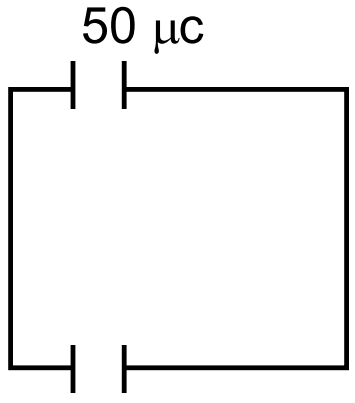
Initial charge stored $=50\mu\text{c}$
Let the dielectric constant of the material induced be ‘k’.
Now, when the extra charge flown through battery is 100.
So, net charge stored in capacitor $=150\mu\text{c}$
Now, $\text{C}_1=\frac{\in_0\text{A}}{\text{d}}$ or $\frac{\text{q}_1}{\text{V}}=\frac{\in_0\text{A}}{\text{d}}\ \dots(1)$
$\text{C}_2=\frac{\in_0\text{Ak}}{\text{d}}$ or $\frac{\text{q}_2}{\text{V}}=\frac{\in_0\text{Ak}}{\text{d}}\ \dots(2)$
Dividing (1) and (2) we get $\frac{\text{q}_1}{\text{q}_2}=\frac{1}{\text{k}}$
$\Rightarrow\frac{50}{150}=\frac{1}{\text{k}}$
$\Rightarrow\text{k}=3$

Need a full question paper?

Generate a complete, print-ready paper with questions like this in minutes — across 16+ boards, with answer keys.

Start Generating Free

Similar questions

Calculate the number of degrees of freedom of molecules of hydrogen in $1cc$ of hydrogen gas at NTP.
A gas mixture consists of molecules of $A, B$ and $C$ with masses $m_A > m_B > m_c$. Rank the three types of molecules in decreasing order of (a) average KE, (b) rms speeds.
A metallic rod of length $1m$ is rigidly clamped at its midpoint. Longitudinal stationary waves are set up in the rod in such a way that there are two nodes on either side of the midpoint. The amplitude of an antinode is $2 \times 10^{-6}m$. Write the equation of motion at a point $2cm$ from the midpoint and those of the constituent waves in the rod. (Young's modulus = $2 \times 10^{11}Nm^{-2}$ and density = $8000kg m^{-3}$)
The emf $\in$ and the internal resistance r of the battery, shown in the figure. are 4.3V and $1.0\Omega$ respectively. The external resistance R is $50\Omega.$ The resistances of the ammeter and voltmeter are $2.0\Omega$ and $200\Omega$ respectively. (a) Find the readings of the two $200\Omega$ respectively. (a) Find the readings of the two meters. (b) The switch is thrown to the other side. What will be the readings of the two meters now?
In an experiment on photoelectric effect, the stopping potential is measured for monochromatic light beams corresponding to different wavelengths. The data collected are 11s follows:
wavelength (nm) 350 400 450 500 550
stopping potential(V): 1.45 1.00 0.66 0.38 0.16
Plot the stopping potential against inverse of wavelength $\big(\frac{1}{\lambda}\big) $ on a graph paper and find
  1. The Planck constant,
  2. The work function of the emitter and.
  3. The threshold wavelength.
What is kinetic energy? Prove that kinetic energy of any object is $\frac{1}{2} m v^2$. Verify this using integration method also.
A $50kg$ girl wearing high heel shoes balances on a single heel. The heel is circular with a diameter $1.0cm$. What is the pressure exerted by the heel on the horizontal floor?
Consider the de Broglie wavelength of an electron and a proton. Which wavelength is smaller if the two particles have.
  1. The same speed.
  2. The same momentum.
  3. The same energy?.
A man standing in front of a mountain at a certain distance beats a drum at regular intervals. The drumming rate is gradually increased, and he finds that the echo is not heard distinctly, when the rate becomes 40 per minute. He then moves nearer to the mountain by 90 metres, and finds what the echo is again not heard when the drumming rates becomes 60 per minute. Calculate
  1. The distance between the mountain and the initial position of the man.
  2. The velocity of sound.
An icebox almost completely filled with ice at $0^\circ C$ is dipped into a large volume of water at $20^\circ C$. The box has walls of surface area $2400cm^2$, thickness $2.0mm$ and thermal conductivity $0.06\text{Wm}^{-1}{^{\circ}}\text{C}^{-1}.$ Calculate the rate at which the ice melts in the box. Latent heat of fusion of ice $= 3.4\times10^5\text{Jkg}^{-1}.$