Question
A car accelerates from rest at a constant rate α for some time, after which it decelerates at a constant rate $\beta$ to come to rest. If t is the total time elapsed, then calculate.
  1. The maximum velocity attained by the car.
  2. The total distance travelled by the car.

Answer

  1. Let the car accelerate at a rate $\alpha$ for time t1 and attain a maximum velocity v. Then the car decelerates at a constant rate $\beta$ for remaining time (t - t1) and again comes to rest. Then from adjoining figure, it is clear that
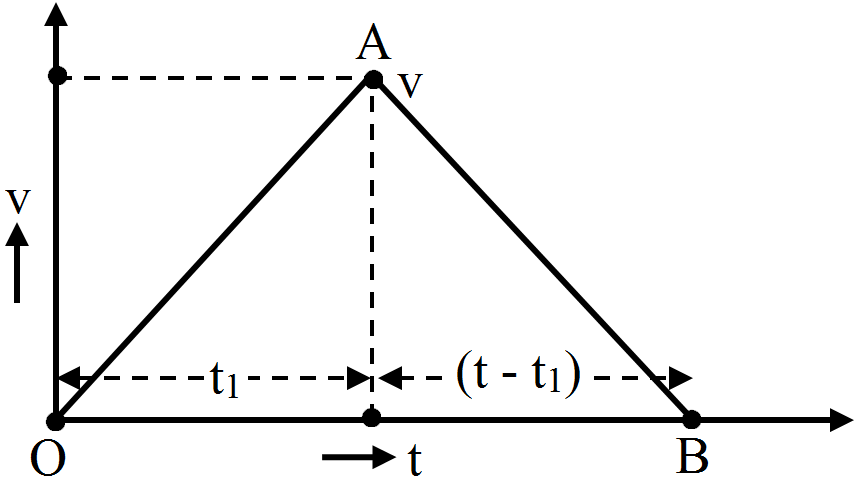
$\text{v}=\alpha\text{t}_1=\beta(\text{t}-\text{t}_1)$

$\therefore \text{t}_1=\frac{\text{v}}{\alpha}$

$(\text{t}-\text{t}_1)=\frac{\text{v}}{\beta}$

Adding these two, we have

$\text{t}=\frac{\text{v}}{\alpha}+\frac{\text{v}}{\beta}=\text{v}\Big(\frac{\alpha+\beta}{\alpha\beta}\Big)$

$\Rightarrow \text{v}=\frac{\alpha\beta\text{t}}{(\alpha+\beta)}$

  1. Total distance travelled by the car s = area OAB $=\frac{1}{2}(\text{t})\times(\text{v})$

$\therefore \text{s}=\frac{1}{2}\text{t}\times\frac{\alpha\beta\text{t}}{(\alpha+\beta)}$

$=\frac{1}{2}\frac{\alpha\beta}{(\alpha+\beta)}\text{t}^2$
Need a full question paper?

Generate a complete, print-ready paper with questions like this in minutes — across 16+ boards, with answer keys.

Start Generating Free

Similar questions

An X-ray tube operates at 40kV. Suppose the electron converts 70% of its energy into a photon at each collision. Find the lowest there wavelengths emitted from the tube. Neglect the energy imparted to the atom with which the electron collides.
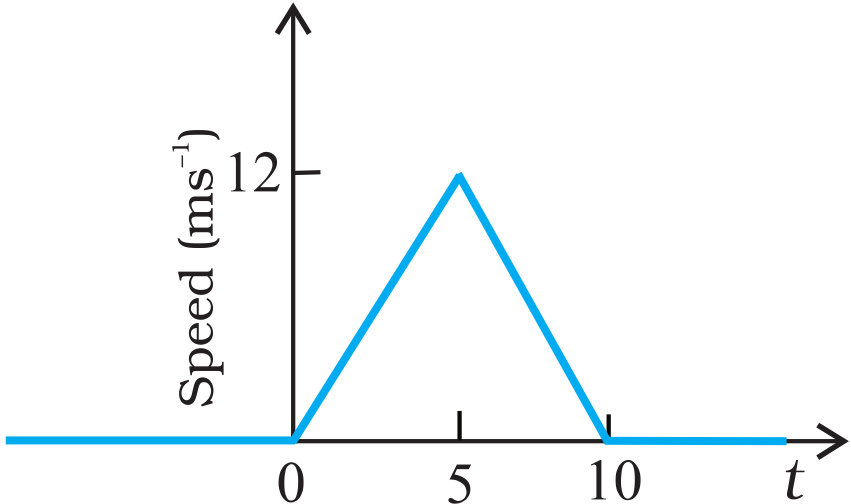
The speed-time graph of a particle moving along a fixed direction is shown in. Obtain the distance traversed by the particle between.
  1. t = 0s to 10s,
  2. t = 2s to 6s.

What is the average speed of the particle over the intervals in (a) and (b)?
A ball of mass 100g and having a charge of 4.9 × 10-5C is released from rest in a region where a horizontal electric field of 2.0 × 104NC-1 exists.
  1. Find the resultant force acting on the ball.
  2. What will be the path of the ball?
  3. Where will the ball be at the end of 2s?
Figure shows a square loop of edge a made of a uniform wire. A current i enters the loop at the point A and leaves it at the point C. Find the magnetic field at the point P which is on the perpendicular bisector of AB at a distance $\frac{\text{a}}{4}$ from it.

Estimate the fraction of molecular volume to the actual volume occupied by oxygen gas at STP. Take the diameter of an oxygen molecule to be $3\mathring{\text{A}}$ 
A 400kg satellite is in a circular orbit of radius 2RE about the earth. How much energy is required to transfer it to circular orbit of radius 4RE? What are the changes in the kinetic energy and potential energy?
A particle executes a simple harmonic motion of amplitude 1.0cm along the principal axis of a convex lens of focal length 12cm. The mean position of oscillation is at 20cm from the lens. Find the amplitude of oscillation of the image of the particle.
A capacitor of capacitance C is connected to a battery of emf $\in$ at t = 0 through a resistance R. Find the maximum rate at which energy is stored in the capacitor. When does the rate have this maximum value?
An electron makes 3 × 10⁵ revolutions per second in a circle of radius 0.5 angstrom. Find the magnetic field B at the centre of the circle.
A neutron (um/ s) collides with a nucleus at rest of mass number A. How muchenergy is transferred to the nucleus by the neutron?