MCQ
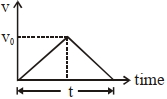
A car accelerates from rest at a constant rate $\alpha$ for some time after which it decelerates at a constant rate $\beta$ to come to rest. If the total time elapsed is $t$ seconds, the total distance travelled is
  • A
    $\frac{4 \alpha \beta}{(\alpha+\beta)} t ^{2}$
  • B
    $\frac{2 \alpha \beta}{(\alpha+\beta)} t ^{2}$
  • $\frac{\alpha \beta}{2(\alpha+\beta)} t ^{2}$
  • D
    $\frac{\alpha \beta}{4(\alpha+\beta)} t ^{2}$
Answer

Correct option: C.
$\frac{\alpha \beta}{2(\alpha+\beta)} t ^{2}$
c
$v _{0}=\alpha t _{1}$ and $0= v _{0}-\beta t _{2} \Rightarrow v _{0}=\beta t _{2}$

$t _{1}+ t _{2}= t$

$v _{0}\left(\frac{1}{\alpha}+\frac{1}{\beta}\right)= t$

$\Rightarrow v _{0}=\frac{\alpha \beta t }{\alpha+\beta}$

Distance $=$ area of $v - t$ graph

$=\frac{1}{2} \times t \times v _{0}=\frac{1}{2} \times t \times \frac{\alpha \beta t }{\alpha+\beta}=\frac{\alpha \beta t ^{2}}{2(\alpha+\beta)}$

Need a full question paper?

Generate a complete, print-ready paper with questions like this in minutes — across 16+ boards, with answer keys.

Start Generating Free

Similar questions

The pressure of a gas kept in an isothermal container is 200kPa. If half the gas is removed from it, the pressure will be:
A pendulum clock that keeps correct time on the earth is taken to the moon. It will run:

  1. At correct rate.

  2. 6 times faster.

  3. $\sqrt{6}$ times faster.

  4. $\sqrt{6}$ times slower.

A van der Waal's gas obeys the equation of state $\left(p+\frac{n^2 a}{V^2}\right)(V-n b)=n R T$. Its internal energy is given by $U=C T-\frac{n^2 a}{V}$. The equation of a quasistatic adiabat for this gas is given by
A system exhibiting S.H.M. must possess
A smooth sphere of mass $M$ moving with velocity $u$ directly collides elastically with another sphere of mass m at rest. After collision their final velocities are $V$ and $v$ respectively. The value of $v$ is
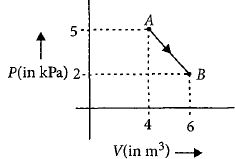
One mole of an ideal diatomic gas undergoes a transition from $A$ to $B$ along a path $AB$ as shown in the figure. 

The change in internal energy of the gas during the transition is ............$\;kJ$

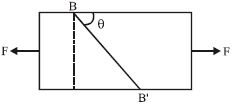
A bar of cross-sectional area $A$ is subjected two equal and opposite tensile forces at its ends as shown in figure. Consider a plane $BB'$ making an angle $\theta $ with the length The ratio of tensile stress to the shearing stress on the plane $BB'$ is
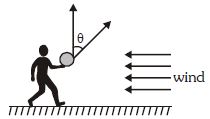
A body throws a ball upwards with velocity $v_0 = 20\, m/s$ . The wind imparts a horizontal acceleration of $4\, m/s^2$ to the ball. The angle $\theta $ from vertical at which the ball must be thrown so that the ball returns to the boy's hand is $(g = 10\, m/s^2)$
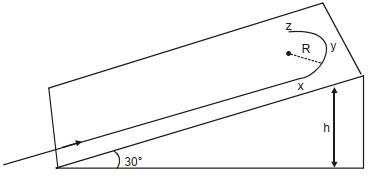
A student skates up a ramp that makes an angle $30^{\circ}$ with the horizontal. $He /$ she starts (as shown in the figure) at the bottom of the ramp with speed $v_0$ and wants to turn around over a semicircular path xyz of radius $R$ during which he/she reaches a maximum height $h$ (at point y) from the ground as shown in the figure. Assume that the energy loss is negligible and the force required for this turn at the highest point is provided by his/her weight only. Then ( $g$ is the acceleration due to gravity)

$(A)$ $v_0^2-2 g h=\frac{1}{2} g R$

$(B)$ $v_0^2-2 g h=\frac{\sqrt{3}}{2} g R$

$(C)$ the centripetal force required at points $x$ and $z$ is zero

$(D)$ the centripetal force required is maximum at points $x$ and $z$

A wooden block with a coin placed on its top, floats in water as shown in the distance l and h are shown in the figure. After some time the coin falls into the water. Then: