Questions · Page 1 of 16

M.C.Q (1 Marks)

🎯

Test yourself on this topic

50 questions · timed · auto-graded

MCQ 11 Mark
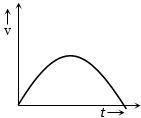
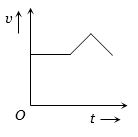
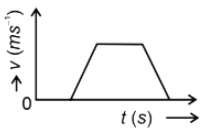
The velocity $(v)-$ time $(t)$ plot of the motion of a body is shown below:

(image)

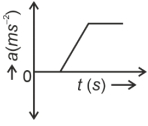
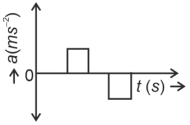
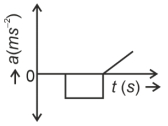
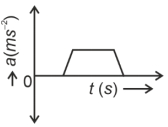
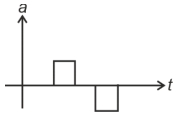
The acceleration $(a)-$ time $(t)$ graph that best suits this motion is :
  • A


  • C

  • D

Answer
Correct option: B.

b
Initially, the body has zero velocity and zero slope. Hence the acceleration would be zero initially. After that, the slope of v-t curve is constant and positive.

After some time, velocity becomes constant and acceleration is zero.

After that, the slope of v-t curve is constant and negative.
View full question & answer
MCQ 21 Mark
A vehicle travels half the distance with speed $v$ and the remaining distance with speed $2\,v$.Its average speed is :
  • A
    $\frac{3 v}{4}$
  • B
    $\frac{ v }{3}$
  • C
    $\frac{2 v}{3}$
  • $\frac{4 v}{3}$
Answer
Correct option: D.
$\frac{4 v}{3}$
d
$V_{a v g}=\frac{2 v_1 v_2}{v_1+v_2}=\frac{2(v)(2 v)}{v+2 v}=\frac{4 v^2}{3 v}=\frac{4 v}{3}$
View full question & answer
MCQ 31 Mark
A bullet from a gun is fired on a rectangular wooden block with velocity $u$.When bullet travels $24\,cm$ through the block along its length horizontally, velocity of bullet becomes $\frac{u}{3}$. Then it further penetrates into the block in the same direction before coming to rest exactly at the other end of the block. The total length of the block is $........\,cm$
  • A
    $30$
  • $27$
  • C
    $24$
  • D
    $28$
Answer
Correct option: B.
$27$
b
By $v^2=u^2+2 a s$

$\left(\frac{u}{3}\right)^2=u^2-2 a x$

$2 a x=u^2-\frac{u^2}{9}$

$2 a x=\frac{8 u^2}{9}.........(1)$

Similarly from starting

$v^2=u^2+2 ax$

$0= u ^2-2 ax _2$

$2 ax _2= u ^2..........(2)$

$By (1) /(2)$

$\frac{ x }{ x _2}=\frac{8}{9}$

$\frac{24}{ x _2}=\frac{8}{9}$

$x _2=27\,cm$

View full question & answer
MCQ 41 Mark
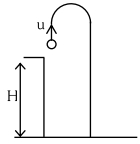
A horizontal bridge is built across a river. A student standing on the bridge throws a small ball vertically upwards with a velocity $4\,m s ^{-1}$. The ball strikes the water surface after $4\,s$. The height of bridge above water surface is $......\,m$ $\left(\right.$ Take $\left.g=10\,m s ^{-2}\right)$
  • A
    $68$
  • B
    $56$
  • C
    $60$
  • $64$
Answer
Correct option: D.
$64$
d
$S = ut +\frac{1}{2} a t^2$

$-H =4 \times 4-\frac{1}{2} \times 10 \times 4^2$

$-H =16-80$

$-H =-64$

$H =64\,m$

View full question & answer
MCQ 51 Mark
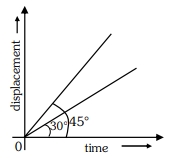
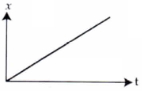
The displacement-time graphs of two moving particles make angles of $30^{\circ}$ and $45^{\circ}$ with the $x$-axis as shown in the figure. The ratio of their respective velocity is :
  • A
    $1: 1$
  • B
    $1: 2$
  • $1: \sqrt{3}$
  • D
    $\sqrt{3}: 1$
Answer
Correct option: C.
$1: \sqrt{3}$
c
Velocity is slope of $x$-t graph

$V =\frac{ dx }{ dt }=\tan \theta$

$\frac{ V _{1}}{ V _{2}}=\frac{\tan \theta_{1}}{\tan \theta_{2}}=\frac{\tan 30^{\circ}}{\tan 45^{\circ}}=\frac{1}{\sqrt{3}}$

View full question & answer
MCQ 61 Mark
The ratio of the distances travelled by a freely falling body in the $1^{\text {st }}, 2^{\text {nd }}, 3^{\text {rd }}$ and $4^{\text {th }}$ second :
  • A
    $1: 4: 9: 16$
  • $1: 3: 5: 7$
  • C
    $1: 1: 1: 1$
  • D
     $1: 2: 3: 4$
Answer
Correct option: B.
$1: 3: 5: 7$
b
$S _{ nth }= u +\frac{ a }{2}(2 n -1)$

$=0+\frac{ a }{2}(2 n -1)$

$S _{r th } \propto(2 n -1)$

$\Rightarrow S_{1 s }, S _{2 ed }, S _{3 ed }, S _{\text {4th }}$

$=[2(1)-1]:[2(2)-1]:[2(3)-1]:[2(4)-1]$

$=1: 3: 5: 7$

View full question & answer
MCQ 71 Mark
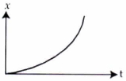
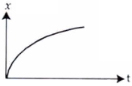
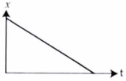
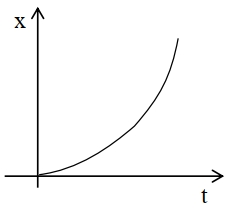
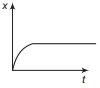
The position-time $(x-t)$ graph for positive acceleration is

  • B

  • C

  • D

Answer
Correct option: A.

a
$x=\frac{1}{2} a t^2 \quad$ (if coefficients of $t^2$ is positive $(a > 0)$ upward opening parabola)
View full question & answer
MCQ 81 Mark
A small block slides down on a smooth inclined plane, starting from rest at time $t=0 .$ Let $S_{n}$ be the distance travelled by the block in the interval $\mathrm{t}=\mathrm{n}-1$ to $\mathrm{t}=\mathrm{n} .$ Then, the ratio $\frac{\mathrm{S}_{\mathrm{n}}}{\mathrm{S}_{\mathrm{n}+1}}$ is
  • A
    $\frac{2 n-1}{2 n}$
  • $\frac{2 n-1}{2 n+1}$
  • C
    $\frac{2 n+1}{2 n-1}$
  • D
    $\frac{2 n}{2 n-1}$
Answer
Correct option: B.
$\frac{2 n-1}{2 n+1}$
b
$\frac{s_{n}}{S_{n+1}}=\frac{\frac{a}{2}(2 n-1)}{\frac{a}{2}(2(n+1)-1)}=\frac{2 n-1}{2 n+2-1}=\frac{2 n-1}{2 n+1}$
View full question & answer
MCQ 91 Mark
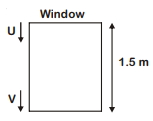
A person sitting in the ground floor of a building notices through the window, of height $1.5 \;m ,$ a ball dropped from the roof of the building crosses the window in $0.1 \;s$. What is the velocity (In $m/s$) of the ball when it is at the topmost point of the window $?\left( g =10\, m / s ^{2}\right)$
  • A
    $20$
  • B
    $15.5$
  • $14.5$
  • D
    $4.5$
Answer
Correct option: C.
$14.5$
c
From equation of motion

$S = ut +\frac{1}{2} at ^{2}$

$1.5= u (0.1)+\frac{1}{2} \times 10(0.1)^{2}$

$1.5=(0.1) u +0.05$

$u =15-0.5$

$\quad=14.5 m / s$

View full question & answer
MCQ 101 Mark
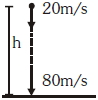
A ball is thrown vertically downward with a velocity of $20\; m / s$ from the top of a tower. It hits the ground after some time with a velocity of $80\, m / s$. The helght of the tower is $......m$ : $\left( g =10\, m / s ^{2}\right)$
  • $300$
  • B
    $360$
  • C
    $340$
  • D
    $320$
Answer
Correct option: A.
$300$
a
$v^{2}=u^{2}+2 g h$

$80^{2}=20^{2}+2 \times 10 h$

$h =300 m$

View full question & answer
MCQ 111 Mark
Preeti reached the metro station and found that the escalator was not working. She walked up the stationary escalator in time $t_1$ . On other days, if she remains stationary on the moving escalator, then the escalator takes her up in time $t_2$. The time taken by her to walk up on the moving escalator will be 
  • A
    $\frac{{{t_1}{t_2}}}{{{t_2} - {t_1}}}$
  • $\;\frac{{{t_1}{t_2}}}{{{t_2} + {t_1}}}$
  • C
    ${t_1} - {t_2}$
  • D
    $\frac{{{t_1} + {t_2}}}{2}$
Answer
Correct option: B.
$\;\frac{{{t_1}{t_2}}}{{{t_2} + {t_1}}}$
b
$\begin{array}{l}
Let\,{v_1}\,is\,the\,velocity\,of\,preeti\,on\,stationary\,escalator\,and\,\\
d\,is\,the\,{\rm{distance}}\,travelled\,bt\,her\\
\therefore \,{v_1} = \frac{d}{{{t_1}}}\\
Again\,let\,{v_2}\,is\,the\,velocity\,of\,escalator\,\\
\therefore \,{v_2} = \frac{d}{{{t_2}}}
\end{array}$

$\begin{array}{l}
\therefore \,Net\,velocity\,of\,preeti\,on\,moving\,escalator\,with\,respect\,\\
to\,the\,ground\,\\
\,\,\,\,\,\,\,\,\,\,\,v = {v_1} + {v_2} = \frac{d}{{{t_1}}} + \frac{d}{{{t_2}}} = d\left( {\frac{{{t_1} + {t_2}}}{{{t_t}{t_2}}}} \right)\\
The\,time taken by her to walk up on the moving escalatror will be\\
\,\,\,\,\,\,t = \frac{d}{v} = \frac{d}{{d\left( {\frac{{{t_1} + {t_2}}}{{{t_1}{t_2}}}} \right)}} = \frac{{{t_1}{t_2}}}{{{t_1} + {t_2}}}
\end{array}$

View full question & answer
MCQ 121 Mark
Two cars $P$ and $Q$ start from a point at the same time in a straight line and their positions are represented by $ x_p(t)=at+bt^2 $ and $x_Q(t)= ft- t^2$. At what time do the cars have the same velocity $?$ 
  • A
    $\frac{{a + f}}{{2\left( {1 + b} \right)}}$
  • $\;\frac{{f - a}}{{2\left( {1 + b} \right)}}$
  • C
    $\;\frac{{a + f}}{{\left( {1 + b} \right)}}$
  • D
    $\;\frac{{a + f}}{{2\left( {b - 1} \right)}}$
Answer
Correct option: B.
$\;\frac{{f - a}}{{2\left( {1 + b} \right)}}$
b
$\begin{array}{l}
\,\,\,Position\,of\,car\,P\,at\,any\,time\,t,\,is\\
\,\,{x_p}\left( t \right) = at + b{t^2}\\
\,\,{v_p}\left( t \right) = \frac{{d{x_p}\left( t \right)}}{{dt}} = a + 2bt\,\,\,\,\,\,\,\,\,\,\,\,\,\,\,\,\,\,\,\,\,\,\,\,\,\,\,...\left( i \right)\\
{\rm{Similarly}},\,for\,car\,Q,\\
\,\,\,\,\,\,\,\,\,\,\,\,\,{x_Q}\left( t \right) = ft - {t^2}\\
\,\,\,\,\,\,\,\,\,\,\,\,\,{v_Q}\left( t \right) = \frac{{d{x_q}\left( t \right)}}{{dt}} = f - 2t\,\,\,\,\,\,\,\,\,\,\,\,\,\,\,\,\,\,...\left( {ii} \right)\\
\,\,\,\,\,\,\,\,\,\,{v_p}\left( t \right) = {v_Q}\left( t \right)\,\,\,\,\,\,\,\,\,\,\,\,\,\,\,\,\,\,\,\,\,\,\,\,\,\,\,\,\,\,\,\,\,\,\,\,\left( {Given} \right)\\
\therefore \,\,\,\,\,\,\,\,\,\,\,a + 2bt = f - 2t\,or,\,2t\left( {b + 1} \right) = f - a\\
\therefore \,\,\,\,\,\,\,\,\,\,\,\,t = \frac{{f - a}}{{2\left( {1 + b} \right)}}\,
\end{array}$
View full question & answer
MCQ 131 Mark
If the velocity of a particle is $v =At+ Bt^2$ ,where $A$ and $B$ are constants, then the distance travelled by it between $1\, s$ and $2\, s$ is
  • A
    $3A+7B$
  • $\frac{3}{2}A + \frac{7}{3}B$
  • C
    $\frac{A}{2} + \frac{B}{3}$
  • D
    $\;\frac{3}{2}A + 4B$
Answer
Correct option: B.
$\frac{3}{2}A + \frac{7}{3}B$
b
$V=\alpha t+\beta t^{2}$

$\frac{ ds }{ dt }=\alpha t +\beta t ^{2}$

$\int_{s_{1}}^{s_{2}} d s=\int_{1}^{2}\left(\alpha t+\beta t^{2}\right) d t$

$S_{2}-S_{1}=\left[\frac{\alpha t^{2}}{2}+\frac{\beta t^{3}}{3}\right]_{1}^{2}$

As particle is not changing direction So distance $=$ displacement.

Distance $=\left[\frac{\alpha[4-1]}{2}+\frac{\beta[8-1]}{3}\right]$

$=\frac{3 \alpha}{2}+\frac{7 \beta}{3}$

View full question & answer
MCQ 141 Mark
A body is moving with variable acceleration $(a)$ along a straight line. The average acceleration of body in time interval $t_1$ to $t_2$ is
  • A
    $\frac{a\left[t_2+t_1\right]}{2}$
  • B
    $\frac{a\left[t_2-t_1\right]}{2}$
  • C
    $\frac{\int \limits_1^{t_2} a d t}{t_2+t_1}$
  • $\frac{\int \limits_{t_1}^{t_2} a d t}{t_2-t_1}$
Answer
Correct option: D.
$\frac{\int \limits_{t_1}^{t_2} a d t}{t_2-t_1}$
d
(d)

Average acceleration $=\frac{\text { Change in velocity }}{\text { Time }} \Rightarrow a_{ av }=\frac{\int \limits_{t_1}^{t_2} a d t}{t_2-t_1}$

View full question & answer
MCQ 151 Mark
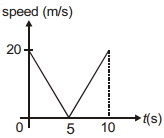
The speed-time graph for a body moving along a straight line is shown in figure. The average acceleration of body may be .......... $m / s ^2$
  • A
    $0$
  • B
    $4$
  • C
    $-4$
  • All of these
Answer
Correct option: D.
All of these
d
(d)

The acceleration from zero to $5 \,s$ is $a=\frac{0-20}{5-0}=\frac{-20}{5}=-4 \,ms ^{-2}$

From $5 \,s$ to $10 \,s$

$a=\frac{20-0}{10-5}=4 \,ms ^{-2}$

$a=\frac{\text { Total change in velocity }}{\text { Time }}$

$=\frac{20-20}{10-0}=0 \,ms ^{-2}$

View full question & answer
MCQ 161 Mark
A particle travels half of the distance of a straight journey with a speed $6 \,m / s$. The remaining part of the distance is covered with speed $2 \,m / s$ for half of the time of remaining journey and with speed $4 \,m / s$ for the other half of time. The average speed of the particle is ....... $m / s$
  • A
    $3$
  • $4$
  • C
    $3 / 4$
  • D
    $5$
Answer
Correct option: B.
$4$
b
(b)

From $C$ to $B$ the time interval of travelling is same.

So, $v_{ av }=\frac{v_2+v_3}{2}=\frac{2+4}{2}=3 \,m / s$

Now, first half is covered with $6 \,ms ^{-1}$ and second half with $3 \,ms ^{-1}$. So when distances are same.

$v_{ av }=\frac{2 v_1 v_2}{v_1+v_2}=\frac{2 \times 6 \times 3}{6+3}=4 \,ms ^{-1}$

$v_{ av }=4 \,ms ^{-1}$

View full question & answer
MCQ 171 Mark
The displacement-time graph for two particles $A$ and $B$ are straight lines inclined at angles of ${30^o}$ and ${60^o}$ with the time axis. The ratio of velocities of ${V_A}:{V_B}$ is
  • A
    $1:2$
  • B
    $1:\sqrt 3 $
  • C
    $\sqrt 3 :1$
  • $1:3$
Answer
Correct option: D.
$1:3$
d
(d)$\frac{{{v_A}}}{{{v_B}}} = \frac{{\tan {\theta _A}}}{{\tan {\theta _B}}}$ $ = \frac{{\tan 30^\circ }}{{\tan 60^\circ }}$$ = \frac{{1/\sqrt 3 }}{{\sqrt 3 }} = \frac{1}{3}$
View full question & answer
MCQ 181 Mark
An electron starting from rest has a velocity that increases linearly with the time that is $v = kt,$ where $k = 2m/{\sec ^2}$. The distance travelled in the first $3 \,seconds$ will be...........$m$
  • $9$
  • B
    $16$
  • C
    $27$
  • D
    $36$
Answer
Correct option: A.
$9$
a
(a)$S = \int_0^3 {v\;dt} = \int_0^3 {kt\;dt} = \left[ {\frac{1}{2}k{t^2}} \right]_0^3 = \frac{1}{2} \times 2 \times 9 = 9\,m$
View full question & answer
MCQ 191 Mark
The acceleration $'a'$ in $m/{s^2}$ of a particle is given by $a = 3{t^2} + 2t + 2$ where $t$ is the time. If the particle starts out with a velocity $u = 2\,m/s$ at $t = 0$, then the velocity at the end of $2$ second is.......$m/s$
  • A
    $12$
  • $18$
  • C
    $27$
  • D
    $36$
Answer
Correct option: B.
$18$
b
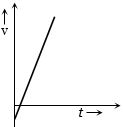
(b) $ v = u + \int_{}^{} {adt = u + \int_{}^{} {(3{t^2} + 2t + 2)dt} } $

$ = u + \frac{{3{t^3}}}{3} + \frac{{2{t^2}}}{2} + 2t = u + {t^3} + {t^2} + 2t$

$ = 2 + 8 + 4 + 4 = 18\;m/s$     (As $t = 2\, sec$)

View full question & answer
MCQ 201 Mark
A particle moves along $X-$axis in such a way that its coordinate $X$ varies with time $t$ according to the equation $x = (2 - 5t + 6{t^2})\,m$. The initial velocity of the particle is.......$m/s$
  • $ - 5$
  • B
    $6$
  • C
    $ - 3$
  • D
    $3$
Answer
Correct option: A.
$ - 5$
a
(a) The velocity of the particle is

$\frac{{dx}}{{dt}} = \frac{d}{{dt}}(2 - 5t + 6{t^2}) = (0 - 5 + 12t)$

For initial velocity $t = 0$, hence $v = - 5\;m/s$.

View full question & answer
MCQ 211 Mark
A particle moves along $X-$axis as $x = 4(t - 2) + a{(t - 2)^2}$ Which of the following is true ?
  • A
    The initial velocity of particle is $4$
  • The acceleration of particle is $2a$
  • C
    The particle is at origin at $t = 0$
  • D
    None of these
Answer
Correct option: B.
The acceleration of particle is $2a$
b
(b) $x = 4(t - 2) + a{(t - 2)^2}$

At $t = 0,\,x = - 8 + 4a = 4a - 8$

$v = \frac{{dx}}{{dt}} = 4 + 2a(t - 2)$

At $t = 0,\;\;v = 4 - 4a = 4(1 - a)$

But acceleration,$a = \frac{{{d^2}x}}{{d{t^2}}} = 2a$

View full question & answer
MCQ 221 Mark
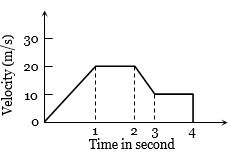
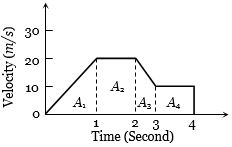
The variation of velocity of a particle with time moving along a straight line is illustrated in the following figure. The distance travelled by the particle in four seconds is.........$m$
  • A
    $60$ 
  • $55$
  • C
    $25$
  • D
    $30$
Answer
Correct option: B.
$55$
b
(b) Distance = Area under $v -t$ graph $ = {A_1} + {A_2} + {A_3} + {A_4}$

$ = \frac{1}{2} \times 1 \times 20 + (20 \times 1) + \frac{1}{2}(20 + 10) \times 1 + (10 \times 1)$

$ = 10 + 20 + 15 + 10 = 55\;m$

View full question & answer
MCQ 231 Mark
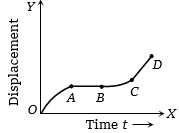
The graph between the displacement $x$ and time $t$ for a particle moving in a straight line is shown in figure. During the interval $OA,\,AB,\,BC$ and $t = 1,\;{v_x} = 0$, the sign of acceleration of the particle at $OA, AB, BC, CD$ is respectively
  • A
    $+ \,\,  0\,\,   + \,\,  +$
  • $-   \,\,0   \,\,+ \,\,  0$
  • C
    $+ \,\,  0\,\,   -\,\,   +$
  • D
    $-\,\,0 \,\,  - \,\,  0$
Answer
Correct option: B.
$-   \,\,0   \,\,+ \,\,  0$
b
(b) Region $OA$ shows that graph bending toward time axis i.e. acceleration is negative.
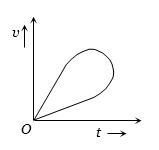
Region $AB$ shows that graph is parallel to time axis i.e. velocity is zero. Hence acceleration is zero.

Region $BC$ shows that graph is bending towards displacement axis i.e. acceleration is positive.

Region $CD$ shows that graph having constant slope i.e. velocity is constant. Hence acceleration is zero.

View full question & answer
MCQ 241 Mark
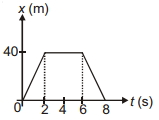
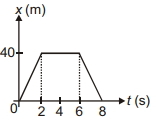
The position $(x)$ of a particle moving along $x$-axis varies with time $(t)$ as shown in figure. The average acceleration of particle in time interval $t=0$ to $t=8 s$ is ........... $m / s ^2$
  • $-5$
  • B
    $3$ 
  • C
    $-4$
  • D
    $2.5$
Answer
Correct option: A.
$-5$
a
(b)

$t=0 \text { to } t=2 \quad \quad t=6 \text { to } t=8$

$v=20 \,m / s \quad \quad \quad v=-20 \,m / s$

$a_{\text {avg }}=\frac{\Delta v}{\Delta t}=\frac{-20-20}{8}=\frac{-40}{8}=-5\,ms ^{-2}$

$a_{\text {avg }}=-5 \,ms ^{-2}$

View full question & answer
MCQ 251 Mark
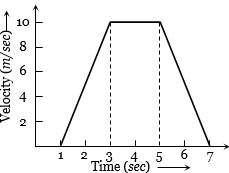
For the velocity-time graph shown in figure below the distance covered by the body in last two seconds of its motion is what fraction of the total distance covered by it in all the seven seconds
  • A
    $0.5$
  • $0.25$
  • C
    $0.33$
  • D
    $0.67$
Answer
Correct option: B.
$0.25$
b
(b)$\frac{{{{(S)}_{(last\;2s)}}}}{{{{(S)}_{7s}}}} = \frac{{\frac{1}{2} \times 2 \times 10}}{{\frac{1}{2} \times 2 \times 10 + 2 \times 10 + \frac{1}{2} \times 2 \times 10}} = \frac{1}{4}$
View full question & answer
MCQ 261 Mark
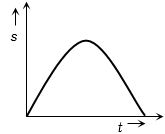
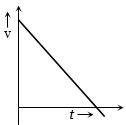
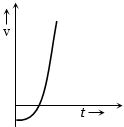
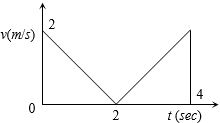
The graph of displacement v/s time is given below Its corresponding velocity-time graph will be

  • B

  • C

  • D

Answer
Correct option: A.

a
(a)We know that the velocity of body is given by the slope of displacement -time graph. So it is clear that initially slope of the graph is positive and after some time it becomes zero (corresponding to the peak of graph) and then it will becomes negative.
View full question & answer
MCQ 271 Mark
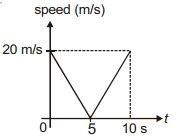
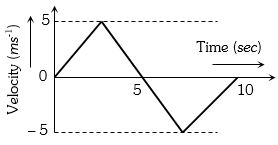
The $v- t$ plot of a moving object is shown in the figure. The average velocity of the object during the first $10$ seconds is...........$m/s$
  • $0$
  • B
    $2.5$
  • C
    $5$
  • D
    $2$
Answer
Correct option: A.
$0$
a
(a) Since total displacement is zero, hence average velocity is also zero.
View full question & answer
MCQ 281 Mark
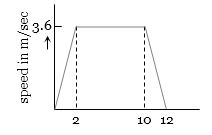
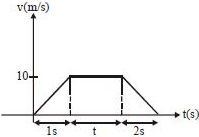
A lift is going up. The total mass of the lift and the passenger is $1500\, kg$. The variation in the speed of the lift is as given in the graph. the height to which the lift takes the passenger is ............ $m$
  • A
    $3.6$
  • B
    $8$
  • C
    $1.8$
  • $36$
Answer
Correct option: D.
$36$
d
(d)Distance travelled by the lift $ = $ Area under velocity time graph

$ = \left( {\frac{1}{2} \times 2 \times 3.6} \right) + \left( {8 \times 3.6} \right) + \left( {\frac{1}{2} \times 2 \times 3.6} \right)$= $36m$

View full question & answer
MCQ 301 Mark
The acceleration of a particle starting from rest, varies with time according to the relation $A = -a\omega^2 sin\omega t.$ The displacement of this particle at a time $t$ will be
  • A
    $ - \frac{1}{2}\,(a{\omega ^2}\sin \omega \,t)\,{t^2}$
  • B
    $a\omega \,\sin \omega \,t$
  • C
    $a\omega \,\cos \omega \,t$
  • $a\,\sin \omega \,t$
Answer
Correct option: D.
$a\,\sin \omega \,t$
d
(d) Velocity $v = \int {A\;dt = \int {( - a{\omega ^2}} } \sin \omega t)\;dt = a\omega \cos \omega t$

Displacement $x = \int {v\;dt = \int {a\omega } } \cos \omega t\;dt = a\sin \omega t$

View full question & answer
MCQ 311 Mark
A car $A$ is travelling on a straight level road with a uniform speed of $60$$km/h.$It is followed by another car $B$ which is moving with a speed of $70$ $km/h.$When the distance between them is $2.5\, km$, the car $B$ is given a deceleration of $20$$km/{h^2}.$ After how much time will $ B$ catch up with $A$...........$hr$
  • A
    $1$
  • $0.5$
  • C
    $0.25$
  • D
    $1/8$
Answer
Correct option: B.
$0.5$
b
(b) Let car $B$ catches, car $A$ after $‘t’$ sec, then

$60t + 2.5 = 70t - \frac{1}{2} \times 20 \times {t^2}$

==> $10{t^2} - 10t + 2.5 = 0$==> ${t^2} - t + 0.25 = 0$

$\therefore $ $t = \frac{{1 \pm \sqrt {1 - 4 \times (0.25)} }}{2} = \frac{1}{2}hr$

View full question & answer
MCQ 321 Mark
A bird flies for $4 \,s$ with a velocity of $|\;t - 2|\;m/s$ in a straight line, where $t$ is time in seconds. It covers a distance of .........$m$
  • A
    $2$
  • $4$
  • C
    $6$
  • D
    $8$
Answer
Correct option: B.
$4$
b
(b) The velocity time graph for given problem is shown in the figure.

Distance travelled $S =$ Area under curve $= 2+2=4m$

View full question & answer
MCQ 331 Mark
A particle is projected with velocity ${\upsilon _0}$ along $x - axis$. The deceleration on the particle is proportional to the square of the distance from the origin i.e., $a = \alpha {x^2}.$ The distance at which the particle stops is
  • A
    $\sqrt {\frac{{3{\upsilon _0}}}{{2\alpha }}} $
  • B
    ${\left( {\frac{{3{v_o}}}{{2\alpha }}} \right)^{\frac{1}{3}}}$
  • C
    $\sqrt {\frac{{3\upsilon {}_0^2}}{{2\alpha }}} $
  • ${\left( {\frac{{3\upsilon {}_0^2}}{{2\alpha }}} \right)^{\frac{1}{3}}}$
Answer
Correct option: D.
${\left( {\frac{{3\upsilon {}_0^2}}{{2\alpha }}} \right)^{\frac{1}{3}}}$
d
(d) $a = \frac{{dv}}{{dt}} = \frac{{dv}}{{dx}}\frac{{dx}}{{dt}}$ $ = v\frac{{dv}}{{dx}} = - \alpha {x^2}$ (given)

==> $\int\limits_{{v_0}}^0 {vdv = - \alpha \int\limits_0^S {{x^2}dx} } $ ==> $\left[ {\frac{{{v^2}}}{2}} \right]_{{v_0}}^0 = - \alpha \left[ {\frac{{{x^3}}}{3}} \right]_0^S$

==> $\frac{{v_0^2}}{2} = \frac{{\alpha \,{S^3}}}{3}$==> $S = {\left( {\frac{{3v_0^2}}{{2\alpha }}} \right)^{\frac{1}{3}}}$

View full question & answer
MCQ 341 Mark
The displacement of a particle moving in a straight line depends on time as $x=\alpha t^3+\beta t^2+\gamma t+\delta$.The ratio of initial acceleration to its initial velocity depends
  • A
    only on $\alpha$ and $\gamma$
  • only on $\beta$ and $\gamma$
  • C
    only on $\alpha$ and $\beta$
  • D
    only on $\alpha$
Answer
Correct option: B.
only on $\beta$ and $\gamma$
b
(b)

$v=3 \alpha t^2+2 \beta t+\gamma$

$v_{t=0}=v_i=\gamma$

$a=6 \alpha t+2 \beta: a_{t=0}=a_i=2 \beta$

$\therefore \frac{v_i}{a_i}=\frac{\gamma}{2 \beta}$

View full question & answer
MCQ 351 Mark
The velocity-time graph for a particle moving along $x$-axis is shown in the figure. The corresponding displacement-time graph is correctly shown by
  • A

  • B

  • C


Answer
Correct option: D.

d
(d)

Motion is first accelerated in positive direction, then uniform in negative direction.

View full question & answer
MCQ 361 Mark
The position of a particle moving along the $y-$ axis is given as $y = 3t^2 -t^3$ where $y$ is in $metre$ and $t$ is in $second$ . The time when the particle attains maximum positive position will be........$s$
  • A
    $1.5$
  • B
    $4$
  • $2$
  • D
    $3$
Answer
Correct option: C.
$2$
c
$y=3 t^{2}-t^{3} \Rightarrow \frac{d y}{d t}=6 t-3 t^{2}=0$

at $t=0 ; y=0$

at $t=2, y=4$

View full question & answer
MCQ 371 Mark
The velocity $v$ of a particle is given by the equation $v = 6t^2 -6t^3$, where $v$ is in $m/sec$ and $t$ is time in $seconds$ then
  • A
    at $t = 0$, velocity is maximum
  • B
    at $t = \frac{2}{3}$, velocity is minimum
  • minimum velocity is zero
  • D
    minimum velocity is $-2\, m/sec$
Answer
Correct option: C.
minimum velocity is zero
c
$\frac{\mathrm{d} \mathrm{V}}{\mathrm{dt}}=12 \mathrm{t}-18 \mathrm{t}^{2}=0 \Rightarrow \mathrm{t}=0,2 / 3$

$\frac{\mathrm{d}^{2} \mathrm{V}}{\mathrm{dt}^{2}}=12-36 \mathrm{t}>0 \Rightarrow$ for $\mathrm{t}=0$ so $\mathrm{v}_{\min }$ will be at

$t=0$

View full question & answer
MCQ 381 Mark
 Three particles start simultaneously from a point on a horizontal smooth plane. First particle moves with speed $v_1$ towards east, second particle moves towards north with speed $v_2$ and third-one moves towards north-east. The velocity of the third particle, so that the three always lie on a line, is
  • A
    $\frac{v_1+v_2}{\sqrt{2}}$
  • B
    $\sqrt{v_1 v_2}$
  • C
    $\frac{v_1 v_2}{v_1+v_2}$
  • $\sqrt{2} \frac{v_1 v_2}{v_1+v_2}$
Answer
Correct option: D.
$\sqrt{2} \frac{v_1 v_2}{v_1+v_2}$
d
(d)

Equation of line $R S$ is $y=-m x+C$

Or $y=-\left(\frac{v_2}{v_1}\right) x+v_2 t$

or $\quad v_1 y=-v_2 x+v_1 v_2 t$

Equation of line $O P$ is

$y=x$

Point $P$ is the point of intersection, we get

$x_P=y_P=\frac{v_1 v_2 t}{v_1+v_2}$

$O P=\sqrt{x_P^2+y_P^2}$

$=\frac{\sqrt{2} v_1 v_2 t}{v_1+v_2}$

$v_3=\frac{O P}{t}=\frac{\sqrt{2} v_1 v_2}{v_1+v_2}$

View full question & answer
MCQ 391 Mark
A particle moves along a straight line such that its displacement at any time $t$ is given by $s = (t^3 -6t^2 + 3t + 4)\, m$. ...... $m/s$ is the velocity of the particle when its acceleration is zero ................. $\mathrm{m/s}$
  • A
    $-3$
  • $-9$
  • C
    $-6$
  • D
    $-12$
Answer
Correct option: B.
$-9$
b
$s=t^{3}-6 t^{2}+3 t+4$

$\mathrm{v}=\frac{\mathrm{ds}}{\mathrm{dt}}=3 \mathrm{t}^{2}-12 \mathrm{t}+3$

$a=\frac{d v}{d t}=6 t-12$

$a=0$

$t=2 \sec$

Velocity at $t=2 \mathrm{sec}$

$\mathrm{v}=-9 \mathrm{m} / \mathrm{s}$

View full question & answer
MCQ 401 Mark
In the $s-t$ equation $\left(s=10+20 t-5 t^2\right)$, match the following columns.
Colum $I$ Colum $II$
$(A)$ Distance travelled in $3\,s$ $(p)$ $-20$ units
$(B)$ Displacement in $1\,s$ $(q)$ $15$ units
$(C)$ Initial acceleration $(r)$ $25$ units
$(D)$ Velocity at $4\,s$ $(s)$ $-10$ units
  • $( A \rightarrow r , B \rightarrow p , C \rightarrow s , D \rightarrow p )$
  • B
    $( A \rightarrow p , B \rightarrow p , C \rightarrow s , D \rightarrow r )$
  • C
    $( A \rightarrow r , B \rightarrow s , C \rightarrow p , D \rightarrow p )$
  • D
    $( A \rightarrow s , B \rightarrow p , C \rightarrow r , D \rightarrow p )$
Answer
Correct option: A.
$( A \rightarrow r , B \rightarrow p , C \rightarrow s , D \rightarrow p )$
a
(a)

Comparing the given equation with general equation of displacement, $s=s_0+u t+\frac{1}{2} a t^2$, we get

$u=+20 \text { unit and } a=-10 \text { unit }$

View full question & answer
MCQ 411 Mark
Match the following columns.
colum $I$ colum $II$
$(A)$ Constant positive acceleration $(p)$ Speed may increase
$(B)$ Constant negative acceleration $(q)$ Speed may decrease
$(C)$ Constant displacement $(r)$ Speed is zero
$(D)$ Constant slope of $a-t$ graph $(s)$ Speed must increase
  • A
    $( A \rightarrow p , q , B \rightarrow p , q , C \rightarrow r , D \rightarrow p , q )$
  • B
    $( A \rightarrow  q , B \rightarrow p , C \rightarrow r , D \rightarrow p , q )$
  • C
    $( A \rightarrow p , r , B \rightarrow p , s , C \rightarrow r , D \rightarrow p , q )$
  • $( A \rightarrow p , q , B \rightarrow p , q , C \rightarrow r , D \rightarrow p , q )$
Answer
Correct option: D.
$( A \rightarrow p , q , B \rightarrow p , q , C \rightarrow r , D \rightarrow p , q )$
d
(d)

With constant positive acceleration, speed will increase when velocity is positive, speed will decrease if velocity is negative.Similarly, with constant negative acceleration speed will increase, if velocity is also negative and speed will decrease, if velocity is positive.
View full question & answer
MCQ 421 Mark
The acceleration $a$ in $m / s ^2$, of a particle is given by $a=3 t^2+2 t+2$, where $t$ is the time. If the particle starts out with a velocity $v=2 m / s$ at $t=0$, then the velocity at the end of $2\,s$ is $............m/s$
  • A
    $12$
  • B
    $14$
  • C
    $16$
  • $18$
Answer
Correct option: D.
$18$
d
(d)

$d v=a d t$

$\therefore \int \limits_2^v d v=\int \limits_0^2\left(3 t^2+2 t+2\right) d t$

$\text { or } v=18\,m / s$

View full question & answer
MCQ 431 Mark
If the velocity of a particle is $(10 + 2t^2) m/s$, then the average acceleration of the particle between $2s$ and $5s$ is..........$m/s^2$
  • A
    $2$
  • B
    $4$
  • C
    $12$
  • $14$
Answer
Correct option: D.
$14$
d
(d) Average acceleration $ = \frac{{{\rm{Change\, in\, velocity }}}}{{{\rm{Time\, taken }}}}$

$ = \frac{{{v_2} - {v_1}}}{{{t_2} - {t_1}}}$ $ = \frac{{\left[ {10 + 2{{(5)}^2}} \right] - \left[ {10 + 2{{(2)}^2}} \right]}}{3} = \frac{{60 - 18}}{3}$$ = 14\;m/{s^2}$.

View full question & answer
MCQ 441 Mark
Mark the correct statements for a particle going on a straight line
  • A
    if the position and velocity have opposite sign, the particle is moving towards the origin
  • B
    if the velocity is zero for a time interval, the acceleration is zero at any instant within the time interval
  • C
    if the velocity and acceleration have opposite sign, the object is slowing down
  • All of the above
Answer
Correct option: D.
All of the above
d
All options are correct except $C$ because, if the velocity is zero at an instant, then acceleration may not necessarily be zero at that instant.

For e.g. when an object is thrown vertically upward, at highest point velocity is zero but acceleration on it due to gravity is non-zero.

Option $D$ is correct as the derivative of velocity will be zero in case velocity is zero for a time interval,

View full question & answer
MCQ 451 Mark
Which of the following statements are true for a moving body?
  • A
    If its speed changes, its velocity must change and it must have some acceleration
  • B
    If its velocity changes, its speed must change and it must have some acceleration
  • C
    If its velocity changes, its speed may or may not change, and it must have some acceleration
  • Both $(A)$ and $(C)$
Answer
Correct option: D.
Both $(A)$ and $(C)$
d
View full question & answer
MCQ 461 Mark
The maximum possible acceleration of a train moving on a straight track is $10\  m/s^2$ and maximum possible retardation is $5 \ m/s^2.$ If maximum achievable speed of train is $10\ m/s$ then minimum time in which train can complete a journey of $135\ m$ starting from rest and ending at rest, is.........$s$
  • A
    $5$
  • B
    $10$
  • $15$
  • D
    $20$
Answer
Correct option: C.
$15$
c
$\frac{1}{2}(1+2)(10)+10 t=135$

$t=12 s$

View full question & answer
MCQ 471 Mark
Two trains travelling on the same track are approaching each other with equal speeds of $40\ m/s$ . The drivers of the trains begin to decelerate simultaneously when they are just $2.0\ km$ apart. Assuming the decelerations to be uniform and equal, the value of the deceleration to barely avoid collision should be..........$m/s^2$
  • A
    $11.8$
  • B
    $11$
  • C
    $2.1$
  • $0.8$
Answer
Correct option: D.
$0.8$
d
Both trains will travel a distance of $1 \mathrm{km}$ before

to come in rest. ln this case by using

$v^{2}=u^{2}+2 a s$

$\Rightarrow 0=(40)^{2}+2 \mathrm{a} \times 1000$

$\Rightarrow \mathrm{a}=-0.8 \mathrm{m} / \mathrm{s}^{2}$

View full question & answer
MCQ 481 Mark
A body $A$ starts from rest with an acceleration $a_1$ . After $2\ seconds$ , another body $B$ starts from rest with an acceleration $a_2$ . If they travel equal distance in the $5th\ second$ , after the start of $A$ , then the ratio $a_1$ : $a_2$ is equal to
  • $5 : 9$
  • B
    $5 : 7$
  • C
    $9 : 5$
  • D
    $9 : 7$
Answer
Correct option: A.
$5 : 9$
a
According to problem

Distance travelled by body $\mathrm{A}$ in $5^{\text {th }}$ sec and distance travelled by body $\mathrm{B}$ in $3^{\mathrm{rd}}$ sec. of its motion are

equal.

$0+\frac{a_{1}}{2}(2 \times 5-1)=0+\frac{a_{2}}{2}[2 \times 3-1]$

$9 a_{1}=5 a_{2} \Rightarrow \frac{a_{1}}{a_{2}}=\frac{5}{9}$

View full question & answer
MCQ 491 Mark
Your friend driving his car overtakes your car on the highway. Which of the following statement must be true at the instant he is passing you? Assume the cars as point particles.
  • A
    Your speed and his speed are the same.
  • B
    Your acceleration and his acceleration are the same
  • Your position on the highway is the same as his position on the highway
  • D
    He also observes that you overtake his car.
Answer
Correct option: C.
Your position on the highway is the same as his position on the highway
c
View full question & answer
MCQ 501 Mark
The displacement of a particle after time $t$ is given by $x = \left( {k/{b^2}} \right)\left( {1 - {e^{ - bt}}} \right)$ where $b$ is a constant. What is the acceleration of the particle? 
  • A
    $k{e^{ - bt}}$
  • $-k{e^{ - bt}}$
  • C
    $\frac{k}{{{b^2}}}{e^{ - bt}}$
  • D
    $\frac{-k}{{{b^2}}}{e^{ - bt}}$
Answer
Correct option: B.
$-k{e^{ - bt}}$
b
$x=\frac{k}{b^{2}}\left(1-e^{-b t}\right)$

$\frac{d x}{d t}=\frac{k}{b} e^{-b t}, \frac{d^{2} x}{d t^{2}}=-k e^{-b t}$

View full question & answer
M.C.Q (1 Marks) - Physics STD 11 Science Questions - Vidyadip