MCQ
A car accelerates from rest at a constant rate $\alpha $ for some time, after which it decelerates at a constant rate $\beta $ and comes to rest. If the total time elapsed is $t$, then the maximum velocity acquired by the car is
  • A
    $\left( {\frac{{{\alpha ^2} + {\beta ^2}}}{{\alpha \beta }}} \right)\,t$
  • B
    $\left( {\frac{{{\alpha ^2} - {\beta ^2}}}{{\alpha \beta }}} \right)\,t$
  • C
    $\frac{{(\alpha + \beta )\,t}}{{\alpha \beta }}$
  • $\frac{{\alpha \beta \,t}}{{\alpha + \beta }}$
Answer

Correct option: D.
$\frac{{\alpha \beta \,t}}{{\alpha + \beta }}$
d
(d) Let the car accelerate at rate $\alpha $ for time ${t_1}$ then maximum velocity attained, $v = 0 + \alpha {t_1} = \alpha {t_1}$

Now, the car decelerates at a rate $\beta $ for time $(t - {t_1})$ and finally comes to rest. Then,

$0 = v - \beta (t - {t_1})$ $⇒$ $0 = \alpha {t_1} - \beta t + \beta {t_1}$

$⇒$  ${t_1} = \frac{\beta }{{\alpha + \beta }}t$

 $v = \frac{{\alpha \beta }}{{\alpha + \beta }}t$

Need a full question paper?

Generate a complete, print-ready paper with questions like this in minutes — across 16+ boards, with answer keys.

Start Generating Free

Similar questions

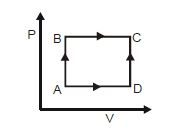
A shown in the figure, the amount of heat absorbed along the path $ABC$ is $90\,J$ and the amount of work done by the system is $30\,J$ . If the amount of work done along the path $ADC$ is $20\,J$ , the amount of heat absorbed will be  .... $J$
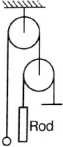
In the figure, mass of a ball is $\frac{9}{5}$ times mass of the rod. Length of rod is $1 \,m$. The level of ball is same as rod level. Find out time taken by the ball to reach at upper end of rod. (in $S$)
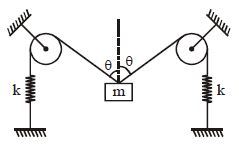
In the situation as shown in figure time period of vertical oscillation of block for small displacements will be 
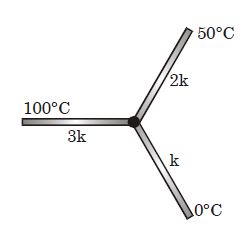
Three rods of the same dimensions have thermal conductivities $3k, 2k$ and $k$. They are arranged as shown, with their ends at $100\,^oC, 50\,^oC$ and $0\,^oC$. The temperature of their junction is
A block of mass $m$ slides down the plane inclined at angle $30^{\circ}$ with an acceleration $\frac{ g }{4}$. The value of coefficient of kinetic friction will be :
A sphere and a cube of same material and same volume are heated upto same temperature and allowed to cool in the same surroundings. The ratio of the amounts of radiations emitted will be
$10\,gm$ of ice at $0\,^oC$ is mixed with $'m'\,gm$ of water at $50\,^oC$ . ........ $gm$ is minimum value of $m$ so that ice melts completely. ( $L_f = 80\,cal/gm$ and $S_W = 1\,cal/gm-\,^oC$ )
$Assertion$: In the measurement of physical quantities direct and indirect methods are used.

$Reason$ : The accuracy and precision of measuring instruments along with errors in measurements should be taken into account, while expressing the result.

The apparent coefficient of expansion of a liquid when heated in a copper vessel is $C$ and when heated in a silver vessel is $S$. If $A$ is the linear coefficient of expansion of copper, then the linear coefficient of expansion of silver is
In a resonance tube the first resonance with a tuning fork occurs at $16 cm$ and second at $49 cm.$ If the velocity of sound is $330 m/s,$ the frequency of tuning fork is