MCQ
A car accelerates on a horizontal road due to force exerted by
  • A
    The engine of the car
  • B
    The driver of the car
  • C
    The earth as weight of the car
  • The road

Answer

Correct option: D.
The road
d
(d)

Due to frictional force by the road.

Need a full question paper?

Generate a complete, print-ready paper with questions like this in minutes — across 16+ boards, with answer keys.
Start Generating Free

Similar questions

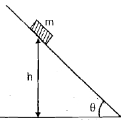
A block of mass $m$ is sliding down an inclined plane with constant speed.At a certain instant $t_0$, its height above the ground is $h$. The coefficient of kinetic friction between the block and the plane is $\mu$. If the block reaches the ground at a later instant $t_g$, then the energy dissipated by friction in the time interval $\left(t_g-t_0\right)$ is
A physical quantity which has a direction
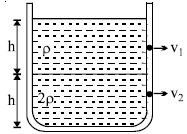
Equal volumes of two immiscible liquids of densities $\rho$ and $2\rho$ are filled in a vessel as shown in figure. Two small holes are punched at depth $h/ 2$ and $3h/2$ from the surface of lighter liquid. If $v_1 $ and $v_2 $ are the velocities of a flux at these two holes, then $v_1/v_2 $ is : 
$Assertion :$ The time-period of pendulum, on a satellite orbiting the earth is infinity.
$Reason :$ Time-period of a pendulum is inversely proportional to $\sqrt g$
An ideal gas is compressed to half its initial volume by means of several processes. Which of the process results in the maximum work done on the gas? 
Two waves each of amplitude a and have a phase difference $\frac{\pi}{2}$. The amplitude and frequency of a resultant wave due to their superposition will be
Two long capillary tubes $A$ and $B $ of radius $R_B>R_A$ dipped in same liquid. Then
Starting from rest a body slides down a $45^o$ inclined plane in twice the time it takes to slide down the same distance in the absence of friction. The co-efficient of friction between the body and the inclined plane is: 
A wave represented by the equation $y = A cos (kx - \omega t)$ is superimposed with another wave to form a statioary wave such that the point $x =0$ is a node. The equation of the other wave is:
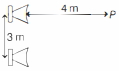
Two small identical speakers are connected in phase to the same source. The speakers are $3 \,m$ apart and at ear level. An observer stands at $P, 4 \,m$ in front of one speaker as shown alongside. The sound she hears is least intense when the wavelength is $\lambda_1$ and most intense when the wavelength is $\lambda_2$. Then, the possible values of $\lambda_1$ and $\lambda_2$ are