MCQ
A car accelerates on a horizontal road due to the forces exerted by
  • A
    the engine of the car
  • B
    the driver of the car
  • C
    the car on earth
  • the road on the car

Answer

Correct option: D.
the road on the car
d
A car accelerates on a horizontal road due to the force exerted by the road on the car.

Need a full question paper?

Generate a complete, print-ready paper with questions like this in minutes — across 16+ boards, with answer keys.
Start Generating Free

Similar questions

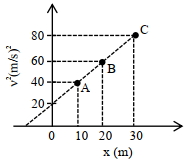
A particle is moving with constant acceleration $'a'.$ Following graph shows $v^{2}$ versus $x$ (displacement) plot. The acceleration of the particle is $......{m} / {s}^{2}$
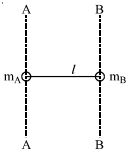
$A$ point mass $m_A$ is connected to a point mass $m_B$ by a massless rod of length $l$ as shown in the figure. It is observed that the ratio of the moment of inertia of the system about the two axes $BB$ and $AA$, which is parallel to each other and perpendicular to the rod is $\frac{{{I_{BB}}}}{{{I_{AA}}}}=3$. The distance of the centre of mass of the system from the mass $A$ is
The instantaneous displacement of an oscillating spring is $y=5 \sin \left(0.2 \pi t+\frac{\pi}{2}\right) m$ its period of oscillations is :
A wooden cube just floats inside water with a $200 \,gm$ mass placed on it. When the mass is removed, the cube floats with its top surface $2 \,cm$ above the water level. the side of the cube is ......... $cm$
Two samples $A$ and $B$ of a gas initially at the same pressure and temperature are compressed from volume $ V$ to $ V/2$ ($A$ isothermally and adiabatically). The final pressure of $ A$ is
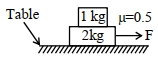
The coefficient of static friction between two blocks is $0.5$ and the table is smooth. The maximum horizontal force that can be applied to move the blocks together is $\ldots \ldots . N$. (take $\left.g=10\, {ms}^{-2}\right)$
Two equal positive charges are kept at points A and B. The electric potential at the points between A and B (excluding these points) is studied while moving from A to B. The potential.
The average momentum of a molecule in a sample of an ideal gas depends on:
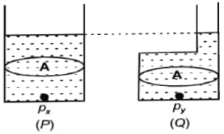
Figure shows two containers $P$ and $Q$ with same base area $A$ and each filled upto same height with same liquid. Select the correct alternative .............
Which of the following combinations have the dimensions of time? L, C, R represent inductance, capacitance and resistance respectively?