A circular road of radius $1000 \,m$ has banking angle ${45^o}$. The maximum safe speed of a car having mass $2000 \,kg$ will be, if the coefficient of friction between tyre and road is $0.5$ ....... $m/s$
Medium


Download our appand get started for free
Experience the future of education. Simply download our apps or reach out to us for more information. Let's shape the future of learning together!No signup needed.*
Similar Questions
- 1A disc with a flat small bottom beaker placed on it at a distance $R$ from its center is revolving about an axis passing through the center and perpendicular to its plane with an angular velocity $\omega$. The coefficient of static friction between the bottom of the beaker and the surface of the disc is $\mu$. The beaker will revolve with the disc ifView Solution
- 2A block is moving on an inclined plane making an angle $45^{\circ}$ with the horizontal and the coefficient of friction is $\mu$. The force required to just push it up the inclined plane is $3$ times the force required to just prevent it from sliding down. If we define $N=10 \ \mu$, then $N$ isView Solution
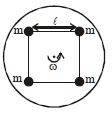
- 3Four identical point masses $'m'$ joined by light string of length $'l'$ arrange such that they form square frame. Centre of table is coincide with centre of arrangment. If arrangement rotate with constant angular velocity $'\omega '$ , find out tension in each stringView Solution
- 4A small block of mass $m$ is projected horizontally with speed $u$ where friction coefficient between block and plane is given by $\mu = cx$, where $x$ is displacement of the block on plane. Find maximum distance covered by the blockView Solution
- 5A $100 \,kg$ car is moving with a maximum velocity of $9 \,m/s$ across a circular track of radius $30\,m$. The maximum force of friction between the road and the car is ........ $N$View Solution
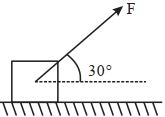
- 6As shown in the figure a block of mass $10\,kg$ lying on a horizontal surface is pulled by a force $F$ acting at an angle $30^{\circ}$, with horizontal. For $\mu_{ s }=0.25$, the block will just start to move for the value of $F..........\,N$ : $\left[\right.$ Given $\left.g =10\,ms ^{-2}\right]$View Solution
- 7$A$ block of mass $M$ is placed on $a$ horizontal surface and it is tied with an inextensible string to $a$ block of mass, as shown in figure. A block of mass $m_0$ is also placed on $M$ If $\mu < \mu_{min}$ (the minimum friction required to keep the block $m$ stationary), then the downward acceleration of $m$ isView Solution

- 8A block of mass $15 \,kg $ is resting on a rough inclined plane as shown in figure. The block is tied up by a horizontal string which has tension of $50\,N$. The minimum coefficient of friction between the surfaces of contact is $(g = 10\,m/s^2)$View Solution
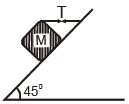
- 9The tension $T$ in the string shown in figure is ..................... $N$View Solution
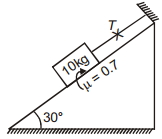
- 10A car is moving with a constant speed of $20\,m / s$ in a circular horizontal track of radius $40\,m$. A bob is suspended from the roof of the car by a massless string. The angle made by the string with the vertical will be : (Take $g =10$ $\left.m / s ^2\right)$View Solution