MCQ
A Carnot engine operates between ${227^o}C$ and ${27^o}C.$ Efficiency of the engine will be
  • A
    $0.33$
  • $0.4$
  • C
    $0.75$
  • D
    $0.6$

Answer

Correct option: B.
$0.4$
b
(b) $\eta = 1 - \frac{{{T_2}}}{{{T_1}}} = 1 - \frac{{300}}{{500}} = \frac{2}{5}$

Need a full question paper?

Generate a complete, print-ready paper with questions like this in minutes — across 16+ boards, with answer keys.

Start Generating Free

Similar questions

A simple pendulum has time period $T_1$. The point of suspension is now moved upward according to equation $y = k{t^2}$ where $k = 1\,m/se{c^2}$. If new time period is $T_2$ then ratio $\frac{{T_1^2}}{{T_2^2}}$ will be
Two tuning forks $A\,\, \& \,\,B$ produce notes of frequencies $256 Hz \,\,\& \,\,262 Hz$ respectively. An unknown note sounded at the same time as $A$ produces beats . When the same note is sounded with $B$, beat frequency is twice as large . The unknown frequency could be  ... $Hz$
A body is projected at an angle of $30^{\circ}$ with the horizontal with momentum $p$. At its highest point, the magnitude of the momentum is
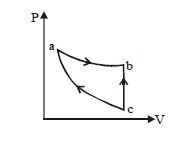
An ideal gas expands isothermally along $ab$ and does $600\,J$ of work. During the process
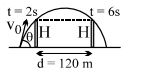
A projectile crosses two walls of equal height $H$ symmetrically as shown If the horizontal distance between the two walls is $d = 120\,\, m$, then the range of the projectile is ........ $m$
A large number of water drops, each of radius $r$, combine to have a drop of radius $R$. If the surface tension is $T$ and mechanical equivalent of heat is $J ,$ the rise in heat energy per unit volume will be
A body moving with velocity $v$ has momentum and kinetic energy numerically equal. What is the value of $v$ ........$m/s$
The $\text{r.m.s}$ velocity of the molecules of an ideal gas is $C$ at a temperature of $100K.$ at what temperature is $\text{r.m.s.}$ velocity will be doubted?
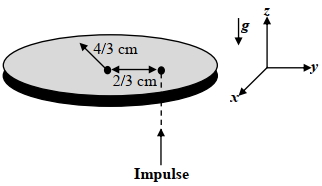
A thin circular coin of mass $5 \mathrm{gm}$ and radius $4 / 3 \mathrm{~cm}$ is initially in a horizontal $x y$-plane. The coin is tossed vertically up ( $+z$ direction) by applying an impulse of $\sqrt{\frac{\pi}{2}} \times 10^{-2} \mathrm{~N}-\mathrm{s}$ at a distance $2 / 3 \mathrm{~cm}$ from its center. The coin spins about its diameter and moves along the $+z$ direction. By the time the coin reaches back to its initial position, it completes $n$ rotations. The value of $n$ is. . . . . [Given: The acceleration due to gravity $\mathrm{g}=10 \mathrm{~ms}^{-2}$ ]
In a particular system the units of length, mass and time are chosen to be $10\;cm , 10 \;g$, and $0.1\;s$ respectively. The units of force in this system will be equal to?