MCQ 11 Mark
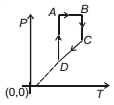
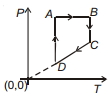
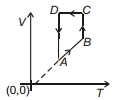
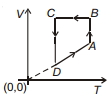
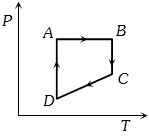
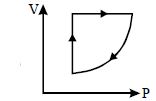
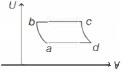
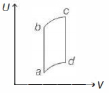
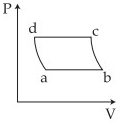
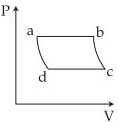
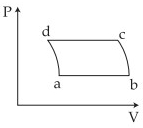
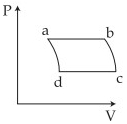
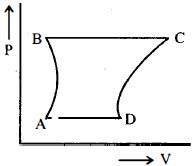
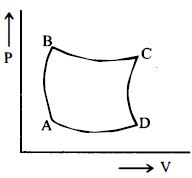
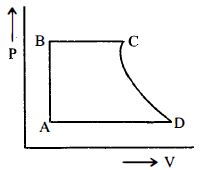
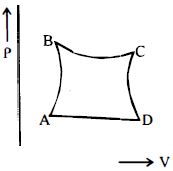
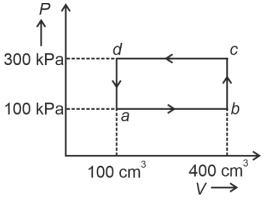
A cyclic process of a thermodynamic system is taken through $a$ $b$ $c$ $d$ $a$. The work done by the gas along the path $b$ $c$ is
- A
$30 \mathrm{~J}$
- B
$-90 \mathrm{~J}$
- C
$-60 \mathrm{~J}$
- ✓
Answerd
Path $b c$ is an isochoric process.
$\therefore \quad$ Work done by gas along path $b c$ is zero.
View full question & answer→MCQ 21 Mark
A Carnot engine has an efficiency of $50 \%$ when its source is at a temperature $327^{\circ}\,C$. The temperature of the sink is $.........^{\circ} C$
Answerb
Efficiency of carnot engine
$\% \eta=\left(1-\frac{T_{\text {sink }}}{T_{\text {source }}}\right) \times 100$
$T_{\text {source }}=327^{\circ}\,C =600\,K$
$50=\left(1-\frac{T_{\text {sink }}}{600}\right) \times 100$
$\frac{1}{2}=1-\frac{T_{\text {sink }}}{600}$
$T _{\text {Sink }}=300\,K$
So temp. of sink is ${ }^{\circ} C =300-2763=27^{\circ}\,C$
View full question & answer→MCQ 31 Mark
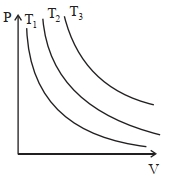
An ideal gas undergoes four different processes from the same initial state as shown in the figure below. Those processes are adiabatic, isothermal, isobaric and isochoric. The curve which represents the adiabatic process among $1,2,3$ and $4$ is
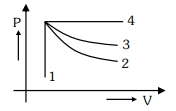
Answera
$1$ : Isochoric
$2$: Adiabatic
$3$ : Isothermal
$4$: Isobaric
View full question & answer→MCQ 41 Mark
An ideal gas follows a process described by the equation $PV ^2= C$ from the initial $\left( P _1, V _1, T _1\right)$ to final $\left(P_2, V_2, T_2\right)$ thermodynamics states, where $C$ is a constant. Then
- A
If $P_1 > P_2$ then $T_1 < T_2$
- B
If $V_2 > V_1$ then $T_2 > T_1$
- ✓
If $V_2 > V_1$ then $T_2 < T_1$
- D
If $P_1 > P_2$ then $V_1 > V_2$
AnswerCorrect option: C. If $V_2 > V_1$ then $T_2 < T_1$
c
$PV ^2= C$
$\Rightarrow \frac{ nRT }{ V } V ^2= C$
$\Rightarrow TV =\text { constant }$
$\therefore V _2 > V _1 \Rightarrow T _1 > T _2$
View full question & answer→MCQ 51 Mark
Two cylinders $A$ and $B$ of equal capacity are connected to each other via a stop cock. A contains an Ideal gas at standard temperature and pressure. $B$ is completely evacuated. The entire system is thermally insulated. The stop cock is suddenly opened. The process is :
Answerc
Free expansion i.e. expansion against vacuum is adiabatic in nature for all type of gases. It should be noted that temperature final temperature is equal to initial temperature for ideal gases.
View full question & answer→MCQ 61 Mark
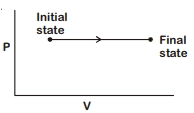
The $P-V$ diagram for an ideal gas in a piston cylinder assembly undergoing a thermodynamic process is shown in the figure. The process is
Answerd
Because pressure remains same during the process, so it is isobaric process.
View full question & answer→MCQ 71 Mark
The efficiency of a Carnot engine depends upon
- A
the temperature of the source only
- B
the temperature of the sink only
- ✓
the temperatures of the source and sink
- D
the volume of the cylinder of the engine
AnswerCorrect option: C. the temperatures of the source and sink
c
Efficiency of Carnot engine
$\eta=\left(1-\frac{T_{2}}{T_{1}}\right) \times 100 \%$
So efficiency depends on temperature of source $\left(T_{1}\right)$ and temperature of $\sin k\left(T_{2}\right)$
View full question & answer→MCQ 81 Mark
In which of the following processes, heat is neither absorbed nor released by a system ?
Answerb
Adiabatic process
$\Delta Q=0$
View full question & answer→MCQ 91 Mark
A sample of $0.1\, g$ of water at $100^o C$ and normal pressure $(1.013 \times 10^5 N m^{-2} )$ requires $54\ cal $ of heat energy to convert to steam at $100^o C.$ If the volume of the steam produced is $167.1 \,cc,$ the change in internal energy of the sample, is ....... $J$
- A
$104.3$
- ✓
$208.7$
- C
$84.5$
- D
$42.2$
AnswerCorrect option: B. $208.7$
b
Using first law of thermodynamics,
$\Delta Q = \Delta U + \Delta W$
$ \Rightarrow 54 \times 4.18 = \Delta U + 1.013 \times {10^5}\left( {167.1 \times {{10}^{ - 6}} - 0} \right)$
$ \Rightarrow \Delta U = 208.7\,J$
View full question & answer→MCQ 101 Mark
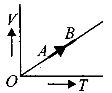
The volume $( V)$ of a monatomic gas varies with its temperature $(T)$ , as shown in the graph. The ratio of work done by the gas , to the heat absorbed by it, when it undergoes a change from state $A$ to state $B$ , is
- ✓
$\;\frac{2}{5}$
- B
$\frac{2}{3}$
- C
$\;\frac{2}{7}$
- D
$\;\frac{1}{3}$
AnswerCorrect option: A. $\;\frac{2}{5}$
a
Given process is isobaric.
$\therefore \,dQ = n{C_p}dT;\,where\,{C_p}\,is\,specific\,heat\,at\,constant\,pressure.$
or $dQ = n\left( {\frac{5}{2}R} \right)dT$
$Also,\,dW = PdV = nRdT\,\left( {PV = nRT} \right)$
Required ratio$ = \frac{{dW}}{{dQ}} = \frac{{nRdT}}{{n\left( {\frac{5}{2}R} \right)dT}} = \frac{2}{5}$
View full question & answer→MCQ 111 Mark
The efficiency of an ideal heat engine working between the freezing point and boiling point of water, is ........ $\%$
- ✓
$26.8$
- B
$20 $
- C
$12.5$
- D
$6.25$
AnswerCorrect option: A. $26.8$
a
Efficiency of an ideal heat engine,
$\eta = \left( {1 - \frac{{{T_2}}}{{{T_1}}}} \right)$
Freezing point of water $ = {0^ \circ }C = 273\,K$
Boiling point of water$ = {100^ \circ }C = \left( {100 + 273} \right)K$
$ = 373\,K$
$T_2$ Sink temperature$=273 K$
$T_1$ Source temperature $=373 K$
$\% \eta = \left( {1 - \frac{{{T_2}}}{{{T_1}}}} \right) \times 100 = \left( {1 - \frac{{273}}{{373}}} \right) \times 100$
$ = \left( {\frac{{100}}{{373}}} \right) \times 100 = 26.8\% $
View full question & answer→MCQ 121 Mark
The volume of $1\; mole$ of an ideal gas with the adiabatic exponent $\gamma$ is changed according to the relation $V=\frac bT$ where $b =$ constant. The amount of heat absorbed by the gas in the process if the temperature is increased by $\triangle T$ will be
- A
$\frac{R}{{\gamma - 1}} \Delta T$
- ✓
$\left( {\frac{{2 - \gamma }}{{\gamma - 1}}} \right)R \Delta T$
- C
$\;\frac{{R \Delta T}}{{\gamma - 1}}$
- D
$\left( {\frac{{1 - \gamma }}{{\gamma + 1}}} \right)R \Delta T$
AnswerCorrect option: B. $\left( {\frac{{2 - \gamma }}{{\gamma - 1}}} \right)R \Delta T$
b
$V=\frac bT$
$VT=$constant
$V(p V)=$ constant
$\therefore p V^{2}=$ constant
In the process $p V^{x}=$ constant, molar heat capacity is
$C=\frac{R}{\gamma-1}+\frac{R}{1-x}$
Here, $x=2$
$\therefore C=\frac{R}{\gamma-1}+\frac{R}{1-2}=\left(\frac{2-\gamma}{\gamma-1}\right) R$
Now, $Q=n C \Delta T$
$=(1)\left(\frac{2-\gamma}{\gamma-1}\right) R \Delta T$
$=\left(\frac{2-\gamma}{\gamma-1}\right) R \Delta T$
View full question & answer→MCQ 131 Mark
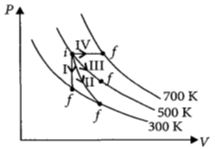
Thermodynamic processes are indicated in the following diagram.
Match the following
$\begin{array}{|l|l|} \hline Column\,\,-\,\,1 & Column\,\,-\,\,2 \\ \hline P\,:\,Process\,\,-\,\,I & \,\,A\,\,:\,\,Adiabatic \\ \hline Q\,:\,Process\,\,-\,\,II & \,\,B\,\,:\,\,Isobaric \\ \hline R\,:\,Process\,\,-\,\,III & \,\,C\,\,:\,\,Isochoric \\ \hline S\,:\,Process\,\,-\,\,IV & \,\,D\,\,:\,\,Isothermal \\ \hline \end{array}$
- ✓
$P \to C,\;\;Q \to A,\;\;\;R \to D,\;\;S \to B$
- B
$P \to C,\;\;Q \to D,\;\;\;R \to B,\;\;S \to A$
- C
$P \to D,\;\;Q \to B,\;\;\;R \to A,\;\;S \to C$
- D
$\;P \to A,\;\;Q \to C,\;\;\;R \to D,\;\;S \to B$
AnswerCorrect option: A. $P \to C,\;\;Q \to A,\;\;\;R \to D,\;\;S \to B$
a
In process $I,$ volume is constant
$\therefore \,\,\,\,process\,I \to Isochoric;\,P \to C$
As slope of curve $II$ is more than the slope of curve $III$.
$process\,II \to Adiabatic\,and\,processIII \to Isothermal$
$\therefore \,\,\,Q \to A,R \to D$
In process $IV$, pressure is constant
Process $IV \to Isobaric;\,S \to B$
View full question & answer→MCQ 141 Mark
One mole of a gas obeying the equation of state $P(V-b)=R T$ is made to expand from a state with coordinates $\left(P_{1}, V_{1}\right)$ to a state with $\left(P_{2}, V_{2}\right)$ along a process that is depicted by a straight line on a $P-V$ diagram. Then, the work done is given by
- ✓
$\frac{1}{2}$(${P_1} + {P_2})\left( {{V_2} - {V_1}} \right)$
- B
$\;\frac{1}{2}$(${P_2} - {P_1})\left( {{V_2} - {V_1}} \right)$
- C
$\frac{1}{2}$(${P_1} + {P_2})\left( {{V_2} - {V_1} + 2b} \right)$
- D
$\;\frac{1}{2}$(${P_2} - {P_1})\left( {{V_2} + {V_1} + 2b} \right)$
AnswerCorrect option: A. $\frac{1}{2}$(${P_1} + {P_2})\left( {{V_2} - {V_1}} \right)$
a
Workdone during the complete cycle is equal to the area enclosed by the P-V graph
$W=\frac{1}{2} \text { base } \times \text { height }+ \text { Area of rectangular }$
$=\frac{1}{2}\left(V_2-V_1\right) \times\left(P_1-P_2\right)+\left(V_2-V_1\right) P_2$
$=\left(V_2-V_1\right)\left[\frac{P_1}{2}-\frac{P_2}{2}+P_2\right]$
$=\left(V_2-V_1\right)\left[\frac{P_1}{2}+\frac{P_2}{2}\right]$
$=\frac{1}{2}\left(P_1+P_2\right)\left(V_2-V_1\right)$

View full question & answer→MCQ 151 Mark
The temperature inside a refrigerator is $t_2 \,^o C$ and the room temperature is $t_1\,^o C.$ The amount of heat delivered to the room for each joule of electrical energy consumed ideally will be
- A
$\frac{{{t_2} + 273}}{{{t_1} - {t_2}}}$
- B
$\;\frac{{{t_1} + {t_2}}}{{{t_2} + 273}}$
- C
$\;\frac{{{t_1}}}{{{t_1} - {t_2}}}$
- ✓
$\;\frac{{{t_1} + 273}}{{{t_1} - {t_2}}}$
AnswerCorrect option: D. $\;\frac{{{t_1} + 273}}{{{t_1} - {t_2}}}$
d
Temperature inside refrigerator $ = {t_2}{\,^ \circ }C$
Room temperature $ = {t_1}{\,^ \circ }C$
For refrigerator,
$\frac{{Heat\,given\,to\,high\,temperature\,\left( {{Q_1}} \right)}}{{Heat\,taken\,from\,lower\,temperature\,\left( {{Q_2}} \right)}} = \frac{{{T_1}}}{{{T_2}}}$
$\frac{{{Q_1}}}{{{Q_2}}} = \frac{{{t_1} + 273}}{{{t_2} + 273}}$
$ \Rightarrow \frac{{{Q_1}}}{{{Q_1} - W}} = \frac{{{t_1} + 273}}{{{t_2} + 273}}\,\,or\,\,1 - \frac{W}{{{Q_1}}} = \frac{{{t_2} + 273}}{{{t_1} + 273}}$
$or\,\,\frac{W}{Q_1} = \frac{{{t_1} - {t_2}}}{{{t_1} + 273}}$
The amount of heat delivered to the room for each joule pf electrical energy $\left( {W = 1\,J} \right)$
${Q_1} = \frac{{{t_1} + 273}}{{{t_1} - {t_2}}}$
View full question & answer→MCQ 161 Mark
A refrigerator works between $4^o C$ and $30^o C.$ It is required to remove $600$ calories of heat every second in order to keep the temperature of the refrigerated space constant. The power required is ....... $W$ (Take $1\, cal \,=\, 4.2\, Joules\,)$
- A
$23.65$
- ✓
$236.5$
- C
$2365$
- D
$2.365$
AnswerCorrect option: B. $236.5$
b
$Given,\,{T_2} = {4^ \circ }C = 277\,K,{T_1} = {30^ \circ }C = 303\,K$
${Q_2} = 600\,cal\,per\,second$
Coefficient of performance, $\alpha = \frac{{{T_2}}}{{{T_1} - {T_2}}}$
$ = \frac{{277}}{{303 - 277}} = \frac{{277}}{{26}}$
Also,$\alpha = \frac{{{Q_2}}}{W}$
$\therefore $ $Work\,to\,be\,done\,per\,second=power\,required$
$ = W = \frac{{{Q_2}}}{\alpha } = \frac{{26}}{{277}} \times 600\,cal\,per\,second$
$ = \frac{{26}}{{277}} \times 600 \times 4.2\,J\,per\,second = 236.5\,W$
View full question & answer→MCQ 171 Mark
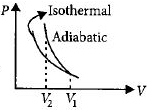
A gas is compressed isothermally to half its initial volume. The same gas is compressed separately through an adiabatic process until its volume is again reduced to half. Then
- ✓
Compressing the gas through adiabatic process will require more work to be done.
- B
Compressing the gas isothermally or adiabatically will require the same amount of work.
- C
Which of the case (whether compression through isothermal or through adiabatic process) requires more work will depend upon the atomicity of the gas.
- D
Compressing the gas isothermally will require more work to be done.
AnswerCorrect option: A. Compressing the gas through adiabatic process will require more work to be done.
a
${V_1} = V,{V_2} = V/2$
$On\,P - V\,diagram,$
$Area\,under\,adiabatic\,curve>Area\,under\,isothermal\,curve,$
So compressing the gas through adiabatic process will require more work to be done.
View full question & answer→MCQ 181 Mark
A thermodynamic system goes from states $(i)\,\,{P_1}, V$ to $2{P_1}, V\, (ii)\, P, V$ to $P, 2V.$ Then work done in the two cases is
- A
- ✓
Zero, $P{V_1}$
- C
$P{V_1}$, Zero
- D
$P{V_1},\;{P_1}{V_1}$
AnswerCorrect option: B. Zero, $P{V_1}$
b
(b) $(i)$ Case $ \to $Volume = constant $ \Rightarrow \int_{}^{} {PdV} = 0$
$(ii)$ Case$ \to P =$ constant $ \Rightarrow \int_{\,{V_1}}^{\,2{V_1}} {PdV} = P\int_{\,{V_1}}^{\,2{V_1}} {dV = P{V_1}} $
View full question & answer→MCQ 191 Mark
A system is given $300$ calories of heat and it does $600$ joules of work. How much does the internal energy of the system change in this process ..... $J$. ($J = 4.18$ joules/cal)
- ✓
$654$
- B
$156.5$
- C
$-300$
- D
$-528.2$
Answera
(a) $J\Delta Q = \Delta U + \Delta W,\;\;\Delta U = J\Delta Q - \Delta W$
$\Delta U = 4.18 \times 300 - 600 = 654\;Joule$
View full question & answer→MCQ 201 Mark
If $R =$ universal gas constant, the amount of heat needed to raise the temperature of $2$ mole of an ideal monoatomic gas from $273K$ to $373K$ when no work is done ...... $R$
- A
$100 $
- B
$150 $
- ✓
$300 $
- D
$500 $
AnswerCorrect option: C. $300 $
c
(c) $\Delta Q = \Delta U + \Delta W$ $\Delta W = 0$==> $\Delta Q = \Delta U$$ = \frac{f}{2}\mu R\Delta T$
$ = \frac{3}{2} \times 2R(373 - 273)$ $= 300R.$
View full question & answer→MCQ 211 Mark
The specific heat of hydrogen gas at constant pressure is ${C_P} = 3.4 \times {10^3}cal/kg{\,^o}C$ and at constant volume is ${C_V} = 2.4 \times {10^3}cal/kg{\,^o}C.$If one kilogram hydrogen gas is heated from ${10^o}C$ to ${20^o}C$ at constant pressure, the external work done on the gas to maintain it at constant pressure is
- A
${10^5}\,cal$
- ✓
${10^4}\,cal$
- C
${10^3}\,cal$
- D
$5 \times {10^3}\,cal$
AnswerCorrect option: B. ${10^4}\,cal$
b
(b) From FLOT $\Delta Q = \Delta U + \Delta W$
Work done at constant pressure ${(\Delta W)_P} = {(\Delta Q)_P} - \Delta U$
${(\Delta Q)_P} - {(\Delta Q)_V}$(As we know ${(\Delta Q)_V} = \Delta U$)
Also ${(\Delta Q)_P} = m{c_P}\Delta T$ and ${(\Delta Q)_V} = m{c_V}\Delta T$
==> ${(\Delta W)_P} = m({c_P} - {c_V})\Delta T$
==> ${(\Delta W)_P} = 1 \times (3.4 \times {10^3} - 2.4 \times {10^3}) \times 10 = {10^4}cal$
View full question & answer→MCQ 221 Mark
One mole of an ideal monoatomic gas is heated at a constant pressure of one atmosphere from ${0^o}C$ to ${100^o}C$. Then the change in the internal energy is
AnswerCorrect option: C. $12.48 \times {10^2}$joules
c
(c) Change in internal energy is always equal to the heat supplied at constant volume.
i.e. $\Delta U = {(\Delta Q)_V} = \mu {C_V}\Delta T.$
For monoatomic gas ${C_V} = \frac{3}{2}R$
==> $\Delta U = \mu \,\left( {\frac{3}{2}R} \right)\Delta T = 1 \times \frac{3}{2} \times 8.31 \times (100 - 0)$
$ = 12.48 \times {10^2}J$
View full question & answer→MCQ 231 Mark
When heat energy of $1500\; Joules$, is supplied to a gas at constant pressure $2.1 \times {10^5}\;N/{m^2}$, there was an increase in its volume equal to $2.5 \times {10^{ - 3}}\;{m^3}$. The increase in internal energy of the gas in Joules is ...... $J$
- A
$450$
- B
$525$
- ✓
$975$
- D
$2025$
Answerc
(c) According to FLOT
$\Delta Q = \Delta U + P(\Delta V)$==> $\Delta U = \Delta Q - P(\Delta V)$
$ = 1500 - (2.1 \times {10^5})(2.5 \times {10^{ - 3}})$$=975 \,Joule$
View full question & answer→MCQ 241 Mark
In a thermodynamics process, pressure of a fixed mass of a gas is changed in such a manner that the gas releases $20 J$ of heat and $8J$ of work is done on the gas. If the initial internal energy of the gas was $30J.$ The final internal energy will be ...... $J$
Answera
(a)Given $\Delta Q = - 20J,$ $\Delta W = - 8J$and ${U_1} = 30J$
$\Delta Q = \Delta U + \Delta W$==> $\Delta U = (\Delta Q - \Delta W)$
==> $({U_f} - {U_i})$= $({U_f} - 30) = - 20 - ( - 8)$ ==>${U_f} = 18J$
View full question & answer→MCQ 251 Mark
A perfect gas goes from state $A$ to another state $B$ by absorbing $8 \times {10^5}J$ of heat and doing $6.5 \times {10^5}J$ of external work. It is now transferred between the same two states in another process in which it absorbs ${10^5}J$ of heat. Then in the second process
- ✓
Work done on the gas is $0.5 \times {10^5}J$
- B
Work done by gas is $0.5 \times {10^5}J$
- C
Work done on gas is ${10^5}J$
- D
Work done by gas is ${10^5}J$
AnswerCorrect option: A. Work done on the gas is $0.5 \times {10^5}J$
a
(a) In first process using $\Delta Q = \Delta U + \Delta W$
==> $8 \times {10^5} = \Delta U + 6.5 \times {10^5}$==> $\Delta U = 1.5 \times 10J$
Since final and initial states are same in both process
So $\Delta U$ will be same in both process
For second process using $\Delta Q = \Delta U + \Delta W$
==> ${10^5} = 1.5 \times {10^5} + \Delta W$==>$\Delta W = - 0.5 \times {10^5}J$
View full question & answer→MCQ 261 Mark
The first law of thermodynamics can be written as $ \Delta U = \Delta Q + \Delta W$ for an ideal gas. Which of the following statements is correct?
- A
$\Delta U$ is always zero when no heat enters or leaves the gas
- B
$\Delta W$ is the work done by the gas in this written law.
- ✓
$\Delta U$ is zero when heat is supplied and the temperature stays constant
- D
$\Delta Q = -\Delta W$ when the temperature increases very slowly.
AnswerCorrect option: C. $\Delta U$ is zero when heat is supplied and the temperature stays constant
c
When no heat enters or leaves, $\Delta Q =0$
Therefore, $\Delta U = W$
Hence, it is an incorrect option.
Option:$B$
It is given $\Delta U = Q + W$, So, workisdoneonthegas.
Hence, it is also an incorrect option.
Option:$C$
$\Delta U = nC _v \Delta T$
Since Temperature is constant,
$\Delta U =0$
View full question & answer→MCQ 271 Mark
One mole of a perfect gas in a cylinder fitted with a piston has a pressure $P,$ volume $V$ and temperature $T.$ If the temperature is increased by $1 \,K$ keeping pressure constant, the increase in volume is
- A
$\frac{{2V}}{{273}}$
- B
$\frac{V}{{91}}$
- ✓
$\frac{V}{{273}}$
- D
$V$
AnswerCorrect option: C. $\frac{V}{{273}}$
c
(c) For isobaric process $\frac{{{V_2}}}{{{V_1}}} = \frac{{{T_2}}}{{{T_1}}} \Rightarrow {V_2} = V \times \frac{{274}}{{273}}$
Increase $ = \frac{{274\;V}}{{273}} - V = \frac{V}{{273}}$
View full question & answer→MCQ 281 Mark
Unit mass of a liquid with volume ${V_1}$ is completely changed into a gas of volume ${V_2}$ at a constant external pressure $P$ and temperature $T.$ If the latent heat of evaporation for the given mass is $L,$ then the increase in the internal energy of the system is
- A
- B
$P({V_2} - {V_1})$
- ✓
$L - P({V_2} - {V_1})$
- D
$L$
AnswerCorrect option: C. $L - P({V_2} - {V_1})$
c
(c) $\Delta Q = \Delta V + P\Delta V$$\Rightarrow mL = \Delta U + P(V_2 -V_1)$
$\Rightarrow$ $\Delta U = L -P (V_2 -V_1)\; ( m = 1)$
View full question & answer→MCQ 291 Mark
Two kg of water is converted into steam by boiling at atmospheric pressure. The volume changes from $2 \times {10^{ - 3}}\,{m^3}$ to $3.34{m^3}.$ The work done by the system is about ....... $kJ$
- A
$-340$
- B
$-170$
- C
$170$
- ✓
$340$
Answerd
(d) $W = P\Delta V = 1.01 \times {10^5}(3.34 - 2 \times {10^{ - 3}})$
$ = 337 \times {10^3}J \approx 340\;KJ$
View full question & answer→MCQ 301 Mark
A mono atomic gas is supplied the heat $Q$ very slowly keeping the pressure constant. The work done by the gas will be
- A
$\frac{2}{3}Q$
- B
$\frac{3}{5}Q$
- ✓
$\frac{2}{5}Q$
- D
$\frac{1}{5}Q$
AnswerCorrect option: C. $\frac{2}{5}Q$
c
(c) $\Delta Q = \Delta U + \Delta W$==> $\Delta W = {(\Delta Q)_P} - \Delta U$$ = {(\Delta Q)_P}\left[ {1 - \frac{{{{(\Delta Q)}_V}}}{{{{(\Delta Q)}_P}}}} \right]$
$ = {(\Delta Q)_P}\left[ {1 - \frac{{{C_V}}}{{{C_P}}}} \right] = Q = \left[ {1 - \frac{3}{5}} \right] = \frac{2}{5}Q$
${(\Delta Q)_P} = Q$and $\gamma = \frac{5}{3}$ for monatomic gas
View full question & answer→MCQ 311 Mark
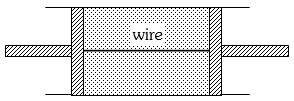
A cylindrical tube of uniform cross-sectional area $A$ is fitted with two air tight frictionless pistons. The pistons are connected to each other by a metallic wire. Initially the pressure of the gas is $P_0$ and temperature is $T_0$, atmospheric pressure is also $P_0$. Now the temperature of the gas is increased to $2T_0$, the tension in the wire will be
- A
$2{P_0}A$
- ✓
${P_0}A$
- C
$\frac{{{P_0}A}}{2}$
- D
$4{P_0}A$
AnswerCorrect option: B. ${P_0}A$
b
(b)Volume of the gas is constant $V = $ constant
$P \propto T$
i.e., pressure will be doubled if temperature is doubled
$P = 2{P_0}$
Now let F be the tension in the wire. Then equilibrium of any one piston gives
$F = (P - {P_0})A = (2{P_0} - {P_0})A = {P_0}A$

View full question & answer→MCQ 321 Mark
When an ideal gas $(\gamma = 5/3$) is heated under constant pressure, then what percentage of given heat energy will be utilised in doing external work
Answera
(a)$\Delta Q = \Delta U + \Delta W \Rightarrow \frac{{\Delta W}}{{\Delta Q}} = 1 - \frac{{\Delta U}}{{\Delta Q}} = 1 - \frac{{n{C_V}dT}}{{n{C_P}dT}}$
$ \Rightarrow \frac{{\Delta W}}{{\Delta Q}} = 1 - \frac{{{C_V}}}{{{C_P}}} = 1 - \frac{3}{5} = \frac{2}{5} = 0.4$
View full question & answer→MCQ 331 Mark
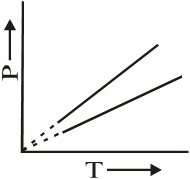
A perfect gas of a given mass is heated first in a small vessel and then in a large vessel, such that their volumes remain unchanged. The $P-T$ curves are
- A
parabolic with same curvature
- B
parabolic with different curvature
- C
- ✓
linear with different slopes
AnswerCorrect option: D. linear with different slopes
d
According to ideal gas equation,
$P V=n R T$
$P \propto n T(\text { at constant } V)$
thus, $P-T$ curves are linear but with different slopes depending on $n .$
View full question & answer→MCQ 341 Mark
A monoatomic idea gas expands at constant pressure, with heat $Q$ supplied. The fraction of $Q$ which goes as work done by the gas is
Answerd
As we use
$\Delta Q=n C_{p} \Delta T$
$\Delta \mathrm{U}=\mathrm{nC}_{\mathrm{v}} \Delta \mathrm{T}$
From first law of thermodynamics
$\Delta Q=\Delta U+\Delta W$
$\Delta \mathrm{W}=\Delta Q+\Delta \mathrm{U}$
$\Delta \mathrm{W}=\mathrm{nR} \Delta \mathrm{T}$
As $\mathrm{C}_{\mathrm{P}}-\mathrm{C}_{\mathrm{V}}=\mathrm{R}$
$\frac{\Delta W}{\Delta Q}=\frac{n R \Delta T}{n C_{P} \Delta T}=\frac{R}{C_{P}}=\frac{R}{\frac{5}{2} R}=\frac{2}{5}$
View full question & answer→MCQ 351 Mark
$V\, = \,K\,{\left( {\frac{P}{T}} \right)^{0.33}}$ where $k$ is constant. It is an,
Answerc
$V\, = \,K\,{\left( {\frac{{nRT}}{{VT}}} \right)^{0.33}}$
$V^{1.33} =$ constan
$V =$ constant
View full question & answer→MCQ 361 Mark
At constant pressure how much fraction of heat supplied to gas is converted into mechanical work?
- ✓
$\frac{{\gamma - 1}}{\gamma }$
- B
$\frac{\gamma }{{\gamma - 1}}$
- C
$\gamma -1$
- D
$\frac{\gamma }{{\gamma + 1}}$
AnswerCorrect option: A. $\frac{{\gamma - 1}}{\gamma }$
a
By $FLOT$ $W=Q-\Delta V$
at constant pressure $Q=n C_{p} \Delta T$
$\Delta \mathrm{U}=\mathrm{nC}_{\mathrm{v}} \Delta \mathrm{T}$
$\Rightarrow \frac{W}{Q}=\frac{n \Delta T\left(C_{p}-C_{V}\right)}{n C_{p} \Delta T}=\frac{C_{p}-C_{V}}{C_{p}}=\frac{\gamma}{\gamma-1}$
View full question & answer→MCQ 371 Mark
Which of the following process will give maximum amount of heat to surrounding when volume becomes half of initial
Answera
Here isochoric process is not possible and for
adiabatic process, $\mathrm{Q}=0$ For isothermal process
${Q_{rejected}}\, = - W = nR{T_0}\ell n\left( {{V_0}/\frac{{{V_0}}}{2}} \right) = nR{T_0}\ell n\,2$
$=0.693 \mathrm{nRT}_{0}$
For isobaric process
$Q_{\text {rejected }}=-n C_{p} \Delta T=-n\left(\frac{f}{2}+1\right) n R\left(-\frac{T_{0}}{2}\right)$
$=\left(0.5+\frac{f}{4}\right) n R T_{0}>0.693 n R T_{0}$
It is clear that more heat is rejected in isobaric process.
View full question & answer→MCQ 381 Mark
$540$ calories of heat converts $1$ cubic centimeter of water at $100\,^oC$ into $1671$ cubic centimeter of steam at $100\,^oC$ at a pressure of one atmosphere. Then the work done against the atmospheric pressure is nearly .......... $cal$
Answerb
$W=P\left(V_{2}-V_{1}\right)$
$=10^{5}(1671-1) \times 10^{-6} \mathrm{J}$
$=\frac{10^{5} \times 1670 \times 10^{-6}}{4.2} \mathrm{cal}$
$W=\frac{1670 \times 10^{-1}}{4 \cdot 2}$
$=40 \mathrm{cal}$
View full question & answer→MCQ 391 Mark
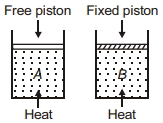
Two cylinders contain same amount of ideal monatomic gas. Same amount of heat is given to two cylinders. If temperature rise in cylinder $A$ is $T_0$ then temperature rise in cylinder $B$ will be .........
- A
$\frac{4}{3} T_0$
- B
$2 T_0$
- C
$\frac{T_0}{2}$
- ✓
$\frac{5}{3} T_0$
AnswerCorrect option: D. $\frac{5}{3} T_0$
d
(d)
Cylinder $A$
Free piston i.e., at constant pressure
Cylinder $B$
Fixed piston i.e., at constant volume
$\Delta Q=\Delta U$
$n C_P \Delta T=n C_V \Delta T$
$C_P T_0=C_V(\Delta T)^{\prime}$
$\Delta T^{\prime}=\frac{C_P}{C_V} T_0=\gamma T_0=\frac{5}{3} T_0$
View full question & answer→MCQ 401 Mark
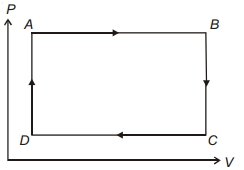
The pressure and volume of a gas are changed as shown in the $P-V$ diagram in this figure. The temperature of the gas will ........
- ✓
Increase as it goes from $A$ to $B$
- B
Increase as it goes from $B$ to $C$
- C
Remain constant during these changes
- D
Decrease as it goes from $D$ to $A$
AnswerCorrect option: A. Increase as it goes from $A$ to $B$
a
(a)
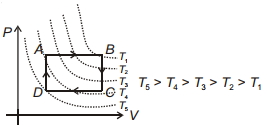
In the process $A \rightarrow B$
Pressure is constant.
$P V=n R T$
So $V \propto T$
and volume is increasing so temperature also increases.
View full question & answer→MCQ 411 Mark
In an isothermal reversible expansion, if the volume of $96\, gm$ of oxygen at $27°C$ is increased from $70$ litres to $140$ litres, then the work done by the gas will be
- A
$300\,R\,{\log _{10}}\,2$
- B
$81\,R\,{\log _e}\,2$
- C
$900\,R\,{\log _{10}}\,2$
- ✓
$2.3 \times 900\,R\,{\log _{10}}\,2$
AnswerCorrect option: D. $2.3 \times 900\,R\,{\log _{10}}\,2$
d
(d) $W = \mu RT{\log _e}\frac{{{V_2}}}{{{V_1}}}$
$ = \left( {\frac{m}{M}} \right)RT{\log _e}\frac{{{V_2}}}{{{V_1}}} = 2.3 \times \frac{m}{M}RT{\log _{10}}\frac{{{V_2}}}{{{V_1}}}$
$ = 2.3 \times \frac{{96}}{{32}}R\,\,(273 + 27)\,{\log _{10}}\frac{{140}}{{70}} = \,2.3 \times 900R{\log _{10}}2$
View full question & answer→MCQ 421 Mark
A vessel containing $5\, litres$ of a gas at $0.8 \,pa$ pressure is connected to an evacuated vessel of volume $3$ litres. The resultant pressure inside will be ...... $pa$ (assuming whole system to be isolated)
- A
$4/3 $
- ✓
$0.5 $
- C
$2.0 $
- D
$3/4 $
AnswerCorrect option: B. $0.5 $
b
(b) $0.8 \times 5 = P \times (3 + 5) \Rightarrow P = 0.5\;pa$
View full question & answer→MCQ 431 Mark
One mole of ${O_2}$ gas having a volume equal to $22.4$ litres at ${0^o}C$ and $1$ atmospheric pressure in compressed isothermally so that its volume reduces to $11.2$ litres. The work done in this process is ...... $J$
- A
$1672.5$
- B
$1728$
- C
$ - 1728$
- ✓
$ - 1572.5$
AnswerCorrect option: D. $ - 1572.5$
d
(d)$W = - \mu RT{\log _e}\frac{{{V_2}}}{{{V_1}}} = - 1 \times 8.31 \times (273 + 0){\log _e}\left( {\frac{{22.4}}{{11.2}}} \right)$
$ = - \,8.31 \times 273 \times {\log _e}2$$ = - 1572.5J$ [${\log _e}2 = 0.693$]
View full question & answer→MCQ 441 Mark
In an isothermal process the volume of an ideal gas is halved. One can say that
- A
Internal energy of the system decreases
- B
Work done by the gas is positive
- ✓
Work done by the gas is negative
- D
Internal energy of the system increases
AnswerCorrect option: C. Work done by the gas is negative
c
(c) For isothermal process
$dU = 0$ and work done $ = dW = P({V_2} - {V_1})$
$\;{V_2} = \frac{{{V_1}}}{2} = \frac{V}{2}$
$dW = - \frac{{PV}}{2}$
View full question & answer→MCQ 451 Mark
When an ideal gas in a cylinder was compressed isothermally by a piston, the work done on the gas was found to be $1.5 \times {10^4}\;joules$. During this process about
- ✓
$3.6 \times {10^3}$ cal of heat flowed out from the gas
- B
$3.6 \times {10^3}$ cal of heat flowed into the gas
- C
$1.5 \times {10^4}$ cal of heat flowed into the gas
- D
$1.5 \times {10^4}$ cal of heat flowed out from the gas
AnswerCorrect option: A. $3.6 \times {10^3}$ cal of heat flowed out from the gas
a
(a)In isothermal compression, there is always an increase of heat. which must flow out the gas.
$\Delta Q = \Delta U + \Delta W \Rightarrow \Delta Q = \Delta W\;\;(\because \;\Delta U = 0)$
==> $\Delta Q = - 1.5 \times {10^4}J = \frac{{1.5 \times {{10}^4}}}{{4.18}}cal = - 3.6 \times {10^3}cal$
View full question & answer→MCQ 461 Mark
$540$ calories of heat convert $1 $ cubic centimeter of water at ${100^o}C$ into $1671 $ cubic centimeter of steam at ${100^o}C$ at a pressure of one atmosphere. Then the work done against the atmospheric pressure is nearly ...... $cal$
Answerb
(b) Amount of heat given $ = 540\;calories$
Change in volume $\Delta V = 1670\;c.c$
Atmospheric pressure $P = 1.01 \times {10^6}\;dyne/c{m^2}$
Work done against atmospheric pressure
$W = P\Delta V$$ = \frac{{1.01 \times {{10}^6} \times 1670}}{{4.2 \times {{10}^7}}} \approx 40\;cal$
View full question & answer→MCQ 471 Mark
One mole of an ideal gas expands at a constant temperature of $300 \,K$ from an initial volume of $10\, litres$ to a final volume of $20\, litres$. The work done in expanding the gas is ...... $J.$ $(R = 8.31 J/mole-K)$
- A
$750$
- ✓
$1728$
- C
$1500$
- D
$3456$
AnswerCorrect option: B. $1728$
b
(b) ${W_{iso}} = \mu RT{\log _e}\frac{{{V_2}}}{{{V_1}}} = 1 \times 8.31 \times 300{\log _e}\frac{{20}}{{10}} = 1728J$
View full question & answer→MCQ 481 Mark
A cylinder fitted with a piston contains $0.2 \,moles$ of air at temperature $27°C.$ The piston is pushed so slowly that the air within the cylinder remains in thermal equilibrium with the surroundings. Find the approximate work done by the system if the final volume is twice the initial volume ...... $J$
- A
$543 $
- ✓
$345 $
- C
$453 $
- D
$600 $
AnswerCorrect option: B. $345 $
b
(b) $W = \mu RT{\log _e}\left( {\frac{{{V_2}}}{{{V_1}}}} \right)$$ = 0.2 \times 8.3 \times {\log _e}2\, \times (27 + 273)$
$ = 0.2 \times 8.3 \times 300 \times 0.693 = 345J$
View full question & answer→MCQ 491 Mark
The volume of an ideal gas is $1$ litre and its pressure is equal to $72cm$ of mercury column. The volume of gas is made $900\, cm^3$ by compressing it isothermally. The stress of the gas will be ...... $cm$ (mercury)
Answera
(a)For isothermal process ${P_1}{V_1} = {P_2}{V_2}$
==> ${P_2} = \frac{{{P_1}{V_1}}}{{{V_2}}} = \frac{{72 \times 1000}}{{900}}=80 \,cm$
Stress $\Delta P = {P_2} - {P_1} = 80 - 72 = 8cm$
View full question & answer→MCQ 501 Mark
An insulator container contains $4\, moles$ of an ideal diatomic gas at temperature $T.$ Heat $Q$ is supplied to this gas, due to which $2 \,moles$ of the gas are dissociated into atoms but temperature of the gas remains constant. Then
- A
$Q = 2RT$
- ✓
$Q = RT$
- C
$Q = 3RT$
- D
$Q = 4RT$
AnswerCorrect option: B. $Q = RT$
b
(b) $Q = \Delta U$$ = {U_f} - {U_i}$ = [internal energy of $4$ moles of a monoatomic gas $+$ internal energy of $2$ moles of a diatomic gas] $-$ [internal energy of $4$ moles of a diatomic gas]
$ = \left( {4 \times \frac{3}{2}RT + 2 \times \frac{5}{2}RT} \right) - \left( {4 \times \frac{5}{2}RT} \right) = RT$
$Note : \,(a)\, 2$ moles of diatomic gas becomes $4$ moles of a monoatomic gas when gas dissociated into atoms.
$(b)$ Internal energy of $\mu $ moles of an ideal gas of degrees of freedom $F$ is given by $U = \frac{f}{2}\mu RT$
$F = 3$ for a monoatomic gas and $5$ for diatomic gas.
View full question & answer→MCQ 511 Mark
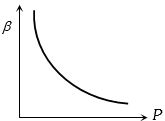
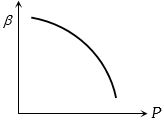
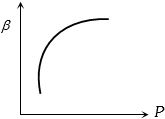
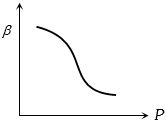
Which of the following graphs correctly represents the variation of $\beta = - (dV/dP)/V$ with $P$ for an ideal gas at constant temperature
Answera
(a) For an isothermal process $PV =$ constant
==> $PdV + VdP = 0$ ==> $ - \frac{1}{V}\left( {\frac{{dV}}{{dP}}} \right) = \frac{1}{P}$
So, $\beta = \frac{1}{P}$ graph will be rectangular hyperbola.
View full question & answer→MCQ 521 Mark
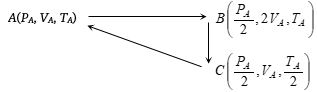
Three moles of an ideal gas $\left( {{C_P} = \frac{7}{2}R} \right)$ at pressure ${P_A}$ and temperature ${T_A}0$ is isothermally expanded to twice its initial volume. It is then compressed at constant pressure to its original volume. Finally the gas is compressed at constant volume to its original pressure ${P_A}.$ The correct $P-V$ and $P-T$ diagrams indicating the process are
Answera
(a) Let the process start from initial pressure ${P_A},$ volume ${V_A}$ and temperature ${T_A}$.
(i) Isothermal expansion $(PV = {\rm{constant)}}$ at temperature ${T_A}$ to twice the initial volume ${V_A}$
Compression at constant pressure $\frac{{{P_A}}}{2}$ to original volume ${V_A}\,(i.e.\,V \propto T)$
(iii)Isochoric process (at volume ${V_A}$) to initial condition $(i.e.\,P \propto T)$
View full question & answer→MCQ 531 Mark
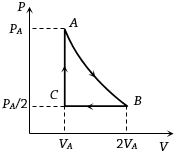
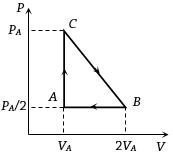
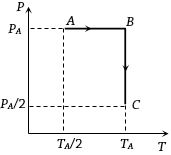
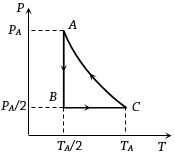
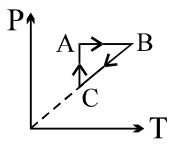
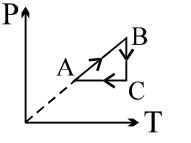
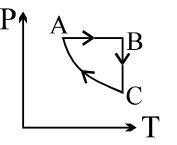
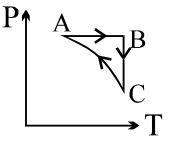
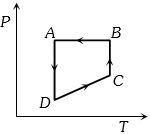
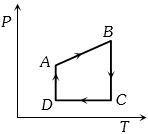
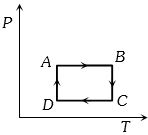
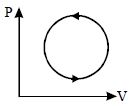
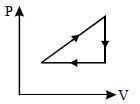
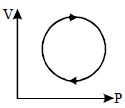
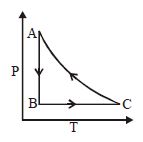
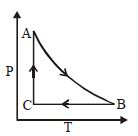
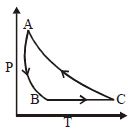
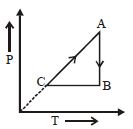
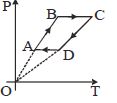
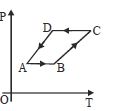
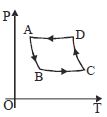
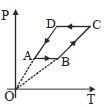
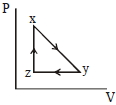
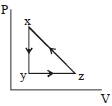
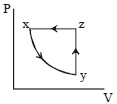
An ideal gas undergoes a thermodynamics cycle as shown in figure. Which of the following graphs represents the same cycle?
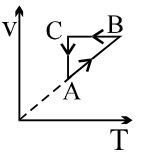
Answera
$\mathrm{AB}-$ isobaric process
$\mathrm{BC}$ - isochoric process
$\mathrm{CA}-$ isothermal process
View full question & answer→MCQ 541 Mark
A bubble from bottom of lake rises to its surface. Its volume doubles in the process. Assuming isothermal conditions, atmospheric pressure $= 75\, cm$ of $Hg$ and ratio of densities of mercury and water $40/3$. The depth of lake will be ..... $m$
Answerb
Isothermal condition $\mathrm{P}_{1} \mathrm{V}_{1}=\mathrm{P}_{2} \mathrm{V}_{2}$
$\left(\rho_{1} {g} 5\right)(2 \mathrm{V})=\left[\left(\rho_{1} g 75\right)+\rho_{2}{g} h\right] V$
$\Rightarrow \rho_{1} \mathrm{g} 75=\rho_{2} {g} \mathrm{h}$
$\Rightarrow \mathrm{h}=75 \times \frac{\rho_{1}}{\rho_{2}}=\frac{75 \times 40}{3}=1000 \mathrm{cm}=10 \mathrm{m}$
View full question & answer→MCQ 551 Mark
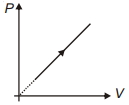
During the thermodynamic process shown in figure for an ideal gas
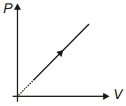
- A
$\Delta T=0$
- B
$\Delta Q=0$
- C
$W < 0$
- ✓
$\Delta U > 0$
AnswerCorrect option: D. $\Delta U > 0$
d
(d)
For a straight $P-V$ graph line $P \propto V$
If pressure increases, volume increases then $T$ also increases $[P V \propto T]$
So $\Delta T \neq 0$
Volume increasing so work is positive, $W > 0$
and temperature also increasing so $\Delta Q > 0$
$\because \Delta Q=\Delta U+\Delta W$
So $\Delta U > 0$
View full question & answer→MCQ 561 Mark
For $P-V$ diagram of a thermodynamic cycle as shown in figure, process $B C$ and $D A$ are isothermal. Which of the corresponding graphs is correct?
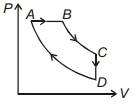
Answerb
(b)
From $A \longrightarrow B$, volume increasing, pressure constant
$B \longrightarrow C$, Pressure $\propto \frac{1}{\text { Volume }} \Rightarrow$ Temperature constant
Same for $D \longrightarrow A$
$C \longrightarrow D$ pressure decreasing, volume constant
So $P \propto T$
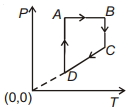
View full question & answer→MCQ 571 Mark
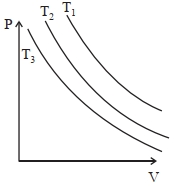
The process $C D$ is shown in the diagram. As system is taken from $C$ to $D$, what happens to the temperature of the system?
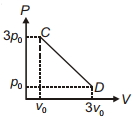
- A
Temperature first decreases and then increases
- ✓
Temperature first increases and then decreases
- C
Temperature decreases continuously
- D
Temperature increases continuously
AnswerCorrect option: B. Temperature first increases and then decreases
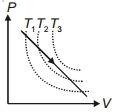
b
(b)
$T_3 > T_2 > T_1$
So from $C \rightarrow D$
Temperature first increases then decreases.
View full question & answer→MCQ 581 Mark
An air bubble of volume $v _0$ is released by a fish at a depth $h$ in a lake. The bubble rises to the surface. Assume constant temperature and standard atmospheric pressure above the lake. The volume of the bubble just before touching the surface will be (density) of water is $\rho$
AnswerCorrect option: D. $v _0\left(1+\frac{\rho g h}{ p }\right)$
d
(d)
As the bubble rises the pressure gets reduced for constant temperature, if $P$ is the standard atmospheric pressure, then $(P+\rho g h) V_0=P V$ or $V = V _0\left(1+\frac{\rho gh }{ P }\right)$
View full question & answer→MCQ 591 Mark
The pressure in the tyre of a car is four times the atmospheric pressure at $300 K$. If this tyre suddenly bursts, its new temperature will be $(\gamma = 1.4)$
- A
$300\,{(4)^{1.4/0.4}}$
- B
$300\,{\left( {\frac{1}{4}} \right)^{ - 0.4/1.4}}$
- C
$300\,{(2)^{ - 0.4/1.4}}$
- ✓
$300\,{(4)^{ - 0.4/1.4}}$
AnswerCorrect option: D. $300\,{(4)^{ - 0.4/1.4}}$
d
(d) For adiabatic process $\frac{{{T^\gamma }}}{{{P^{\gamma - 1}}}} = $ constant
==>$\frac{{{T_2}}}{{{T_1}}} = {\left( {\frac{{{P_1}}}{{{P_2}}}} \right)^{\frac{{1 - \gamma }}{\gamma }}}$
==>$\frac{{{T_2}}}{{300}} = {\left( {\frac{4}{1}} \right)^{\frac{{(1 - 1.4)}}{{1.4}}}}$
==>${T_2} = 300{(4)^{ - \frac{{0.4}}{{1.4}}}}$
View full question & answer→MCQ 601 Mark
A gas at $NTP$ is suddenly compressed to one-fourth of its original volume. If $\gamma $ is supposed to be $\frac{3}{2}$, then the final pressure is........ atmosphere
Answerc
(c) $P{V^\gamma } = {\rm{constant}} \Rightarrow \frac{{{P_2}}}{{{P_1}}} = {\left( {\frac{{{V_1}}}{{{V_2}}}} \right)^\gamma }$$ \Rightarrow \frac{{{P_2}}}{1} = {\left( {\frac{{{V_1}}}{{{V_1}/4}}} \right)^{3/2}} = 8$
==> ${P_2} = 8\;atm$.
View full question & answer→MCQ 611 Mark
The pressure and density of a diatomic gas $(\gamma = 7/5)$ change adiabatically from $(P, d)$ to $(P', d')$. If $\frac{{d'}}{d} = 32$, then $\frac{{P'}}{P}$ should be
Answerc
(c) Volume of the gas $V = \frac{m}{d}$and using $P{V^\gamma }$= constant
We get $\frac{{P'}}{P} = {\left( {\frac{V}{{V'}}} \right)^\gamma } = \,{\left( {\frac{{d'}}{d}} \right)^\gamma } = {(32)^{7/5}} = 128$
View full question & answer→MCQ 621 Mark
The slopes of isothermal and adiabatic curves are related as
- A
Isothermal curve slope = adiabatic curve slope
- B
Isothermal curve slope = $\gamma \times $ adiabatic curve slope
- ✓
Adiabatic curve slope = $\gamma \times $ isothermal curve slope
- D
Adiabatic curve slope = $\frac{1}{2} \times $isothermal curve slope
AnswerCorrect option: C. Adiabatic curve slope = $\gamma \times $ isothermal curve slope
c
(c) For Isothermal process $PV = $constant
$ \Rightarrow \left( {\frac{{dP}}{{dV}}} \right) = \frac{{ - P}}{V} = $ Slope of Isothermal curve
For adiabatic$P{V^\gamma } = $constant
$ \Rightarrow \frac{{dP}}{{dV}} = \frac{{ - \gamma P}}{V} = $ Slop of adiabatic curve slope
Clearly, ${\left( {\frac{{dP}}{{dV}}} \right)_{{\rm{adiabatic}}}} = \gamma {\left( {\frac{{dP}}{{dV}}} \right)_{{\rm{Isothermal }}}}$
View full question & answer→MCQ 631 Mark
The adiabatic elasticity of hydrogen gas $(\gamma = 1.4)$ at $NTP$ is
- A
$1 \times {10^5}\;N/{m^2}$
- B
$1 \times {10^{ - 8}}\;N/m^2$
- C
$1.4\;N/{m^2}$
- ✓
$1.4 \times {10^5}N/{m^2}$
AnswerCorrect option: D. $1.4 \times {10^5}N/{m^2}$
d
(d) ${E_\varphi } = \gamma P = 1.4 \times (1 \times {10^5}) = 1.4 \times {10^5}N/{m^2}$
View full question & answer→MCQ 641 Mark
One gm mol of a diatomic gas $(\gamma = 1.4)$ is compressed adiabatically so that its temperature rises from ${27^o}C$ to ${127^o}C$. The work done will be
- ✓
$2077.5\, joules$
- B
$207.5\, joules$
- C
$207.5 \,ergs$
- D
AnswerCorrect option: A. $2077.5\, joules$
a
(a) $W = \frac{R}{{\gamma - 1}}({T_1} - {T_2})$
$ = \frac{{8.31 \times \{ (273 + 27) - (273 + 127)\} }}{{1.4 - 1}} = - 2077.5\;joules$
View full question & answer→MCQ 651 Mark
A polyatomic gas $\left( {\gamma = \frac{4}{3}} \right)$ is compressed to $\frac{1}{8}$ of its volume adiabatically. If its initial pressure is ${P_o}$, its new pressure will be
- A
$8{P_o}$
- ✓
$16{P_0}$
- C
$6{P_o}$
- D
$2{P_o}$
AnswerCorrect option: B. $16{P_0}$
b
(b)$\frac{{{P_2}}}{{{P_1}}} = {\left( {\frac{{{V_1}}}{{{V_2}}}} \right)^\gamma }$==> ${P_2} = {P_1}{\left( {\frac{{{V_1}}}{{{V_2}}}} \right)^\gamma } = {P_0}{(8)^{4/3}} = 16{P_0}.$
View full question & answer→MCQ 661 Mark
An ideal gas is expanded adiabatically at an initial temperature of $300 K$ so that its volume is doubled. The final temperature of the hydrogen gas is $(\gamma = 1.40)$
- ✓
$227.36 K$
- B
$500.30 K$
- C
$454.76 K$
- D
$ - {47^o}C$
AnswerCorrect option: A. $227.36 K$
a
(a) $T{V^{\gamma - 1}} = $constant
==> $\frac{{{T_2}}}{{{T_1}}} = {\left( {\frac{{{V_1}}}{{{V_2}}}} \right)^\gamma }$
==> ${T_2} = {T_1}{\left( {\frac{{{V_1}}}{{{V_2}}}} \right)^\gamma }$
$ \Rightarrow {T_2} = 300{\left( {\frac{1}{2}} \right)^{0.4}} = 227.36\;K$
View full question & answer→MCQ 671 Mark
Helium at ${27^o}C$ has a volume of $8$ litres. It is suddenly compressed to a volume of $1$ litre. The temperature of the gas will be ....... $^oC$ $[\gamma = 5/3]$
- A
${108}$
- B
${9327}$
- C
${1200}$
- ✓
${927}$
AnswerCorrect option: D. ${927}$
d
(d) $T{V^{\gamma - 1}} = $constant$ \Rightarrow {T_2} = {T_1}{\left( {\frac{{{V_1}}}{{{V_2}}}} \right)^{\gamma - 1}} = {927^o}C$
View full question & answer→MCQ 681 Mark
At $N.T.P.$ one mole of diatomic gas is compressed adiabatically to half of its volume $\gamma = 1.41$. The work done on gas will be ....... $J$
- A
$1280 $
- B
$1610 $
- ✓
$1815 $
- D
$2025 $
AnswerCorrect option: C. $1815 $
c
(c)${T_2} = {T_1}{\left( {\frac{{{V_1}}}{{{V_2}}}} \right)^{\gamma - 1}} = 273{(2)^{0.41}}$$ = 273 \times 1.328 = 363K$
$W = \frac{{R({T_1} - {T_2})}}{{\gamma - 1}} = \frac{{8.31(273 - 363)}}{{1.41 - 1}}$$ = - \,1824$
==> $|W| \approx 1815 J$
View full question & answer→MCQ 691 Mark
Two moles of an ideal monoatomic gas at ${27^o}C$ occupies a volume of $V.$ If the gas is expanded adiabatically to the volume $2V,$ then the work done by the gas will be ....... $J$ $[\gamma = 5/3,\,R = 8.31J/mol\,K]$
- A
$ - 2767.23$
- ✓
$2767.23$
- C
$2500$
- D
$ - 2500$
AnswerCorrect option: B. $2767.23$
b
(b) $W = \frac{{\mu R({T_1} - {T_2})}}{{(\gamma - 1)}} = \frac{{\mu R{T_1}}}{{(\gamma - 1)}}\left[ {1 - \frac{{{T_2}}}{{{T_1}}}} \right]$
$ = \frac{{\mu R{T_1}}}{{(\gamma - 1)}}\left[ {1 - {{\left( {\frac{{{V_1}}}{{{V_2}}}} \right)}^{\gamma - 1}}} \right]$
$ = \frac{{2 \times 8.31 \times 300}}{{\left( {\frac{5}{3} - 1} \right)}}\left[ {1 - {{\left( {\frac{1}{2}} \right)}^{\frac{5}{3} - 1}}} \right]$$ = + 2767.23\;J$
View full question & answer→MCQ 701 Mark
At ${27^o}C$ a gas is suddenly compressed such that its pressure becomes $\frac{1}{8}th$ of original pressure. Temperature of the gas will be $(\gamma = 5/3)$
- A
$420K$
- B
${327^o}C$
- C
$300K$
- ✓
$ - {142^o}C$
AnswerCorrect option: D. $ - {142^o}C$
d
(d) ${T^\gamma }{P^{1 - \gamma }} = $constant ==> $T \propto {P^{\frac{{\gamma - 1}}{\gamma }}}$
==> $\frac{{{T_2}}}{{{T_1}}} = {\left( {\frac{{{P_2}}}{{{P_1}}}} \right)^{\frac{{\gamma - 1}}{\gamma }}} = {\left( {\frac{1}{8}} \right)^{\frac{{5/3 - 1}}{{5/3}}}}$
${T_2} = 300 \times {\left( {\frac{1}{8}} \right)^{0.4}} = 131K = - 142^\circ C$
View full question & answer→MCQ 711 Mark
An ideal gas at a pressures of $1$ atmosphere and temperature of ${27^o}C$ is compressed adiabatically until its pressure becomes $8$ times the initial pressure, then the final temperature is ..... $^oC$ ($\gamma = 3/2$)
Answerd
(d)Using relation$\frac{{{T_2}}}{{{T_1}}} = {\left( {\frac{{{P_2}}}{{{P_1}}}} \right)^{\frac{{\gamma - 1}}{\gamma }}} = {(8)^{\frac{{3/2 - 1}}{{3/2}}}} = 2$.
==> ${T_2} = 2{T_1}$==> ${T_2} = 2\,(273 + 27) = 600K = 327^\circ C$
View full question & answer→MCQ 721 Mark
Air is filled in a motor tube at ${27^o}C$ and at a pressure of $8$ atmospheres. The tube suddenly bursts, then temperature of air is $[{\rm{Given}}\,\,\gamma \,{\rm{of}}\,{\rm{air}} = \,1.5]$
- A
${27.5^o}C$
- B
${75^o}K$
- ✓
$150\,K$
- D
${150^o}C$
AnswerCorrect option: C. $150\,K$
c
(c) $\frac{{{T_2}}}{{{T_1}}} = {\left( {\frac{{{P_2}}}{{{P_1}}}} \right)^{\frac{{\gamma - 1}}{\gamma }}}$
$ \Rightarrow \frac{{{T_2}}}{{{T_1}}} = {\left( {\frac{1}{8}} \right)^{\frac{{1.5 - 1}}{{1.5}}}} = {\left( {\frac{1}{8}} \right)^{\frac{1}{3}}} = \frac{1}{2}$
$ \Rightarrow {T_2} = \frac{{{T_1}}}{2} = \frac{{300}}{2} = 150K$.
View full question & answer→MCQ 731 Mark
If $\gamma = 2.5$ and volume is equal to $\frac{1}{8}$ times to the initial volume then pressure $P' $ is equal to (Initial pressure $= P$)
AnswerCorrect option: C. $P' = P \times {(2)^{15/2}}$
c
(c)$\frac{{{P_2}}}{{{P_1}}} = {\left( {\frac{{{V_1}}}{{{V_2}}}} \right)^\gamma } \Rightarrow \frac{{P'}}{P} = {(8)^{5/2}} \Rightarrow P' = P \times {(2)^{15/2}}$
View full question & answer→MCQ 741 Mark
A gas is suddenly compressed to $1/4$ th of its original volume at normal temperature. The increase in its temperature is ....... $K$ $(\gamma = 1.5)$
- ✓
$273 $
- B
$573 $
- C
$373 $
- D
$473 $
AnswerCorrect option: A. $273 $
a
(a) $\because \;T{V^{\gamma - 1}} = $constant $⇒$ ${T_1}V_1^{\gamma - 1} = {T_2}V_2^{\gamma - 1}$
$⇒$ ${T_2} = {T_1}{\left( {\frac{{{V_1}}}{{{V_2}}}} \right)^{\gamma - 1}} = {T_1}{(4)^{1.5 - 1}} = 2{T_1}$
change in temperature
$ = {T_2} - {T_1} = 2{T_1} - {T_1} = {T_1} = 273\,K$
View full question & answer→MCQ 751 Mark
A gas ($\gamma = 1.3)$ is enclosed in an insulated vessel fitted with insulating piston at a pressure of ${10^5}\,N/{m^2}$. On suddenly pressing the piston the volume is reduced to half the initial volume. The final pressure of the gas is
- A
${2^{0.7}} \times {10^5}$
- ✓
${2^{1.3}} \times {10^5}$
- C
${2^{1.4}} \times {10^5}$
- D
AnswerCorrect option: B. ${2^{1.3}} \times {10^5}$
b
(b)$\because \;P{V^\gamma } = k$(constant) ==> ${P_1}V_1^\gamma = {P_2}V_2^\gamma $
$⇒$ ${P_2} = {P_1}{\left( {\frac{{{V_1}}}{{{V_2}}}} \right)^\gamma } = {10^5} \times {(2)^{1.3}}$ $(\because \;{V_2} = \frac{{{V_1}}}{2})$
View full question & answer→MCQ 761 Mark
One mole of an ideal gas with $\gamma = 1.4$, is adiabatically compressed so that its temperature rises from $27°C$ to $35°C$. The change in the internal energy of the gas is ....... $J$ $(R = 8.3\,J/mol.K)$
- A
$-166$
- ✓
$166$
- C
$-168 $
- D
$168$
Answerb
(b) Change in internal energy of the gas
$\Delta U = - \,\Delta W\frac{R}{{\gamma - 1}}\left[ {{T_2} - {T_1}} \right]$$ = \frac{{8.3}}{{(1.4 - 1)}}[308 - 300] = 166J$
View full question & answer→MCQ 771 Mark
The volume of a gas is reduced adiabatically to $\frac{1}{4}$ of its volume at $27°C$, if the value of $\gamma = 1.4,$ then the new temperature will be
- A
$350 \times {4^{0.4}}K$
- ✓
$300 \times {4^{0.4}}K$
- C
$150 \times {4^{0.4}}K$
- D
AnswerCorrect option: B. $300 \times {4^{0.4}}K$
b
(b) For adiabatic change $T{V^{\gamma - 1}}$= constant
==> $\frac{{{T_2}}}{{{T_1}}} = {\left( {\frac{{{V_1}}}{{{V_2}}}} \right)^{\gamma - 1}}$
==> ${T_2} = {\left( {\frac{{{V_1}}}{{{V_2}}}} \right)^{\gamma - 1}} \times {T_1}$
==> ${T_2} = {\left( {\frac{V}{{V/4}}} \right)^{1.4 - 1}} \times 300$ $ = 300 \times {(4)^{0.4}}K$
View full question & answer→MCQ 781 Mark
Adiabatic modulus of elasticity of a gas is $2.1 \times {10^5}N/{m^2}.$ What will be its isothermal modulus of elasticity $\left( {\frac{{{C_p}}}{{{C_v}}} = 1.4} \right)$
- A
$1.8 \times {10^5}N/{m^2}$
- ✓
$1.5 \times {10^5}N/{m^2}$
- C
$1.4 \times {10^5}N/{m^2}$
- D
$1.2 \times {10^5}N/{m^2}$
AnswerCorrect option: B. $1.5 \times {10^5}N/{m^2}$
b
(b)$\frac{{{\rm{Adiabatic elasticicity}}\;({E_\varphi })}}{{{\rm{Isothermal}}\;{\rm{elasticicity}}\;({E_\theta })}} = \gamma $
==>${E_\theta } = \frac{{{E_\varphi }}}{\gamma }$
==> ${E_\theta } = \frac{{2.1 \times {{10}^5}}}{{1.4}}$$ = 1.5 \times {10^5}N/{m^2}$
View full question & answer→MCQ 791 Mark
The volume of air increases by $5\%$ in its adiabatic expansion. The percentage decrease in its pressure will be ...... $\%$
Answerc
(c) $P{V^\gamma } = K$or $P\gamma \,{V^{\gamma - 1}}dV + dP.\;{V^\gamma } = 0$
or $\frac{{dP}}{P} = - \gamma \frac{{dV}}{V}$ or $\frac{{dP}}{P} \times 100 = - \gamma \,\left( {\frac{{dV}}{V} \times 100} \right)$
$ = - 1.4 \times 5 = 7\% $
View full question & answer→MCQ 801 Mark
The temperature of a hypothetical gas increases to $\sqrt 2 $ times when compressed adiabatically to half the volume. Its equation can be written as
- ✓
$P{V^{3/2}}$= constant
- B
$P{V^{5/2}}$= constant
- C
$P{V^{7/3}}$= constant
- D
$P{V^{4/3}}$= constant
AnswerCorrect option: A. $P{V^{3/2}}$= constant
a
(a) $T{V^{\gamma - 1}}$= constant
$\therefore \frac{{{T_1}}}{{{T_2}}} = {\left( {\frac{{{V_2}}}{{{V_1}}}} \right)^{\gamma - 1}}$or ${\left( {\frac{1}{2}} \right)^{\gamma - 1}} = \sqrt {\frac{1}{2}} $
$\therefore \gamma - 1 = \frac{1}{2}$or $\gamma = \frac{3}{2}$
$P{V^{3/2}}$= constant
View full question & answer→MCQ 811 Mark
Two samples $A$ and $B$ of a gas initially at the same pressure and temperature are compressed from volume $ V$ to $ V/2$ ($A$ isothermally and adiabatically). The final pressure of $ A$ is
- A
Greater than the final pressure of $ B$
- B
Equal to the final pressure of $ B$
- ✓
Less than the final pressure of $B$
- D
Twice the final pressure of $ B$
AnswerCorrect option: C. Less than the final pressure of $B$
c
(c)$A$ is compressed isothermally, hence
${P_1}V = {P_2}\frac{V}{2} \Rightarrow {P_2} = 2{P_1}$
and $B$ is compressed adiabatically, hence
${P_1}{V^\gamma } = {P_2}\,{\left( {\frac{V}{2}} \right)^\gamma } \Rightarrow {P_2} = {(2)^\gamma }{P_1}$
Since $\gamma > 1$, hence ${P_2}' > {P_2}$or ${P_2} < {P'_2}$
View full question & answer→MCQ 821 Mark
Initial pressure and volume of a gas are $ P$ and $V$ respectively. First it is expanded isothermally to volume $4V$ and then compressed adiabatically to volume $ V$. The final pressure of gas will be
Answerb
(b) In isothermal process ${P_1}{V_1} = {P_2}{V_2}$
or $PV = {P_2} \times 4V$
$\therefore {P_2} = \frac{P}{4}$
In adiabatic process
${P_2}{V_2}^\gamma = {P_3}{V_3}^\gamma $==> $\frac{P}{4} \times {(4V)^{1.5}} = {P_2}{V^{1.5}}$==> ${P_3} = 2P$
View full question & answer→MCQ 831 Mark
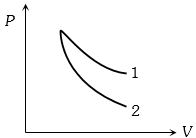
$P-V$ plots for two gases during adiabatic process are shown in the figure. Plots $1$ and $2$ should correspond respectively to
- A
$He$ and ${O_2}$
- ✓
${O_2}$ and $He$
- C
$He$ and $Ar$
- D
${O_2}$ and ${N_2}$
AnswerCorrect option: B. ${O_2}$ and $He$
b
(b) In adiabatic process, slope of $PV-$graph.
$\frac{{dP}}{{dV}} = - \gamma \frac{P}{V}$==> |Slope| $\propto \gamma$
From the given graph $(Slope)_2 > (Slope)_1$ ==> ${\gamma _2} > {\gamma _1}$
therefore $1$ should correspond to $O_2 (\gamma$ = 1.4) and $2$ should correspond to $He$ ($\gamma = 1.66$)
View full question & answer→MCQ 841 Mark
Four curves $A, B, C$ and $D$ are drawn in the adjoining figure for a given amount of gas. The curves which represent adiabatic and isothermal changes are
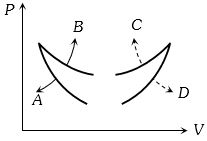
- A
$C$ and $D$ respectively
- B
$D$ and $C$ respectively
- ✓
$A$ and $B$ respectively
- D
$B$ and $A$ respectively
AnswerCorrect option: C. $A$ and $B$ respectively
c
(c)As we know that slope of isothermal and adiabatic curves are always negative and slope of adiabatic curve is always greater than that of isothermal curve
Hence in the given graph curve $A$ and $B$ represents adiabatic and isothermal changes respectively.
View full question & answer→MCQ 851 Mark
In the following $P-V$ diagram two adiabatics cut two isothermals at temperatures $T_1$ and $T_2$ (fig.). The value of $\frac{{{V_a}}}{{{V_d}}}$ will be
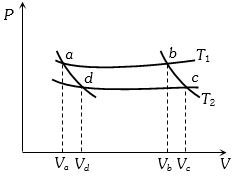
- ✓
$\frac{{{V_b}}}{{{V_c}}}$
- B
$\frac{{{V_c}}}{{{V_b}}}$
- C
$\frac{{{V_d}}}{{{V_a}}}$
- D
${V_b}{V_c}$
AnswerCorrect option: A. $\frac{{{V_b}}}{{{V_c}}}$
a
(a) For adiabatic process ${T_1}V_b^{\gamma - 1}$= Constant
For $bc$ curve ${T_1}V_b^{\gamma - 1} = {T_2}V_c^{\gamma - 1}$ or $\frac{{{T_2}}}{{{T_1}}} = {\left( {\frac{{{V_b}}}{{{V_c}}}} \right)^{\gamma - 1}}$…..$(i)$
For $ad$ curve ${T_1}V_a^{\gamma - 1} = {T_2}V_d^{\gamma - 1}$ or $\frac{{{T_2}}}{{{T_1}}} = {\left( {\frac{{{V_a}}}{{{V_d}}}} \right)^{\gamma - 1}}$…..$(ii)$
From equation $(i)$ and $(ii)$ $\frac{{{V_b}}}{{{V_c}}} = \frac{{{V_a}}}{{{V_d}}}$
View full question & answer→MCQ 861 Mark
A certain mass of gas at $273 K$ is expanded to $81$ times its volume under adiabatic condition. If $\gamma = 1.25$ for the gas, then its final temperature is ..... $^oC$
AnswerCorrect option: B. $-182$
b
(b) For adiabatic process $T{V^{\gamma - 1}}$= constant
==> $\frac{{{T_2}}}{{{T_1}}} = {\left( {\frac{{{V_1}}}{{{V_2}}}} \right)^{\gamma - 1}}$==> ${T_2} = {\left( {\frac{{{V_1}}}{{{V_2}}}} \right)^{\gamma - 1}} \times {T_1}$
==> ${T_2} = {\left( {\frac{1}{{81}}} \right)^{1.25 - 1}} \times 273$$ = {\left( {\frac{1}{{81}}} \right)^{0.25}} \times 273$
$ = \frac{{273}}{3} = 91K = \,-182°C$
View full question & answer→MCQ 871 Mark
A gas is compressed adiabatically till its temperature is doubled. The ratio of its final volume to initial volume will be
- A
$1/2$
- B
More than $1 / 2$
- ✓
Less than $1 / 2$
- D
Between $1$ and $2$
AnswerCorrect option: C. Less than $1 / 2$
c
(c) $\frac{{{T_2}}}{{{T_1}}} = {\left( {\frac{{{V_1}}}{{{V_2}}}} \right)^{\gamma - 1}} = 2 \Rightarrow {\left( {\frac{{{V_2}}}{{{V_1}}}} \right)^{\gamma - 1}} = \frac{1}{2} \Rightarrow \frac{{{V_2}}}{{{V_1}}} = {\left( {\frac{1}{2}} \right)^{\frac{1}{{\gamma - 1}}}} < \frac{1}{2}$
==> ${V_2} < \frac{{{V_1}}}{2}$
View full question & answer→MCQ 881 Mark
A tyre filled with air $({27^o}C,$ and $2$ atm) bursts, then what is temperature of air ....... $^oC$ $(\gamma = 1.5)$
AnswerCorrect option: A. $ - 33$
a
(a) $\frac{{{T_2}}}{{{T_1}}} = {\left( {\frac{{{P_2}}}{{{P_1}}}} \right)^{\frac{{\gamma - 1}}{\gamma }}}$==> $\frac{{{T_2}}}{{(273 + 27)}} = {\left( {\frac{1}{2}} \right)^{\frac{{1.5 - 1}}{{1.5}}}} = $${\left( {\frac{1}{2}} \right)^{\frac{1}{3}}} = \frac{1}{{2.5}}$
==> ${T_2} = \frac{{{T_1}}}{{1.25}} = \frac{{(273 + 27)}}{{1.25}} = 238\,K = - \,34.8^\circ C$
View full question & answer→MCQ 891 Mark
Three samples of the same gas $A, B$ and $C(\gamma = 3/2)$ have initially equal volume. Now the volume of each sample is doubled. The process is adiabatic for $A$ isobaric for $B $ and isothermal for $C$. If the final pressures are equal for all three samples, the ratio of their initial pressures are
- A
$2\sqrt 2 \,\,:\,\,2\,\,:\,\,1$
- ✓
$2\sqrt 2 \,\,:\,\,1\,\,:\,\,2$
- C
$\sqrt 2 \,\,:\,\,1\,\,:\,\,2$
- D
$2\,\,:\,\,1\,\,:\,\,\sqrt 2 $
AnswerCorrect option: B. $2\sqrt 2 \,\,:\,\,1\,\,:\,\,2$
b
(b) Let the initial pressure of the three samples be ${P_A},\,{P_B}$ and ${P_C}$, then ${P_A}{(V)^{3/2}} = {(2V)^{3/2}}P$, ${P_B} = P$ and
${P_C}(V) = P(2V)$
==> ${P_A}\,:\,{P_B}\,:\,{P_C} = {(2)^{3/2}}:\,1\,\,:\,\,2 = 2\sqrt 2 \,:\,1\,:\,\,2$
View full question & answer→MCQ 901 Mark
Monoatomic, diatomic and triatomic gases whose initial volume and pressure are same, are compressed till their volume becomes half the initial volume.
- ✓
If the compression is adiabatic then monoatomic gas will have maximum final pressure.
- B
If the compression is adiabatic then triatomic gas will have maximum final pressure.
- C
If the compression is adiabatic then their final pressure will be same.
- D
If the compression is isothermal then their final pressure will be different.
AnswerCorrect option: A. If the compression is adiabatic then monoatomic gas will have maximum final pressure.
a
For an adiabatic process,
$P V^{\gamma}=$ constant
or
$\frac{P_{1}}{P_{2}}=\left(\frac{V_{2}}{V_{1}}\right)^{\gamma}$
or
$P_{2}=2^{\gamma} P_{1}$
Now, for a monoatomic gas, the value of $\gamma$ is the highest
Thus, for the same change in volume, the monoatomic gas will have the maximum pressure.
View full question & answer→MCQ 911 Mark
The $PV$ diagram shows four different possible reversible processes performed on a monatomic ideal gas. Process $A$ is isobaric (constant pressure). Process $B$ is isothermal (constant temperature). Process $C$ is adiabatic. Process $D$ is isochoric (constant volume). For which process$(es)$ does the temperature of the gas decrease?
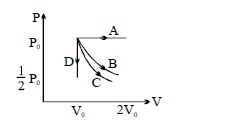
AnswerCorrect option: C. Only Processes $C$ and $D$
c
In $A$ temperature will increase
in $B$ temperature remains constant
in $C \& D$ temperature decrease.
Hence, option $C$ is the correct answer.
View full question & answer→MCQ 921 Mark
Consider two containers $A$ and $B$ containing identical gases at the same pressure, volume and temperature. The gas in container $A$ is compressed to half of its original volume isothermally while the gas in container $B$ is compressed to half of its original value adiabatically. The ratio of final pressure of gas in $B$ to that of gas in $A$ is
- ✓
$2^{\gamma-1}$
- B
${\left( {\frac{1}{2}} \right)^{\gamma - 1}}$
- C
${\left( {\frac{1}{{1 - \gamma }}} \right)^2}$
- D
${\left( {\frac{1}{{\gamma - 1 }}} \right)^2}$
AnswerCorrect option: A. $2^{\gamma-1}$
a
When the compression is isothermal for gas in $A$
$P_{2} V_{2}=P_{1} V_{1}$
$P_{2}=P_{1} \frac{V_{1}}{V_{2}}=P_{1} \frac{V_{1}}{V_{1} / 2}=2 P_{1}$
For gas in $\mathrm{B}$, when compression is adiabatic,
$P_{2}^{\prime} V_{2}^{\prime}=P_{1} V_{1}^{\gamma}$
$P_{2}^{\prime}=P_{1}\left(\frac{V_{1}}{V_{2}^{\prime}}\right)^{\gamma}=P_{1}\left(\frac{V_{1}}{V_{1} / 2}\right)^{\gamma}=2^{\gamma} P_{1}$
$\therefore \frac{P_{2}^{\prime}}{P_{2}}=\frac{2^{\gamma} P_{1}}{2 P_{1}}=2^{\gamma-1}$
View full question & answer→MCQ 931 Mark
Graph $A-B$ is an adiabatic curve. Choose the correct statement
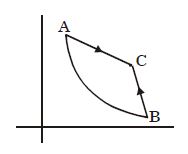
- A
Process $AC$ and $BC$ , both are exothermic
- ✓
Process $AC$ and $BC$ , both are endothermic
- C
Process $AC$ is endothermic, $BC$ is exothermic
- D
Process $AC$ is exothermic, $BC$ is endothermic
AnswerCorrect option: B. Process $AC$ and $BC$ , both are endothermic
View full question & answer→MCQ 941 Mark
Initial pressure and volume of a gas are $P$ and $V$ respectively. First it is expanded isothermally to volume $4V$ and then compressed adiabatically to volume $V$ . The final pressure of gas will be (given $\gamma = 3/2$ )
- A
$1\,P$
- ✓
$2\,P$
- C
$4\,P$
- D
$8\,P$
AnswerCorrect option: B. $2\,P$
b
In isothermal process $\mathrm{P}_{1} \mathrm{V}_{1}=\mathrm{P}_{2} \mathrm{V}_{2}$
$\Rightarrow \mathrm{PV}=\mathrm{P}_{2} \times 4 \mathrm{V} \quad \because \mathrm{P}_{2}=\mathrm{P} / 4$
In adiabatic process
$\mathrm{P}_{2} \mathrm{V}_{2}^{\gamma}=\mathrm{P}_{3} \mathrm{V}_{3}^{\gamma} \Rightarrow \frac{\mathrm{P}}{4} \times(4 \mathrm{V})^{15}=\mathrm{P}_{3} \mathrm{V}^{15} \Rightarrow \mathrm{P}_{3}=2 \mathrm{P}$
View full question & answer→MCQ 951 Mark
The work of $146\,kJ$ is performed in order to compress one kilo mole of a gas adiabatically and in this process the temperature of the gas increases by $7\,^oC$ . The gas is $(R = 8.3\, J\, mol^{-1}\, K^{-1})$
- ✓
- B
- C
a mixture of monoatomic and diatomic
- D
Answera
$w=\frac{n R \Delta T}{\gamma-1}$
$146 \times 10^{3}=\frac{10^{3} \times 8.3 \times 7}{\gamma-1}$
$\gamma-1=\frac{8.3 \times 7}{146}=\frac{58.1}{146}$
$\gamma=\frac{58}{146}+1$
$\gamma=\frac{58+146}{146}$
$=\frac{204}{146}$
$=\frac{7}{5}$ diatomic nature.
View full question & answer→MCQ 961 Mark
A sample of an ideal gas is contained in a cylinder. The volume of the gas is suddenly decreased. A student makes the following statements to explain the change in pressure of the gas
$I.$ The average kinetic energy of the gas atoms increases
$II.$ The atoms of the gas hit the walls of the cylinder more frequently
$III.$ Temperature of the gas remains unchanged
Which of these statements is true?
- ✓
$I$ and $II$ only
- B
$I$ and $III$ only
- C
$II$ and $III$ only
- D
$I, II$ and $III$
AnswerCorrect option: A. $I$ and $II$ only
a
Adiabatic compression will increase temperature and kinetic energy
View full question & answer→MCQ 971 Mark
Two identical balls, $A$ and $B$ , of uniform composition and initially at the same temperature, each absorb exactly the same amount of heat. $A$ is hanging down from the ceiling while $B$ rests on the horizontal floor in the same room. Assuming no subsequent heat loss by the balls, which of the following statements is correct about their final temperatures, $T_A$ and $T_B$ , once the balls have reached their final state?
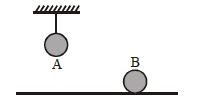
- A
$T_A < T_B$
- ✓
$T_A > T_B$
- C
$T_A = T_B$
- D
$T_A \leq T_B$
AnswerCorrect option: B. $T_A > T_B$
b
When the balls are warmed, their centre of masses are moving as radii of balls are increasing. The centre of mass of ball $A$ will come down and that of ball $B$ will go up.In case of ball $A,$ the gravitational potential energy decreases.This corresponds to additional heating of ball.
$T_{A}>T_{B}$
View full question & answer→MCQ 981 Mark
One mole of an ideal gas $(\gamma = 1.4)$ is adiabatically compressed so that its temperature rises from $27\,^oC$ to $35\,^oC$. The change in the internal energy of the gas is .... $J$ (given $R = 8.3 \,J/mole/K$)
- A
$-166$
- ✓
$166$
- C
$-168$
- D
$168$
Answerb
$\Delta \mathrm{U}=-\mathrm{W}=\frac{\mathrm{nR}\left(\mathrm{T}_{1}-\mathrm{T}_{2}\right)}{1-\mathrm{r}}=\frac{1 \times 8.3(-8)}{1-1.4}=166 \mathrm{J}$
View full question & answer→MCQ 991 Mark
A monoatomic gas $\left( {\gamma = \frac{5}{3}} \right)$ is suddenly compressed to $\frac{1}{8}$ of its original volume, then the pressure of gas will change to how many times the initial pressure?
- A
$\frac{{24}}{5}$
- B
$8$
- C
$\frac{{40}}{3}$
- ✓
$32$
Answerd
Sudden compression means adiabatic process
View full question & answer→MCQ 1001 Mark
A motor-car tyre has a pressure of $2\, atm$ at $27\,^oC$. It suddenly burst's. If $\left( {\frac{{{C_p}}}{{{C_v}}}} \right) = 1.4$ for air, find the resulting temperatures (Given $4^{1/7} = 1.219$)
- A
$27\, K$
- B
$27\,^oC$
- ✓
$-27\,^oC$
- D
$246\,^oC$
AnswerCorrect option: C. $-27\,^oC$
c
$\mathrm{PV}^{\gamma}=$ constant (Adiabatic suddenly)
$\mathrm{P}_{1} \mathrm{V}_{1}^{\gamma}=\mathrm{P}_{2} \mathrm{V}_{2}^{\gamma}$
or $\quad \mathrm{T} \mathrm{P}^{(1-\gamma) / \gamma}=$ constant
$\mathrm{T}_{1} \mathrm{P}_{1}^{(1-\mathrm{\gamma}) / \gamma}=\mathrm{T}_{2} \mathrm{P}_{2}^{(1-\gamma) / \gamma}$
$\mathrm{T}_{2}=\mathrm{T}_{1}\left(\frac{\mathrm{P}_{1}}{\mathrm{P}_{2}}\right)^{(\mathrm{1}-\mathrm{y}) / \gamma}=\mathrm{T}_{1}(2)^{\frac{-0.4}{1.4}}=\frac{300}{(4)^{1 / 7}}$
$\Rightarrow \mathrm{T}_{2}=246 \mathrm{K}=-27^{\circ} \mathrm{C}$
View full question & answer→MCQ 1011 Mark
In an adiabatic process where in pressure is increased by $\frac{2}{3}\% $ if $\frac{{{C_p}}}{{{C_v}}} = \frac{3}{2},$ then the volume decreases by about
- ✓
$\frac{4}{9}\% $
- B
$\frac{2}{3}\% $
- C
$4\%$
- D
$\frac{9}{4}\% $
AnswerCorrect option: A. $\frac{4}{9}\% $
a
$\frac{\Delta \mathrm{P}}{\mathrm{P}}=-\gamma \frac{\Delta \mathrm{V}}{\mathrm{V}} \quad \frac{2}{3} \times \frac{1}{\gamma}=\frac{\Delta \mathrm{V}}{\mathrm{V}} \quad \frac{\Delta \mathrm{V}}{\mathrm{V}}=-\frac{4}{9} \%$
View full question & answer→MCQ 1021 Mark
In the adiabatic compression, the decrease in volume is associated with
- A
increase in temperature and decrease in pressure
- B
decrease in temperature and increase in pressure
- C
decrease in temperature and decrease in pressure
- ✓
increase in temperature and increase in pressure
AnswerCorrect option: D. increase in temperature and increase in pressure
d
For an adiabatic process we have $P \times V^{\gamma}=k$ where $k$ is a constant
And similarly, $T \times V^{\gamma-1}=l$ where $l$ is a constant.
Therefore, the decrease in volume is associated with increase in temperature as well as increase in pressure.
View full question & answer→MCQ 1031 Mark
If during an adiabatic process the pressure of mixture of gases is found to be proportional to square of its absolute temperature. The ratio of $C_p / C_v$ for mixture of gases is .........
Answera
(a)
$P \propto T^2$
$P T^{-2}=$ constant $\quad$ compare with $P T^{\left(\frac{\gamma}{1-\gamma}\right)}=$ constant
$\frac{C_P}{C_V}=\gamma=2$
View full question & answer→MCQ 1041 Mark
A mixture of gases at $STP$ for which $\gamma=1.5$ is suddenly compressed to $\frac{1}{9}$ th of its original volume. The final temperature of mixture is .......... $^{\circ} C$
Answerb
(b)
$T V^{1-1}=\text { constant }$
$T_1 V_1^{\gamma-1}=T_2 V_2^{\gamma-1}$
$T_2=T_1\left(\frac{V_1}{V_2}\right)^{\gamma-1}$
$T_2=(273 \,K )\left[\frac{V_1}{V / 9}\right]^{1.5-1}$
$T_2=(273 \,K ) \times 3$
$=819 \,K$
$=546^{\circ} C$
View full question & answer→MCQ 1051 Mark
Slope of isotherm for a gas (having $\gamma=\frac{5}{3}$ ) is $3 \times 10^5 \,N / m ^2$. If the same gas is undergoing adiabatic change then adiabatic elasticity at that instant is ........... $\times 10^5 N / m ^2$
Answerb
(b)
Adiabatic elasticity $=\gamma P$
$=\frac{5}{3} \times 3 \times 10^5=5 \times 10^5 \,N / m ^2$
View full question & answer→MCQ 1061 Mark
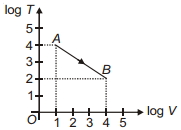
Figure shows, the adiabatic curve on a $\log T$ and log $V$ scale performed on ideal gas. The gas is ............
- ✓
- B
- C
- D
Mixture of monatomic and diatomic
Answera
(a)
$T V^{\gamma-1}=K$
$\log T+(\gamma-1) \log V=0$
$\log T=-(\gamma-1) \log V$
$y=-(\gamma-1) x$
$\frac{y}{x}=-(\gamma-1)=\text { slope }=\frac{2-4}{4-1}$
$\Rightarrow-(\gamma-1)=-\frac{2}{3}$
$\gamma=\frac{5}{3}$
$\therefore \text { Monoatomic.}$
View full question & answer→MCQ 1071 Mark
Neon gas of a given mass expands isothermally to double volume. What should be the further fractional decrease in pressure, so that the gas when adiabatically compressed from that state, reaches the original state?
- ✓
$1-2^{-2 / 3}$
- B
$1-3^{1 / 3}$
- C
$2^{1 / 3}$
- D
$3^{2 / 3}$
AnswerCorrect option: A. $1-2^{-2 / 3}$
a
(a)
$P_1 V_1=P_2 V_2$ [for isothermal]
$P V=P \times 2 V$
$\frac{P}{2}=P^{\prime}$
$P_1 V_1^\gamma=P_2 V_2^\gamma$ [for adiabatic]
$\frac{P}{2} \times(2 V)^{5 / 3}=P_2(V)^{5 / 3}$ $[\gamma$ for neon $=5 / 3]$
$P=P_2 \cdot(2)^{-2 / 3}$
Fractional decrease $=\frac{P_2-P}{P_2}=\frac{P_2-P_2 \cdot(2)^{-2 / 3}}{P_2}=1-2^{-2 / 3}$
View full question & answer→MCQ 1081 Mark
An ideal gas expands in such a manner that its pressure and volume can be related by equation $P{V^2} = $ constant. During this process, the gas is
- A
- ✓
- C
Neither heated nor cooled
- D
First heated and then cooled
Answerb
(b) $P{V^2} = $constant represents adiabatic equation. So during the expansion of ideal gas internal energy of gas decreases and temperature falls.
View full question & answer→MCQ 1091 Mark
Suppose ideal gas equation follows $V{P^3}$= constant. Initial temperature and volume of the gas are $T$ and $V$ respectively. If gas expand to $27V$ then its temperature will be come
Answerb
(b) $V{P^3}$= constant = $k$ ==> $P = \frac{k}{{{V^{1/3}}}}$
Also$PV = \mu RT$==>$\frac{k}{{{V^{1/3}}}}.V = \mu RT$==> ${V^{2/3}} = \frac{{\mu RT}}{k}$
Hence ${\left( {\frac{{{V_1}}}{{{V_2}}}} \right)^{2/3}} = \frac{{{T_1}}}{{{T_2}}}$==> ${\left( {\frac{V}{{27V}}} \right)^{2/3}} = \frac{T}{{{T_2}}}$==> ${T_2} = 9\,T$
View full question & answer→MCQ 1101 Mark
A gas expands adiabatically at constant pressure such that its temperature $T \propto \frac{1}{{\sqrt V }}$, the value of ${C_P}/{C_V}$ of gas is
Answerb
(b) $T{V^{\gamma - 1}} = $ constant ==> $T \propto {V^{1 - \gamma }}$
According to question $T \propto {V^{ - \frac{1}{2}}}$
Hence $1 - \gamma = - \frac{1}{2} \Rightarrow \gamma \frac{3}{2} = 1.5$
View full question & answer→MCQ 1111 Mark
A gas expands with temperature according to the relation $V = k{T^{2/3}}.$ What is the work done when the temperature changes by ${30^o}C$
- A
$10 R$
- ✓
$20 R$
- C
$30 R$
- D
$40 R$
AnswerCorrect option: B. $20 R$
b
(b) $W = \int_{}^{} {PdV = \int_{}^{} {\frac{{RT}}{V}dV} } $
Since $V = k{T^{2/3}}$ ==> $dV = \frac{2}{3}K{T^{ - 1/3}}dT$
Eliminating $K,$ we find $\frac{{dV}}{V} = \frac{2}{3}\frac{{dT}}{T}$
Hence$W = \int_{{T_1}}^{{T_2}} {\,\frac{2}{3}\frac{{RT}}{T}dT} = \frac{2}{3}R({T_2} - {T_1}) = \frac{2}{3}R(30) = 20\,R$
View full question & answer→MCQ 1121 Mark
In case of an adiabatic process the correct relation in terms of pressure $p$ and density $\rho $ of a gas is
- A
$p \,{\rho ^\gamma } =$ constant
- B
$p ^\gamma \,{\rho ^{\gamma-1}} =$ constant
- C
$p \,{\rho ^{\gamma-1}} =$ constant
- ✓
$p \,{\rho ^{ - \gamma }} =$ constant
AnswerCorrect option: D. $p \,{\rho ^{ - \gamma }} =$ constant
d
Note that $p V^{\gamma}=$ constant and that $\rho$ is inversely
proportional to $V.$
Adiabatic process
$\mathrm{pV}^{\gamma}=$ constant
$\mathrm{p}\left(\frac{\mathrm{M}}{\rho}\right)^{\gamma}=\mathrm{constant}$
$\mathrm{p} \cdot \mathrm{M}^{\gamma} \cdot \rho^{-\gamma}=$ constant $\quad\left(\mathrm{M}^{\gamma} \text { is constant }\right)$
$\mathrm{p} \cdot \rho^{-\gamma}=$ constant
View full question & answer→MCQ 1131 Mark
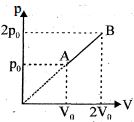
An enclosed one mole of a monoatomic gas is taken through a process $A$ to $B$ as shown in figure. The molar heat capacity of the gas for this process is
Answerb
$\mathrm{C}=\mathrm{C}_{\mathrm{v}}+\frac{\mathrm{R}}{1-\mathrm{n}}$
in the given process
$\mathrm{P} \alpha \mathrm{V}$
$\mathrm{PV}^{-1}=\mathrm{const}$
$n=-1$
$\Rightarrow \mathrm{C}=\frac{3}{2} \mathrm{R}+\frac{\mathrm{R}}{1-(-1)}=2 \mathrm{R}$
View full question & answer→MCQ 1141 Mark
$P_i, V_i$ and $P_f$, $V_f$ are initial and final pressures and volumes of a gas in a thermodynamic process respectively. If $PV^n =$ constant, then the amount of work done is
AnswerCorrect option: D. minimum for $n = \infty $
d
$\mathbf{P V}^{x}=$ cons. (Polytropic process)
$W=\frac{n R \Delta T}{1-x}$
View full question & answer→MCQ 1151 Mark
An ideal gas is taken through a quasi-static process described by $P = \alpha\, V^2$, with $\alpha = 5\,atm/m^6$. The gas is expanded to twice its original volume of $1\,m^3$. How much work is done by the expanding gas in this process
- A
$10.8\,J$
- ✓
$1.18\,M\,J$
- C
$5\,J$
- D
$4.3\,M\,J$
AnswerCorrect option: B. $1.18\,M\,J$
b
$\mathrm{W}=\int_{\mathrm{V}_{1}}^{\mathrm{v}_{2}} \mathrm{P} \mathrm{d} \mathrm{v}$
$=5 \times 10^{5} \int_{1}^{2} \mathrm{V}^{2} \mathrm{d} \mathrm{v}$
$=5 \times 10^{5}\left[\frac{V^{3}}{3}\right]_{1}^{2}$
$=\frac{5}{3} \times\left[2^{3}-1^{3}\right] \times 10^{5} \mathrm{J}$
$=1018 \mathrm{MJ}$
View full question & answer→MCQ 1161 Mark
Gas obey $P^2V =$ constant. The initial temperature and volume are $T_0$ and $V_0$. If gas expands to volume $2V_0$, the final temp is
- ✓
$\sqrt 2\, T_0$
- B
$2\,T_0$
- C
$T_0/2$
- D
${T_0}/\sqrt 2 $
AnswerCorrect option: A. $\sqrt 2\, T_0$
a
$\mathrm{P}^{2} \mathrm{V}=\mathrm{constant}$
$\left(\frac{\mathrm{nRT}}{\mathrm{V}}\right)^{2} \mathrm{V}=\mathrm{constant}$
$\frac{\mathrm{T}^{2}}{\mathrm{V}}=\mathrm{constant}$
$\frac{\mathrm{T}_{1}^{2}}{\mathrm{V}_{1}}=\frac{\mathrm{T}_{2}^{2}}{\mathrm{V}_{2}} \quad \Rightarrow \quad \mathrm{T}_{2}^{2}=\frac{\mathrm{V}_{2}}{\mathrm{V}_{1}} \mathrm{T}_{1}^{2}=2 \mathrm{T}_{0}^{2}$
$\Rightarrow \mathrm{T}_{2}=\sqrt{2} \mathrm{T}_{0}$
View full question & answer→MCQ 1171 Mark
An ideal gas is subjected to a thermodynamic process $PV^{2.5} = 0.40$ where $P$ is in $Pa$ and $V$ is in $m^3$.What is the slope of the $P-V$ curve with volume plotted against $x-$ axis at $V=1\, m^3$ ?
Answera
$\mathrm{PV}^{2.5}=0.40$
$\mathrm{P}=0.40 \mathrm{V}^{-2.5}$
$\frac{\mathrm{dP}}{\mathrm{dV}}=0.40\left[-2.5 \mathrm{V}^{-3.5}\right]$
at $\quad V=1$
$\left(\frac{\mathrm{dP}}{\mathrm{dV}}\right)_{\mathrm{V}=1}=-1$
View full question & answer→MCQ 1181 Mark
In a thermodynamic process two moles of a monatomic ideal gas obeys $P \propto V^{-2}$. If temperature of the gas increases from $300 \,K$ to $400 \,K$, then find work done by the gas .........$R$ (where $R=$ universal gas constant).
- A
$200$
- ✓
$-200$
- C
$-100$
- D
$-400$
AnswerCorrect option: B. $-200$
b
(b)
$P \propto V^{-2}$
$P V^2=$ constant $\quad$ Compare with $P V^N=$ constant then $N=2$
$W=\mu\left(\frac{R}{1-N}\right) \Delta T$
$W=\frac{\mu R}{1-N}\left(T_2-T_1\right)$
$=\frac{2 \times R(400-300)}{(1-2)}$
$=-200 R$
View full question & answer→MCQ 1191 Mark
A diatomic gas undergoes a process represented by $PV ^{1.3}=$ constant. Choose the incorrect statement
- A
The gas expands by absorbing heat from the surroundings
- B
The gas cools down during expansion
- C
The work done by surroundings during expansion of the gas is negative
- ✓
Answerd
(d)
$P V^{1.3}=K$
$W=\frac{P_2 V_2-P_1 V_1}{1-N}$
$\because N > 1$, so $W$ is negative.
Heat supplied by surrounding heat goes to do work.
$\therefore$ Down when expands.
View full question & answer→MCQ 1201 Mark
In a cyclic process, work done by the system is
- A
- ✓
Equal to heat given to the system
- C
More than the heat given to system
- D
Independent of heat given to the system
AnswerCorrect option: B. Equal to heat given to the system
b
(b) For cyclic forces $\Delta U = 0$ So, $\Delta Q = \Delta W$
View full question & answer→MCQ 1211 Mark
$1c{m^3}$ of water at its boiling point absorbs $540$ calories of heat to become steam with a volume of $1671c{m^3}$.If the atmospheric pressure = $1.013 \times {10^5}N/{m^2}$ and the mechanical equivalent of heat = $4.19J/calorie$, the energy spent in this process in overcoming intermolecular forces is ..... $cal$
Answerc
(c) $\Delta Q = \Delta U + \Delta W$
$\therefore $$\Delta U = \Delta Q - \Delta W = 540 - \frac{{P({V_2}/{V_1})}}{J}$
$ = 540 - \frac{{1.013 \times {{10}^5} \times [(1671 - 1) \times {{10}^{ - 6}}]}}{{4.2}}$
$ = 540 - 39.7 = 500\;calories$
View full question & answer→MCQ 1221 Mark
The $P-V$ diagram shows seven curved paths (connected by vertical paths) that can be followed by a gas. Which two of them should be parts of a closed cycle if the net work done by the gas is to be at its maximum value
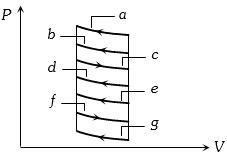
Answerc
(c) Area enclosed between $a$ and $f$ is maximum. So work done in closed cycles follows $a$ and $f$ is maximum.
View full question & answer→MCQ 1231 Mark
In pressure-volume diagram given below, the isochoric, isothermal, and isobaric parts respectively, are
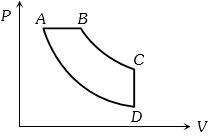
- A
$BA, AD, DC$
- B
$DC, CB, BA$
- C
$AB, BC, CD$
- ✓
$CD, DA, AB$
AnswerCorrect option: D. $CD, DA, AB$
d
(d) Process $CD$ is isochoric as volume is constant, Process $DA$ is isothermal as temperature constant and Process $AB$ is isobaric as pressure is constant.
View full question & answer→MCQ 1241 Mark
The $P-V$ diagram of a system undergoing thermodynamic transformation is shown in figure. The work done on the system in going from $A → B → C$ is $50 J$ and $ 20\, cal$ heat is given to the system. The change in internal energy between $A$ and $C$ is ...... $J$
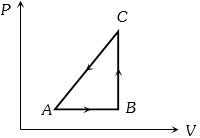
- A
$34 $
- B
$70 $
- C
$84 $
- ✓
$134 $
AnswerCorrect option: D. $134 $
d
(d) Heat given $\Delta Q = 20\,cal = 20 \times 4.2\, = 84\,J$.
Work done $\Delta W = -50 J$ [As process is anticlockwise]
By first law of thermodynamics
==> $\Delta U = \Delta Q - \Delta W = 84 - ( - \,50)\, = 134J$
View full question & answer→MCQ 1251 Mark
A cyclic process for $1\, mole$ of an ideal gas is shown in figure in the $V-T,$ diagram. The work done in $AB, BC$ and $CA$ respectively
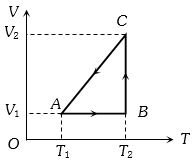
- A
$0,\,R{T_2}\ln \left( {\frac{{{V_1}}}{{{V_2}}}} \right)\,,\,R\,({T_1} - {T_2})$
- B
$R({T_1} - {T_2}),\,0,\,R{T_1}\ln \frac{{{V_1}}}{{{V_2}}}$
- ✓
$0,\,R{T_2}\ln \left( {\frac{{{V_2}}}{{{V_1}}}} \right)\,,\,R\,({T_1} - {T_2})$
- D
$0,\,R{T_2}\ln \left( {\frac{{{V_2}}}{{{V_1}}}} \right)\,,\,R\,({T_2} - {T_1})$
AnswerCorrect option: C. $0,\,R{T_2}\ln \left( {\frac{{{V_2}}}{{{V_1}}}} \right)\,,\,R\,({T_1} - {T_2})$
c
(c) Process $AB$ is isochoric, $\therefore$ ${W_{AB}} = P\,\Delta V = 0$
Process $BC$ is isothermal $\therefore$ ${W_{BC}} = R{T_2}.\ln \left( {\frac{{{V_2}}}{{{V_1}}}} \right)$
Process $CA$ is isobaric
$\therefore {W_{CA}} = - \,P\Delta V$$ = - \,R\Delta T$$ = - \,R({T_1} - {T_2})$$ = R({T_2} - {T_1})$
(Negative sign is taken because of compression)
View full question & answer→MCQ 1261 Mark
A cyclic process $ABCD$ is shown in the figure $P-V$ diagram. Which of the following curves represent the same process
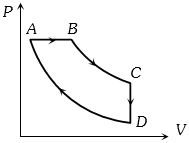
Answera
(a) $AB$ is isobaric process, $BC$ is isothermal process, $CD$ is isometric process and $DA$ is isothermal process
These process are correctly represented by graph $ (a).$
View full question & answer→MCQ 1271 Mark
Work done in the given $P-V$ diagram in the cyclic process is
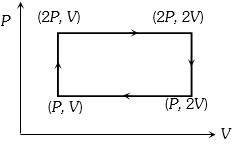
Answera
(a) Work done = Area of closed $PV$ diagram
= $(2V - V) \times (2P - P) = PV$
View full question & answer→MCQ 1281 Mark
In the figure given two processes $A$ and $B$ are shown by which a thermo-dynamical system goes from initial to final state $F.$ If $\Delta {Q_A}$ and $\Delta {Q_B}$ are respectively the heats supplied to the systems then
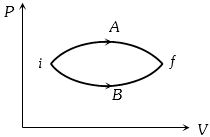
- A
$\Delta {Q_A} = \Delta {Q_B}$
- B
$\Delta {Q_A} \ge \Delta {Q_B}$
- C
$\Delta {Q_A} < \Delta {Q_B}$
- ✓
$\Delta {Q_A} > \Delta {Q_B}$
AnswerCorrect option: D. $\Delta {Q_A} > \Delta {Q_B}$
d
(d) $\Delta Q = \Delta U + \Delta W;$ $\Delta U$ does not depend upon path.
$\because \Delta {W_A} > \Delta {W_B}$ ==> $\Delta {Q_A} > \Delta {Q_B}$
View full question & answer→MCQ 1291 Mark
In the diagrams $(i)$ to $(iv)$ of variation of volume with changing pressure is shown. A gas is taken along the path $ABCD. $ The change in internal energy of the gas will be
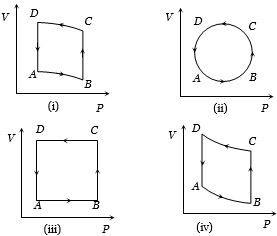
- A
Positive in all cases $(i)$ to $(iv)$
- B
Positive in cases $(i), (ii)$ and $(iii)$ but zero in $(iv)$ case
- C
Negative in cases $(i), (ii)$ and $(iii)$ but zero in $(iv)$ case
- ✓
Answerd
$(d)$ In all given cases, process is cyclic and in cyclic process $\Delta U = 0$
View full question & answer→MCQ 1301 Mark
A system is taken through a cyclic process represented by a circle as shown. The heat absorbed by the system is
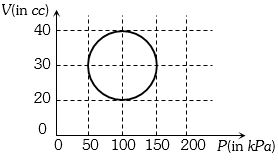
- A
$\pi \times {10^3}J$
- ✓
$\frac{\pi }{2}J$
- C
$4\pi \times {10^2}J$
- D
$\pi \,J$
AnswerCorrect option: B. $\frac{\pi }{2}J$
b
(b) In cyclic process $\Delta Q =$ Work done = Area inside the closed curve.
Treat the circle as an ellipse of area $ = \frac{\pi }{4}({P_2} - {P_1})\,({V_2} - {V_1})$
$\Rightarrow \Delta Q = \frac{\pi }{4}\{ (150 - 50) \times {10^3}\} = \frac{\pi }{2}J$
View full question & answer→MCQ 1311 Mark
A system changes from the state $({P_1},\;{V_1})$ to $({P_2},{V_2})$ as shown in the figure. What is the work done by the system
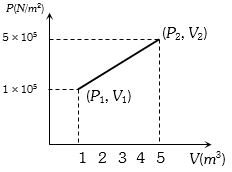
AnswerCorrect option: C. $12 \times {10^5}\;joule$
c
(c) Work done = Area of $PV$ graph (here trapezium)
$ = \frac{1}{2}(1 \times {10^5} + 5 \times {10^5}) \times (5 - 1) = 12 \times {10^5}J$
View full question & answer→MCQ 1321 Mark
When a system is taken from state $i$ to a state $f$ along path $iaf, \,Q = 50\,J$ and $W = 20J.$ Along path $ibf, \,Q = 35J.$ If $W = - 13J$ for the curved return path $f i, Q$ for this path is ...... $J$
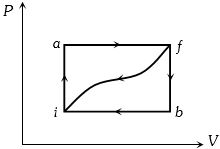
- A
$33 $
- B
$23 $
- C
$-7 $
- ✓
$-43 $
AnswerCorrect option: D. $-43 $
d
(d) $\Delta U$, remains same for both path
For path $iaf : \Delta U = \Delta Q - \Delta W = 50 - 20 = 30J$.
For path $fi : \Delta U = - \,30\,J\,{\rm{and\, }}\Delta W = - 13J$
==> $\Delta Q = - \,30 - 13 = - \,43\;J$.
View full question & answer→MCQ 1331 Mark
An ideal gas is taken from point $A$ to the point $B,$ as shown in the $P-V$ diagram, keeping the temperature constant. The work done in the process is
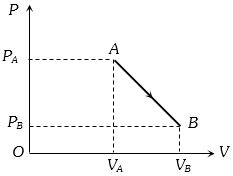
- A
$({P_A} - {P_B})({V_B} - {V_A})$
- B
$\frac{1}{2}({P_B} - {P_A})({V_B} + {V_A})$
- C
$\frac{1}{2}({P_B} - {P_A})({V_B} - {V_A})$
- ✓
$\frac{1}{2}({P_B} + {P_A})({V_B} - {V_A})$
AnswerCorrect option: D. $\frac{1}{2}({P_B} + {P_A})({V_B} - {V_A})$
d
(d) $W =$ Area bonded by the indicator diagram with $V-$ axis
$ = \frac{1}{2}({P_A} + {P_B})\,({V_B} - {V_A})$
View full question & answer→MCQ 1341 Mark
The $P-V$ diagram of a system undergoing thermodynamic transformation is shown in figure. The work done by the system in going from $A \to B \to C$ is $30J$ and $40J$ heat is given to the system. The change in internal energy between $A$ and $C$ is ....... $J$
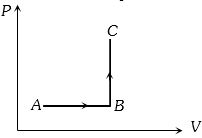
- ✓
$10 $
- B
$70 $
- C
$84 $
- D
$134 $
Answera
(a) Heat given $\Delta Q = 40 J$ and Work done $\Delta W = 30 J$
$⇒$ $\Delta U = \Delta Q - \Delta W = 40 -30 = 10 J.$
View full question & answer→MCQ 1351 Mark
The $P-V$ diagram of $2$ gm of helium gas for a certain process $A \to B$ is shown in the figure. what is the heat given to the gas during the process $A \to B$
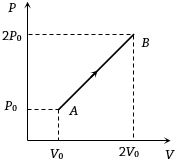
- A
$4{P_o}{V_o}$
- ✓
$6{P_o}{V_o}$
- C
$4.5{P_o}{V_o}$
- D
$2{P_o}{V_o}$
AnswerCorrect option: B. $6{P_o}{V_o}$
b
(b) Change in internal energy from $A \to B$ is
$\Delta U = \frac{f}{2}\mu R\Delta T = \frac{f}{2}({P_f}{V_f} - {P_i}{V_i})$
$ = \frac{3}{2}(2{P_0} \times 2{V_0} - {P_0} \times {V_0}) = \frac{9}{2}{P_0}{V_0}$
Work done in process $A \to B$ is equal to the Area covered by the graph with volume axis i.e.,
${W_{A \to B}} = \frac{1}{2}({P_0} + 2{P_0}) \times (2{V_0} - {V_0}) = \frac{3}{2}{P_0}{V_0}$
Hence, $\Delta Q = \Delta U + \Delta W$$ = \frac{9}{2}{P_0}{V_0} + \frac{3}{2}{P_0}{V_0} = 6{P_0}{V_0}$
View full question & answer→MCQ 1361 Mark
In the case of diatomic gas, the heat given at constant pressure is that part of energy which is used for the expansion of gas, is
- A
$\frac{2}{5}$
- B
$\frac{3}{7}$
- ✓
$\frac{2}{7}$
- D
$\frac{5}{7}$
AnswerCorrect option: C. $\frac{2}{7}$
c
(c) $\Delta W = $energy used for expansion $ = PdV = RdT$
$\Delta Q = $heat supplied to diatomic gas at constant $P$
$\therefore \;\frac{{\Delta W}}{{\Delta Q}} = \frac{{RdT}}{{\frac{7}{2}RdT}} = \frac{2}{7}$
View full question & answer→MCQ 1371 Mark
$P-V$ diagram of an ideal gas is as shown in figure. Work done by the gas in process $ABCD$ is
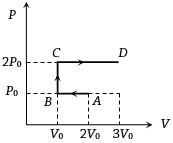
- A
$4\,{P_0}{V_0}$
- B
$2\,{P_0}{V_0}$
- ✓
$3\,{P_0}{V_0}$
- D
${P_0}{V_0}$
AnswerCorrect option: C. $3\,{P_0}{V_0}$
c
(c) ${W_{AB}} = - \,{P_0}{V_0}$, ${W_{BC}} = 0$ and ${W_{CD}} = 4{P_0}{V_0}$
==> ${W_{ABCD}} = - \,{P_0}{V_0} + 0 + 4{P_0}{V_0} = 3{P_0}{V_0}$
View full question & answer→MCQ 1381 Mark
Volume versus temperature graph of two moles of helium gas is as shown in figure. The ratio of heat absorbed and the work done by the gas in process $1-2$ is
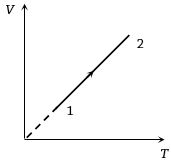
Answerb
(b) $V-T$ graph is a straight line passing through origin. Hence, $V \propto T$ or $P = {\rm{constant}}$
$\therefore $ $\Delta Q = n{C_P}\Delta T$ and $\Delta U = n{C_V}\Delta T$
Also $\Delta W = \Delta Q - \Delta U = \mu \,({C_P} - {C_V})\,\Delta T$
$\therefore \,\,\,\,\,\,\frac{{\Delta Q}}{{\Delta W}} = \frac{{n{C_P}\Delta T}}{{n\,({C_P} - {C_V})\,\Delta T}}$$ = \frac{{{C_P}}}{{{C_P} - {C_V}}} = \frac{1}{{1 - \frac{{{C_V}}}{{{C_P}}}}}$
$\frac{{{C_V}}}{{{C_P}}} = \frac{3}{5}$ for helium gas. Hence $\frac{{\Delta Q}}{{\Delta W}} = \frac{1}{{1 - 3/5}} = \frac{5}{2}$
View full question & answer→MCQ 1391 Mark
Heat is supplied to a diatomic gas at constant pressure. The ratio of $\Delta Q\,:\,\Delta U\,:\,\Delta W$ is
- A
$5:3:2$
- B
$5:2:3$
- ✓
$7:5:2$
- D
$7:2:5$
AnswerCorrect option: C. $7:5:2$
c
(c) $\Delta Q = \mu {C_P}\Delta T = \frac{7}{2}\mu R\Delta T$ $\left( {{C_P} = \frac{7}{2}R} \right)$
$\Delta U = \mu {C_V}\Delta T = \frac{5}{2}\mu R\Delta T$ $\left( {{C_V} = \frac{5}{2}R} \right)$
and $\Delta W = \Delta Q - \Delta U = \mu R\Delta T$
==> $\Delta Q\,:\,\Delta U\,\,:\,\,\Delta W = 7\,\,:\,\,5\,\,:\,\,2$
View full question & answer→MCQ 1401 Mark
$N$ moles of an ideal diatomic gas are in a cylinder at temperature $T$. suppose on supplying heat to the gas, its temperature remain constant but $n$ moles get dissociated into atoms. Heat supplied to the gas is
- A
- ✓
$\frac{1}{2}nRT$
- C
$\frac{3}{2}nRT$
- D
$\frac{3}{2}(N - n)RT$
AnswerCorrect option: B. $\frac{1}{2}nRT$
b
(b) Since the gas is enclosed in a vessel, therefore, during heating process, volume of the gas remains constant. Hence, no work is done by the gas. It means heat supplied to the gas is used to increase its internal energy only.
Initial internal energy of the gas is ${U_1} = N\,\left( {\frac{5}{2}R} \right)\,T$
Since $n$ moles get dissociated into atoms, therefore, after heating, vessel contains $(N - n)$ moles of diatomic gas and $2n$ moles of a mono-atomic gas. Hence the internal energy for the gas, after heating, will be equal to
${U_2} = (N - n)\left( {\frac{5}{2}R} \right)\,T + 2n\,\left( {\frac{3}{2}R} \right)\,T$$ = \frac{5}{2}\,NRT + \,\frac{1}{2}nRT$
Hence, the heat supplied = increase in internal energy
$ = \,({U_2} - {U_1})\, = \,\frac{1}{2}\,nRT$
View full question & answer→MCQ 1411 Mark
A given mass of a gas expands from a state $A$ to the state $B$ by three paths $1, 2$ and $3$ as shown in $T-V$ indicator diagram. If $W_1, W_2$ and $W_3$ respectively be the work done by the gas along the three paths, then
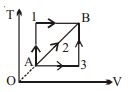
- ✓
$W_1 > W_2 > W_3$
- B
$W_1 < W_2 < W_3$
- C
$W_1 = W_2 = W_3$
- D
$W_1 < W_2, W_1 > W_3$
AnswerCorrect option: A. $W_1 > W_2 > W_3$
View full question & answer→MCQ 1421 Mark
In the above thermodynamic process, the correct statement is
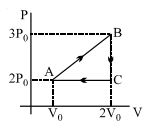
- A
Heat given in the complete cycle $ABCA$ is zero
- B
Work done in the complete cycle $ABCA$ is zero
- ✓
Work done in the complete cycle $ABCA$ is $(1/2 P_0V_0)$
- D
AnswerCorrect option: C. Work done in the complete cycle $ABCA$ is $(1/2 P_0V_0)$
View full question & answer→MCQ 1431 Mark
Pressure versus temperature graph of an ideal gas is shown in figure
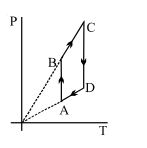
- A
During the process $AB$ work done by the gas in positive
- B
during the process $CD$ work done by the gas is negative
- ✓
during the process $BC$ internal energy of the gas is increasing
- D
AnswerCorrect option: C. during the process $BC$ internal energy of the gas is increasing
c
Internal energy of an ideal gas is a function of temperature alone, and doesn't depend on any other parameters like volume, or pressure.
In process $BC,$ the temperature increases linearly; hence the internal energy of the gas also increases.
View full question & answer→MCQ 1441 Mark
One mole of an ideal gas is contained with in a cylinder by a frictionless piston and is initially at temperature $T$. The pressure of the gas is kept constant while it is heated and its volume doubles. If $R$ is molar gas constant, the work done by the gas in increasing its volume is
- A
$RT\, ln2$
- B
$1/2 \,\,RT$
- ✓
$RT$
- D
$3/2\,\, RT$
Answerc
Expression for work done is given by.
$W=P \Delta V$
Given that
$\mathrm{P}=$ Constant
And volume is doubled from initial position.
$W=P(2 V-V)$
$=P V$
But, by ldeal gas equation $P V=n R T$
For $1$ mole gas, $P V=R T$
$\Rightarrow W=R T$
View full question & answer→MCQ 1451 Mark
A closed container is fully insulated from outside. One half of it is filled with an ideal gas $X$ separated by a plate Pfrom the other half $Y$ which contains a vacuum as shown in figure. When $P$ is removed, $X$ moves into $Y$. Which of the following statements is correct?
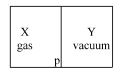
AnswerCorrect option: A. No work is done by $ X$
a
Work done by a gas is given by$:$
$w=\int P d V$
Work done by $x$ is against vacuum, hence $P=0$
$w=\int P d V=\int 0 d V=0$
Hence no work is done by or done on $x$.
View full question & answer→MCQ 1461 Mark
In a cyclic process, a gas is taken from state $A$ to $B$ via path $-I$ as shown in the indicator diagram and taken back to state $A$ from state $B$ via path $-II$ . In the complete cycle
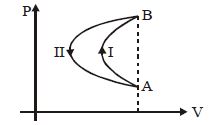
- ✓
positive work is done on the gas
- B
- C
no work is done by the gas
- D
nothing can be said about work as data is insufficient
AnswerCorrect option: A. positive work is done on the gas
a
As work done in state $(II)$ is more than in state $(I)$
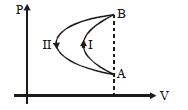
View full question & answer→MCQ 1471 Mark
Air is pumped into a balloon, of initial volume $V$ , until its diameter has doubled. If the atmospheric pressure is $p$ , what is the work done against the atmosphere ?
- A
$pV$
- B
$3\ pV$
- C
$4\ pV$
- ✓
$7\ pV$
AnswerCorrect option: D. $7\ pV$
d
$V\ \propto \ R^3, R \rightarrow 2R$ then $V \rightarrow 8V$
Work $ = P (8V -V) = 7PV$ [isobaric process]
View full question & answer→MCQ 1481 Mark
$100\ g$ of water is heated from $30^o\ C$ to $50^o\ C$ Ignoring the slight expansion of the water, the change in its internal energy is ...... $kJ$ (specific heat of water is $4184\ J/kg/K$)
Answerd
As work done $=0$
$[\mathrm{as} W=p \Delta V \text { and } \Delta V=0, \text { so } W=0]$
$\Delta U=m C \Delta T$
$=100 \times 10^{-3} \times 4184 \times(50-30) \approx 8.4 \mathrm{kJ}$
View full question & answer→MCQ 1491 Mark
An ideal gas is taken through the cycle $A \to B \to C \to A$ , as shown in the figure. If the net heat supplied to the gas in the cycle is $5\ J$, the work done by the gas in the process $C \to A$ is .... $J$
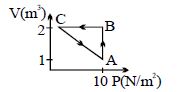
Answera
$\mathrm{dR}=\mathrm{dU}+\mathrm{d} \mathrm{W}$
$5=0+10(2-1)+0+\mathrm{W}_{\mathrm{CA}}$
$\mathrm{W}_{\mathrm{CA}}=5-10$
$=-5$ Joule
View full question & answer→MCQ 1501 Mark
In the $P-V$ diagram shown, the gas does $5\, J$ of work in isothermal process $ab$ and $4\,J$ in adiabatic process $bc$. .... $J$ will be the change in internal energy of the gas in straight path $c$ to $a$ ?
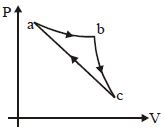
Answerc
For isothermal : $\Delta U = 0$
For adiabatic : $\Delta U = -\Delta W$
View full question & answer→MCQ 1511 Mark
A fixed amount of a gas undergoes a thermodynamic process as shown such that heat interaction along path $B \to C \to A$ is equal to the work done by the gas along path $A \to B \to C$. Then process $A \to B$ is :-
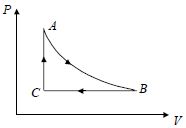
- A
- ✓
- C
can be isothermal or adiabatic
- D
Answerb
As process is cyclic $\Rightarrow \Delta \mathrm{U}_{\mathrm{ABCA}}=0$
$\Rightarrow \mathrm{Q}_{\mathrm{ABCA}}=\mathrm{W}_{\mathrm{ABCA}}$
$\Rightarrow \mathrm{Q}_{\mathrm{A} \rightarrow \mathrm{B}}+\mathrm{Q}_{\mathrm{B} \rightarrow \mathrm{C}}+\mathrm{Q}_{\mathrm{C} \rightarrow \mathrm{A}}$
$=\mathrm{W}_{\mathrm{A} \rightarrow \mathrm{B}}+\mathrm{W}_{\mathrm{B} \rightarrow \mathrm{C}}+\mathrm{W}_{\mathrm{C} \rightarrow \mathrm{A}}$ $.(1)$
Given $Q_{B \rightarrow C}+Q_{C \rightarrow A}=W_{A \rightarrow B}+W_{B \rightarrow C}$ $(2)$
Subtracting $( 2)$ from $( 1)$
$\mathrm{Q}_{\mathrm{A} \rightarrow \mathrm{B}}=\mathrm{W}_{\mathrm{C} \rightarrow \mathrm{A}}=0$
(as process $\mathrm{C} \rightarrow \mathrm{A}$ is isochoric)
process $A \rightarrow B$ is adiabatic.
View full question & answer→MCQ 1521 Mark
In the figure shown, amount of heat supplied to one mole of an ideal gas is plotted on the horizontal axis and amount of work done by gas is drawn on vertical axis. Assuming process be isobaric i.e. gas can be
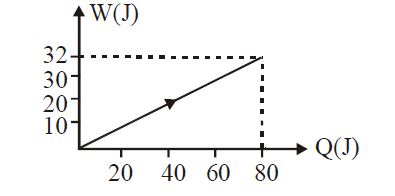
Answera
$\frac{W}{Q}=\frac{n R \Delta T}{n C_{p} \Delta T}=\frac{3 2}{80}=\frac{2}{5}$
$5 \mathrm{R}=2 \mathrm{C}_{\mathrm{p}}=2\left[\mathrm{C}_{\mathrm{v}}+\mathrm{R}\right]$
$C_{v}=\frac{3 R}{2}$
$\therefore(1)$
View full question & answer→MCQ 1531 Mark
In the following figures heat is absorbed by the gas
MCQ 1541 Mark
When an ideal diatomic gas is heated at constant pressure, the fraction of the heat energy supplied which increases the internal energy of the gas, is
Answerd
Fraction of supplied energy which increases the internal energy is given by
$f=\frac{\Delta \mathrm{U}}{(\Delta \mathrm{Q})_{\mathrm{P}}}=\frac{(\Delta \mathrm{Q})_{\mathrm{V}}}{(\Delta \mathrm{Q})_{\mathrm{P}}}=\frac{\mu \mathrm{C}_{\mathrm{V}} \Delta \mathrm{T}}{\mu \mathrm{C}_{\mathrm{P}} \Delta \mathrm{T}}=\frac{1}{\gamma}$
For diatomic gas $\gamma=\frac{7}{5} \Rightarrow f=\frac{5}{7}$
View full question & answer→MCQ 1551 Mark
An ideal gas expands isothermally along $ab$ and does $600\,J$ of work. During the process
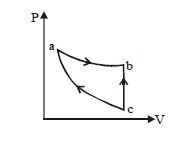
- A
the heat rejected by the gas to the surroundings is $600\,J$
- ✓
the heat absorbed by the gas from the surrounding is $600\,J$
- C
no heat exchange between gas and its surroundings takes place
- D
the heat absorbed by the gas is less than $600\,J$
AnswerCorrect option: B. the heat absorbed by the gas from the surrounding is $600\,J$
b
$dQ=dU+dW$
$dQ=0+600$
$dQ=600\,J$
View full question & answer→MCQ 1561 Mark
The adjoining figure shows the $P-V$ diagram for a fixed mass of an ideal gas undergoing cyclic process. $AB$ represents isothermal process and $CA$ represents isochoric process.Which of the graph shown in the following figures represents the $P-T$ diagram of the cyclic process ?
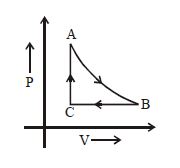
Answerd
| $AB$ |
$BC$ |
$CA$ |
| $T-constant$ |
$P-constant$ |
$P\uparrow$ |
| $P\propto \frac{1}{V}$ |
$V\propto T$ |
$T\downarrow$ |
|
$P \uparrow$
$V \downarrow$
|
$V \downarrow$
$T \uparrow$
|
|
View full question & answer→MCQ 1571 Mark
A Container having $1\ mole$ of a gas at a temperature $27\ ^oC$ has a movable piston which maintains at constant pressure in container of $1\ atm.$ The gas is compressed until temperature becomes $127^oC.$ The work done is ........ $J$ $(C_p\ for\ gas\ is\ 7.03\ cal/mol-K)$
- A
$703$
- ✓
$831$
- C
$121$
- D
$2035 $
Answerb
At constant pressure $W=P \Delta V=\mu R \Delta T$
$=1 \times 8.31 \times 100=831$
View full question & answer→MCQ 1581 Mark
The figure shows the $P-V$ plot of an ideal gas taken through a cycle $ABCDA.$ The part $ABC$ is a semicircle and $CDA$ is half of an ellipse. Then,
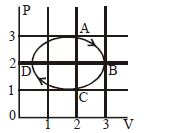
- A
The process during the path $A \to B$ is isothermal
- B
Heat is absorbed by the gas during the path $B\to C\to D$
- C
Work done during the path $A\to B\to C$ is zero
- ✓
Positive work is done by the gas in the cycle $ABCDA$
AnswerCorrect option: D. Positive work is done by the gas in the cycle $ABCDA$
d
For clockwise cycle on $p-V$ diagram with $P$ on $y$ $-axis,$ net work done is positive.
View full question & answer→MCQ 1591 Mark
A cyclic process $ABCA$ is shown in the $V-T$ diagram. Process on the $P-V$ diagram is
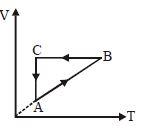
Answerc
The process $A B$ is isobaric since it is an inclined straight line in the $V-T$ diagram.
The process $\mathrm{BC}$ is an isochoric process since the volume is constant
The process $\mathrm{CA}$ is isothermal since, temperature remains constant.
The only $P-v$ graph that matches the above criteria is option $\mathrm{C}$
View full question & answer→MCQ 1601 Mark
An ideal monoatomic gas is taken round the cycle $12341$ shown in the figure ( $p\,-\,V$ diagram). The work done in one cycle is ?
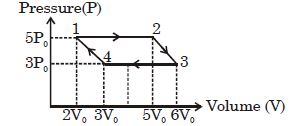
- A
$3P_0V_0$
- B
$8P_0V_0$
- ✓
$6P_0V_0$
- D
$5P_0V_0$
AnswerCorrect option: C. $6P_0V_0$
c
$W_{clockwise\,cycle} = + (Area\, 12341)$
$= (6V_0 -3V_0) (5P_0 -3P_0) = 6P_0V_0$
View full question & answer→MCQ 1611 Mark
The latent heat of vaporization of water is $2240 \,J/gm$. If the work done in the process of vaporization of $1\, gm$ is $168\, J$, then increase in internal energy is .... $J$
- A
$2408$
- B
$2240$
- ✓
$2072$
- D
$1904$
AnswerCorrect option: C. $2072$
c
$\mathrm{L}=2240 \mathrm{J}, \mathrm{m}=1 \mathrm{gm}$
$\mathrm{d} \mathrm{W}=168 \mathrm{J}$
$\mathrm{dQ}=\mathrm{mL}=\mathrm{dU}+\mathrm{d} \mathrm{W}$
or $1 \times 2240=d U+168$
$\mathrm{dU}=2072 \mathrm{J}$
View full question & answer→MCQ 1621 Mark
A diatomic ideal gas undergoes a thermodynamic change according to the $P-V$ diagram shown in the figure. The heat given the gas in $AB$
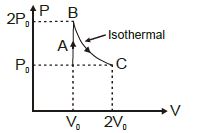
- ✓
$2.5\,\, P_0\,V_0$
- B
$1.4\,\, P_0\,V_0$
- C
$3.9\,\, P_0\,V_0$
- D
$1.1\,\, P_0\,V_0$
AnswerCorrect option: A. $2.5\,\, P_0\,V_0$
a
$\mathrm{AB} \rightarrow \Delta \mathrm{Q}=\mu \mathrm{C}_{\mathrm{v}} \Delta \mathrm{T}$
$=\mu \frac{1}{2} \mathrm{R}\left(2 \mathrm{T}_{0}-\mathrm{T}_{0}\right)$
$=\frac{5}{2} \mathrm{P}_{0} \mathrm{V}_{0}$
View full question & answer→MCQ 1631 Mark
An ideal monoatomic gas is taken through the thermodynamic states $A \to B \to C \to D$ via the paths shown in the figure. If $U_A, U_B, U_C$ and $U_D$ represent the internal energy of the gas in state $A, B\, C$ and $D$ respectively, then which of the following is not true?
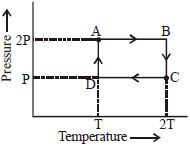
- A
$U_A -U_D = 0$
- B
$U_B -U_C = 0$
- C
$U_C -U_D > 0$
- ✓
$U_B -U_A < 0$
AnswerCorrect option: D. $U_B -U_A < 0$
d
$A \rightarrow B$ Isobaric process $B-C$ Isothermal Process
$P=$ const
$\mathrm{U}_{\mathrm{C}}-\mathrm{U}_{\mathrm{B}}=0$
$\mathrm{T} \uparrow$
$\mathrm{U}_{\mathrm{B}}-\mathrm{U}_{\mathrm{A}}>0$
$\mathrm{C} \rightarrow \mathrm{D}$
$\mathrm{U}_{\mathrm{C}}-\mathrm{U}_{\mathrm{P}}>0$
View full question & answer→MCQ 1641 Mark
A shown in the figure, the amount of heat absorbed along the path $ABC$ is $90\,J$ and the amount of work done by the system is $30\,J$ . If the amount of work done along the path $ADC$ is $20\,J$ , the amount of heat absorbed will be .... $J$
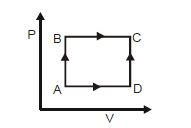
Answera
$\Delta \mathrm{U}_{\mathrm{ABC}}=\Delta \mathrm{U}_{\mathrm{ADC}}$
$\Rightarrow \Delta \mathrm{Q}_{\mathrm{ABC}}-\mathrm{W}_{\mathrm{ABC}}=\Delta \mathrm{Q}_{\mathrm{ADC}}-\mathrm{W}_{\mathrm{ADC}}$
$\Rightarrow 90-30=\Delta Q_{A D C}-20$
$\Rightarrow \Delta \mathrm{Q}_{\mathrm{ADC}}=80 \mathrm{J}$
View full question & answer→MCQ 1651 Mark
A thermodynamic process is the pressure and volumes corresponding to some points in the figure are, $P_A = 3 \times 10^4 Pa$, $V_A = 2 \times 10^{-3}\, m^3$, $P_B = 8 \times 10^4 Pa$, $V_D = 5 \times 10^{-3}\,m^3$. In process $AB, 600\, J$ of heat and in process $BC, 200\, J$ of heat is added to the system. The change in the internal energy in process $AC$ would be .... $J$
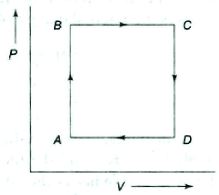
Answera
$\Delta \mathrm{U}_{\mathrm{AC}}=\Delta \mathrm{U}_{\mathrm{AC}}+\mathrm{W}_{\mathrm{AC}}$
$(600+200)=\Delta \mathrm{U}_{\mathrm{AC}}+\left[8 \times 10^{4}(5-2) \times 10^{-3}\right]$
$\Delta \mathrm{U}_{\mathrm{AC}}=800-240$
$=560$ Jule.
View full question & answer→MCQ 1661 Mark
Figure shows a polytropic process for an ideal gas. The work done by the gas will be in process $AB$ is
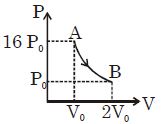
- A
$\frac{{15}}{2}\,{P_0}{V_0}$
- ✓
$\frac{{14}}{3}\,{P_0}{V_0}$
- C
$8\,{P_0}{V_0}$
- D
AnswerCorrect option: B. $\frac{{14}}{3}\,{P_0}{V_0}$
b
$\because P_{1} V_{1}^{x}=P_{2} V_{2}^{x}$
$\frac{16 \mathrm{P}_{0}}{\mathrm{P}_{0}}=\left(\frac{2 \mathrm{V}_{0}}{\mathrm{V}_{0}}\right)^{\mathrm{x}}$
$x=4$
$\mathrm{w}=\frac{\mathrm{P}_{2} \mathrm{V}_{2}-\mathrm{P}_{1} \mathrm{V}_{1}}{1-\mathrm{x}}=\frac{2 \mathrm{P}_{0} \mathrm{V}_{0}-16 \mathrm{P}_{0} \mathrm{V}_{0}}{1-4}$
$=\frac{14}{3} \mathrm{P}_{0} \mathrm{V}_{0}$
View full question & answer→MCQ 1671 Mark
A cyclic process is shown in figure. Work done during isobaric expansion is ...... $J$
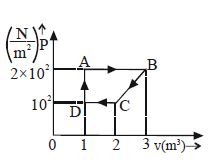
Answerc
$W = 2\times10^2\, (2) = 400\, J$
View full question & answer→MCQ 1681 Mark
What is the nature of change in internal energy in the following three thermodynamical processes shown in figure
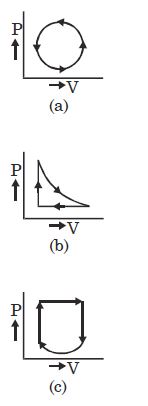
- A
$\Delta U$ is positive in all the three cases
- B
$\Delta U$ is negative in all the three cases
- C
$\Delta U$ is $+$ for $(a)$, $-$ for $(b)$, zero for $(c)$
- ✓
$\Delta U = 0$, in all the cases
AnswerCorrect option: D. $\Delta U = 0$, in all the cases
d
$dU$ is independent to path (it is a state function)
View full question & answer→MCQ 1691 Mark
When an ideal triatomic non-linear gas is heated at constant pressure, the fraction of the heat energy supplied which increases the internal energy of the gas is
- A
$1.33$
- ✓
$0.75$
- C
$0.71$
- D
$1.67$
AnswerCorrect option: B. $0.75$
b
Heat supplied at constant pressure $=\mathrm{nC}_{\mathrm{p}} \Delta \mathrm{T}$
Change in internal energy $=\mathrm{nC}_{\mathrm{v}} \Delta \mathrm{T}$
$\therefore$ Fraction $=\frac{C_{v}}{C_{p}}=\frac{1}{\gamma}$
For a non$-$linear triatomic gas $\gamma=\frac{4}{3}$
fraction $=\frac{3}{4}$
View full question & answer→MCQ 1701 Mark
Pressure versus temperature graph of an ideal gas is as shown in figure. Density of the gas at point $A$ is ${\rho _0}$. Density at point $B$ will be
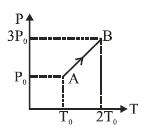
- A
$\frac{3}{4}\,{\rho _0}$
- ✓
$\frac{3}{2}\,{\rho _0}$
- C
$\frac{4}{3}\,{\rho _0}$
- D
$2\,{\rho _0}$
AnswerCorrect option: B. $\frac{3}{2}\,{\rho _0}$
b
$\rho=\frac{P M}{R T}$ or $\rho \propto \frac{P}{T}$
$\left(\frac{P}{T}\right)_{A}=\frac{P_{0}}{T_{0}}$ and $\left(\frac{P}{T}\right)_{B}$
$=\frac{3}{2}\left(\frac{P_{0}}{T_{0}}\right)\left(\frac{P}{T}\right)_{B}=\frac{3}{2}\left(\frac{P}{T}\right)_{A}$
$\therefore \quad \rho_{B}=\frac{3}{2} \rho_{A}=\frac{3}{2} \rho_{0}$
View full question & answer→MCQ 1711 Mark
$1\, mole$ of an ideal monoatomic gas at temperature $'T_0'$ expands slowly according to the law $P = KV$, where $K$ is a constant. If the final temperature of the gas is $2T_0$. Find the heat supplied to the gas
- A
$\frac{{2{T_0}}}{2}$
- B
${2{T_0}}$
- ✓
${2RT}$
- D
$\frac{3}{2}\,R{T_0}$
AnswerCorrect option: C. ${2RT}$
c
$\mathrm{Q}=\Delta \mathrm{U}+\Delta \mathrm{w}$
$\Delta \mathrm{U}=\mathrm{nC}_{\mathrm{v}} \Delta \mathrm{T}=1 \times \frac{3}{2} \mathrm{R} \times\left(2 \mathrm{T}_{0}-\mathrm{T}_{0}\right)=\frac{3}{2} \mathrm{RT}_{0}$
Work $=\frac{\mu R \Delta T}{n-1}=\frac{1 \times R \times\left(2 T_{0}-T_{0}\right)}{2} \Rightarrow\left(\frac{R T_{0}}{2}\right)$
$\mathrm{Q}=\frac{3}{2} \mathrm{RT}_{0}+\frac{\mathrm{RT}_{0}}{2}$
$=2 \mathrm{RT}_{0}$
View full question & answer→MCQ 1721 Mark
A sample of ideal gas $(\gamma = 1.4)$ is heated at constant pressure. If an $100\, J$ is supplied to gas, the work done by the gas is ...... $J$
- A
$42.12$
- B
$56.28$
- ✓
$28.57$
- D
$36.23$
AnswerCorrect option: C. $28.57$
c
At constant pressure
$\mathrm{W}=\mathrm{P} \Delta \mathrm{V}=\mathrm{n} \mathrm{R} \Delta \mathrm{T}$
But $Q=n C_{p} \Delta T=n \frac{\gamma R}{r-1}$
$\Rightarrow \quad W=Q\left(\frac{\gamma-1}{r}\right)=100\left(\frac{1.4-1}{1.4}\right)=28.57 \mathrm{J}$
View full question & answer→MCQ 1731 Mark
A monoatomic gas is taken along path $AB$ as shown. Calculate change in internal energy of system
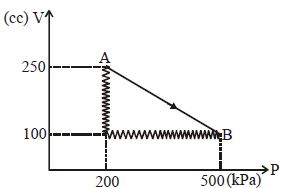
- A
$279.8\,\,J$
- B
$341\,\,J$
- C
$241\,\,J$
- ✓
Answerd
$\Delta U\, = \,n{C_v}\Delta T\, = \,F/2\,({P_2}{V_2} - {P_1}{V_1})$
$\Delta U =$ Zero
View full question & answer→MCQ 1741 Mark
A gas taken through cyclic process $ABCA$ is shown in figure. If $2.4\,cal.$ of heat is given in the process, what is value of $J$ ...... $J/cal$ (mechanical equivalent of heat)?
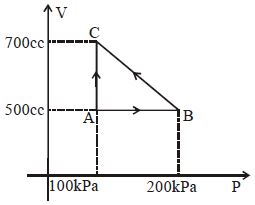
AnswerCorrect option: A. $4.17$
a
for cyclic process
$\mathrm{dQ}=\mathrm{d} \mathrm{W}$
$\Rightarrow \mathrm{d} \mathrm{Q}=\frac{1}{2} \times 200 \times 100 \times 10^{-6} \times 10^{3} \mathrm{J}=10 \mathrm{Joule}$
also $dQ$ $=2.4 \mathrm{cal}$
$\Rightarrow \mathrm{J}=\frac{10}{2.4}=4.17 \mathrm{J} / \mathrm{cal}$
View full question & answer→MCQ 1751 Mark
The $P-V$ diagram of a certain process (carnot cycle) is as shown. The process is also represent as
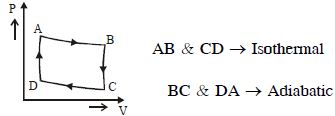
Answerc
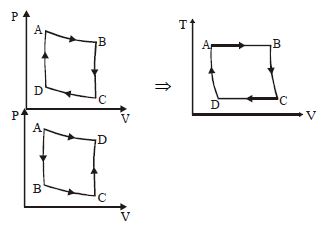
View full question & answer→MCQ 1761 Mark
In the $P-V$ diagram, $I$ is the initial state and $F$ is the final state. The gas goes from $I$ to $F$ by $(i)\,IAF,\,\,(ii)\,IBF,\,\,(iii) ICF$. The heat absorbed by the gas is
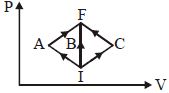
- A
the same in all three processes
- B
the same in $(i)$ and $(ii)$
- ✓
greater in $(i)$ than in $(ii)$
- D
the same in $(i)$ and $(iii)$
AnswerCorrect option: C. greater in $(i)$ than in $(ii)$
c
Heat absrobed in a thermodynamic process is given by
$\Delta \mathrm{Q}=\Delta \mathrm{U}+\Delta \mathrm{W}$
Here, $\Delta \mathrm{U}$ is same for all the three processes as it depends only on initial and final states.
$\text { But } \quad \Delta \mathrm{W}_{1}=+\mathrm{ve}, \Delta \mathrm{W}_{\mathrm{II}}=0$
${\text { and }} {\Delta \mathrm{W}_{\mathrm{III}}=-\mathrm{ve}} $
${\text { or }} {\Delta \mathrm{Q}_{1}>\Delta \mathrm{Q}_{\mathrm{II}}}$
View full question & answer→MCQ 1771 Mark
In a thermodynamics process, pressure of a fixed mass of a gas is changed in such a manner that the gas releases $20\,J$ of heat and $8\,J$ of work is done on the gas. If the initial internal energy of the gas was $30\,J$. The final internal energy will be...... $J$
Answera
$d Q=-20 J$
$d W=-8 J$
$V_{i}=30 J$
$d Q=d V+d W$
$d Q=\left(V_{f}-V_{i}\right)+d W$
$-20=\left(V_{f}-30\right)-8$
$-12=V_{f}-30$
$V_{f}=18$
$\therefore$ Final internal energy $=18 J$
View full question & answer→MCQ 1781 Mark
One mole of a monoatomic gas is carried along process $ABCDEA$ as shown in diagram. Find the net work done by gas ......... $J$
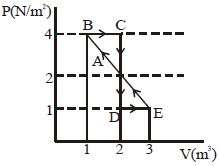
Answerc
Work $=$ Area enclosed by curve
$\mathrm{W}=\mathrm{W}_{\mathrm{ABCD}}+\mathrm{W}_{\mathrm{DEAD}}$
$\mathrm{W}=1-\frac{1}{2}=\frac{1}{2} \mathrm{J}$
View full question & answer→MCQ 1791 Mark
An ideal system can be brought from state $A$ to $B$ through four paths as shown in the figure. The energy given to the system is minimum in
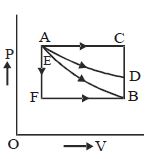
- A
path $ACB$
- B
path $ADB$
- C
path $AEB$
- ✓
path $AFB$
AnswerCorrect option: D. path $AFB$
d
$\Delta Q = \Delta W + dU$ for all path $dU$ will be same due to state function. and work done will be minimum in $AFB$ path so energy given to system is min in $AFB$ path.
View full question & answer→MCQ 1801 Mark
For a thermodynamic process $\delta Q = -50$ $calorie$ and $W = -20$ $calorie$ . If the initial internal energy is $-30$ $calorie$ then final internal energy will be ....... $calorie$
- A
$191.20$
- ✓
$-60$
- C
$100$
- D
$-100$
Answerb
$\delta \mathrm{Q}=\mathrm{W}+\delta \mathrm{U}$
$-50=-20+\left(U_{t}-U_{1}\right)$
$\mathrm{U}_{\mathrm{f}}-(-30)=-30$
$\mathrm{U}_{\mathrm{f}}=-60 \mathrm{Cal}$
View full question & answer→MCQ 1811 Mark
Following figure shows $P-T$ graph for four processes $A, B, C$ and $D$. Select the correct alternative
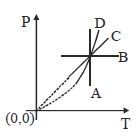
- A
$A -$ Isobaric process
- B
$B-$ Adiabatic process
- ✓
$C-$ Isochoric process
- D
$D-$ Isothermal process
AnswerCorrect option: C. $C-$ Isochoric process
View full question & answer→MCQ 1821 Mark
The figure shows $P-V$ diagram of a thermodynamic cycle. Which corresponding curve is correct?
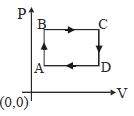
Answera
$\begin{array}{lll}\text { For } A-B: V=\text { constant } & \text { (ideal qas equation } \Rightarrow) \\ (P \propto T) & (\text { straight line) } & (P V=n R T \\ A B & & (P \alpha T) \text { for } A B\end{array}$
For $B-C \because P=$ constant $(v \propto T)$ for $B C$
$(V \propto T)$ (constant line parallel to $T($ temperature)) axis.
For $C D$ it will be similar to $A B$
and $DA$ It will be simicar to $BC$
$\therefore$ considering all above constraints option $(A)$ is the correct graph
View full question & answer→MCQ 1831 Mark
Work done in the cyclic process shown in figure is ...........
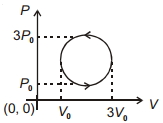
- A
$4 P_0 V_0$
- B
$-4 P_0 V_0$
- ✓
$-\frac{22}{7} P_0 V_0$
- D
$-13 P_0 V_0$
AnswerCorrect option: C. $-\frac{22}{7} P_0 V_0$
c
(c)
Cyclic process is anticlockwise then
Work done $=-$ (Area of $P-V$ graph $)$
$W=-\pi R_1 R_2$
$=-\pi\left(\frac{3 P_0-P_0}{2}\right) \times\left(\frac{3 V_0-V_0}{2}\right)$
$=\frac{-22}{7} P_0 V_0$
View full question & answer→MCQ 1841 Mark
Work done for the process shown in the figure is ............ $J$
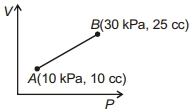
Answerd
(d)
Area under graph and $V$ axis $=$ work done
$=\frac{1}{2} \times(30+10) \times 10^3 \times(25-10) \times 10^{-6}$
$=0.3 \,J$
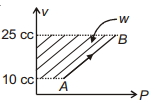
View full question & answer→MCQ 1851 Mark
If a gas is taken from $A$ to $C$ through $B$ then heat absorbed by the gas is $8 \,J$. Heat absorbed by the gas in taking it from $A$ to $C$ directly is ............. $J$
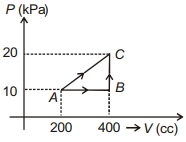
Answerb
(b)
When taken through $A B C[\triangle U+$ work $=$ heat absorbed $]$
Heat absorbed $=$ area under graph $+\Delta U=8$
$\Delta U=8-\frac{10 \times 200}{1000}=6$
when taken directly to $C$
$W+\Delta U=Q$
${\left[\frac{10 \times 200}{1000}+\frac{1}{2} \times \frac{2000}{1000}\right]+6=Q \Rightarrow Q=9 \,J }$
View full question & answer→MCQ 1861 Mark
A $P-T$ graph is shown for a cyclic process. Select correct statement regarding this
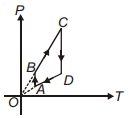
- A
During process $C D$, work done by gas is negative
- B
During process $A B$, work done by the gas is positive
- ✓
During process $B C$ internal energy of system increases
- D
During process $B C$ internal energy of the system decreases
AnswerCorrect option: C. During process $B C$ internal energy of system increases
c
(c)
In process $B C$ (isochoric process) where $\Delta T$ is (+)ive.
So $\Delta U=n C_v \Delta T$
$\because \Delta T$ is positive $\Rightarrow U$ increases
View full question & answer→MCQ 1871 Mark
For a reversible process, necessary condition is
- A
In the whole cycle of the system, the loss of any type of heat energy should be zero
- B
That the process should be too fast
- C
That the process should be slow so that the working substance should remain in thermal and mechanical equilibrium with the surroundings
- ✓
The loss of energy should be zero and it should be quasistatic
AnswerCorrect option: D. The loss of energy should be zero and it should be quasistatic
d
(d) For a reversible process $\int {\frac{{dQ}}{T} = 0} $
View full question & answer→MCQ 1881 Mark
A solid body of constant heat capacity $1\,J /{ }^{\circ} C$ is being heated by keeping it in contact with reservoirs in two ways :
$(i)$ Sequentially keeping in contact with $2$ reservoirs such that each reservoir supplies same amount of heat.
$(ii)$ Sequentially keeping in contact with 8 reservoirs such that each reservoir supplies same amount of heat.
In both the cases body is brought from initial temperature $100^{\circ}\,C$ to final temperature $200^{\circ}\,C$. Entropy change of the body in the two cases respectively is :
- A
$\ln 2,2 \ln 2$
- B
$2 \ln 2,8 \ln 2$
- C
$\ln 2,4 \ln 2$
- ✓
$\ln 2, \ln 2$
AnswerCorrect option: D. $\ln 2, \ln 2$
d
(d)
The entropy change of the body in the two cases is same as entropy is a state function.
View full question & answer→MCQ 1891 Mark
A Carnot engine working between $300\,K$ and $600\,K$ has work output of $800\, J$ per cycle. What is amount of heat energy supplied to the engine from source per cycle...... $J/cycle$
- A
$1800$
- B
$1000$
- C
$2000 $
- ✓
$1600$
AnswerCorrect option: D. $1600$
d
(d) $\eta = \frac{{{T_1} - {T_2}}}{{{T_1}}} = \frac{W}{Q}$
==> $Q = \left( {\frac{{{T_1}}}{{{T_1} - {T_2}}}} \right)\,W$
$ = \frac{{600}}{{(600 - 300)}} \times 800 =1600 \,J$
View full question & answer→MCQ 1901 Mark
An ideal heat engine exhausting heat at ${77^o}C$ is to have a $30\%$ efficiency. It must take heat at ...... $^oC$
Answerb
(b) $\eta = 1 - \frac{{{T_2}}}{{{T_1}}}$ ==> $\frac{{30}}{{100}} = 1 - \frac{{350}}{{{T_1}}}$
==> $\frac{{350}}{{{T_1}}} = 1 - \frac{{50}}{{100}} = \frac{{70}}{{100}} = \frac{7}{{10}}$==> ${T_1} = 500\,K = 227^\circ C$
View full question & answer→MCQ 1911 Mark
Efficiency of Carnot engine is $100\%$ if
- A
${T_2} = 273\,\,K$
- ✓
${T_2} = 0\,\,K$
- C
${T_1} = 273\,\,K$
- D
${T_1} = 0\,\,K$
AnswerCorrect option: B. ${T_2} = 0\,\,K$
b
(b) $\eta = 1 - \frac{{{T_2}}}{{{T_1}}}$ for $100\%$ efficiency $\eta = 1$ which gives $T_2 = 0\, K.$
View full question & answer→MCQ 1921 Mark
A Carnot's engine used first an ideal monoatomic gas then an ideal diatomic gas. If the source and sink temperature are ${411^o}C$ and ${69^o}C$ respectively and the engine extracts $1000\, J $ of heat in each cycle, then area enclosed by the $PV$ diagram is ........ $J$
- A
$100 $
- B
$300 $
- ✓
$500 $
- D
$700 $
AnswerCorrect option: C. $500 $
c
(c) $\eta = 1 - \frac{{{T_2}}}{{{T_1}}} = 1 - \frac{{(273 + 69)}}{{(273 + 411)}} = 0.5$
==> Work done$ = \eta \times Q = 0.5 \times 1000 = 500\,J$
View full question & answer→MCQ 1931 Mark
A Carnot engine absorbs an amount $Q$ of heat from a reservoir at an abosolute temperature $T$ and rejects heat to a sink at a temperature of $T/3.$ The amount of heat rejected is
- A
$Q / 4$
- ✓
$Q / 3$
- C
$Q / 2$
- D
$2Q / 3$
AnswerCorrect option: B. $Q / 3$
b
(b) $\because \;\eta = 1 - \frac{{{T_2}}}{{{T_1}}} = \frac{W}{{{Q_1}}}$ ${T_2} = 300\,K$
where ${Q_1} = $ heat absorbed, ${Q_2} = $ heat rejected
==> $1 - \frac{{T/3}}{T} = \frac{W}{{{Q_1}}}$ ==> $\frac{2}{3} = \frac{W}{{{Q_1}}} = \frac{{{Q_1} - {Q_2}}}{{{Q_1}}}$
==> $\frac{2}{3} = 1 - \frac{{{Q_2}}}{{{Q_1}}}$ ==> $\frac{{{Q_2}}}{{{Q_1}}} = \frac{1}{3}$ ==> ${Q_2} = \frac{{{Q_1}}}{3} = \frac{Q}{3}$
View full question & answer→MCQ 1941 Mark
The temperature of sink of Carnot engine is ${27^o}C$. Efficiency of engine is $25\%.$ Then temperature of source is ...... $^oC$
Answerc
(c) $\eta = 1 - \frac{{{T_2}}}{{{T_1}}}$ ==> $\frac{{25}}{{100}} = 1 - \frac{{300}}{{{T_1}}}$ ==> $\frac{1}{4} = 1 - \frac{{300}}{{{T_1}}}$
${T_1} = 400\,K = 127^\circ C$
View full question & answer→MCQ 1951 Mark
The temperature of reservoir of Carnot's engine operating with an efficiency of $70\%$ is $1000K.$ The temperature of its sink is ...... $K$
- ✓
$300 $
- B
$400 $
- C
$500 $
- D
$700 $
AnswerCorrect option: A. $300 $
a
(a) $\eta = 1 - \frac{{{T_2}}}{{{T_1}}}$ ==> $\frac{{70}}{{100}} = 1 - \frac{{{T_2}}}{{1000}}$ ==> ${T_2} = 300\,K$
View full question & answer→MCQ 1961 Mark
In a Carnot engine, when ${T_2} = {0^o}C$ and ${T_1} = {200^o}C,$ its efficiency is ${\eta _1}$ and when ${T_1} = 0{\,^o}C$ and ${T_2} = - 200{\,^o}C$, Its efficiency is ${\eta _2}$, then what is ${\eta _1}/{\eta _2}$
- ✓
$0.577$
- B
$0.733$
- C
$0.638$
- D
AnswerCorrect option: A. $0.577$
a
(a) $\eta = 1 - \frac{{{T_2}}}{{{T_1}}} = \frac{{{T_1} - {T_2}}}{{{T_1}}}$ $ \Rightarrow \,{\eta _1} = \frac{{(473 - 273)}}{{473}} = \frac{{200}}{{473}}$
and ${\eta _2} = \frac{{273 - 73}}{{273}} = \frac{{200}}{{273}}$
So required ratio $\frac{{{\eta _1}}}{{{\eta _2}}} = \frac{{273}}{{473}} = 0.577$
View full question & answer→MCQ 1971 Mark
A carnot engine has the same efficiency between $800 K$ to $500 K$ and $x\, K$ to $600 K.$ The value of $x$ is ...... $K$
- A
$1000 $
- ✓
$960 $
- C
$846 $
- D
$754 $
AnswerCorrect option: B. $960 $
b
(b) In first case, $({\eta _1}) = 1 - \frac{{500}}{{800}} = \frac{3}{8}$
and in second case, $({\eta _2}) = 1 - \frac{{600}}{x}$
Since ${\eta _1} = {\eta _2},$ therefore $\frac{3}{8} = 1 - \frac{{600}}{x}$
or $\frac{{600}}{x} = 1 - \frac{3}{8} = \frac{5}{8}$or$x = \frac{{600 \times 8}}{5} = 960K$
View full question & answer→MCQ 1981 Mark
A Carnot’s engine is made to work between $200°C$ and $0°C$ first and then between $0°C$ and $-200°C.$ The ratio of efficiencies of the engine in the two cases is
- A
$1.73 : 1$
- ✓
$1:1.73$
- C
$1:1$
- D
$1:2$
AnswerCorrect option: B. $1:1.73$
b
(b) In first case ${\eta _1} = 1 - \frac{{{T_2}}}{{{T_1}}} = 1 - \frac{{(273 + 0)}}{{(273 + 200)}} = \frac{{200}}{{473}}$
In second case ${\eta _2} = 1 - \frac{{(273 - 200)}}{{(273 + 0)}} = \frac{{200}}{{273}}$
==> $\frac{{{\eta _1}}}{{{\eta _2}}} = \frac{1}{{\left( {\frac{{473}}{{273}}} \right)}} = 1:1.73$
View full question & answer→MCQ 1991 Mark
For which combination of working temperatures the efficiency of Carnot’s engine is highest
- A
$80 K, 60 K$
- B
$100 K, 80 K$
- C
$60 K, 40 K$
- ✓
$40 K, 20 K$
AnswerCorrect option: D. $40 K, 20 K$
d
(d) $\eta = 1 - \frac{{{T_2}}}{{{T_1}}};$ for $\eta$ to be max. ratio $\frac{{{T_2}}}{{{T_1}}}$ should be min.
View full question & answer→MCQ 2001 Mark
An ideal heat engine working between temperature $T_1$ and $T_2 $ has an efficiency $\eta$, the new efficiency if both the source and sink temperature are doubled, will be
- A
$\frac{\eta }{2}$
- ✓
$\eta $
- C
$2\eta $
- D
$3\eta $
AnswerCorrect option: B. $\eta $
b
(b) In first case ${\eta _1} = \frac{{{T_1} - {T_2}}}{{{T_1}}}$
In second case ${\eta _2} = \frac{{2{T_1} - 2{T_2}}}{{2{T_1}}}$$ = \frac{{{T_1} - {T_2}}}{{{T_1}}} = \eta $
View full question & answer→MCQ 2011 Mark
An engine is supposed to operate between two reservoirs at temperature $727°C$ and $227°C.$ The maximum possible efficiency of such an engine is
Answera
(a) $\eta = \frac{{{T_1} - {T_2}}}{{{T_1}}} = \frac{{(273 + 727) - (273 + 227)}}{{273 + 727}}$$ = \frac{{1000 - 500}}{{1000}} = \frac{1}{2}$
View full question & answer→MCQ 2021 Mark
An engineer claims to have made an engine delivering $10 kW$ power with fuel consumption of $1 g/sec$. The calorific value of the fuel is $2 kcal/g$. Is the claim of the engineer
Answerb
(b) Input energy $ = \frac{{1g}}{{\sec }} \times \frac{{2kcal}}{g} = 2kcal/\sec .$
Output energy $ = 10\;KW = 10\;K\;J/S$$ = \frac{{10}}{{4.2}}kcal/\sec .$
==> $\eta = \frac{{{\rm{output}}\;{\rm{energy}}}}{{{\rm{input}}\;{\rm{energy}}}} = \frac{{10}}{{4.2 \times 2}} > 1,$ it is impossible.
View full question & answer→MCQ 2031 Mark
A Carnot engine whose low temperature reservoir is at $7\,°C$ has an efficiency of $50\%$. It is desired to increase the efficiency to $70\%$. By how many degrees should the temperature of the high temperature reservoir be increased ....... $K$
Answerd
(d) Initially $\eta = \frac{{{T_1} - {T_2}}}{{{T_1}}}$==> $0.5 = \frac{{{T_1} - (273 + 7)}}{{{T_1}}}$
==> $\frac{1}{2} = \frac{{{T_1} - 280}}{{{T_1}}}$==> ${T_1} = 560K$
Finally ${\eta _1}' = \frac{{{T_1}'\, - {T_2}}}{{{T_1}^\prime }}$==>$0.7 = \frac{{{T_1}'\, - \,(273 + 7)}}==>{{{T_1}^\prime }}$==>${T_1}' = 933K$
$\therefore$ increase in temperature $ = 933 - 560 = 373K \approx 380K$
View full question & answer→MCQ 2041 Mark
A thermodynamic cycle takes in heat energy at a high temperature and rejects energy at a lower temperature. If the amount of energy rejected at the low temperature is $3$ times the amount of work done by the cycle, the efficiency of the cycle is
- ✓
$0.25$
- B
$0.33$
- C
$0.67$
- D
$0.9$
AnswerCorrect option: A. $0.25$
a
Let heat taken be $Q_{1}$, heat rejected be $Q_{2},$ and work done be $W$
Then $Q_{2}=3 W$
Also, $Q_{1}=Q_{2}+W$
$\Rightarrow Q_{1}=4 W$
Efficiency of cycle=work done/heat taken $=\frac{W}{4 W}=\frac{1}{4}=0.25$
View full question & answer→MCQ 2051 Mark
An ideal Carnot heat engine with an efficiency of $30\%$.It absorbs heat from a hot reservoir at $727^o C$. The temperature of the cold reservoir is .... $^oC$
Answerb
$\eta=1-\frac{T_{2}}{T_{1}}$
$\frac{T_{2}}{T_{1}}=0.7$
$\mathrm{T}_{1}=1000 \mathrm{K}$
$\mathrm{T}_{2}=0.7 \times 1000$
$\mathrm{T}_{2}=700 \mathrm{K}$
$\mathrm{T}_{2}=427^{\circ} \mathrm{C}$
View full question & answer→MCQ 2061 Mark
Choose the incorrect statement from the following
$S1:$ The efficiency of a heat engine can be $1,$ but the coefficient of performance of a refrigerator can never be infinity.
$S2:$ The first law of thermodynamics is basically the principle of conservation of energy.
$S3:$ The second law of thermodynamics does not allow several phenomena consistent with the first law.
$S4:$ A process,whose only result is to transfer heat from a colder to a hotter object, is impossible.
Answera
Efficiency of heat engine, $\eta=1-\frac{\mathrm{T}_{2}}{\mathrm{T}_{1}}$
For $\eta=1 \text { (i.e. } 100 \%)$ either, $\mathrm{T}_{1}=\infty$ or $\mathrm{T}_{2}=0 \mathrm{K}$
As source at infinite temperature or sink at $0\, \mathrm{K}$ are not attainable.
Therefore heat engine cannot have efficiency $1$
View full question & answer→MCQ 2071 Mark
Consider a carnot's cycle operating between $T_1 = 500\,K$ and $T_2 = 300\,K$ producing $1\,kJ$ of mechanical work per cycle. Find the heat transferred to the engine by the reservoirs .... $J$
- A
$2000$
- ✓
$2500$
- C
$1500$
- D
$1000$
AnswerCorrect option: B. $2500$
b
$\eta=1-\frac{\mathrm{T}_{2}}{\mathrm{T}_{1}}=1-\frac{300}{500}=\frac{2}{5}$
$\eta=\frac{W}{Q} \quad Q=\frac{W}{\eta}=\frac{1000 J}{2 / 5}$
$\mathrm{Q}=2500 \mathrm{J}$
View full question & answer→MCQ 2081 Mark
The efficiency of carnot engine is $50\%$ and temperature of sink is $500\,K$ . If temperature of source is kept constant and its efficiency raised to $60\%$ , then the required temperature of the sink will be .... $K$
Answerc
$\mathrm{T}_{\sin \mathrm{k}}=500$
$\eta=50 \%$
$\mathrm{T}_{\text {source }}=1000 \mathrm{k}$
Now $\eta_{2}=60 \%$
$\frac{60}{100}=\frac{1000-\mathrm{T}_{2}}{1000}$
$\mathrm{T}_{2}=400 \mathrm{k}$
View full question & answer→MCQ 2091 Mark
A Carnot engine has efficiency $25\%$ . It operates between reservoirs of constant temperature with temperature difference of $80\,K$ . What is the temperature of low temperature reservoir ...... $^oC$
Answerc
$\eta=25 \% \quad \eta=\frac{\mathrm{T}_{1}-\mathrm{T}_{2}}{\mathrm{T}_{1}} \times 100 \%$
$\therefore \frac{80}{\mathrm{T}_{1}} \times 100=25 \quad \Rightarrow \mathrm{T}_{1}=320 \mathrm{K}$
$\therefore \mathrm{T}_{2}=320-80=240 \mathrm{K}$
$=-33^{\circ} \mathrm{C}$
View full question & answer→MCQ 2101 Mark
An ideal heat engine exhausting heat at $77\,^oC$. To have a $30\%$ efficiency. It must take heat at...... $^oC$
Answerb
$\eta=1-\frac{\mathrm{T}_{\mathrm{L}}}{\mathrm{T}_{\mathrm{H}}} \Rightarrow \frac{30}{100}=1-\frac{350}{\mathrm{T}_{\mathrm{H}}}$
$\Rightarrow \mathrm{T}_{\mathrm{H}}=500 \mathrm{K}$
View full question & answer→MCQ 2111 Mark
A Carnot engine with sink's temperature at $17\,^oC$ has $50\%$ efficiency. By how much should its source temperature be changed to increases its efficiency to $60\%$ ?...... $K$
Answerd
$\eta=1-\frac{\mathrm{T}_{2}}{\mathrm{T}_{1}}$
$\Rightarrow \frac{50}{100}=1-\frac{290}{\mathrm{T}_{1}} \Rightarrow \mathrm{T}_{1}=580 \mathrm{K}$
$\Rightarrow \frac{60}{100}=1-\frac{290}{\mathrm{T}_{1}^{\prime}} \Rightarrow \mathrm{T}_{1}^{\prime}=725 \mathrm{K}$
$\Rightarrow \Delta \mathrm{T}=\mathrm{T}_{1}^{\prime}-\mathrm{T}_{1}=145 \mathrm{K}$
View full question & answer→MCQ 2121 Mark
A carnot engine with its cold body at $17\,^oC$ has $50\%$ effficiency. If the temperature of its hot body is now increased by $145\,^oC$, the efficiency becomes...... $\%$
Answerb
$\eta=\frac{T_{1}-T_{2}}{T_{1}}$
$\left.\mathrm{T}_{1}=\text { temperature of source (in } \mathrm{K}\right)$
$\mathrm{T}_{2}=$ temperature of $\operatorname{sink}(\mathrm{in} \mathrm{K})$
$\frac{1}{2}=\frac{\mathrm{T}_{1}-290}{\mathrm{T}_{1}}$
$\mathrm{T}_{1}=580 \mathrm{K}$
If $\mathrm{T}_{1}$ is increased by $145^{\circ} \mathrm{C}$
$\mathrm{T}_{1}^{\prime}=580+145=725 \mathrm{K}$
$\eta^{\prime}=\frac{725-290}{725}=0.6$
View full question & answer→MCQ 2131 Mark
Water falls from a height of $60\,m$ at the rate of $15\,kg/s$ to operate a turbine. The losses due to frictional forces are $10\%$ of energy. How much power is generated by the turbine ....... $kW$ $(g = 10\,m/s^2)$
- A
$12.3$
- B
$7.0$
- ✓
$8.1$
- D
$10.2$
Answerc
Generated power
$=\left(\frac{\mathrm{mgh}}{\mathrm{t}}\right) \times \frac{90}{100}=(15 \times 60 \times 10) \times \frac{90}{100}=8.1 \mathrm{kW}$
View full question & answer→MCQ 2141 Mark
A carnot engine is made to work between $200\,^oC$ and $0\,^oC$ first and then between $0\,^oC$ and $-200\,^oC$. The ratio of efficiencies $\left( {\frac{{{\eta _2}}}{{{\eta _1}}}} \right)$ of the engine in two cases is
- A
$1:1.5$
- B
$1:1$
- C
$1:2$
- ✓
$1.73:1$
AnswerCorrect option: D. $1.73:1$
d
$n = 1 - \frac{{{T_2}}}{{{T_1}}}$
View full question & answer→MCQ 2151 Mark
In a heat engine, the temperature of the source and sink are $500\, K$ and $375\, K$. If the engine consumes $25\times10^5\, J$ per cycle, the work done per cycle is
- ✓
$6.25\times10^5\, J$
- B
$3\times10^5\, J$
- C
$2.19\times10^5\, J$
- D
$4\times10^4\, J$
AnswerCorrect option: A. $6.25\times10^5\, J$
a
Here, $T_{1}=500 \mathrm{K}, T_{2}=375 \mathrm{K}$
$\mathrm{Q}_{1}=25 \times 10^{5} \mathrm{J}$
$\therefore \eta=1-\frac{\mathrm{T}_{2}}{\mathrm{T}_{1}}=1-\frac{375}{500}=0.25$
$\mathrm{W}=\eta \mathrm{Q}=0.25 \times 25 \times 10^{5}=6.25 \times 10^{5} \mathrm{J}$
View full question & answer→MCQ 2161 Mark
A Carnot engine whose sink is at $300 \,K$ has an efficiency of $50 \%$. By how much should the temperature of source be increased so as the efficiency becomes $70 \%$ is ............ $K$
Answerd
(d)
Temperature of sink; $T_2=300 K$
Original efficiency; $\eta=50 \%=0.5$
Let initial temperature $: \rightarrow T_1$
we know; $\eta=1-\frac{T_2}{T_1}$
Substituting the values we get:
$0.5=1-\frac{300}{T_1}$
$\Rightarrow T_1=600\,K$
Now; new efficiency; $\eta^{\prime}=70 \%=.7$
New initial temperature $=T_1^{\prime}$
$\Rightarrow 0.7=1-\frac{T_2}{\left(T_1\right)^{\prime}}$
$\Rightarrow 0.7=1-\frac{300}{\left(T_1\right)^{\prime}}$
$\Rightarrow\left(T_1\right)^{\prime}=1000\,K$
$\therefore$ Increase in source temperature is:
$\Delta T =(1000-600)\,K$
$\Rightarrow \Delta T =400\,K$
So the temperature of the source should be increased by $400\,K$.
View full question & answer→MCQ 2171 Mark
In practice, all heat engines have efficiency less than that of a Carnot engine because
- A
Carnot engine is irreversible
- ✓
A reversible process can never be attained in a real world
- C
Irreversible engine has higher efficiency than reversible engine
- D
Efficiency of Camot engine is always one
AnswerCorrect option: B. A reversible process can never be attained in a real world
b
(b)
Theoreticel engine tht operates on the revasibh Cannot Cyele.
$A B$ (Infinite steps)
$\eta=1-\frac{T_l}{T_s}$
$T=0\,K$
View full question & answer→MCQ 2181 Mark
An ideal refrigerator has a freezer at a temperature of $ - 13^\circ C.$ The coefficient of performance of the engine is $5.$ The temperature of the air (to which heat is rejected) will be
- A
$325°C$
- B
$325K$
- ✓
$39°C$
- D
$320°C$
AnswerCorrect option: C. $39°C$
c
(c) Coefficient of performance
$K = \frac{{{T_2}}}{{{T_1} - {T_2}}}$==>$5 = \frac{{(273 - 13)}}{{{T_1} - (273 - 13)}} = \frac{{260}}{{{T_1} - 260}}$
==> $5{T_1} - 1300 = 260$==> $5{T_1} = 1560$
==> ${T_1} = 312K \to 39^\circ C$
View full question & answer→MCQ 2191 Mark
In a mechanical refrigerator, the low temperature coils are at a temperature of $-23°C$ and the compressed gas in the condenser has a temperature of $27°C.$ The theoretical coefficient of performance is
Answera
(a) Coefficient of performance $K = \frac{{{T_2}}}{{{T_1} - {T_2}}}$
$ = \frac{{(273 - 23)}}{{(273 + 27) - (273 - 23)}}$$ = \frac{{250}}{{300 - 250}} = \frac{{250}}{{20}} = 5$
View full question & answer→MCQ 2201 Mark
The coefficient of performance of a refrigerator is $5$ . If the temperature inside freezer is $-20\,^oC$ , the temperature of the surroundings to which it rejects heat is ....... $^oC$
Answerb
Coefficient of performance of refrigerator
$\mathrm{COP}=\frac{\mathrm{T}_{\mathrm{L}}}{\mathrm{T}_{\mathrm{H}}-\mathrm{T}_{\mathrm{L}}}$
Where $\mathrm{T}_{\mathrm{L}} \rightarrow$ lower Temperature
$\mathrm{\&} \quad \mathrm{T}_{\mathrm{H}} \rightarrow$ Higher Temperature
So, $5=\frac{T_{L}}{T_{H}-T_{L}}$
$\Rightarrow \mathrm{T}_{\mathrm{H}}=\frac{6}{5} \mathrm{T}_{\mathrm{L}}=\frac{6}{5}(253)=303.6 \mathrm{K}$
View full question & answer→MCQ 2211 Mark
The temperature inside and outside of refrigerator are $260\, K$ and $315\, K$ respectively. Assuming that the refrigerator cycle is reversible, calculate the heat delivered to surroundings for every joule of work done.
- A
$1.73$
- B
$2.73$
- C
$3.73$
- ✓
$5.73$
AnswerCorrect option: D. $5.73$
d
$\mathrm{T}_{2}=260 \mathrm{K} . \mathrm{T}_{1}=315 \mathrm{K} \quad ; \mathrm{W}=1$ joule
Coefficient of performance of Carnot
refrigerator $\beta=\frac{\mathrm{Q}_{2}}{\mathrm{W}}=\frac{\mathrm{T}_{2}}{\mathrm{T}_{1}-\mathrm{T}_{2}}$
$\therefore \frac{\mathrm{Q}_{2}}{1}=\frac{260}{315-260}=\frac{260}{55} \Rightarrow$
$\mathrm{Q}_{2}=\frac{260}{55}=4.73 \mathrm{J}$
$\mathrm{Q}_{1}=\mathrm{Q}_{2}+\mathrm{W}=5.73$
View full question & answer→MCQ 2221 Mark
Find $V_B = ?$
- A
$V_A\,\,tan\,\,\theta $
- B
$V_A\,\,sec^2\,\,\theta $
- C
$V_A\,\,cosec\,\,\theta $
- ✓
$V_A\,\,cot\,\,\theta $
AnswerCorrect option: D. $V_A\,\,cot\,\,\theta $
View full question & answer→MCQ 2231 Mark
The temperature inside and outside a refrigerator are $273 \,K$ and $300 \,K$ respectively. Assuming that the refrigerator cycle is reversible, for every joule of work done, the heat delivered to the surrounding will be nearly ........ $J$
Answera
(a)
$\eta=1-\frac{T_2}{T_1} ; \eta=1-\frac{273}{300}=\frac{9}{100}$
$\beta=\frac{1-\eta}{\eta}=\frac{100}{9}-1=\frac{91}{9}-11 \,J$
$\beta=\frac{Q}{W}$
For $W=1 \,J$
$Q=\beta$
$Q=11 \,J$
View full question & answer→MCQ 2241 Mark
If an ideal gas is compressed isothermally. Which of the following statements is true?
- A
Energy is transferred into the gas by heat.
- B
- C
Pressure of the gas decreases
- ✓
The internal energy of the gas remains constant
AnswerCorrect option: D. The internal energy of the gas remains constant
d
(D)
$Q =\Delta U + W$
For isothermal process $\Delta U =0$
$\therefore$ Internal energy remains constant
$Q = W$
Positive work done by external agent is completely lost in the form of heat.
As volume gets reduced, pressure increases
$( PV =$ constant $)$
View full question & answer→MCQ 2251 Mark
An ideal gas, initially in state $\left( P _{12}, V _1, T _1\right)$ is expanded isobarically to $\left( P _{12}, V _2, T _2\right)$, then adiabatically $\left( P _{34}, V _3, T _3\right)$. It is then contracted isobarically to $\left( P _{34}, V _4, T _4\right)$ and finally adiabatically back to the initial state. The efficiency of this cycle is
AnswerCorrect option: A. $1-\frac{T_4}{T_1}$
a
(A)
$P _{12} V _2^\gamma= P _{34} V_3^\gamma \quad \dots(i)$
$P _{34} V_4^\gamma= P _{12} V_1^\gamma \quad \dots(ii)$
Multiply $(i)$ and $(ii)$
$V _2^\gamma \cdot V _4^\gamma= V _1^\gamma \cdot V _3^\gamma$
$V _2 V _4= V _1 V _3 \Rightarrow\left(\frac{ V _2}{ V _3}=\frac{ V _1}{ V _4}\right)= K _4$
$\eta=\frac{\text { Work done }}{ Q _{\text {suppl. }}}=1-\frac{ Q _{\text {rej }}}{ Q _{\text {supp }}}=1-\frac{ n _{ C / P } \Delta T _{34}}{ n _{ C / P } \Delta T _{12}}$
$=1-\frac{\Delta( PV )_{34}}{\Delta( PV )_{12}}=1-\frac{ P _{34}\left( V _3- V _4\right)}{ P _{12}\left( V _2- V _1\right)}$
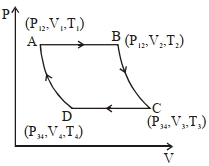
View full question & answer→MCQ 2261 Mark
One mole of a monoatomic ideal gas $\left(c_{ V }=\frac{3}{2} R \right)$ undergoes a cycle where it first goes isochorically from the state $\left(\frac{3}{2} P _0, V _0\right)$ to $\left( P _0, V _0\right)$, and then is isobarically contracted to the volume $\frac{1}{2} V _0$. It is then taken back to the initial state by a path which is a quarter ellipse on the $P - V$ diagram. The efficiency of this cycle is
- A
$\frac{1}{\pi}$
- B
$\frac{\pi}{16+\pi}$
- ✓
$\frac{\pi}{32+\pi}$
- D
$\frac{2 \pi}{32+\pi}$
AnswerCorrect option: C. $\frac{\pi}{32+\pi}$
c
(C)
$n =\frac{ w _{\text {net }}}{ Q _{\text {sup plied }}}$
$w _{\text {net }}=\frac{\pi}{4} \times \frac{ V _0}{2} \times \frac{ P _0}{2}=\frac{\pi P _0 V _0}{16}$
Heat is supplied to the gas only during process $CA$.
$\text { so } Q _{ CA }= w _{ CA }+\Delta U _{ CA }$
$Q _{ CA }=\left(\frac{\pi P _0 V _0}{16}+\frac{ P _0 V _0}{2}\right)+\frac{3}{2} \times P _0 V _0$
$Q _{\text {supplied }}=\frac{\pi P _0 V _0}{16}+2 P _0 V _0$
$n =\frac{\frac{\pi P _0 V _0}{16}}{\frac{\pi P _0 V _0}{16}+2 P _0 V _0}=\frac{\pi}{\pi+32}$
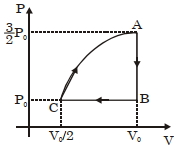
View full question & answer→MCQ 2271 Mark
An engine runs between a reservoir at temperature $200 \,K$ and a hot body which is initially at temperature of $600 \,K$. If the hot body cools down to a temperature of $400 \,K$ in the process, then the maximum amount of work that the engine can do (while working in a cycle) is (the heat capacity of the hot body is $1 \,J / K )$
- A
$200(1-\ln 2) \,J$
- ✓
$200(1-\ln 3 / 2) \,J$
- C
$200(1+\ln 3 / 2) \,J$
- D
$200 \,J$
AnswerCorrect option: B. $200(1-\ln 3 / 2) \,J$
b
$(b)$ The efficiency of engine, $\eta=\frac{W}{Q_{\text {in }}}$ or $W=\eta Q_{\text {in }}$
Also, $Q=\int C d t$
For maximum work, efficiency should be maximum, i.e. for Carnot engine,
$\eta =1-\frac{T_{2}}{T_{1}}=1-\frac{200}{T}$
$\therefore \quad W =\int \eta Q_{\text {in }}$
$=-\int \limits_{600}^{400}\left(1-\frac{200}{T}\right) C d T$
$\Rightarrow \quad W =-C[T-200 \ln T]_{600}^{400}$
$=-C\left[-200+\ln \left(\frac{3}{2}\right) 200\right] J$
Here, $C=1$ (given)
$\therefore \quad W=200-200 \ln \left(\frac{3}{2}\right) \,J$
or $\quad W=200\left[1-\ln \left(\frac{3}{2}\right)\right] \,J$
View full question & answer→MCQ 2281 Mark
The efficiency of the cycle shown below in the figure (consisting of one isobar, one adiabat and one isotherm) is $50 \%$. The ratio $x$, between the highest and lowest temperatures attained in this cycle obeys (the working substance is an ideal gas)
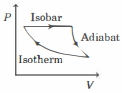
- A
$x=e^{x-1}$
- ✓
$x^{2}=e^{x}-1$
- C
$x=e^{x^{2}-1}$
- D
$x^{2}=e^{x^{2}-1}$
AnswerCorrect option: B. $x^{2}=e^{x}-1$
b
$(b)$ The given $p-V$ diagram can be shown as,
For curve $A B$ (isobaric),
$\frac{V_{B}-V_{A}}{T_{B}-T_{A}}$ ...........$(i)$
For curve $B C$ (adiabatic),
$T_{B}^{\top} V_{B}^{\gamma-1} =T_{C} V_{C}^{\gamma-1}$ ..........$(ii)$
$\text { Since, } V_{B} =x V_{A}$
$\text { and } V_{C} =x\left(\frac{\gamma}{\gamma-1}\right) V_{A}$
Efficiency of cycle,
$\eta=1-\frac{Q_{C A}}{Q_{A B}}$
$=1-\frac{n R T_{A} \ln \left(\frac{V_{C}}{V_{A}}\right)}{\frac{n \gamma}{\gamma-1)}\left(T_{B}-T_{A}\right)}$
$=1-\frac{\left(\frac{\gamma}{\gamma-1}\right) \ln x}{\left(\frac{\gamma}{\gamma-1}\right)(x-1)} \quad\left[\because \frac{T_{B}}{T_{A}}=x\right]$
Given, $\eta=50 \%=\frac{1}{2}$
$\Rightarrow \quad \frac{1}{2}=\frac{\ln x}{x-1} \Rightarrow x^{2}=e^{x-1}$
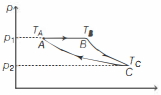
View full question & answer→MCQ 2291 Mark
$0.02\, moles$ of an ideal diatomic gas with initial temperature $20^{\circ} C$ is compressed from $1500 \,cm ^{3}$ to $500 \,cm ^{3}$. The thermodynamic process is such that $p V^{2}=\beta$, where $\beta$ is a constant. Then, the value of $\beta$ is close to (the gas constant, $R=8.31 \,J / K / mol$ ).
- ✓
$7.5 \times 10^{-2} \,Pa - m ^{6}$
- B
$1.5 \times 10^{2} \,Pa - m ^{6}$
- C
$3 \times 10^{-2} \,Pa \cdot m ^{6}$
- D
$2.0 \times 10^{1} \,Pa \cdot m ^{6}$
AnswerCorrect option: A. $7.5 \times 10^{-2} \,Pa - m ^{6}$
a
$(a)$ Process equation is
$p V^{2}=\beta$ ................$(i)$
As gas is ideal, it obeys gas equation,
$p V=n R T$ .................$(ii)$
From Eqs. $(i)$ and $(ii)$, gives
$\left(n R^{\prime} T\right) \cdot V=\beta$
Here, $n=0.02\, moles$,
$R=8.31 \,JK ^{-1} mol ^{-1}$,
$T=20^{\circ} C +273=293 \,K$
and $V=1500 \,cm ^{3}=1.5 \times 10^{-3} \,m ^{3}$
$\therefore \quad \beta=0.02 \times 8.31 \times 293 \times 1.5 \times 10^{-3}$
$=7.3 \times 10^{-2} \,Pa - m ^{6}$
$\approx 7.5 \times 10^{-2} \,Pa \cdot m ^{6}$
View full question & answer→MCQ 2301 Mark
An ideal gas is made to undergo the cyclic process shown in the figure below. Let $\Delta W$ depict the work done, $\Delta U$ be the change in internal energy of the gas and $Q$ be the heat added to the gas. Sign of each of these three quantities for the whole cycle will be (0 refers to no change)

- ✓
$-, 0,-$
- B
$+, 0,+$
- C
$0,0,0$
- D
$+,+,+$
AnswerCorrect option: A. $-, 0,-$
a
$(a)$ Given cyclic process is
Area under compression process $C A$ is more than area under expansion process AB. So, net work done is negative.
i.e. $\Delta W < 0$
Also, in a cyclic process, change in internal energy is zero.
i.e. $\Delta U=0$
Now, by using first law of thermodynamics, we have
$\Delta Q=0+\Delta W$
we see that, $\quad \Delta Q < 0$

View full question & answer→MCQ 2311 Mark
One mole of a monoatomic gas and one mole of a diatomic gas are initially in the same state. Both gases are expanded isothermally and then adiabatically, such that they acquire the same final state. Choose the correct statement.
- ✓
Work done by diatomic gas is more than that by monoatomic gas
- B
Work done by monoatomic gas is more than that by diatomic gas
- C
Work done by both the gases are equal
- D
Change in internal energies of both the gases are equal
AnswerCorrect option: A. Work done by diatomic gas is more than that by monoatomic gas
a
$(a)$ Expansion curves are as shown below.
As, slope of an adiabatic curve $=-\gamma\left(\frac{p}{V}\right)$
Also, $\gamma_{\text {diatomic }}\left(=\frac{7}{5}\right) < \gamma_{\text {monoatomic }}\left(=\frac{5}{3}\right)$
So, adiabatic expansion will be more stecp for monoatomic gas, whereas isotherms for both gases are nearly same. As, work done $=$ area under $p-V$ graph
$\therefore$ Work done is more for diatomic gas.
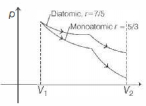
View full question & answer→MCQ 2321 Mark
For an ideal gas, the internal energy is given by $U=5 p V / 2+C$, where $C$ is a constant. The equation of the adiabats in the $p V$-plane will be
- ✓
$p^{5} V^{7}=$ constant
- B
$p^{7} V^{5}=$ constant
- C
$p^{3} V^{5}=$ constant
- D
$p^{5} V^{2}=$ constant
AnswerCorrect option: A. $p^{5} V^{7}=$ constant
a
$(a)$ For an ideal gas,
$C_{V}=\left.\frac{\partial U}{\partial T}\right|_{V=\text { constann }}$
$\text { or } \quad C_{V}=\frac{d U}{d T}$
Also, for $1$ mole of gas,
$C_{V}=\frac{f}{2} \cdot R$
where, $f=$ degree of freedom.
Hence, we have
$\frac{f}{2} R=\frac{d U}{d T}$
Here, $U=\frac{5}{2} p V+C=\frac{5}{2} R T+C$
[ $\because$ one mole of gas is considered]
So, $\quad \frac{f}{2} R=\frac{d}{d T}\left(\frac{5}{2} R T+C\right)$
$\Rightarrow \quad \frac{f}{2} R=\frac{5}{2} R \Rightarrow f=5$
Now, using $y=1+\frac{2}{f}$
where, $\gamma=$ ratio of specific heats
$=$ adiabatic index.
We have, $\gamma=1+\frac{2}{5} \Rightarrow \gamma=\frac{7}{5}$
So, equation of adiabats can be written as $p V^{\gamma}=$ constant $\Rightarrow p V^{7 / 5}=$ constant $\Rightarrow p^{5} V^{7}=$ constant
View full question & answer→MCQ 2331 Mark
An ideal gas undergoes change in its state from the initial state $I$ to the final state $F$ via two possible paths as shown below. Then,
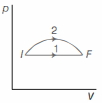
- A
there is no change in internal energy along path $1$
- B
heat is not absorbed by the gas in both paths
- C
the temperature of the gas first increases and then decreases for path $2$
- ✓
work done by the gas is larger in path $1$
AnswerCorrect option: D. work done by the gas is larger in path $1$
d
$(a,c)$ Given paths over $p-V$ graph are
As in both processes, initial and final points are same, change in internal cnergy (which is not a path function) is same. So, option $(a)$ is correct.
- Both processes are expansion process. So, heat is absorbed in both $1$ and $2$ . Hence, option $(b)$ is incorrect.
- Now, consider isotherms over $p-V$ graph given, we clearly see that for path $2$ temperature increases and then decreases. So, option $(c)$ is correct.
- Area enclosed by path $2$ in $p-V$ graph is larger.
So, work done is more in path $2$. Hence, option $(d)$ is incorrect.
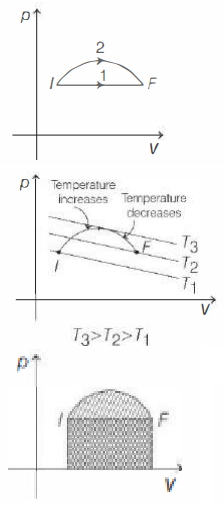
View full question & answer→MCQ 2341 Mark
Graphs below show the entropy versus energy $U$ of two systems $1$ and $2$ at constant volume. The initial energies of the systems are indicated by $U_{1, i}$ and $U_{2, i}$, respectively. Graphs are drawn to the same scale. The systems are then brought into thermal contact with each other. Assume that, at all times the combined energy of the two systems remains constant. Choose the most appropriate option indicating the energies of the two systems and the total entropy after they achieve the equilibrium.
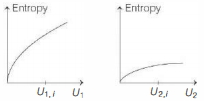
- A
$U_{1}$ increases and $U_{2}$ decreases and the total entropy remains the same
- B
$U_{1}$ decreases and $U_{2}$ increases and the total entropy remains the same
- ✓
$U_{1}$ increases and $U_{2}$ decreases and the total entropy increases
- D
$U_{1}$ decreases and $U_{2}$ increases and the total entropy increases
AnswerCorrect option: C. $U_{1}$ increases and $U_{2}$ decreases and the total entropy increases
c
$(c)$ By second law of thermodynamics, entropy of a system either increases or remains constant (only in reversible quasistatic processes).
Also, from graphs given
$S_{2} > S_{1} \Rightarrow \frac{Q}{T_{2}} > \frac{Q}{T_{1}}$
where, $S$ is entropy, $Q$ is heat and $T$ is the temperature.
or $\quad T_{1} < T_{2}$
Hence, temperature of system $1$ is less than system $2$. So, heat flows from system $2$ to system $1$ .
Hence, $U_{1}$ increases and $U_{2}$ decreases.
View full question & answer→MCQ 2351 Mark
One mole of an ideal monoatomic gas undergoes the following four reversible processes:
Step $1$ It is first compressed adiabatically from volume $8.0 \,m ^{3}$ to $1.0 \,m ^{3}$.
Step $2$ Then expanded isothermally at temperature $T_{1}$ to volume $10.0 \,m ^{3}$.
Step $3$ Then expanded adiabatically to volume $80.0 \,m ^{3}$.
Step $4$ Then compressed isothermally at temperature $T_{2}$ to volume $8.0 \,m ^{3}$.
Then, $T_{1} / T_{2}$ is
Answerb
$(b)$ Given,
Step $1 A$ to $B$ adiabatic compression, $V_{A}=8 \,m ^{3}, V_{B}=1 \,m ^{3}$
Step $2 B$ to $C$ isothermal expansion,
$T_{C}=T_{B}=T_{1}, V_{C}=10 \,m ^{3}$
Step $3 C$ to $D$ adiabatic expansion,
$V_{D}=80 \,m ^{3}$
Step $4 D$ to $A$ isothermal compression,
$T_{D}=T_{A}=T_{2}, V_{A}=8 \,m ^{3}$
Now, for processes $A$ to $B$,
$T_{A} V_{A}^{\gamma-1}=T_{B} V_{B}^{\gamma-1}$
Substituting values in above equation, we get
$T_{2}(8)^{\frac{5}{3}-1}=T_{1}(1)^{\frac{5}{3}-1}$
$\therefore$ For ideal monoatomic gas, $\gamma=\frac{5}{3}$
So, $\quad \frac{T_{1}}{T_{2}}=8^{\frac{2}{3}}=4$
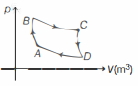
View full question & answer→MCQ 2361 Mark
A long cylindrical pipe of radius $20 \,cm$ is closed at its upper end and has an airtight piston of negligible mass as shown. When a $50 \,kg$ mass is attached to the other end of the piston, it moves down. If the air in the enclosure is cooled from temperature $T$ to $T-\Delta T$, the piston moves back to its original position. Then $\Delta T / T$ is close to (Assuming air to be an ideal gas, $g=10 \,m / s ^2$, atmospheric pressure is $10^5 \,Pa$ )
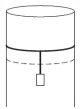
- A
$0.01$
- B
$0.02$
- ✓
$0.04$
- D
$0.09$
AnswerCorrect option: C. $0.04$
c
(c)
Initial pressure in cylinder is atmospheric pressure $p_0$.
When mass $m$ is attached to piston, then pressure $=p_0-\frac{m g}{A}$.
As, temperature remains constant during expansion
$\Rightarrow p_i V_i=p_f V_f$
$\Rightarrow p_0 V_i=\left(p_0-\frac{m g}{A}\right) \cdot V_f$
$\Rightarrow \frac{V_f}{V_i}=\frac{p_0}{\left(p_0-\frac{m g}{A}\right)}$
$\frac{V_i}{V_f}=1-\frac{m g}{p_0 A} \Rightarrow \frac{m g}{p_0 A}=1-\frac{V_i}{V_f}$
$\Rightarrow \frac{m g}{p_0 A}=V_f-V_i=\frac{\Delta V}{V_f}$
Now, when temperature is reduced by $\Delta T$, the volume of gas again contracts to its original volume.
$\Rightarrow \frac{V}{T}=$ constant
or $\quad \frac{\Delta V}{V}=\frac{\Delta T}{T}$
$\Rightarrow \frac{\Delta T}{T}=\frac{\Delta V}{V_f}=\frac{m g}{p_0 A}$
$\Rightarrow \frac{\Delta T}{T}=\frac{m g}{p_0 A}$
$=\frac{50 \times 10}{10^5 \times 3.14 \times(0.2)^2}$
$=\frac{5}{3.14 \times 4} \times \frac{10^2}{10^5 \times 10^{-2}}$
$=0.4 \times 10^{-1}=0.04$
View full question & answer→MCQ 2371 Mark
A thin piece of thermal conductor of constant thermal conductivity insulated on the lateral sides connects two reservoirs which are maintained at temperatures $T_{1}$ and $T_{2}$ as shown in the figure alongside. Assuming that the system is in steady state, which of the following plots best represents the dependence of the rate of change of entropy on the ratio of $T_{1} / T_{2}$ ?
Answerb
$(b)$ Entropy change for a system or body is
$\Delta S=\frac{Q}{T}$
Now, for given system to be in steady state, heat lost by resorvoir at temperature $T_{1}=$ heat gained by resorvoir at temperature $T_{2}$ (=Q say).
So, change in entropy for heat conduction process is
$\Delta S-\frac{-Q}{}+\frac{(+Q)}{T_{1}}$
$\Rightarrow \quad \Delta S=Q\left(\frac{1}{T_{2}}-\frac{1}{T_{1}}\right)$
So, time rate of change of entropy is
$\frac{d S}{d t}=\frac{d}{d t}\left\{Q\left(\frac{1}{T_{2}}-\frac{1}{T_{1}}\right)\right\}$
$=\left(\frac{1}{T_{2}}-\frac{1}{T_{1}}\right) \cdot\left(\frac{d Q}{d t}\right)$
$\frac{d S}{d t}=\left(\frac{T_{1}}{T_{2}}-1\right) \cdot T_{1}\left(\frac{d Q}{d t}\right)$
As, $\quad \frac{d Q}{d t}=-k A\left(\frac{d T}{d x}\right)$
So, $\quad \frac{d S}{d t}=-k A \frac{d T}{d x} \cdot T_{1}\left(\frac{T_{1}}{T_{2}}-1\right)$
$\Rightarrow \quad \frac{d S}{d t}=k A T_{1} \cdot\left(1-\frac{T_{1}}{T_{2}}\right) \cdot \frac{d T}{d x}$
$=\frac{k A T_{1}}{x}\left(1-\frac{T_{1}}{T_{2}}\right)\left(T_{1}-T_{2}\right)$
$=\frac{k A T_{1}^{2}}{x}\left(1-\frac{T_{1}}{T_{2}}\right)\left(1-\frac{T_{2}}{T_{1}}\right)$
Clearly, at $\frac{T_{1}}{T_{2}}=1, \frac{d S}{d t}=0$.
Also, graph is asym metrical. So, correct option is $(b)$.
View full question & answer→MCQ 2381 Mark
One mole of an ideal monoatomic gas undergoes the following four reversible processes:
Step $1$ It is first compressed adiabatically from volume $V_{1}$ to $1 \;m ^{3}$.
Step $2$ Then expanded isothermally to volume $10 \;m ^{3}$.
Step $3$ Then expanded adiabatically to volume $V _{3}$.
Step $4$ Then compressed isothermally to volume $V_{1}$. If the efficiency of the above cycle is $3 / 4$, then $V_{1}$ is ............ $m^3$
Answerd
$(d)$ Given $p-V$ cycle is
$A B:$ Adiabatic compression,
$V_{A}=V_{1}, V_{B}=1 \,m ^{3}$
$B C:$ Isothermal expansion,
$V_{C}=V=10 \,m ^{3}$
$C D$ : Adiabatic expansion,
$V_{D}=V_{3}$
$D A$ : Isothermal compression,
$V_{A}=V_{1}$
Cycle efficiency is given, $\eta=\frac{3}{4}$
For given Carnot's cycle,
$\eta=1-\frac{T_{1}}{T_{2}}=1-\left(\frac{V_{2}}{V_{1}}\right)^{\gamma-1}$
$[\therefore$ Process $A B$ is adiabatic, $\gamma=\frac{5}{3}$ for monoatomic gas]
$\Rightarrow \quad \frac{3}{4}=1-\left(\frac{1}{V_{1}}\right)^{\frac{5}{3}-1} \Rightarrow \frac{1}{V_{1}^{2 / 3}}=\frac{1}{4}$
$\Rightarrow V_{1}=8 \,m ^{3}$
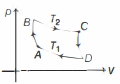
View full question & answer→MCQ 2391 Mark
A gas at initial temperature $T$ undergoes sudden expansion from volume $V$ to $2 \,V$. Then,
Answera
$(a)$ In sudden expansion, time duration is small. Thus, heat does not leave or enter the gas mass.
Process of sudden expansion is adiabatic process, $\Delta Q=0$
View full question & answer→MCQ 2401 Mark
An ideal gas is taken reversibly around the cycle $a-b-c-d-a$ as shown on the temperature $T$ - entropy $S$ diagram. The most appropriate representation of above cycle on a internal energy $U$ - volume $V$ diagram is
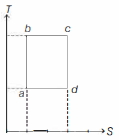
Answera
(a) In given cycle
$b c$ and $a d$ are isothermal processes $(T$ and $U$ are constants). $a b$ and $c d$ are isentropic processes ( $S=$ constant).
So, plot of above cycle on $U-V$ diagram is
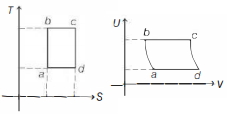
View full question & answer→MCQ 2411 Mark
The heat capacity of one mole an ideal is found to be $C_V=3 R(1+a R T) / 2$, where $a$ is a constant. The equation obeyed by this gas during a reversible adiabatic expansion is
- ✓
$T V^{3 / 2} e^{a R T}=$ constant
- B
$T V^{3 / 2} e^{3 a R T / 2}=$ constant
- C
$T V^{3 / 2}=$ constant
- D
$T V^{3 / 2} e^{2 a R T / 3}=$ constant
AnswerCorrect option: A. $T V^{3 / 2} e^{a R T}=$ constant
a
(A)
From the given data,
$C _{ V }=\frac{3 R ( a + aRT )}{2}$
So,
$C _{ p }= C _{ V }+ R =\frac{3 R ( a + aRT )}{2}+ R =\frac{3 R ( a + aRT )+2 R }{2}$
So,
$\gamma=\frac{C_{ P }}{C_{ V }}-1=\frac{\frac{3 R(a+a R T)+2 R}{2}}{\frac{3 R(a+a R T)}{2}}-1=\frac{2}{3(1+a R T)}=\frac{2}{3}(1+a R T)^{-1}$
Now, by putting this value of $\gamma-1$ in the adiabatic expression formula, we get $TV ^{\gamma-1}=$ constant $\Rightarrow TV ^{3 / 2} e ^{ aRT }=$ constant (we get this by binomial expansion).
Hence proved.
View full question & answer→MCQ 2421 Mark
One mole of ideal gas undergoes a linear process as shown in the figure below. Its temperature expressed as a function of volume $V$ is
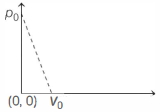
AnswerCorrect option: C. $\frac{p_0 V}{R}\left(1-\frac{V}{V_0}\right)$
c
(c)
Process given is
To find process equation, we use two point form of equation of straight line,
$y-y_1=\frac{y_2-y_1}{x_2-x_1}(x-x_1)$
Here, $(x, y,)=(0, p_0$, and $\left(x_2, y_2\right)=\left(V_0, 0\right)$ Process equation is
$p=p_0-\frac{p_0}{V_0} \cdot V$
As, $\quad p=\frac{R T}{V}$
$\Rightarrow \frac{R T}{V}=p_0-\frac{p_0}{V_0} \cdot V$
$\Rightarrow T=\frac{p_0 V}{R}\left(1-\frac{V}{V_0}\right)$
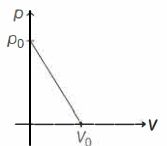
View full question & answer→MCQ 2431 Mark
The state of an ideal gas was changed isobarically. The graph depicts three such isobaric lines. Which of the following is true about the pressures of the gas?
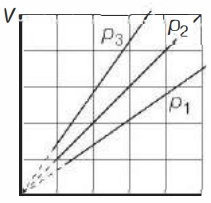
- A
$p_1=p_2=p_3$
- ✓
$p_1 > p_2 > p_3$
- C
$p_1 < p_2 < p_3$
- D
$p_1 / p_2=p_3 / p_1$
AnswerCorrect option: B. $p_1 > p_2 > p_3$
b
(b)
Equation of state for ideal gas is $p V=n R T \Rightarrow V=\frac{n R}{p} \cdot T$
This is equation of line with slope $=\frac{n R}{p}$
$\Rightarrow \quad$ Slope $\propto \frac{1}{p}$
So, from graph, $p_3 < p_2 < p_1$.
View full question & answer→MCQ 2441 Mark
An ideal gas undergoes a circular cycle centred at $4 \,atm , 4 L$ as shown in the diagram. The maximum temperature attained in this process is close to
- ✓
$\frac{30}{R}$
- B
$\frac{36}{R}$
- C
$\frac{24}{R}$
- D
$\frac{16}{R}$
AnswerCorrect option: A. $\frac{30}{R}$
a
(a)
From given cyclic process,
Process equation is
$(p-4)^2+(V-4)^2=4 \quad \dots(i)$
Now, from $p V=n R T$
We can say that $T$ is maximum when $p V$ is maximum.
Now, for given cyclic process, $p V$ maximum occur when $p^2 V^2$ is maximum.
Now,
$p^2 V^2=p^2\left(4-(p-4)^2\right)$ [from Eq. $(i)$]
Now, $p^2 V^2$ is maximum when $\frac{d}{d p} p^2 V^2=0$
$\Rightarrow \quad \frac{d}{d p}\left(p^2 \cdot\left(p^2 \cdot\left(4-(p-4)^2\right)=0\right.\right.$
$\Rightarrow \quad p^2-8 p+14=0$
$=4 \pm \sqrt{2}$
and from Eq. $(i)$, we get
$p=4 \pm \sqrt{2}, V=4 \pm \sqrt{2}$
Taking positive values, we have
$(p V)_{\max } \Rightarrow p=4+\sqrt{2}$
and $V=4+\sqrt{2}$
So, by gas equation, we have
$T_{\max } =\frac{(p V)_{\max }}{R} \quad \text { [for } 1 \,mol \text { of gas] }$
$=\frac{(4+\sqrt{2})(4+\sqrt{2})}{R}$
$=\frac{16+2+2 \times 4 \times \sqrt{2}}{R}$
$=\frac{29.32}{R}=\frac{30}{R}$
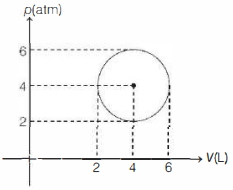
View full question & answer→MCQ 2451 Mark
An ideal gas follows a process described by $p V^2=C$ from $\left(p_1, V_1, T_1\right)$ to $\left(p_2, V_2, T_2\right)$ and $C$ is a constant. Then,
- A
if $p_1 > p_2$ then $T_2 > T_1$
- ✓
if $V_2 > V_1$ then $T_2 < T_1$
- C
if $V_2 > V_1$ then $T_2 > T_1$
- D
if $p_1 > p_2$ then $V_1 > V_2$
AnswerCorrect option: B. if $V_2 > V_1$ then $T_2 < T_1$
b
(b)
$p V^2=C \Rightarrow\left(\frac{n R T}{V}\right) \cdot V^2=C$
$[\therefore$ for an ideal gas, $p V=n R T]$
$\Rightarrow \quad T V=\frac{C}{n R}=$ a constant
$\therefore \quad T \propto-\frac{1}{V}$
So, if $V_2 > V_1$, then $T_2 < T_1$.
View full question & answer→MCQ 2461 Mark
The three processes in a thermodynamic cycle shown in the figure are : Process $1 \rightarrow 2$ is isothermal; Process $2 \rightarrow 3$ is isochoric (volume remains constant); Process $3 \rightarrow 1$ is adiabatic. The total work done by the ideal gas in this cycle is $10 \,J$. The internal energy decreases by $20 \,J$ in the isochoric process. The work done by the gas in the adiabatic process is $-20 \,J$. The heat added to the system in the isothermal process is .............. $J$
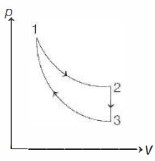
Answerd
(d)
Work done in complete cycle,
$W=W_{12}+W_{23}+W_{31}$
Given $W=10 \,J , W_{23}=0$ and $W_{31}=-20 \,J$
So, from Eq. $(i)$, we have $W_{12}=30 \,J$
As in isothermal process,
Heat absorbed $=$ Work done
$\therefore$ Heat absorbed in process $1 \rightarrow 2=30 \,J$
View full question & answer→MCQ 2471 Mark
In the $p-V$ diagram below, the dashed curved line is an adiabat.For a process that is described by a straight line joining two points $X$ and $Y$ on the adiabat (solid line in the diagram) heat is (Hint consider the variation in temperature from $X$ to $Y$ along the straight line)
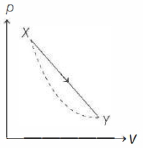
- A
absorbed throughout from $X$ to $Y$
- B
released throughout from $X$ to $Y$
- ✓
absorbed from $X$ upto an intermediate point $Z$ (not shown in the figure) and then released from $Z$ to $Y$
- D
released from $X$ upto an intermediate point $Z$ (not shown in the figure) and then absorbed from $Z$ to $Y$
AnswerCorrect option: C. absorbed from $X$ upto an intermediate point $Z$ (not shown in the figure) and then released from $Z$ to $Y$
c
(c)
As we move along line $X Y$, it cuts a isotherm at higher temperature $\left(T_2 > T_3\right)$
$\left(T_2 > T_3\right)$ but then from $Z$ to $Y$ line moves to a low temperature isotherm. So, heat is absorbed upto $Z$ and then it is released from $Z$ to $Y$.
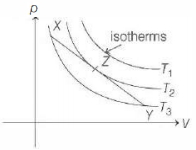
View full question & answer→MCQ 2481 Mark
An ideal monoatomic gas expands to twice its volume. If the process is isothermal, the magnitude of work done by the gas is $W_i$. If the process is adiabatic, the magnitude of work done by the gas is $W_a$. Which of the following is true?
- A
$W_i=W_a > 0$
- ✓
$W_i > W_{a} > 0$
- C
$W_i > W_{a}=0$
- D
$W_{a} > W_i=0$
AnswerCorrect option: B. $W_i > W_{a} > 0$
b
(b)
Indicator diagrams for isothermal and adiabatic processes are as shown below.
In above diagram, $A B$ is isothermal process and $A C$ is adiabatic process.
Work done $=$ Area under $p \cdot V$ graph So, $\quad W_{A B} > W_{A C}$ Also, gas expands, so work done is positive.
$\Rightarrow \quad W_i > W_a > 0$
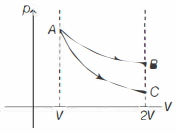
View full question & answer→MCQ 2491 Mark
Jet aircrafts fly at altitudes above $30000 \,ft$, where the air is very cold at $-40^{\circ} C$ and the pressure is $0.28 \,atm$. The cabin is maintained at $1 \,atm$ pressure by means of a compressor which exchanges air from outside adiabatically. In order to have a comfortable cabin temperature of $25^{\circ} C$, we will require in addition
- A
a heater to warm the air injected into the cabin
- ✓
an air-conditioner to cool the air injected into the cabin
- C
neither a heater nor an air-conditioner, the compressor is sufficient
- D
alternatively heating and cooling in the two halves of the compressor cycle
AnswerCorrect option: B. an air-conditioner to cool the air injected into the cabin
b
(b)
Compression of a gas in a compressor is nearly an adiabatic process.
So, by using $p_{\text {in }}^{1-\gamma} \cdot T_{\text {in }}^\gamma=p_{\text {out }}^{1-\gamma} \cdot T_{\text {out }}^\gamma$
We get, $(0.28)^{1-\gamma}(233)^\gamma=(1)^{1-\gamma}(T)^\gamma$
Here, for air, $\gamma=14=\frac{7}{5}$
Hence, $T=(233)(0.28)^{-2 / 7}=\frac{233}{(0.28)^{2 / 7}}$
This temperature is much higher than $298 \,K$ or $25^{\circ} C$.
So, an air-conditioner is needed to cool the air coming out of compressor.
View full question & answer→MCQ 2501 Mark
A constant amount of an ideal gas undergoes the cyclic process $A B C A$ in the $p-V$ graph shown below. The path $B C$ is an isothermal. The work done by the gas during one complete cycle, beginning and ending at $A$ is nearly .......... $\,kJ$
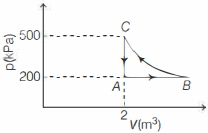
- A
$600$
- B
$300$
- ✓
$-300$
- D
$-600$
AnswerCorrect option: C. $-300$
c
(c)
$\ln$ isothermal process $B C$,
$p V=\text { constant }$
$\Rightarrow \quad D_C V_C=p_B V_B$
$\Rightarrow \quad \frac{p_C V_C-500 \times 2}{p_B}=5\, m ^3$
Now, work done in the complete cycle $C A B C$ is
$W_{C A B C}=W_{C A}+W_{A B}+W_{B C}$
$=0+p \Delta V+\int p d V$
$=200(5-2)+\int \limits_5^2 k \frac{d V}{V}$
$=600+k \int \limits_5^2 \frac{d V}{V}$
$=600+1000(\log 2-\log 5)$
$=600+1000(0.69-160)$
$=600-910 \approx-300 \,kJ$
View full question & answer→MCQ 2511 Mark
One mole of an ideal gas at initial temperature $T$, undergoes a quasi-static process during which the volume $V$ is doubled. During the process, the internal energy $U$ obeys the equation $U=a V^3$, where $a$ is a constant. The work done during this process is
- A
$\frac{3 R T}{2}$
- B
$\frac{5 R T}{2}$
- C
$\frac{5 R T}{3}$
- ✓
$\frac{7 R T}{3}$
AnswerCorrect option: D. $\frac{7 R T}{3}$
d
(d)
In the process given, internal energy is
$U=a V^3$
$\Rightarrow \quad \frac{f n R T}{2} =a V^3$
where, $f=$ degree of freedom $=3$ (for ideal gas) and $n=$ number of moles $=1$.
$\Rightarrow \quad \frac{3}{2} R T=a V^3$
$\Rightarrow \quad \frac{3}{2} p V=a V^3 \quad[\because p V=R T]$
So, pressure in this process is given by
$p=\frac{2 a}{3} V^2$
Now, work done during the process is
$W=\int \limits_V^{2 V} p d V=\int \limits_V^{2 V} \frac{2 a}{3} V^2 d V$
$=\frac{2 a}{3} \times \frac{1}{3}\left((2 V)^3-V^3\right)$
$=\frac{2 a}{9}\left(7 V^3\right)$
$=\frac{2}{9} \times 7 \times \frac{3}{2} R T \quad\left[\because a V^3=\frac{3}{2} R^2 T\right]$
$=\frac{7}{3} R T$
View full question & answer→MCQ 2521 Mark
An ideal gas is made to undergo a cycle depicted by the $p-V$ diagram given below. The curved line from $A$ to $B$ is an adiabat.Then,
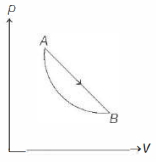
AnswerCorrect option: A. the efficiency of this cycle is given by unity as on heat is released during the cycle
a
(a)
$A$ to $B$ is an expansion process and $B$ to $A$ is adiabatic compression.
So, heat is absorbed in process $A$ to $B$ and is released in process $B$ to $A$.
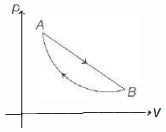
View full question & answer→MCQ 2531 Mark
A piece of hot copper at $100^{\circ} C$ is plunged into a pond at $30^{\circ} C$. The copper cools down to $30^{\circ} C$, while the pond being huge stays at its initial temperature. Then,
- A
copper loses some entropy, the pond stays at the same entropy
- B
copper loses some entropy and the pond gains exactly the same amount of entropy
- ✓
copper loses entropy and the pond gains more than this amount of entropy
- D
both copper and the pond gain in entropy
AnswerCorrect option: C. copper loses entropy and the pond gains more than this amount of entropy
c
(c)
Copper loses entropy and cools. Pond gains same amount of heat and there is some agitation in pond's water caused by plunging of copper.
Hence, pond gain more entropy than copper.
View full question & answer→MCQ 2541 Mark
An ideal gas with constant heat capacity $C_V=\frac{3}{2} n R$ is made to carry out a cycle that is depicted by a triangle in the figure given below. The following statement is true about the cycle.
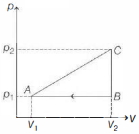
- A
The efficiency is given by $1-\frac{p_1 V_1}{p_2 V_2}$
- B
The efficiency is given by $1-\frac{1}{2} \frac{p_1 V_1}{p_2 V_2}$
- C
Net heat absorbed in the cycle is $\left(p_2-p_1\right)\left(V_2-V_1\right)$
- ✓
Heat absorbed in part $A C$ is given by $2\left(p_2 V_2-p_1 V_1\right)+\frac{1}{2}\left(p_1 V_2-p_2 V_1\right)$
AnswerCorrect option: D. Heat absorbed in part $A C$ is given by $2\left(p_2 V_2-p_1 V_1\right)+\frac{1}{2}\left(p_1 V_2-p_2 V_1\right)$
d
(d)
As $B \rightarrow A \rightarrow C$ is a closed cyclic process, we have
$\Delta U($ complete cycle $)=0$
So, by first law of thermodynamics,
we have $\Delta Q=\Delta W$
or $\Delta Q_{A B}+\Delta Q_{B C}+\Delta Q_{A C}=\Delta W$
$=\Delta W_{A B}+\Delta W_{B C}+\Delta W_{A C}$
$=$ Area enclosed under $p-V$ graph
$\Rightarrow \Delta Q_{A C}=-\left(\Delta Q_{A B}\right.\left.+\Delta Q_{B C}\right)+\frac{1}{2}$ $\left(V_2-V_1\right)\left(p_2-p_1\right)$ $=-\left(\frac{3}{2} n R \Delta T-p_1\left(V_2-V_1\right)\right.$ $\left.+\frac{3}{2} n R \Delta T-V_2\left(p_2-p_1\right)\right)$ $+\frac{1}{2}\left(V_2-V_1\right)\left(p_2-p_1\right)$
$\therefore \Delta Q_{A C}=2\left(p_2 V_2-\right.\left.p_1 V_1\right)$ $+\frac{1}{2}\left(V_2-V_1\right)\left(p_2-p_1\right)$
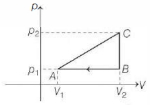
View full question & answer→MCQ 2551 Mark
A van der Waal's gas obeys the equation of state $\left(p+\frac{n^2 a}{V^2}\right)(V-n b)=n R T$. Its internal energy is given by $U=C T-\frac{n^2 a}{V}$. The equation of a quasistatic adiabat for this gas is given by
- A
$T^{C / n R} \cdot V=$ constant
- B
$T^{(C+n R) / n R} \cdot V=$ constant
- ✓
$T^{C / n R} \cdot(V-n b)=$ constant
- D
$p^{(C+n R) / n R} \cdot(V-n b)=$ constant
AnswerCorrect option: C. $T^{C / n R} \cdot(V-n b)=$ constant
c
(c)
Process is quasistatic adiabatic.
$\text { So, } d Q =0$
$\Rightarrow d W =-d U$
$\Rightarrow p \Delta V =-n C_V d T \quad \dots(i)$
$U =C T-\frac{n^2 a }{V} \quad \dots(ii)$
and $\quad p=\frac{n R T}{V-n b}-\frac{n^2 a}{V^2} \quad \dots(iii)$
From Eq. $(ii)$, $d U=C d T+\frac{n^2 a }{V^2} d V$
So, from Eq. $(i)$, we have
$d W=-d U$
$\Rightarrow \quad p d V=-\left(C d T+\frac{n^2}{V^2} d V\right)$
Substituting for $p$ from Eq. $(iii)$ in above equation, we have
$\Rightarrow\left(\frac{n R T}{V-n b}-\frac{n^2 a}{V^2}\right) d V$
$=-C d T-\frac{n^2 \alpha }{V^2} \cdot d V$
$\Rightarrow\left(\frac{n R T}{V-n b}\right) d V=-C d T$
$\Rightarrow \quad \frac{d V}{V-n b}=\frac{-C}{n R} \cdot \frac{d T}{T}$
$\Rightarrow \quad \int \frac{d V}{V-n b}=-\frac{C}{n R} \int \frac{d T}{T}$
$\Rightarrow \log (V-n b)+k=-\log T^{C / n R}$
$\Rightarrow \log \left(T^{C / n R} \cdot(V-n b)\right)=$ constant
$\Rightarrow T^{C / n R} \cdot(V-n b)=$ constant
View full question & answer→MCQ 2561 Mark
An ideal diatomic gas is heated at constant pressure. The ratio of the work done to the heat supplied is
- A
$\frac{3}{5}$
- B
$\frac{2}{5}$
- ✓
$\frac{2}{7}$
- D
$\frac{4}{7}$
AnswerCorrect option: C. $\frac{2}{7}$
c
(c)
Heat supplied at constant pressure is $\Delta Q=n C_p \Delta T$.
Work done by the gas,
$\Delta W=p \Delta V=n R \Delta T$
Ratio of work done to heat supplied is
$\frac{\Delta W}{\Delta Q}=\frac{n R \Delta T}{n C_p \Delta T}$
$=\frac{R}{C_p}=\frac{C_p-C_V}{C_p}$
$=1-\frac{1}{\gamma}$
$=1-\frac{1}{(7 / 5)}=1-\frac{5}{7}=\frac{2}{7}$
View full question & answer→MCQ 2571 Mark
$n$ moles of a van der Waals' gas obeying the equation of state $\left(p+\frac{n^2 a}{V^2}\right)(V-n b)=n R T$, where $a$ and $b$ are gas dependent constants, is made to undergo a cyclic process that is depicted by a rectangle in the $p-V$ diagram as shown below. What is the heat absorbed by the gas in one cycle?
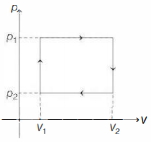
- A
$n\left(p_1-p_2\right)\left(V_2-V_1\right)$
- ✓
$\left(p_1-p_2\right)\left(V_2-V_1\right)$
- C
$\left(p_1+\frac{n^2 a}{V_1^2}-p_2-\frac{n^2 a}{V_2^2}\right)\left(V_1-V_2\right)$
- D
$\left(p_1+\frac{n^2 a}{V_1^2}-p_2-\frac{n^2 a }{V_2^2}\right)\left(V_2-V_1\right)$
AnswerCorrect option: B. $\left(p_1-p_2\right)\left(V_2-V_1\right)$
b
(b)
Work done $=$ Arca enclosed under $p \cdot V$ diagram $=\left(p_1-p_2\right)\left(V_2-V_1\right)$
View full question & answer→MCQ 2581 Mark
Consider $1 \,kg$ of liquid water undergoing change in phase to water vapour at $100^{\circ} C$. At $100^{\circ} C$, the vapour pressure is $1.01 \times 10^5 \,N - m ^2$ and the latent heat of vaporization is $22.6 \times 10^5 \,Jkg ^{-1}$. The density of liquid water is $10^3 \,kg m ^{-3}$ and that of vapour is $\frac{1}{1.8} \,kg m ^{-3}$. The change in internal energy in this phase change is nearly ............ $\,J kg ^{-1}$
- A
$1.8 \times 10^5$
- ✓
$20.8 \times 10^5$
- C
$22.6 \times 10^5$
- D
$11.3 \times 10^5$
AnswerCorrect option: B. $20.8 \times 10^5$
b
(b)
Change in volume of $1 \,kg$ of water due to phase change is
$\Delta V=V_{\text {steam }}-V_{\text {water }}$
$=\frac{m_{\text {seam }}-m_{\text {water }}}{\rho_{\text {steam }}}-\rho_{\text {water }}$
$=\frac{1}{(1 / 18)}-\frac{1}{1000}$
$=1800-0.001=1799 \,m ^3$
Work done against atmospheric pressure during phase change is
$\Delta W =p \Delta V$
$=101 \times 10^5 \times 1799$
$=181699 \,J$
Heat absorbed during phase change is
$\Delta Q =m L$
$=1 \times 22.6 \times 10^5$
$=2260000 \,J$
So, change in internal energy is
$\Delta U =\Delta Q-\Delta W$
$=2260000-181699$
$=2078301 J \,kg$
$=208 \times 10^5 \,J kg ^{-1}$
View full question & answer→MCQ 2591 Mark
A total of $48 \mathrm{~J}$ heat is given to one mole of helium kept in a cylinder. The temperature of helium increases by $2^{\circ} \mathrm{C}$. The work done by the gas is : (Given, $\mathrm{R}=8.3 \mathrm{~J} \mathrm{~K}^{-1} \mathrm{~mol}^{-1}$.)
- A
$72.9 \mathrm{~J}$
- B
$24.9 \mathrm{~J}$
- C
$48 \mathrm{~J}$
- ✓
$23.1 \mathrm{~J}$
AnswerCorrect option: D. $23.1 \mathrm{~J}$
d
$1^{\text {st }}$ law of thermodynamics
$\Delta \mathrm{Q}=\Delta \mathrm{U}+\mathrm{W}$
$\Rightarrow+48=\mathrm{nC}_{\mathrm{v}} \Delta \mathrm{T}+\mathrm{W}$
$\Rightarrow 48=(1)\left(\frac{3 \mathrm{R}}{2}\right)(2)+\mathrm{W}$
$\Rightarrow \mathrm{W}=48-3 \times \mathrm{R}$
$\Rightarrow \mathrm{W}=48-3 \times(8.3)$
$\Rightarrow \mathrm{W}=23.1 \text { Joule }$
View full question & answer→MCQ 2601 Mark
$0.08 \mathrm{~kg}$ air is heated at constant volume through $5^{\circ} \mathrm{C}$. The specific heat of air at constant volume is $0.17 \mathrm{kcal} / \mathrm{kg}^{\circ} \mathrm{C}$ and $\mathrm{J}=4.18$ joule $/ \mathrm{cal}$. The change in its internal energy is approximately.
- A
$318 \mathrm{~J}$
- B
$298 \mathrm{~J}$
- ✓
$284 \mathrm{~J}$
- D
$142 \mathrm{~J}$
AnswerCorrect option: C. $284 \mathrm{~J}$
c
$ \mathrm{Q}=\Delta \mathrm{U} \text { as work done is zero [constant volume] } $
$ \Delta \mathrm{U}=\mathrm{ms} \Delta \mathrm{T} $
$ =0.08 \times(170 \times 4.18) \times 5 $
$ \simeq 284 \mathrm{~J}$
View full question & answer→MCQ 2611 Mark
The given figure represents two isobaric processes for the same mass of an ideal gas, then
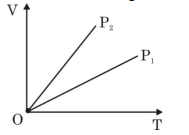
- A
$P_2 \geq P_1$
- B
$P_2>P_1$
- C
$P_1=P_2$
- ✓
$P_1>P_2$
AnswerCorrect option: D. $P_1>P_2$
d
$\mathrm{PV}=\mathrm{nRT}$
$\mathrm{V}=\left(\frac{\mathrm{nR}}{\mathrm{P}}\right)_{\mathrm{T}}$
$\text { Slope }=\frac{\mathrm{nR}}{\mathrm{P}}$
$\text { Slope } \propto \frac{1}{\mathrm{P}}$
$(\text { Slope })_2>(\text { Slope })_1$
$\mathrm{P}_2<\mathrm{P}_1$
View full question & answer→MCQ 2621 Mark
The pressure and volume of an ideal gas are related as $\mathrm{PV}^{3 / 2}=\mathrm{K}$ (Constant). The work done when the gas is taken from state $A\left(P_1, V_1, T_1\right)$ to state $\mathrm{B}\left(\mathrm{P}_2, \mathrm{~V}_2, \mathrm{~T}_2\right)$ is :
- ✓
$2\left(\mathrm{P}_1 \mathrm{~V}_1-\mathrm{P}_2 \mathrm{~V}_2\right)$
- B
$2\left(\mathrm{P}_2 \mathrm{~V}_2-\mathrm{P}_1 \mathrm{~V}_1\right)$
- C
$2\left(\sqrt{\mathrm{P}_1} V_1-\sqrt{\mathrm{P}_2} V_2\right)$
- D
$2\left(\mathrm{P}_2 \sqrt{\mathrm{V}_2}-\mathrm{P}_1 \sqrt{\mathrm{V}_1}\right)$
AnswerCorrect option: A. $2\left(\mathrm{P}_1 \mathrm{~V}_1-\mathrm{P}_2 \mathrm{~V}_2\right)$
a
For $\mathrm{PV}^{\mathrm{x}}=$ constant
If work done by gas is asked then
${W}=\frac{\mathrm{nR} \Delta \mathrm{T}}{1-\mathrm{x}}$
Here x $=\frac{3}{2}$
$ W =\frac{\mathrm{P}_2 \mathrm{~V}_2-\mathrm{P}_1 \mathrm{~V}_1}{-\frac{1}{2}}$
$=2\left(\mathrm{P}_1 \mathrm{~V}_1-\mathrm{P}_2 \mathrm{~V}_2\right) \ldots . \text { Option (1) is correct }$
If work done by external is asked then
$\mathrm{W}=-2\left(\mathrm{P}_1 \mathrm{~V}_1-\mathrm{P}_2 \mathrm{~V}_2\right) \ldots \ldots$ Option $(2)$ is correct
View full question & answer→MCQ 2631 Mark
A sample of gas at temperature $\mathrm{T}$ is adiabatically expanded to double its volume. Adiabatic constant for the gas is $\gamma=3 / 2$. The work done by the gas in the process is : $(\mu=1 \mathrm{~mole})$
- A
$\mathrm{RT}[\sqrt{2}-2]$
- B
$\mathrm{RT}[1-2 \sqrt{2}]$
- C
$\mathrm{RT}[2 \sqrt{2}-1]$
- ✓
$\mathrm{RT}[2-\sqrt{2}]$
AnswerCorrect option: D. $\mathrm{RT}[2-\sqrt{2}]$
d
$\mathrm{W}=\frac{\mathrm{nR} \Delta \mathrm{T}}{1-\gamma}$
$\mathrm{TV}^{\gamma-1}=\text { constant }=\mathrm{T}_{\mathrm{f}}(2 \mathrm{~V})^{\gamma-1}$
$\mathrm{~T}_{\mathrm{f}}=\mathrm{T}\left(\frac{1}{2}\right)^{1 / 2}=\frac{\mathrm{T}}{\sqrt{2}}$
$\mathrm{~W}=\frac{\mathrm{R}\left(\frac{\mathrm{T}}{\sqrt{2}}-\mathrm{T}\right)}{1-\frac{3}{2}}=2 \mathrm{RT} \frac{(\sqrt{2}-1)}{\sqrt{2}}$
$=\mathrm{RT}(2-\sqrt{2})$
View full question & answer→MCQ 2641 Mark
During an adiabatic process, if the pressure of a gas is found to be proportional to the cube of its absolute temperature, then the ratio of $\frac{C_p}{C_V}$ for the gas is:
- A
$\frac{5}{3}$
- B
$\frac{9}{7}$
- ✓
$\frac{3}{2}$
- D
$\frac{7}{5}$
AnswerCorrect option: C. $\frac{3}{2}$
c
$\mathrm{P} \propto \mathrm{T}^3$
$\mathrm{PT}^{-3}=\text { constant }$
$\because \frac{\mathrm{PV}}{\mathrm{T}}=\mathrm{nR}=\text { constant from ideal gas equation }$
$(\mathrm{P})(\mathrm{PV})^{-3}=\text { constant }$
$\mathrm{P}^{-2} \mathrm{~V}^{-3}=\text { cosntant } \quad . .(1)$
$\because \text { Process equation for adiabatic process is }$
$\mathrm{PV}^y=\text { constant } \quad . .(2)$
$\text { Comparing equation (1) and (2) }$
$\frac{\mathrm{C}_{\mathrm{p}}}{\mathrm{C}_{\mathrm{V}}}=\mathrm{y}=\frac{3}{2}$
View full question & answer→MCQ 2651 Mark
Two different adiabatic paths for the same gas intersect two isothermal curves as shown in$P-V$ diagram. The relation between the ratio $\frac{V_a}{V_d}$ and the ratio $\frac{V_b}{V_c}$ is:
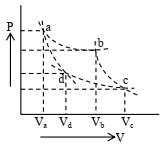
- A
$\frac{V_a}{V_d}=\left(\frac{V_b}{V_c}\right)^{-1}$
- B
$\frac{V_a}{V_d} \neq \frac{V_b}{V_c}$
- ✓
$\frac{V_a}{V_d}=\frac{V_b}{V_c}$
- D
$\frac{V_a}{V_d}=\left(\frac{V_b}{V_c}\right)^2$
AnswerCorrect option: C. $\frac{V_a}{V_d}=\frac{V_b}{V_c}$
c
For adiabatic process
$\mathrm{TV}^{\gamma-1}=\text { constant }$
$\mathrm{T}_{\mathrm{a}} \cdot \mathrm{V}_{\mathrm{a}}^{\gamma-1}=\mathrm{T}_{\mathrm{d}} \cdot \mathrm{V}_{\mathrm{d}}^{\gamma-1}$
$\left(\frac{\mathrm{V}_{\mathrm{a}}}{\mathrm{V}_{\mathrm{d}}}\right)^{\gamma-1}=\frac{\mathrm{T}_{\mathrm{d}}}{\mathrm{T}_{\mathrm{a}}}$
$\mathrm{T}_{\mathrm{b}} \cdot \mathrm{V}_{\mathrm{b}}^{\gamma-1}=\mathrm{T}_{\mathrm{c}} \cdot \mathrm{V}_{\mathrm{c}}^{\gamma-1}$
$\left(\frac{\mathrm{V}_{\mathrm{b}}}{\mathrm{V}_{\mathrm{c}}}\right)^{\gamma-1}=\frac{\mathrm{T}_{\mathrm{c}}}{\mathrm{T}_{\mathrm{b}}}$
$\mathrm{T}_{\mathrm{b}} \cdot \mathrm{V}_{\mathrm{b}}^{\gamma-1}=\mathrm{T}_{\mathrm{c}} \cdot \mathrm{V}_{\mathrm{c}}^{\gamma-1}$
$\left(\frac{\mathrm{V}_{\mathrm{b}}}{\mathrm{V}_{\mathrm{c}}}\right)^{\gamma-1}=\frac{\mathrm{T}_{\mathrm{c}}}{\mathrm{T}_{\mathrm{b}}}$
$\frac{\mathrm{V}_{\mathrm{a}}}{\mathrm{V}_{\mathrm{d}}}=\frac{\mathrm{V}_{\mathrm{b}}}{\mathrm{V}_{\mathrm{c}}} \quad\left(\begin{array}{r}\because \mathrm{T}_{\mathrm{d}}=\mathrm{T}_{\mathrm{c}} \\ \mathrm{T}_{\mathrm{a}}=\mathrm{T}_{\mathrm{b}}\end{array}\right)$
View full question & answer→MCQ 2661 Mark
The volume of an ideal gas $(\gamma=1.5)$ is changed adiabatically from $5$ litres to $4$ litres. The ratio of initial pressure to final pressure is:
- A
$\frac{4}{5}$
- B
$\frac{16}{25}$
- ✓
$\frac{8}{5 \sqrt{5}}$
- D
$\frac{2}{\sqrt{5}}$
AnswerCorrect option: C. $\frac{8}{5 \sqrt{5}}$
c
For Adiabatic process
$P_i V_i=P_f V_f^\gamma$
$P_i(5)^{1.5}=P_f(4)^{1.5}$
$\frac{P_i}{P_f}=\left(\frac{4}{5}\right)^{\frac{3}{2}}=\frac{4}{5} \cdot\left(\frac{4}{5}\right)^{\frac{1}{2}} \Rightarrow \frac{8}{5 \sqrt{5}}$
View full question & answer→MCQ 2671 Mark
A sample of $1$ mole gas at temperature $\mathrm{T}$ is adiabatically expanded to double its volume. If adiabatic constant for the gas is $\gamma=\frac{3}{2}$, then the work done by the gas in the process is:
- ✓
$\mathrm{RT}[2-\sqrt{2}]$
- B
$\frac{\mathrm{R}}{\mathrm{T}}[2-\sqrt{2}]$
- C
$\mathrm{RT}[2+\sqrt{2}]$
- D
$\frac{T}{R}[2+\sqrt{2}]$
AnswerCorrect option: A. $\mathrm{RT}[2-\sqrt{2}]$
a
$\mathrm{TV}^{\gamma-1}=\text { constant }$
$\Rightarrow \mathrm{T}(\mathrm{V})^{\frac{3}{2}-1}=\mathrm{T}_{\mathrm{f}}(2 \mathrm{~V})^{\frac{3}{2}-1}$
$\Rightarrow \mathrm{TV}^{\frac{1}{2}}=\mathrm{T}_{\mathrm{f}}(2)^{\frac{1}{2}}(\mathrm{~V})^{\frac{1}{2}}$
$\Rightarrow \mathrm{T}_{\mathrm{f}}=\left(\frac{\mathrm{T}}{\sqrt{2}}\right)$
$\text { Now, W.D. }=\frac{\mathrm{nR} \Delta \mathrm{T}}{1-\gamma}=\frac{1 \cdot \mathrm{R}\left[\frac{\mathrm{T}}{\sqrt{2}}-\mathrm{T}\right]}{1-\frac{3}{2}}$
$\Rightarrow \text { W.D. }=2 \mathrm{RT}\left[1-\frac{1}{\sqrt{2}}\right]$
$\Rightarrow \text { W.D. }=\mathrm{RT}[2-\sqrt{2}]$
View full question & answer→MCQ 2681 Mark
The specific heat at constant pressure of a real gas obeying $\mathrm{PV}^2=\mathrm{RT}$ equation is :
AnswerCorrect option: D. $C_V+\frac{R}{2 V}$
d
$\mathrm{dQ}=\mathrm{du}+\mathrm{dW}$
$\mathrm{CdT}=\mathrm{C}_{\mathrm{V}} \mathrm{dT}+\mathrm{PdV}$ $....(1)$
$\therefore \quad \mathrm{PV}^2=\mathrm{RT}$
$\quad \mathrm{P}=\text { constant }$
$\quad \mathrm{P}(2 \mathrm{VdV})=\mathrm{RdT}$
$\quad \mathrm{PdV}=\frac{\mathrm{RdT}}{2 \mathrm{~V}}$
Put in equation $(1)$
$\mathrm{C}=\mathrm{C}_{\mathrm{V}}+\frac{\mathrm{R}}{2 \mathrm{~V}}$
View full question & answer→MCQ 2691 Mark
A real gas within a closed chamber at $27^{\circ} \mathrm{C}$ undergoes the cyclic process as shown in figure. The gas obeys $P V^3=\mathrm{RT}$ equation for the path $A$ to $B$. The net work done in the complete cycle is (assuming $R=8 \mathrm{~J} / \mathrm{molK}$ ):
- A
$225 \mathrm{~J}$
- ✓
$205 \mathrm{~J}$
- C
$20 \mathrm{~J}$
- D
$-20 \mathrm{~J}$
AnswerCorrect option: B. $205 \mathrm{~J}$
b
$\mathrm{W}_{\mathrm{AB}} =\int \mathrm{PdV} \quad \text { (Assuming } \mathrm{T} \text { to be constant) }$
$=\int \frac{\mathrm{RTdV}}{\mathrm{V}^3}$
$=\mathrm{RT} \int_2^4 \mathrm{~V}^{-3} \mathrm{dV}$
$=8 \times 300 \times\left(-\frac{1}{2}\left[\frac{1}{4^2}-\frac{1}{2^2}\right]\right)$
$=225 \mathrm{~J}$
$\mathrm{~W}_{\mathrm{BC}} =\mathrm{P} \int_4^2 \mathrm{dV}=10(2-4)=-20 \mathrm{~J}$
$\mathrm{~W}_{\mathrm{CA}} =0$
$\therefore \mathrm{W}_{\text {cyck }} =205 \mathrm{~J}$
Note: Data is inconsistent in process $A B$.
So needs to be challenged.
View full question & answer→MCQ 2701 Mark
A thermodynamic system is taken from an original state $A$ to an intermediate state $B$ by a linear process as shown in the figure. It's volume is then reduced to the original value from $B$ to $C$ by an isobaric process. The total work done by the gas from $A$ to $B$ and $B$ to $C$ would be :
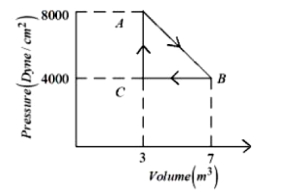
- A
$33800 \mathrm{~J}$
- B
$2200 \mathrm{~J}$
- ✓
$800 \mathrm{~J}$
- D
$1200 \mathrm{~J}$
AnswerCorrect option: C. $800 \mathrm{~J}$
c
Work done $\mathrm{AB}=\frac{1}{2}(8000+6000)$ Dyne $/ \mathrm{cm}^2 \times$ $4 \mathrm{~m}^3=\left(6000 \mathrm{Dyne} / \mathrm{cm}^2\right) \times 4 \mathrm{~m}^3$
Work done $\mathrm{BC}=-\left(4000\right.$ Dyne $\left./ \mathrm{cm}^2\right) \times 4 \mathrm{~m}^3$
Total work done $=2000$ Dyne $/ \mathrm{cm}^2 \times 4 \mathrm{~m}^3$
$=2 \times 10^3 $ $\times \frac{1}{10^5} \frac{\mathrm{N}}{\mathrm{cm}^2} \times 4 \mathrm{~m}^3 $
$ =2 \times 10^{-2} \times \frac{\mathrm{N}}{10^{-4} \mathrm{~m}^2} \times 4 \mathrm{~m}^3 $
$ =2 \times 10^2 \times 4 \mathrm{Nm}=800 \mathrm{~J}$
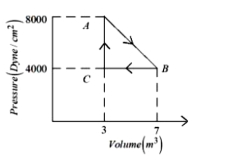
View full question & answer→MCQ 2711 Mark
Choose the correct statement for processes $A$ & $B$ shown in figure.
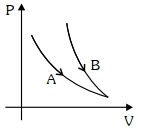
- ✓
$\mathrm{PV}^\gamma=\mathrm{k}$ for process $\mathrm{B}$ and $\mathrm{PV}=\mathrm{k}$ for process $\mathrm{A}$.
- B
$\mathrm{PV}=\mathrm{k}$ for process $\mathrm{B}$ and $\mathrm{A}$.
- C
$\frac{P^{\gamma-1}}{T^\gamma}=k$ forprocess $B$ and $T=k$ for process $A$
- D
$\frac{T^\gamma}{P^{\gamma-1}}=k$ for process $A$ and $P V=k$ for process $B$.
AnswerCorrect option: A. $\mathrm{PV}^\gamma=\mathrm{k}$ for process $\mathrm{B}$ and $\mathrm{PV}=\mathrm{k}$ for process $\mathrm{A}$.
a
Steeper curve $(B)$ is adiabatic
Adiabatic $\Rightarrow \mathrm{PV}^{\prime}=$ const.
Or $\mathrm{P}\left(\frac{\mathrm{T}}{\mathrm{P}}\right)^{\mathrm{r}}=$ const.
$\frac{\mathrm{T}^v}{\mathrm{P}^{v-1}}=\text { const. }$
Curve $(A)$ is isothermal
$\mathrm{T}=$ const.
$\mathrm{PV}=$ const.
View full question & answer→MCQ 2721 Mark
A gas mixture consists of $8$ moles of argon and $6$ moles of oxygen at temperature $T$. Neglecting all vibrational modes, the total internal energy of the system is
- A
$29 \mathrm{RT}$
- B
$20 \mathrm{RT}$
- ✓
$27 \mathrm{RT}$
- D
$21 \mathrm{RT}$
AnswerCorrect option: C. $27 \mathrm{RT}$
c
$\mathrm{U}=\mathrm{nC}_{\mathrm{V}} \mathrm{T}$
$\Rightarrow \mathrm{U}=\mathrm{n}_1 \mathrm{C}_{\mathrm{V}_1} \mathrm{~T}+\mathrm{n}_2 \mathrm{C}_{\mathrm{V}_2} \mathrm{~T}$
$\Rightarrow 8 \times \frac{3 \mathrm{R}}{2} \times \mathrm{T}+6 \times \frac{5 \mathrm{R}}{2} \times \mathrm{T}$
$=27 \mathrm{RT}$
View full question & answer→MCQ 2731 Mark
A diatomic gas $(\gamma=1.4)$ does $200 \mathrm{~J}$ of work when it is expanded isobarically. The heat given to the gas in the process is:
- A
$850 \mathrm{~J}$
- B
$800 \mathrm{~J}$
- C
$600 \mathrm{~J}$
- ✓
$700 \mathrm{~J}$
AnswerCorrect option: D. $700 \mathrm{~J}$
d
$\gamma=1+\frac{2}{f}=1.4 \Rightarrow \frac{2}{f}=0.4$
$\Rightarrow f=5$
$W=n R \Delta T=200 J$
$Q=\left(\frac{f+2}{2}\right) n R \Delta T$
$=\frac{7}{2} \times 200=700 J$
View full question & answer→MCQ 2741 Mark
The heat absorbed by a system in going through the given cyclic process is:
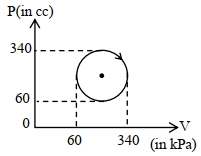
- ✓
$61.6 \mathrm{~J}$
- B
$431.2 \mathrm{~J}$
- C
$616 \mathrm{~J}$
- D
$19.6 \mathrm{~J}$
AnswerCorrect option: A. $61.6 \mathrm{~J}$
a
$\Delta \mathrm{U}=0 \text { (Cyclic process) }$
$\Delta \mathrm{Q}=\mathrm{W}=\text { area of } \mathrm{P}-\mathrm{V} \text { curve. }$
$=\pi \times\left(140 \times 10^3 \mathrm{~Pa}\right) \times\left(140 \times 10^{-6} \mathrm{~m}^3\right)$
$\Delta \mathrm{Q}=61.6 \mathrm{~J}$
View full question & answer→MCQ 2751 Mark
$1\,g$ of a liquid is converted to vapour at $3 \times 10^5\,Pa$ pressure. If $10 \%$ of the heat supplied is used for increasing the volume by $1600\,cm ^3$ during this phase change, then the increase in internal energy in the process will be $............\,J$
- ✓
$4320$
- B
$432000$
- C
$4800$
- D
$4..32$
AnswerCorrect option: A. $4320$
a
Work done $= P \Delta V$
$=3 \times 10^5 \times 1600 \times 10^{-6}$
$=480\,J$
Only $10 \%$ of heat is used in work done.
Hence $\Delta Q=4800\,J$
The rest goes in internal energy, which is $90\,\%$ of heat.
Change in internal energy $=0.9 \times 4800=4320\,J$
View full question & answer→MCQ 2761 Mark
Given below are two statements. One is labelled as Assertion A and the other is labelled as Reason $R$.
Assertion $A$ : If $dQ$ and $dW$ represent the heat supplied to the system and the work done on the system respectively. Then according to the first law of thermodynamics $d Q=d U-d W$.
Reason $R :$ First law of thermodynamics is based on law of conservation of energy.
In the light of the above statements, choose the correct answer from the option given below :
- A
$A$ is correct but $R$ is not correct
- B
$A$ is not correct but $R$ is correct
- ✓
Both $A$ and $R$ are correct and $R$ is the correct explanation of $A$
- D
Both $A$ and $R$ are correct but $R$ is not the correct explanation of $A$
AnswerCorrect option: C. Both $A$ and $R$ are correct and $R$ is the correct explanation of $A$
c
First law of thermodynamics is based on law of conservation of energy and it can be written as $dQ = dU - dW$ where $d$W is work done on the system
View full question & answer→MCQ 2771 Mark
Heat energy of $735\,J$ is given to a diatomic gas allowing the gas to expand at constant pressure. Each gas molecule rotates around an internal axis but do not oscillate. The increase in the internal energy of the gas will be $..........\,J$
View full question & answer→MCQ 2781 Mark
Given below are two statements:
Statement $I:$ If heat is added to a system, its temperature must increase.
Statement $II:$ If positive work is done by a system in a thermodynamic process, its volume must increase.
In the light of the above statements, choose the correct answer from the options given below
- A
Statement $I$ is true but Statement $II$ is false
- B
Both Statement $I$ and Statement $II$ are true
- C
Both Statement $I$ and Statement $II$ are false
- ✓
Statement $I$ is false but Statement $II$ is true
AnswerCorrect option: D. Statement $I$ is false but Statement $II$ is true
d
Statement $I:$ $\Delta Q > 0$
According to $1^{\text {st }}$ law of thermodynamics
$\Delta Q =\Delta U + W$
If $\Delta Q > 0, \Delta U < 0$ and $W > 0$ is also possible.
Hence $\Delta T < 0$, so $T$ decreases.
Statement $I$ is false
Statement $II:$ W $ > 0$
$\therefore \int Pdv > 0$
Therefore volume of system must increase during positive work done by the system.
Statement $II$ is true
View full question & answer→MCQ 2791 Mark
A gas is compressed adiabatically, which one of the following statement is NOT true.
- A
There is no heat supplied to the system
- B
The temperature of the gas increases
- C
The change in the internal energy is equal to the work done on the gas.
- ✓
There is no change in the internal energy
AnswerCorrect option: D. There is no change in the internal energy
d
(1) $\Delta Q=0$
(2) $\Delta Q =\Delta U +\Delta W$
$\Rightarrow \Delta U =-\Delta W$
adiabatic compression $( V \downarrow)$
$\Delta W =- ve \Rightarrow \Delta U =+ ve$
$\Delta U \uparrow \Rightarrow T \uparrow$
$\Delta U \neq 0$
View full question & answer→MCQ 2801 Mark
$1\,kg$ of water at $100\, ^{\circ}C$ is converted into steam at $100^{\circ}\,C$ by boiling at atmospheric pressure. The volume of water changes from $1.00 \times 10^{-3}\,m ^3$ as a liquid to $1.671\,m ^3$ as steam. The change in internal energy of the system during the process will be $........kJ$ (Given latent heat of vaporisaiton $=2257\,kJ / kg$. Atmospheric pressure $=1 \times 10^5\,Pa$ )
- ✓
$+2090$
- B
$-2090$
- C
$-2426$
- D
$+2476$
AnswerCorrect option: A. $+2090$
a
$\Delta Q =\Delta U +\Delta W$
$\therefore \Delta U =\Delta Q -\Delta W$
$= mL _{ V }- P \Delta V$
$=(1\,Kg )\left(2257 \times 10^3\,J / kg \right)$
$-\left(1 \times 10^5\,Pa \right)\left(1.671\,m ^3-1 \times 10^{-3}\,m ^3\right)$
$=2257 \times 10^3\,J -167 \times 10^3\,J$
$=2090\,KJ$
View full question & answer→MCQ 2811 Mark
In an Isothermal change, the change in pressure and volume of a gas can be represented for three different temperature; $T _3 > T _2 > T _1$ as :
Answerd
For isothermal process $P - V$ graph is rectangular hyperbola As dotted line is isobaric line which implies $T _3 > T _2 > T _1$ as volume is increasing.
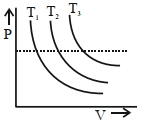
View full question & answer→MCQ 2821 Mark
Heat is given to an ideal gas in an isothermal process.
$A.$ Internal energy of the gas will decrease.
$B.$ Internal energy of the gas will increase.
$C.$ Internal energy of the gas will not change.
$D.$ The gas will do positive work.
$E.$ The gas will do negative work.
Choose the correct answer from the options given below :
- A
$A$ and $E$ only
- B
$B$ and $D$ only
- C
$B$ and $D$ only
- ✓
$C$ and $D$ only
AnswerCorrect option: D. $C$ and $D$ only
d
$dQ = dU + dW \Rightarrow dU = nC _{ V } dT$
$dU =0 \quad \text { (for isothermal) }$
$U =\text { constant }$
$Also dQ > 0 \quad \text { (supplied) }$
Hence,$dW > 0$
View full question & answer→MCQ 2831 Mark
Match List $I$ with List $II$ :
| List $I$ |
List $II$ |
| $A$ Isothermal Process |
$I$ Work done by the gas decreases internal energy |
| $B$ Adiabatic Process |
$II$ No change in internal energy |
| $C$ Isochoric Process |
$III$ The heat absorbed goes partly to increase internal energy and partly to do work |
| $D$ Isobaric Process |
$IV$ No work is done on or by the gas |
Choose the correct answer from the options given below :
- A
$A-II, B-I, C-III, D-IV$
- ✓
$A-II, B-I, C-IV, D-III$
- C
$A-I, B-II, C-IV, D-III$
- D
$A-I, B-II, C-III, D-IV$
AnswerCorrect option: B. $A-II, B-I, C-IV, D-III$
b
$\Delta U = nC _{ v } \Delta T$
For isothermal process $T$ is constant
So $\Delta U =0$
$A \longrightarrow II$
Adiabatic process
$\Delta Q =0$
$\Delta Q =\Delta U +\Delta W$
$\quad \Delta U =-\Delta W$
Work done by gas is positive
So $\Delta U$ is negative
$B \longrightarrow I$
For Isochoric process $\Delta W =0$
$C \longrightarrow IV$
For Isobaric process
$\Delta W = P \Delta V \neq 0$
$\Delta U = nC _{ V } \Delta T \neq 0$
Heat absorbed goes partly to increase internal energy and partly do work.
View full question & answer→MCQ 2841 Mark
A hypothetical gas expands adiabatically such that its volume changes from $8$ litres to $27$ litres. If the ratio of final pressure of the gas to initial pressure of the gas is $\frac{16}{81}$. Then the ratio of $\frac{C_P}{C_V}$ will be
- ✓
$\frac{4}{3}$
- B
$\frac{3}{1}$
- C
$\frac{1}{2}$
- D
$\frac{3}{2}$
AnswerCorrect option: A. $\frac{4}{3}$
View full question & answer→MCQ 2851 Mark
A sample of gas at temperature $T$ is adiabatically expanded to double its volume. The work done by the gas in the process is $\left(\right.$ given, $\left.\gamma=\frac{3}{2}\right)$ :
AnswerCorrect option: D. $W=R T[2-\sqrt{2}]$
d
$T_1 V_1^{\gamma-1}=T_2 V_2^{\gamma-1}$
$T V^{1 / 2}=T_2(2 V)^{1 / 2}$
$T_2=\frac{T}{\sqrt{2}}$
$W=\frac{R\left(T_1-T_2\right)}{\gamma-1}=\frac{R\left(T-\frac{T}{\sqrt{2}}\right)}{\frac{1}{2}}=R T(2-\sqrt{2})$
View full question & answer→MCQ 2861 Mark
Consider two containers $A$ and $B$ containing monoatomic gases at the same Pressure $(P)$, Volume $(V)$ and Temperature $(T)$. The gas in $A$ is compressed isothermally to $\frac{1}{8}$ of its original volume while the gas $B$ is compressed adiabatically to $\frac{1}{8}$ of its original volume. The ratio of final pressure of gas in $B$ to that of gas in $A$ is ...........
- A
$8$
- B
$8^{\frac{3}{2}}$
- C
$\frac{1}{8}$
- ✓
$4$
Answerd
Isothermal process, $T =$ constant
$PV =n R T=\text { constant }$
$P _1 V_1= P _2 V_2$
$PV = P _{ A }( V / 8)$
$P _{ A }=8 P$
Adiabatic process, PV $\gamma=$ constant $\gamma$ for monoatomic gas is $\frac{5}{3}$.
$P _1 V _1^\gamma= P _2 V _2^\gamma$
$\frac{ P _{ B }}{ P }=\left(\frac{ V _1}{ V _2}\right)^\gamma=\left(\frac{ V }{ V / 8}\right)^{\frac{5}{3}}$
$P _{ B }=32 P$
$\frac{ P _{ B }}{ P _{ A }}=\frac{32 P }{8 P }=4$
View full question & answer→MCQ 2871 Mark
The initial pressure and volume of an ideal gas are $P_0$ and $V_0$. The final pressure of the gas when the gas is suddenly compressed to volume $\frac{ V _0}{4}$ will be (Given $\gamma=$ ratio of specific heats at constant pressure and at constant volume)
AnswerCorrect option: B. $P _0(4)^\gamma$
b
As gas is suddenly compressed, the processes is adiabatic.
Equation of gas for adiabatic process is
$PV ^\gamma=\text { constant. }$
$\Rightarrow P _1 V _1^\gamma= P _2 V _2^\gamma$
$\Rightarrow P _0 V _0^\gamma= P _2\left(\frac{ V _0}{4}\right)^\gamma$
$\Rightarrow P _2= P _0(4)^\gamma$
View full question & answer→MCQ 2881 Mark
The pressure of a gas changes linearly with volume from $A$ to $B$ as shown in figure. If no heat is supplied to or extracted from the gas then change in the internal energy of the gas will be $............\,J$
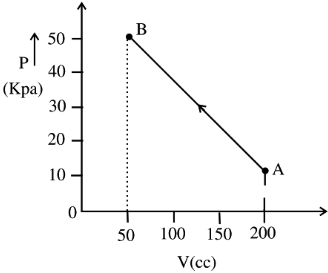
Answerd
$\text { As } \Delta q =0$
$\Delta u =- W$
$W =\int PdV$
$\Delta u =- W =30 \times 10^3 \times 150 \times 10^{-6}$
$=4500 \times 10^{-3}$
$=4.5\,J$
View full question & answer→MCQ 2891 Mark
A Carnot engine with efficiency $50\,\%$ takes heat from a source at $600\,K$. In order to increase the efficiency to $70\,\%$, keeping the temperature of sink same, the new temperature of the source will be $.........\,K$
- A
$360$
- ✓
$1000$
- C
$900$
- D
$300$
AnswerCorrect option: B. $1000$
b
$\text { Initially } \eta=\frac{1}{2}$
$\eta=1-\frac{ T _2}{ T _1}$
$\therefore \frac{1}{2}=1-\frac{ T _2}{600} \quad \Rightarrow T _2=300\,K$
$\Rightarrow \frac{ T _2}{600}=\frac{1}{2} \quad$
Now efficiency is increased to $70 \%$ and $T _2=300$ $K$, Let temp of source $T _1= T$
$\Rightarrow \frac{7}{10}=1-\frac{300}{T}$
$\Rightarrow \frac{300}{ T }=1-\frac{7}{10}$
$\Rightarrow \frac{300}{ T }=\frac{3}{10} \quad \therefore T =1000\,K$
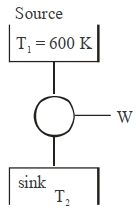
View full question & answer→MCQ 2901 Mark
Given below are two statements : one is labelled as Assertion A and the other is labelled as Reason $R$. Assertion A : Efficiency of a reversible heat engine will be highest at $-273^{\circ} C$ temperature of cold reservoir.
Reason $R$ : The efficiency of Carnot's engine depends not only on temperature of cold reservoir but it depends on the temperature of hot reservoir too and is given as $\eta=\left(1-\frac{ T _2}{ T _1}\right)$.
In the light of the above statements, choose the correct answer from the options given below
- A
$A$ is true but $R$ is false
- B
Both $A$ and $R$ are true but $R$ is NOT the correct explanation of $A$
- C
$A$ is false but $R$ is true
- ✓
Both $A$ and $R$ are true and $R$ is the correct explanation of $A$
AnswerCorrect option: D. Both $A$ and $R$ are true and $R$ is the correct explanation of $A$
d
Both $A$ and $R$ are true and $R$ is the correct explanation of $A$
View full question & answer→MCQ 2911 Mark
A Carnot engine operating between two reservoirs has efficiency $\frac{1}{3}$. When the temperature of cold reservoir raised by $x$, its efficiency decreases to $\frac{1}{6}$. The value of $x$, if the temperature of hot reservoir is $99^{\circ}\,C$, will be $........\,K$
Answerd
$T _{ H }=99^{\circ} C =99+273$
$\qquad=372\,K$
$1-\frac{ T _{ C }}{ T _{ H }}=\frac{1}{3}$
$\frac{ T _{ C }}{ T _{ H }}=\frac{2}{3} \quad(1) \Rightarrow T _{ C }=\frac{2}{3} \times 372$
$1-\frac{ T _{ C }+ X }{ T _{ H }}=\frac{1}{6}$
$\frac{5}{6}=\frac{ T _{ C }+ X }{ T _{ H }}$
$\frac{5}{6}=\frac{248+ X }{372}$
$248+ X =5 \times 62$
$X =310-248=62\,K$
View full question & answer→MCQ 2921 Mark
Work done by a Carnot engine operating between temperatures $127^{\circ}\,C$ and $27^{\circ}\,C$ is $2\,kJ$. The amount of heat transferred to the engine by the reservoir is $........\,kJ$
Answerc
$\eta=1-\frac{ T _2}{ T _1}=\frac{ W }{ Q _1}$
$\Rightarrow \frac{ W }{ Q _1}=1-\frac{300}{400}=\frac{1}{4}$
$\Rightarrow \frac{2 kJ }{ Q _1}=\frac{1}{4}$
$\Rightarrow Q _1=8\,kJ$
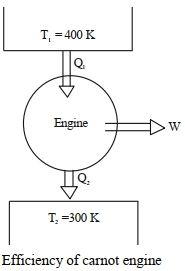
View full question & answer→MCQ 2931 Mark
An engine operating between the boiling and freezing points of water will have
$1.$ efficiency more than $27 \%$
$2.$ efficiency less than the efficiency a Carnot engine operating between the same two temperatures.
$3.$ efficiency equal to $27 \%$
$4.$ efficiency less than $27 \%$
- A
$2,3$ and $4$ only
- B
$2$ and $3$ only
- ✓
$2$ and $4$ only
- D
$1$ and $2$ only
AnswerCorrect option: C. $2$ and $4$ only
c
$\eta=\left(1-\frac{273}{373}\right) \times 100=26.8 \%$
View full question & answer→MCQ 2941 Mark
A source supplies heat to a system at the rate of $1000 \,W$. If the system performs work at a rate of $200\,W$. The rate at which internal energy of the system increases $.......\,W$
- A
$1200$
- B
$600$
- C
$500$
- ✓
$800$
Answerd
$dQ=dU+dw$
$\frac{\mathrm{dU}}{\mathrm{dt}}=\frac{\mathrm{dQ}}{\mathrm{dt}}-\frac{\mathrm{dw}}{\mathrm{dt}}$
$\frac{\mathrm{dU}}{\mathrm{dt}}=1000-200=800 \mathrm{~W}$
View full question & answer→MCQ 2951 Mark
A bicycle tyre is filled with air having pressure of $270\,kPa$ at $27^{\circ}\,C$. The approximate pressure of the air in the tyre when the temperature increases to $36^{\circ}\,C$ is $............kPa$
Answerc
Taking volume constant:$\frac{ P _1}{ T _1}=\frac{ P _2}{ T _2}$
$\Rightarrow P _2=\frac{ P _1}{ T _1} \times T _2=\frac{270 \times(309)}{300}$
$=278\,kPa$
View full question & answer→MCQ 2961 Mark
The thermodynamic process, in which internal energy of the system remains constant is ...........
Answerb
$T =$ constant $\Rightarrow U =$ constant
View full question & answer→MCQ 2971 Mark
A thermodynamic system is taken through cyclic process. The total work done in the process is $.........\,J$
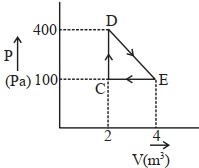
Answerb
$\text { On } P - V \text { scale area of loop }=\text { work done }$
$\Rightarrow W =+\frac{1}{2}(2) \times 300$
$W =300\,J$
View full question & answer→MCQ 2981 Mark
Under isothermal condition, the pressure of a gas is given by $P = aV ^{-3}$, where $a$ is a constant and $V$ is the volume of the gas. The bulk modulus at constant temperature is equal to $..........\,P$
Answerb
$B =-\frac{ dP }{ dv / v }$
$Pv ^3= a$
Differentiating w.r.t to pressure
$v^3+P 3 v^2 \frac{d v}{d P}=0$
$v=-3 \frac{P d v}{d P}=0$
$v=-3 \frac{P d v}{d P}$
$\frac{d P . v}{d v}=-3 P$
$B=-\left(\frac{d P v}{d v}\right)=-(-3 P)=3 P$
View full question & answer→MCQ 2991 Mark
A diatomic gas $(\gamma=1.4)$ does $400 J$ of work when it is expanded isobarically. The heat given to the gas in the process is ............ $J$
- A
$1100$
- B
$1200$
- C
$1300$
- ✓
$1400$
AnswerCorrect option: D. $1400$
d
$Q = nC _{ p } \Delta T =\frac{ n\gamma }{ \gamma -1} R \Delta T$
$Q =\frac{ \gamma }{\gamma -1}\Delta T =\frac{1.4}{0.4} \times 400=1400 \,J$
View full question & answer→MCQ 3001 Mark
Given below are two statement
Statement $-I$ : What $\mu$ amount of an ideal gas undergoes adiabatic change from state $\left( P _{1}, V _{1}, T _{1}\right)$ to state $\left( P _{2}, V _{2}, T _{2}\right)$, the work done is $W =\frac{1 R \left( T _{2}- T _{1}\right)}{1-\gamma}$, where $\gamma=\frac{ C _{ P }}{ C _{ V }}$ and $R =$ universal gas constant,
Statement $-II$ : In the above case. when work is done on the gas. the temperature of the gas would rise.
Choose the correct answer from the options given below
- ✓
Both statement $-I$ and statement $-II$ are true.
- B
Both statement $-I$ and statement $-II$ are false.
- C
Statement $-I$ is true but statement $-II$ is false.
- D
Statement $-I$ is false but statement $-II$ is true.
AnswerCorrect option: A. Both statement $-I$ and statement $-II$ are true.
a
$W _{\text {adiabatic }}=\frac{ NR \left( T _{f}- T _{ i }\right)}{1-\gamma} \rightarrow$ statment $1$
$Q=W+\Delta U$
$0= W +\Delta U$
$\Delta U =- W$
If work is done on the gas, i.e. work is negative
$\therefore \Delta U$ is positive.
$\therefore$ Temperature will increase.
View full question & answer→MCQ 3011 Mark
Starting with the same initial conditions, an ideal gas expands from volume $V_{1}$ to $V_{2}$ in three different ways. The work done by the gas is $W_{1}$ if the process is purely isothermal. $W _{2}$. if the process is purely adiabatic and $W _{3}$ if the process is purely isobaric. Then, choose the coned option
- A
$W _{1} < W _{2} < W _{3}$
- B
$W _{2} < W _{3} < W _{1}$
- C
$W _{3} < W _{1} < W _{2}$
- ✓
$W _{2} < W _{1} < W _{3}$
AnswerCorrect option: D. $W _{2} < W _{1} < W _{3}$
d
Area under curve is work
$W _{2} < W _{1} < W _{3}$
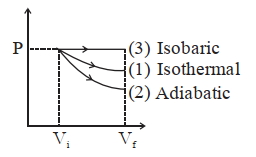
View full question & answer→MCQ 3021 Mark
A certain amount of gas of volume $V$ at $27^{o}\,C$ temperature and pressure $2 \times 10^{7} \;Nm ^{-2}$ expands isothermally until its volume gets doubled. Later it expands adiabatically until its volume gets redoubled. The final pressure of the gas will be (Use $\gamma=1.5$ )
- A
$3.536 \times 10^{5}\,Pa$
- ✓
$3.536 \times 10^{6}\,Pa$
- C
$1.25 \times 10^{6}\,Pa$
- D
$1.25 \times 10^{5}\,Pa$
AnswerCorrect option: B. $3.536 \times 10^{6}\,Pa$
b
$P _{1}=2 \times 10^{7} Pa$
$P _{1} V _{1}= P _{2} V _{2}$
Since $V_{2}=2 V_{1}$ Hence $P_{2}=P_{1} / 2$ (isothermal expansion)
$P _{2}=1 \times 10^{7} Pa$
$P _{2}\left( V _{2}\right)^{\gamma}= P _{3}\left(2 V _{2}\right)^{\gamma}$
$P _{3}=\frac{1 \times 10^{7}}{2^{1.5}}=3.536 \times 10^{6}$
View full question & answer→MCQ 3031 Mark
The pressure $P_{1}$ and density $d_{1}$ of diatomic gas $\left(\gamma=\frac{7}{5}\right)$ changes suddenly to $P _{2}\left(> P _{1}\right)$ and $d _{2}$ respectively during an adiabatic process. The temperature of the gas increases and becomes $......$ times of its initial temperature.$\left(\right.$ given $\left.\frac{ d _{2}}{ d _{1}}=32\right)$
Answerc
$PV ^{\gamma}=$ const $\quad d =\frac{ m }{ v }$
$p \left(\frac{ m }{ d }\right)^{\gamma}=$ const
$\frac{ p }{ d ^{\gamma}}=$ const $\quad \frac{ d _{2}}{ d _{1}}=32$
$\frac{ p _{1}}{ p _{2}}=\left(\frac{ d _{1}}{ d _{2}}\right)^{\gamma}=\left(\frac{1}{32}\right)^{7 / 5}=\frac{1}{128}$
$\frac{ T _{1}}{ T _{2}}=\frac{ P _{1} V _{1}}{ P _{2} V _{2}}=\frac{1}{128} 32=\frac{1}{4}$
View full question & answer→MCQ 3041 Mark
A sample of an ideal gas is taken through the cyclic process $ABCA$ as shown in figure. It absorbs, $40\,J$ of heat during the part $A B$, no heat during $BC$ and rejects $60\,J$ of heat during $CA$. $A$ work $50\,J$ is done on the gas during the part $BC$. The internal energy of the gas at $A$ is $1560\,J$. The work done by the gas during the part $CA$ is.............$J$
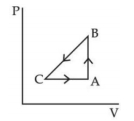
Answerb
$\Delta Q_{\text {cycle }}=40-60=\Delta W$
$\Rightarrow \Delta W =-20 J = W _{ BC }+ W _{ CA }$
$\Rightarrow W _{ CA }=-20 J - W _{ BC }$
$=-20-(-50)$
$=30\,J$
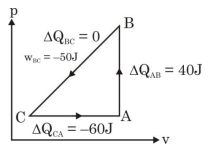
View full question & answer→MCQ 3051 Mark
A thermodynamic system is taken from an original state $D$ to an intermediate state $E$ by the linear process shown in the figure. Its volume is then reduced to the original volume from $E$ to $F$ by an isobaric process. The total work done by the gas from $D$ to $E$ to $F$ will be $......J$
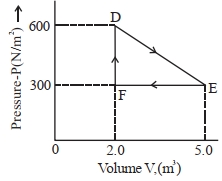
- A
$-450$
- ✓
$450$
- C
$900$
- D
$1350$
Answerb
$W _{ DE }=\frac{1}{2}(600+300) 3\,J$
$=1350\,J$
$W _{ EF }=-300 \times 3=-900\,J$
$W _{ DEF }=450\,J$
View full question & answer→MCQ 3061 Mark
A Carnot engine take $5000 \,k\,cal$ of heat from a reservoir at $727\,^{\circ}C$ and gives heat to a $\operatorname{sink}$ at $127\,^{\circ}C$. The work done by the engine is $.......... \times 10^{6}\,J$
AnswerCorrect option: C. $12.6$
c
$L=\frac{W D}{Q_{H}}$
$\Rightarrow WD = Q _{ H }\left(1-\frac{ T _{ L }}{ T _{ H }}\right)$
$=5 \times 10^{3}\left(1-\frac{400}{1000}\right)$
$=3000\, kcal$
$=12.6 \times 10^{6} J$
View full question & answer→MCQ 3071 Mark
A heat engine operates with the cold reservoir at temperature $324 K$. The minimum temperature of the hot reservoir, if the heat engine takes $300 \; J$ heat from the hot reservoir and delivers $180 \; J$ heat to the cold reservoir per cycle, is $\dots \; K .$
Answerb
$T _{ c }=324 \; k$
$T _{ H }= ?$
$Q _{ H }=300 \; J$
$Q _{ L }=180 \; J$
$1-\frac{ Q _{ L }}{ Q _{ H }}=1-\frac{ T _{ L }}{ T _{ H }}$
$\frac{ Q _{ L }}{ Q _{ H }}=\frac{ T _{ L }}{ T _{ H }}$
$T _{ H }=\frac{ Q _{ H }}{ Q _{ L }} \times T _{ L }=\frac{300}{180} \times 324=540 K$
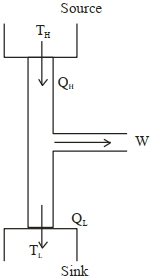
View full question & answer→MCQ 3081 Mark
In a carnot engine, the temperature of reservoir is $527^{\circ} C$ and that of $\operatorname{sink}$ is $200 \; K$. If the workdone by the engine when it transfers heat from reservoir to sink is $12000 \; kJ$, the quantity of heat absorbed by the engine from reservoir is $\times 10^{6} \; J$
Answera
$\left(T_{2}\right) T_{\sin k}=200 \; K$
$\left(T_{1}\right) T_{\text {Reservoir }}=527+273=800 \; K$
$W=12000 K J=12 \times 10^{6} \; J$
$Q_{1}=$ ?
$\eta=1-\frac{T_{2}}{T_{1}}=\frac{W}{Q_{1}}=1-\frac{200}{800}=\frac{12 \times 10^{6}}{Q_{1}}$
$\frac{3}{4}=\frac{12 \times 10^{6}}{Q_{1}}=Q_{1}=16 \times 10^{6} J$
View full question & answer→MCQ 3091 Mark
$300 \,cal$. of heat is given to a heat engine and it rejects $225 \,cal$. of heat. If source temperature is $227^{\circ} C$, then the temperature of sink will be____${ }^{\circ} C$.
Answerd
$1-\frac{Q_{2}}{Q_{1}}=1-\frac{T_{2}}{T_{1}}$
$\frac{ Q _{2}}{ Q _{1}}=\frac{ T _{2}}{ T _{1}}$
$\frac{225}{300}=\frac{ T _{2}}{500}$
$\frac{500 \times 225}{300}= T _{2}$
$375= T _{2}$
$102^{\circ} C = T _{2}$
View full question & answer→MCQ 3101 Mark
Let $\eta_{1}$ is the efficiency of an engine at $T _{1}=447^{\circ}\,C$ and $T _{2}=147^{\circ}\,C$ while $\eta_{2}$ is the efficiency at $T _{1}=947^{\circ}\,C$ and $T _{2}=47^{\circ}\,C$. The ratio $\frac{\eta_{1}}{\eta_{2}}$ will be.
- A
$0.41$
- ✓
$0.56$
- C
$0.73$
- D
$0.70$
AnswerCorrect option: B. $0.56$
b
Efficiency $\eta=1-\frac{ T _{ L }}{ T _{ H }}$
$\eta_{1}=1-\frac{147+273}{447+273}=1-\frac{420}{720}$
$\eta_{1}=\frac{300}{720}$
$\eta_{2}=1-\frac{47+273}{947+273}=1-\frac{320}{1220}$
$\eta_{2}=\frac{900}{1220}$
$\frac{\eta_{1}}{\eta_{2}}=\frac{300}{720} \times \frac{1220}{900}=\frac{122}{72 \times 3}$
$\frac{\eta_{1}}{\eta_{2}}=0.56$
View full question & answer→MCQ 3111 Mark
In $1^{\text {st }}$ case, Carnot engine operates between temperatures $300\,K$ and $100\,K$. In $2^{\text {nd }}$ case, as shown in the figure, a combination of two engines is used. The efficiency of this combination (in $2^{\text {ad }}$ case) will be.
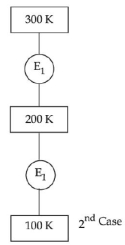
- ✓
same as the $1^{\text {st }}$ case
- B
always greater than the $1^{\text {st }}$ case
- C
always less than the $1^{\text {st }}$ case
- D
may increase or decrease with respect to the $1^{\text {st }}$ case
AnswerCorrect option: A. same as the $1^{\text {st }}$ case
a
First case : $\eta=1-\frac{100}{300}=\frac{2}{3}$
Second case : $\eta_{\text {net }}=\eta_{1}+\eta_{2}-\eta_{1} \eta_{2}$
$\eta_{1}=1-\frac{200}{300}=\frac{1}{3}$
$\eta_{2}=1-\frac{100}{200}=\frac{1}{2}$
$\eta_{\text {net }}=\frac{1}{3}+\frac{1}{2}-\frac{1}{6}=\frac{2}{3}$
$\eta$ (first case) $=\eta$ (second case)
View full question & answer→MCQ 3121 Mark
A Carnot engine has efficiency of $50 \%$. If the temperature of sink is reduced by $40^{\circ} C$, its efficiency increases by $30 \%$. The temperature of the source will be$....K$
- A
$166.7$
- B
$255.1$
- ✓
$266.7$
- D
$367.7$
AnswerCorrect option: C. $266.7$
c
$\eta=1-\frac{ T _{ L }}{ T _{ H }}$
$\frac{1}{2}=1-\frac{ T _{ L }}{ T _{ H }}$
$\frac{1}{2}(1.3)=1-\left(\frac{ T _{ L }-40}{ T _{ H }}\right)$
$\frac{1}{2}(1.3)=\frac{1}{2}+\frac{40}{ T _{ H }} \quad T _{ H }=266.7\,K$
View full question & answer→MCQ 3131 Mark
A monoatomic gas at pressure $P$ and volume $V$ is suddenly compressed to one eighth of its original volume. The final pressure at constant entropy will be $.....P$
Answerc
Constant entropy means process is adiabatic
$PV ^{\gamma}=$ constant
$V _{2}=\frac{ V _{1}}{8}$
$P _{1} V _{1}^{\gamma}= P _{2} V _{2}^{\gamma}$
$P _{1} V _{1}^{\gamma}= P _{2}\left(\frac{ V _{1}}{8}\right)^{5 / 3}$
$P _{1} V _{1}^{5 / 3}=\frac{ P _{2} V _{1}^{5 / 3}}{32}$
$P _{2}=32 P _{1}$
View full question & answer→MCQ 3141 Mark
A Carnot engine whose heat $\operatorname{sinks}$ at $27\,^{\circ} C$, has an efficiency of $25 \%$. By how many degrees should the temperature of the source be changed to increase the efficiency by $100 \%$ of the original efficiency $?$
- A
Increases by $18\,^{\circ} C$
- ✓
Increase by $200\,^{\circ} C$
- C
Increase by $120\,^{\circ} C$
- D
Increase by $73\,^{\circ}$
AnswerCorrect option: B. Increase by $200\,^{\circ} C$
b
$1-\frac{300}{ T }=0$
$\frac{300}{ T }=0.75$
$1-\frac{300}{ T }=0$
$\frac{300}{ T }=0.75$
$T =400 K$
If efficiency increased by $\,100 \%$ then new efficiency $\Rightarrow n ^{\prime}=50 \%$
$1-\frac{300}{T^{\prime}}=0.5$
$T^{\prime}=600 \,K$
Increase in temp $=600-400$
$=200\, K \text { or } 200^{\circ} C$
$T =400\, K$
If efficiency increased by $100 \%\,$ then new efficiency $\Rightarrow n ^{\prime}=50 \%$
$1-\frac{300}{T^{\prime}}=0.5$
$T^{\prime}=600\,K$
Increase in temp $=600-400$
$=200 K \text { or } 200\,^{\circ} C$
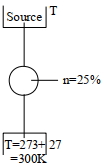
View full question & answer→MCQ 3151 Mark
Consider the efficiency of Carnot's engine is given by $\eta=\frac{\alpha \beta}{\sin \theta} \log _{e} \frac{\beta x}{k T}$, where $\alpha$ and $\beta$ are constants. If $T$ is temperature, $k$ is Boltzman constant, $\theta$ is angular displacement and $x$ has the dimensions of length. Then, choose the incorrect option.
- A
Dimensions of $\beta$ is same as that of force.
- B
Dimensions of $\alpha^{-1} x$ is same as that of energy.
- C
Dimensions of $\eta^{-1} \sin \theta$ is same as that of $\alpha \beta$
- ✓
Dimensions of $\alpha$ is same as that of $\beta$
AnswerCorrect option: D. Dimensions of $\alpha$ is same as that of $\beta$
d
$[\alpha \beta]=[\eta]=[\sin \theta]=$ Dimensionless
$\left[\eta^{-1} \sin \theta\right]=[\alpha \beta]=\text { D.L. }$
View full question & answer→MCQ 3161 Mark
An electric appliance supplies $6000\, {J} / {min}$ heat to the system. If the system delivers a power of $90\, {W}$. How long (in $sec$) it would take to increase the internal energy by $2.5 \times 10^{3}\, {J}$ ?
Answera
$\Delta \mathrm{Q}=\Delta \mathrm{U}+\Delta \mathrm{W}$
$\frac{\Delta \mathrm{Q}}{\Delta \mathrm{t}}=\frac{\Delta \mathrm{U}}{\Delta \mathrm{t}}+\frac{\Delta \mathrm{W}}{\Delta \mathrm{t}}$
$\frac{6000}{60} \frac{\mathrm{J}}{\mathrm{sec}}=\frac{2.5 \times 10^{3}}{\Delta \mathrm{t}}+90$
$\Delta \mathrm{t}=250 \,\mathrm{sec}$
View full question & answer→MCQ 3171 Mark
The amount of heat needed to raise the temperature of $4\, moles$ of a rigid diatomic gas from $0^{\circ} {C}$ to $50^{\circ} {C}$ when no work is done is ......${R}$ ($R$ is the universal gas constant)
Answerc
$\Delta Q=\Delta U+\Delta W$
Here $\Delta W=0$
$\Delta Q=\Delta {U}={nC}_{v} \Delta {T}$
$\Delta Q=4 \times \frac{5 R}{2}(50)=500 \,{R}$
View full question & answer→MCQ 3181 Mark
The temperature of $3.00\, {mol}$ of an ideal diatomic gas is increased by $40.0^{\circ} {C}$ without changing the pressure of the gas. The molecules in the gas rotate but do not oscillate. If the ratio of change in internal energy of the gas to the amount of workdone by the gas is $\frac{{x}}{10} .$ Then the value of ${x}$ (round off to the nearest integer) is ..... . $\left(\right.$ Given $\left.{R}=8.31\, {J} {mol}^{-1} {K}^{-1}\right)$
Answera
Pressure is not changing $\Rightarrow$ isobaric process
$\Rightarrow \Delta {U}={n} {C}_{{v}} \Delta {T}=\frac{5 {nR} \Delta {T}}{2}$
and ${W}={n} {R} \Delta {T}$
$\frac{\Delta {U}}{{W}}=\frac{5}{2}=\frac{{x}}{10} \Rightarrow {x}=25.00$
View full question & answer→MCQ 3191 Mark
One mole of an ideal gas at $27^{\circ} {C}$ is taken from ${A}$ to ${B}$ as shown in the given ${PV}$ indicator diagram. The work done by the system will be $......\times 10^{-1} \,{J}$
[Given : $R=8.3\, {J} /\,mole\,{K}, \ln 2=0.6931$ ] (Round off to the nearest integer)
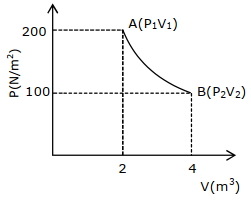
- A
$30012$
- B
$2147$
- C
$834$
- ✓
$17258$
AnswerCorrect option: D. $17258$
d
Process of isothermal
$W=n R T \ln \left(\frac{V_{2}}{V_{1}}\right)$
$1 \times 8.3 \times 300 \times \ln 2$
$=17258 \times 10^{-1} {J}$
View full question & answer→MCQ 3201 Mark
Which one is the correct option for the two different thermodynamic processes ?
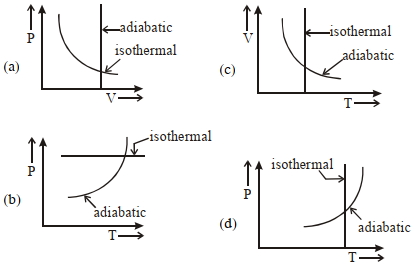
- A
$(c)$ and $(a)$
- ✓
$(c)$ and $(d)$
- C
$(a)$ only
- D
$(b)$ and $(c)$
AnswerCorrect option: B. $(c)$ and $(d)$
b
Option $(a)$ is wrong ; since in adiabatic process $V \neq$ constant
Option $(b)$ is wrong, since in isothermal process
$T = constant$
Option $(c)$ and $(d)$ matches isothermes and adiabatic formula :
$TV ^{\gamma-1}=$ constant and $\frac{ T ^{\gamma}}{ p ^{\gamma-1}}= constant$
View full question & answer→MCQ 3211 Mark
For an adiabatic expansion of an ideal gas, the fractional change in its pressure is equal to (where $\gamma$ is the ratio of specific heats):
- ✓
$-\gamma \frac{ dV }{ V }$
- B
$-\gamma \frac{ V }{ dV }$
- C
$-\frac{1}{\gamma} \frac{ dV }{ V }$
- D
$\frac{ d V }{ V }$
AnswerCorrect option: A. $-\gamma \frac{ dV }{ V }$
a
$PV ^{\gamma}=$ constant
Differentiating
$\frac{ dP }{ dV }=-\frac{\gamma P }{ V }$
$\frac{ dP }{ P }=-\frac{\gamma dV }{ V }$
View full question & answer→MCQ 3221 Mark
Match List$-I$ with List$-II$
| List$-I$ |
List$-II$ |
| $(a)$ Isothermal |
$(i)$ Pressure constant |
| $(b)$ Isochoric |
$(ii)$ Temperature constant |
| $(c)$ Adiabatic |
$(iii)$ Volume constant |
| $(d)$ Isobaric |
$(iv)$ Heat content is constant |
Choose the correct answer from the options given below
- A
$( a ) \rightarrow( i ),( b ) \rightarrow( iii ),( c ) \rightarrow( ii ),( d ) \rightarrow( iv )$
- ✓
$( a ) \rightarrow( ii ),( b ) \rightarrow( iii ),( c ) \rightarrow( iv ),( d ) \rightarrow( i )$
- C
$(a) \rightarrow (ii), (b) \rightarrow( iv ),( c ) \rightarrow( iii ),( d ) \rightarrow( i )$
- D
$(a) \rightarrow( iii ),( b ) \rightarrow( ii ),( c ) \rightarrow( i ),( d ) \rightarrow( iv )$
AnswerCorrect option: B. $( a ) \rightarrow( ii ),( b ) \rightarrow( iii ),( c ) \rightarrow( iv ),( d ) \rightarrow( i )$
b
$(a)$ Isothermal $\Rightarrow$ Temperature constant
$(a)$ $\rightarrow$ $(ii)$
$(b)$ Isochoric $\Rightarrow$ Volume constant
$(a)$ $\rightarrow$ $(iii)$
$(c)$ Adiabatic $\Rightarrow \Delta Q=0$
$\Rightarrow$ Heat content is constant
$(c)$ $\rightarrow$ $(iv)$
$(d)$ Isobaric $\Rightarrow$ Pressure constant
$(d)$ $\rightarrow$ $(i)$
View full question & answer→MCQ 3231 Mark
In the reported figure, there is a cyclic process $ABCDA$ on a sample of $1\, {mol}$ of a diatomic gas. The temperature of the gas during the process ${A} \rightarrow {B}$ and ${C} \rightarrow {D}$ are ${T}_{1}$ and ${T}_{2}\left({T}_{1}\,>\,{T}_{2}\right)$ respectively.
Choose the correct option out of the following for work done if processes $B C$ and $D A$ are adiabatic.
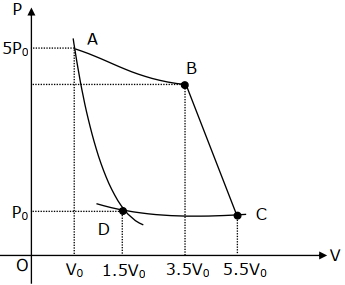
- A
${W}_{{AB}}\,<\,{W}_{{CD}}$
- ✓
${W}_{{AD}}={W}_{{BC}}$
- C
${W}_{{BC}}+{W}_{{DA}}\,>\,0$
- D
${W}_{{AB}}={W}_{{DC}}$
AnswerCorrect option: B. ${W}_{{AD}}={W}_{{BC}}$
b
Work done in adiabatic process $=\frac{-n R}{\gamma-1}\left(T_{f}-T_{i}\right)$
$\therefore W _{ AD }=\frac{- nR }{\gamma-1}\left( T _{2}- T _{1}\right)$
$\text { and } W _{ BC }=\frac{- nR }{\gamma-1}\left( T _{2}- T _{1}\right)$
$\therefore W _{ AD }= W _{ BC }$
View full question & answer→MCQ 3241 Mark
In thermodynamics, heat and work are
- ✓
- B
Intensive thermodynamic state variables
- C
Extensive thermodynamic state variables
- D
Answera
Heat and work are treated as path functions in thermodynamics.
$\Delta Q =\Delta U +\Delta W$
Since work done by gas depends on type of
process i.e. path and $\Delta U$ depends just on initial
and final states, so $\Delta Q$ i.e. heat, also has to
depend on process is path.
View full question & answer→MCQ 3251 Mark
The $P-V$ diagram of a diatomic ideal gas system going under cyclic process as shown in figure. The work done during an adiabatic process $CD$ is (use $\gamma=1.4$) (in $J$)
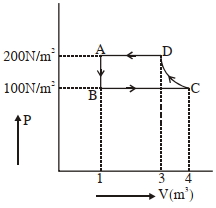
- ✓
$-500$
- B
$-400$
- C
$400$
- D
$200$
AnswerCorrect option: A. $-500$
a
Adiabatic process is from $C$ to $D$
$WD =\frac{ P _{2} V _{2}- P _{1} V _{1}}{1-\gamma}$
$=\frac{P_{D} V_{D}-P_{C} V_{C}}{1-\gamma}$
$=\frac{200(3)-(100)(4)}{1-1.4}$
$=-500\, J$
View full question & answer→MCQ 3261 Mark
In the reported figure, heat energy absorbed by a system in going through a cyclic process is $......\,\pi J$
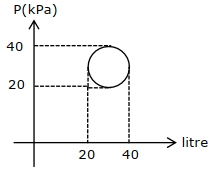
Answerc
For complete cyclic process
$\Delta U=0$
$\therefore \text { from } \Delta Q=\Delta U+W$
$=0+W$
$\Delta Q=W$
$=\text { Area }$
$=\pi r_{1} \cdot r_{2}$
$=\pi \times\left(10 \times 10^{3}\right)\left(10 \times 10^{-3}\right)$
$\Delta Q=100 \pi$
$\therefore \text { Ans. }=100$
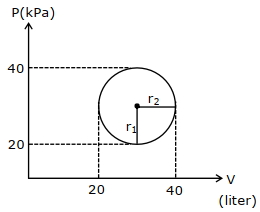
View full question & answer→MCQ 3271 Mark
One mole of an ideal gas is taken through an adiabatic process where the temperature rises from $27^{\circ} {C}$ to $37^{\circ} {C}$. If the ideal gas is composed of polyatomic molecule that has $4$ vibrational modes which of the following is true?
- ✓
Work done on the gas is close to $582\, J$
- B
Work done by the gas is close to $332\, J$
- C
Work done by the gas is close to $582 \,{J}$
- D
Work done on the gas is close to $332 \,J$
AnswerCorrect option: A. Work done on the gas is close to $582\, J$
a
For an ideal gas, each vibrational mode, corresponds to two degrees of freedom, hence, ${f}=3$ (trans.) $+3($ rot. $)+8($ vib. $)=14$
$\gamma=1+\frac{2}{f}$
$\gamma =1+\frac{2}{14}=\frac{8}{7}$
$W =\frac{n R \Delta T}{\gamma-1}=-582$
As ${W}\,<\,0$. Work is done on the gas.
View full question & answer→MCQ 3281 Mark
An ideal gas in a cylinder is separated by a piston in such a way that the entropy of one part is $S_{1}$ and that of the other part is $S_{2}$. Given that $S _{1}> S _{2}$. If the piston is removed then the total entropy of the system will be :
AnswerCorrect option: D. $S _{1}+ S _{2}$
d
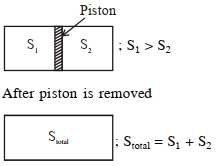
View full question & answer→MCQ 3291 Mark
A Carnot's engine working between $400\, K$ and $800\, K$ has a work output of $1200\, J$ per cycle. The amount of heat energy supplied to the engine from the source in each cycle is ........... $J$
- A
$3200$
- B
$1800$
- C
$1600$
- ✓
$2400$
AnswerCorrect option: D. $2400$
d
$\eta=\frac{ T _{2}}{ T _{1}}=\frac{ Q _{2}}{ Q _{1}}=\frac{ Q _{1}- W }{ Q _{1}} \quad\left(\because W = Q _{1}- Q _{2}\right)$
$\frac{400}{800}=1-\frac{ W }{ Q _{1}}$
$\frac{ W }{ Q _{1}}=1-\frac{1}{2}=\frac{1}{2}$
$Q _{1}=2 W =2400 J$
View full question & answer→MCQ 3301 Mark
For an ideal heat engine, the temperature of the source is $127\,^{\circ} C$. In order to have $60\, \%$ efficiency the temperature of the sink should be $........\,{ }^{\circ} C$. (Round off to the Nearest Integer)
- ✓
$-\,113$
- B
$121$
- C
$107$
- D
$128$
AnswerCorrect option: A. $-\,113$
a
$n =0.60=1=\frac{ T _{ L }}{ T _{ H }}$
$\frac{ T _{ L }}{ T _{ H }}=0.4 \Rightarrow T _{ L }=0.4 \times 400$
$=160\, K$
$=-113\,^{\circ} C$
View full question & answer→MCQ 3311 Mark
A reversible heat engine converts one-fourth of the heat input into work. When the temperature of the sink is reduced by $52\, K$, its efficiency is doubled. The temperature in Kelvin of the source will be ...... .
Answerb
$\eta=\frac{1}{4}=1-\frac{ T _{2}}{ T _{1}}$
$\frac{ T _{2}}{ T _{1}}=\frac{3}{4}$
$\frac{ T _{2}-52}{ T _{1}}=\frac{1}{2}$
View full question & answer→MCQ 3321 Mark
A heat engine operates between a cold reservoir at temperature ${T}_{2}=400\, {K}$ and a hot reservoir at temperature ${T}_{1} .$ It takes $300 \,{J}$ of heat from the hot reservoir and delivers $240\, {J}$ of heat to the cold reservoir in a cycle. The minimum temperature of the hot reservoir has to be $....{K}$
Answerb
${Q}_{\text {in }}=300\, {J} ; Q_{\text { out }}=240\, {J}$
Work done $=Q_{\text {in }}-Q_{\text {out }}=300-240=60 {J}$
Efficiency $=\frac{W}{{Q}_{\text {in }}}=\frac{60}{300}=\frac{1}{5}$
efficiency $=1-\frac{{T}_{2}}{{T}_{1}}$
$\frac{1}{5}=1-\frac{400}{{T}_{1}} \Rightarrow \frac{400}{{T}_{1}}=\frac{4}{5}$
${T}_{1}=500\, {k}$
View full question & answer→MCQ 3331 Mark
A refrigerator consumes an average $35\, {W}$ power to operate between temperature $-10^{\circ} {C}$ to $25^{\circ} {C}$. If there is no loss of energy then how much average heat per second does it transfer? (in ${J} / {s}$)
Answera
$\frac{{T}_{{L}}}{{T}_{{H}}-{T}_{{L}}}={C} . {O} \cdot {P} .=\frac{\frac{{dH}}{{dt}}}{\frac{{dW}}{{dt}}}$
$\frac{263}{35} \times 35=\frac{{dH}}{{dt}}$
$\frac{{dH}}{{dt}}=263$ $watts$
View full question & answer→MCQ 3341 Mark
A sample of gas with $\gamma=1.5$ is taken through an adiabatic process in which the volume is compressed from $1200\, {cm}^{3}$ to $300\, {cm}^{3}$. If the initial pressure is $200\, {kPa}$. The absolute value of the workdone by the gas in the process $= \,..... J.$
Answerd
$\gamma=1.5$
$p_{1} v_{1}^{\gamma}=p_{2} v_{2}^{\gamma}$
$(200)(1200)^{1.5}=P^{2}(300)^{1.5}$
$P_{2}=200[4]^{3 / 2}=1600 {kPa}$
$\mid$ W.D. $\mid=\frac{{p}_{2} {v}_{2}-{p}_{1} {v}_{1}}{v-1}=\left(\frac{480-240}{0.5}\right)=480 {J}$
View full question & answer→MCQ 3351 Mark
Thermodynamic process is shown below on a $P-V$ diagram for one mole of an ideal gas. If $V _{2}=2 V _{1}$ then the ratio of temperature $T _{2} / T _{1}$ is ...... .
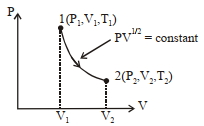
- A
$\frac{1}{2}$
- B
$2$
- ✓
$\sqrt{2}$
- D
$\frac{1}{\sqrt{2}}$
AnswerCorrect option: C. $\sqrt{2}$
c
$PV ^{1 / 2}= c$
$\frac{ nRT }{ V } V ^{1 / 2}= c$
$T = c ^{1} V ^{1 / 2}$
$\frac{ T _{2}}{ T _{1}}=\left(\frac{ V _{2}}{ V _{1}}\right)^{1 / 2}=\left(\frac{2 V _{1}}{ V _{1}}\right)^{1 / 2}$
$\frac{ T _{2}}{ T _{1}}=\sqrt{2}$
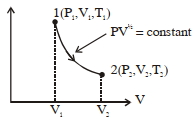
View full question & answer→MCQ 3361 Mark
The volume $V$ of a given mass of monoatomic gas changes with temperature $T$ according to the relation $V = KT ^{2 / 3}$. The workdone when temperature changes by $90\, K$ will be $x\,R$. The value of $x$ is $[ R =$ universal gas constant $]$
Answerb
We know that work done is
$W =\int PdV\quad \ldots (1)$
$\Rightarrow P=\frac{ nRT }{ V }\quad \ldots (2)$
$\Rightarrow W =\int \frac{ nRT }{ V } dv\quad \ldots (3)$
and $V = KT ^{2 . / 3}\quad \ldots (4)$
$\Rightarrow W =\int \frac{ nRT }{ KT ^{2 / 3}} \cdot dv \quad \ldots (5)$
$\Rightarrow$ from (4)$: dv =\frac{2}{3} KT ^{-1 / 3} dT$
$\Rightarrow W =\int_{ T _{1}}^{ T _{2}} \frac{ nRT }{ KT ^{2 / 3}} \frac{2}{3} K \frac{1}{ T ^{1 / 3}} dT$
$\Rightarrow W =\frac{2}{3} n R \times\left( T _{2}- T _{1}\right) \ldots(6)$
$\Rightarrow T _{2}- T _{1}=90 K \ldots(7)$
$\Rightarrow W=\frac{2}{3} n R \times 90$
$\Rightarrow W =60 nR$
Assuming $1$ mole of gas
$n =1$
So $W =60 \,R$
View full question & answer→MCQ 3371 Mark
$n$ mole a perfect gas undergoes a cyclic process $ABCA$ (see figure) consisting of the following processes.
$A \rightarrow B :$ Isothermal expansion at temperature $T$ so that the volume is doubled from $V _{1}$ to $V _{2}=2 V _{1}$ and pressure changes from $P _{1}$ to $P _{2}$
$B \rightarrow C :$ Isobaric compression at pressure $P _{2}$ to initial volume $V _{1}$
$C \rightarrow A$ : Isochoric change leading to change of pressure from $P _{2}$ to $P _{1}$
Total workdone in the complete cycle $ABCA$ is
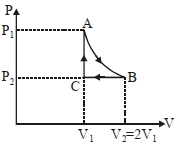
AnswerCorrect option: D. $nRT \left(\ln 2-\frac{1}{2}\right)$
d
$W _{\text {Isothermal }}= nRT \ln \left(\frac{ v _{2}}{ v _{1}}\right)$
$W _{\text {Isobaric }}= P \Delta V = nR \Delta T$
$W _{\text {Isochoric }}=0$
$W _{1}= nRT \ln \left(\frac{2 V }{ V }\right)= nRT \ln 2$
$W _{2}= nR \left(\frac{ T }{2}- T \right)=- nR \frac{ T }{2}$
$W _{3}=0$
$\Rightarrow W _{ net }= W _{1}+ W _{2}+ W _{3}$
$W _{ net }= nRT \left(\ln 2-\frac{1}{2}\right)$
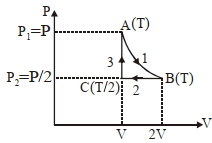
View full question & answer→MCQ 3381 Mark
A diatomic gas, having $C_{p}=\frac{7}{2} R$ and $C _{ v }=\frac{5}{2} R ,$ is heated at constant pressure. The ratio $dU : dQ : dW :$
- A
$5: 7: 3$
- ✓
$5: 7: 2$
- C
$3: 7: 2$
- D
$3: 5: 2$
AnswerCorrect option: B. $5: 7: 2$
b
$d U = n C _{ v } dT$
$dQ = nC _{ p } dT$
$dW = PdV = nRdT$ (isobaric process)
$d U : dQ : dW : C _{ v }: C _{ p }: R$
$=\frac{5 R }{2}: \frac{7 R }{2} \cdot R =5: 7: 2$
View full question & answer→MCQ 3391 Mark
In a certain thermodynamical process, the pressure of a gas depends on its volume as $kV ^{3}$. The work done when the temperature changes from $100^{\circ} C$ to $300^{\circ} C$ will be .......... $nR$, where $n$ denotes number of moles of a gas.
Answerc
$P=k V^{3}$
$T_{i}=100^{\circ} C $
$T _{ f }=300^{\circ} C$
$\Delta T =300-100$
$\Delta T =200^{\circ} C$
$P = kV ^{3}$
now $PV = nRT$
$\therefore kV ^{4}= nRT$
now $4 kV ^{3} dV = nRdT$
$\therefore PdV = nRdT / 4$
$\therefore$ Work $=\int PdV =\int \frac{ nRdT }{4}=\frac{ nR }{4} \Delta T$
$=\frac{200}{4} \times nR =50 nR$
View full question & answer→MCQ 3401 Mark
If one mole of an ideal gas at $\left( P _{1}, V _{1}\right)$ is allowed to expand reversibly and isothermally ($A$ to $B$ ) its pressure is reduced to one-half of the original pressure (see $figure$). This is followed by a constant volume cooling till its pressure is reduced to one-fourth of the initial value $( B \rightarrow C ) .$ Then it is restored to its initial state by a reversible adiabatic compression ($C$ to $A$). The net workdone by the gas is equal to ...... .
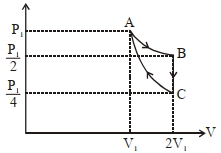
AnswerCorrect option: A. $RT \left(\ln 2-\frac{1}{2(\gamma-1)}\right)$
a
$A-B=$ isothermal process
$W _{ AB }= P _{1} V _{1} \ln \left[\frac{2 V _{1}}{ V _{1}}\right]= P _{1} V _{1} \ln (2)$
$B - C \rightarrow$ Isochoric process
$W _{ BC }=0$
$C - A \rightarrow$ Adiabatic process
$W _{ CA }=\frac{ P _{1} V _{1}-\frac{ P _{1}}{4} \times 2 V _{1}}{1-\gamma}=\frac{ P _{1} V _{1}\left[1-\frac{1}{2}\right]}{1-\gamma}=\frac{ P _{1} V _{1}}{2(1-\gamma)}$
$W _{ net }= W _{ AB }+ W _{ BC }+ W _{ CA } \quad\left\{ P _{1} V _{1}= RT \right\}$
$= P _{1} V _{1} \ln (2)+0+\frac{ P _{1} V _{1}}{2(1-\gamma)}$
$W _{\text {net }}= RT \left[\ln (2)-\frac{1}{2(\gamma-1)}\right]$
View full question & answer→MCQ 3411 Mark
A reversible engine has an efficiency of $\frac{1}{4}$. If the temperature of the sink is reduced by $58^{\circ} {C}$, its efficiency becomes double. Calculate the temperature of the sink. (In $^{\circ} {C}$)
- ✓
$174$
- B
$280$
- C
$180.4$
- D
$382$
Answera
${T}_{2}=$ sink temperature
$\eta=1-\frac{{T}_{2}}{{T}_{1}}$
$\frac{1}{4}=1-\frac{{T}_{2}}{{T}_{1}}$
$\frac{{T}_{2}}{{T}_{1}}=\frac{3}{4} \ldots$ $(i)$
$\frac{1}{2}=1-\frac{{T}_{2}-58}{{T}_{1}}$
$\frac{{T}_{2}}{{T}_{1}}-\frac{58}{{T}_{1}}=\frac{1}{2}$
$\frac{3}{4}=\frac{58}{{T}_{1}}+\frac{1}{2}$
$\frac{1}{4}=\frac{58}{{T}_{1}} \Rightarrow {T}_{1}=232$
${T}_{2}=\frac{3}{4} \times 232$
${T}_{2}=174\, {K}$
View full question & answer→MCQ 3421 Mark
Two carnot engines $A$ and $B$ operate in series such that engine $A$ absorbs heat at $T_{1}$ and rejects heat to a sink at temperature $T$. Engine $B$ absorbs half of the heat rejected by engine $A$ and rejects heat to the sink at ${T}_{3}$. When workdone in both the cases is equal, the value of ${T}$ is
- ✓
$\frac{2}{3} {T}_{1}+\frac{1}{3} T_{3}$
- B
$\frac{3}{2} {T}_{1}+\frac{1}{3} {T}_{3}$
- C
$\frac{1}{3} {T}_{1}+\frac{2}{3} {T}_{3}$
- D
$\frac{2}{3} {T}_{1}+\frac{3}{2} {T}_{3}$
AnswerCorrect option: A. $\frac{2}{3} {T}_{1}+\frac{1}{3} T_{3}$
a
carnot engine is as shown
${W}_{{A}}=1-\frac{{Q}_{2}}{{Q}_{1}}=1-\frac{{T}}{{T}_{1}} \Rightarrow \frac{{Q}_{2}}{{Q}_{1}}=\frac{{T}}{{T}_{1}}$
${W}_{{B}}=1-\frac{{Q}_{3}}{\left({Q}_{2} / 2\right)}=1-\frac{{T}_{3}}{{T}} \Rightarrow \frac{2 {Q}_{3}}{{Q}_{2}}=\frac{{T}_{3}}{{T}}$
Now, ${W}_{{A}}={W}_{{B}}$
${Q}_{1}-{Q}_{2}=\frac{{Q}_{2}}{2}-{Q}_{3}$
$\Rightarrow \frac{2 {Q}_{1}}{{Q}_{2}}+\frac{2 {Q}_{3}}{{Q}_{2}}=3$
$\Rightarrow \frac{2 {T}_{1}}{{T}}+\frac{{T}_{3}}{{T}}=3$
$\frac{2 {T}_{1}}{3}+\frac{{T}_{3}}{3}={T}$
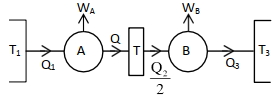
View full question & answer→MCQ 3431 Mark
A litre of dry air at $STP$ expands adiabatically to a volume of $3$ litres. If $\gamma=1.40,$ the work done by air is$(3^{1.4}=4.6555)$ [Take air to be an ideal gas $]$
- ✓
$90.5 \;J$
- B
$48 \;J$
- C
$60.7 \;J$
- D
$100.8 \;J$
AnswerCorrect option: A. $90.5 \;J$
a
$\mathrm{W}=\frac{\mathrm{nR}\left(\mathrm{T}_{1}-\mathrm{T}_{2}\right)}{\gamma-1}=\frac{\mathrm{P}_{1} \mathrm{V}_{1}-\mathrm{P}_{2} \mathrm{V}_{2}}{0.4}$
$W=\frac{100-\frac{100}{4.6555} \times 3}{0.4}=88.90\;J$
View full question & answer→MCQ 3441 Mark
A thermodynamic cycle $xyzx$ is shown on a $V-T$ diagram.
The $P-V$ diagram that best describes this cycle is
(Diagrams are schematic and not to scale)
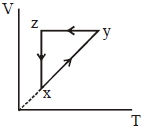
Answerd
$\mathrm{x} \rightarrow \mathrm{y} \Rightarrow$ Isobaric
$\mathrm{y} \rightarrow \mathrm{z} \Rightarrow$ Isochoric
$\mathrm{z} \rightarrow \mathrm{x} \Rightarrow \mathrm{Isothermal}$
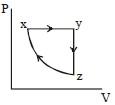
View full question & answer→MCQ 3451 Mark
Which of the following is an equivalent cyclic process corresponding to the thermodynamic cyclic given in the figure? where, $1 \rightarrow 2$ is adiabatic.
(Graphs are schematic and are not to scale)
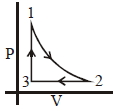
Answerd
In process 2 to 3 pressure is constant and in process 3 to 1 volume is constant
View full question & answer→MCQ 3461 Mark
A balloon filled with helium $\left(32^{\circ} C \right.$ and $1.7\; atm$.) bursts. Immediately afterwards the expansion of helium can be considered as
Answerb
Bursting of helium balloon is irreversible $\&$ adiabatic.
View full question & answer→MCQ 3471 Mark
Match the thermodynamic processes taking place in a system with the correct conditions. In the table: $\Delta Q$ is the heat supplied, $\Delta W$ is the work done and $\Delta U$ is change in internal energy of the system
| Process |
Condition |
| $(I)$ Adiabatic |
$(A)\; \Delta W =0$ |
| $(II)$ Isothermal |
$(B)\; \Delta Q=0$ |
| $(III)$ Isochoric |
$(C)\; \Delta U \neq 0, \Delta W \neq 0 \Delta Q \neq 0$ |
| $(IV)$ Isobaric |
$(D)\; \Delta U =0$ |
- ✓
$I-B, II-D, III-A, IV-C$
- B
$I-B, II-A, III-D, IV-C$
- C
$I - A , II - A , III - B , IV - C$
- D
$I - A , II - B , III - D , IV - D$
AnswerCorrect option: A. $I-B, II-D, III-A, IV-C$
a
$(I)$ Adiabatic process $\Rightarrow \Delta Q=0$ No exchange of heat takes place with surroundings
$(II)$ Isothermal proess $\Rightarrow$ Temperature remains constant $(\Delta T =0)$
$\Delta u =\frac{ F }{2} nR \Delta T \Rightarrow \Delta u =0$
No change in internal energy $[\Delta u =0]$
$(III)$ Isochoric process Volume remains constant
$\Delta V =0$
$W =\int P \cdot d V =0$
Hence work done is zero.
$(IV)$ Isobaric process $\Rightarrow$ Pressure remains constant
$W = P . \Delta V \neq 0$
$\Delta u =\frac{ F }{2} nR \Delta T =\frac{ F }{2}[ P \Delta V ] \neq 0$
$\Delta Q = n C _{ p } \Delta T \neq 0$
View full question & answer→MCQ 3481 Mark
In an adiabatic process, the density of a diatomic gas becomes $32$ times its initial value. The final pressure of the gas is found to be $n$ times the initial pressure. The value of $n$ is
- A
$326$
- B
$\frac{1}{32}$
- C
$32$
- ✓
$128$
Answerd
In adiabatic process
$PV ^{\gamma}= constant$
$P \left(\frac{ m }{\rho}\right)^{\gamma}= constant$
as mass is constant
$P \propto \rho^{\gamma}$
$\frac{P_{f}}{P_{i}}=\left(\frac{\rho_{f}}{\rho_{i}}\right)^{\gamma}=(32)^{7 / 5}=2^{7}=128$
View full question & answer→MCQ 3491 Mark
A closed vessel contains $0.1$ mole of a monoatomic ideal gas at $200\, K$. If $0.05$ mole of the same gas at $400\, K$ is added to it, the final equilibrium temperature (in $K$ ) of the gas in the vessel will be closed to
- A
$269.5$
- B
$260.6$
- C
$250.5$
- ✓
$266.67$
AnswerCorrect option: D. $266.67$
d
As work done on gas and heat supplied to the gas are zero,
total internal energy of gases remain same
$u _{1}+ u _{2}= u _{1}^{\prime}+ u _{2}^{\prime}$
$(0.1) C _{ v }(200)+(0.05) C _{ v }(400)=(0.15) C _{ v } T$
$T =\frac{800}{3} k =266.67 k$
View full question & answer→MCQ 3501 Mark
Two ideal Carnot engines operate in cascade (all heat given up by one engine is used by the other engine to produce work) between temperatures, $\mathrm{T}_{1}$ and $\mathrm{T}_{2} .$ The temperature of the hot reservoir of the first engine is $\mathrm{T}_{1}$ and the temperature of the cold reservoir of the second engine is $\mathrm{T}_{2} . T$ is temperature of the sink of first engine which is also the source for the second engine. How is $T$ related to $\mathrm{T}_{1}$ and $\mathrm{T}_{2}$, if both the engines perform equal amount of work?
- A
$\mathrm{T}=\frac{2 \mathrm{T}_{1} \mathrm{T}_{2}}{\mathrm{T}_{1}+\mathrm{T}_{2}}$
- B
$\mathrm{T}=\sqrt{\mathrm{T}_{1} \mathrm{T}_{2}}$
- ✓
$\mathrm{T}=\frac{\mathrm{T}_{1}+\mathrm{T}_{2}}{2}$
- D
$T=0$
AnswerCorrect option: C. $\mathrm{T}=\frac{\mathrm{T}_{1}+\mathrm{T}_{2}}{2}$
c
$\frac{\mathrm{Q}_{\mathrm{H}}}{\mathrm{Q}_{\mathrm{L}}}=\frac{\mathrm{T}_{1}}{\mathrm{T}}$ and $\mathrm{W}=\mathrm{Q}_{\mathrm{H}}-\mathrm{Q}_{\mathrm{L}}$
$\frac{\mathrm{Q}_{\mathrm{L}}}{\mathrm{Q}_{\mathrm{L}}^{\prime}}=\frac{\mathrm{T}}{\mathrm{T}_{2}}$ and $\mathrm{W}=\mathrm{Q}_{\mathrm{L}}-\mathrm{Q}_{\mathrm{L}}$
From $(1)$ and $(2)$
we get $\mathrm{T}=\frac{\mathrm{T}_{1}+\mathrm{T}_{2}}{2}$
View full question & answer→MCQ 3511 Mark
A Carnot engine operates between two reservoirs of temperatures $900\; \mathrm{K}$ and $300 \;\mathrm{K}$ The engine performs $1200\; \mathrm{J}$ of work per cycle. The heat energy (in $\mathrm{J}$ ) delivered by the engine to the low temperature reservoir, in a cycle. is
Answerc
for carnot engine
$\frac{Q_{1}}{Q_{2}}=\frac{T_{1}}{T_{2}}$
$\frac{\mathrm{Q}+1200}{\mathrm{Q}}=\frac{900}{300}$
$\mathrm{Q}+1200=3 \mathrm{Q}$
$Q=600 \mathrm{J}$
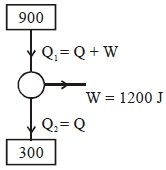
View full question & answer→MCQ 3521 Mark
A heat engine is involved with exchange of heat of $1915\, J,$ $-40\, J ,+125\, J$ and $-Q\,J$, during one cycle achieving an efficiency of $50.0 \%$. The value of $Q$ is.......$J$
Answerc
$\eta=\frac{\text { Work done }}{\text { Heat supplied }}$
$\frac{1}{2}=\eta=\frac{1915-40+125- Q }{1915+125}$
$\frac{1}{2}=\frac{2000- Q }{2040}$
$2040=4000-2 Q$
$2 Q =1960$
$Q =980 J$
View full question & answer→MCQ 3531 Mark
If minimum possible work is done by a refrigerator in converting $100\; grams$ of water at $0^{\circ} C$ to ice, how much heat (in calories) is released to the surrounding at temperature $27^{\circ} C$ (Latent heat of ice $=80 Cal / gram$ ) to the nearest integer?
- A
$8000$
- B
$8502$
- ✓
$8791$
- D
$8561$
AnswerCorrect option: C. $8791$
c
$W + Q _{1}= Q _{2}$
$W = Q _{2}- Q _{1}$
$C.O.P. =\frac{ Q _{1}}{ W }=\frac{ Q _{1}}{ Q _{2}- Q _{1}}=\frac{273}{300-273}=\frac{ Q _{1}}{ W }$
$W =\frac{27}{273} \times 80 \times 100 \times 4.2$
$Q _{2}= W+Q_{1}$
$Q _{2}=\frac{27}{273} \times 80 \times 100 \times 4.2+80 \times 100 \times 4.2$
$Q _{2}=\frac{300}{273} \times 80 \times 100=8791.2 cal$
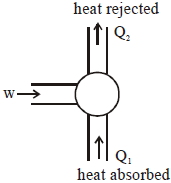
View full question & answer→MCQ 3541 Mark
Starting at temperature $300\; \mathrm{K},$ one mole of an ideal diatomic gas $(\gamma=1.4)$ is first compressed adiabatically from volume $\mathrm{V}_{1}$ to $\mathrm{V}_{2}=\frac{\mathrm{V}_{1}}{16} .$ It is then allowed to expand isobarically to volume $2 \mathrm{V}_{2} \cdot$ If all the processes are the quasi-static then the final temperature of the gas (in $\left. \mathrm{K}\right)$ is (to the nearest integer)
- ✓
$1818$
- B
$2020$
- C
$1576$
- D
$1734$
AnswerCorrect option: A. $1818$
a
$\mathrm{PV} ^\gamma=$ constant
$\mathrm{TV} ^{\gamma-1}=\mathrm{C}$
$300 \times \mathrm{V}^{\frac{7}{5}-1}=\mathrm{T}_{2}\left(\frac{\mathrm{V}}{16}\right)^{\frac{7}{5}-1}$
$300 \times 2^{4 \times \frac{2}{5}}=\mathrm{T}_{2}$
Isobaric process
$\mathrm{V}=\frac{\mathrm{nRT}}{\mathrm{P}}$
$\mathrm{V}_{2}=\mathrm{kT}_{2}$
$2 \mathrm{V}_{2}=\mathrm{KT}_{\mathrm{f}}$
$\frac{1}{2}=\frac{\mathrm{T}_{2}}{\mathrm{T}_{\mathrm{f}}} \Rightarrow \mathrm{T}_{\mathrm{f}}=2 \mathrm{T}_{2}$
$\mathrm{T}_{\mathrm{f}}=2 \times 300 \times 2^{\frac{8}{5}}=1818.85$
View full question & answer→MCQ 3551 Mark
An engine takes in $5$ moles of air at $20\,^{\circ} C$ and $1$ $atm,$ and compresses it adiabaticaly to $1 / 10^{\text {th }}$ of the original volume. Assuming air to be a diatomic ideal gas made up of rigid molecules, the change in its internal energy during this process comes out to be $X\, kJ$. The value of $X$ to the nearest integer is
- A
$46.87$
- ✓
$45.78$
- C
$55.78$
- D
$50.23$
AnswerCorrect option: B. $45.78$
b
Diatomic :
$f=5$
$\gamma=7 / 5$
$T _{ i }= T =273+2 0 =293 K$
$V_{i}=V$
$V _{ f }= V / 10$
Adiabatic $TV ^{\gamma-1}=$ constant
$T _{1} V _{1}^{\gamma-1}= T _{2} V _{2}^{\gamma-1}$
$T \cdot V ^{7 / 5-1}= T _{2}\left(\frac{ V }{10}\right)^{7 / 5-1}$
$\Rightarrow T _{2}= T .10^{2 / 5}$
$\Delta U =\frac{ nfR \left( T _{2}- T _{1}\right)}{2}=\frac{5 \times 5 \times \frac{25}{3} \times\left( T \cdot 10^{2 / 5}- T \right)}{2}$
$=\frac{25 \times 25 \times}{6} T \left(10^{2 / 5}-1\right)$
$=\frac{625 \times 293 \times\left(10^{2 / 5}-1\right)}{6}$
$=4.033 \times 10^{3} \approx 4 kJ$
View full question & answer→MCQ 3561 Mark
Three different processes that can occur in an ideal monoatomic gas are shown in the $P$ vs $V$ diagram. The paths are labelled as $A \rightarrow B, A \rightarrow C$ and $A \rightarrow D .$ The change in internal energies during these process are taken as $E _{ AB }, E _{ AC }$ and $E _{ AD }$ and the work done as $W _{ AB }$ $W _{ AC }$ and $W _{ AD }$
The correct relation between these parameters are
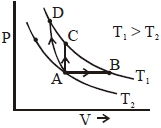
- ✓
$E _{ AB }= E _{ AC }= E _{ AD }, W _{ AB }>0, W _{ AC }=0,$ $W _{ AD }>0$
- B
$E _{ AB }< E _{ AC }< E _{ AD }, W _{ AB }>0, W _{ AC }> W _{ AD }$
- C
$E _{ AB }= E _{ AC }< E _{ AD }, W _{ AB }>0, W _{ AC }=0$ $W _{ AD }<0$
- D
$E _{ AB }> E _{ AC }> E _{ AD }, W _{ AB }< W _{ AC }< W _{ AD }$
AnswerCorrect option: A. $E _{ AB }= E _{ AC }= E _{ AD }, W _{ AB }>0, W _{ AC }=0,$ $W _{ AD }>0$
a
$\Delta U = nC _{ v } \Delta T =$ same
$AB \rightarrow$ volume is increasing $\Rightarrow W >0$
$AD \rightarrow$ volume is decreasing $\Rightarrow W <0$
$AC \rightarrow$ volume is constant $\Rightarrow W =0$
View full question & answer→MCQ 3571 Mark
An engine operates by taking a monatomic ideal gas through the cycle shown in the figure. The percentage efficiency of the engine is close to $.......\%$
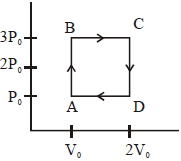
Answera
$W _{ ABCDA }=2 P _{0} V _{0}$
$Q_{\text {in }}=Q_{A B}+Q_{B C}$
$Q _{ AB }= nC \left( T _{ B }- T _{ A }\right)$
$=\frac{ n 3 R }{2}\left( T _{ B }- T _{ A }\right)$
$=\frac{3}{2}\left(P_{B} V_{B}-P_{A} V_{A}\right)$
$=\frac{3}{2}\left(3 P_{B} V_{0}=P_{0} V_{0}\right)=3 P_{0} V_{0}$
$Q _{ BC }= nC _{ P }\left( T _{ C }- T _{ B }\right)$
$=\frac{ n 5 R }{2}\left( T _{ C }- T _{ B }\right)$
$=\frac{5}{2}\left(P_{C} V_{C}-P_{B} V_{B}\right)$
$=\frac{5}{2}\left(6 P _{0} V _{0}-3 P _{0} V _{0}\right)=\frac{15}{2} P _{0} V _{0}$
$\eta=\frac{ W }{ Q _{ in }} \times 100=\frac{2 P _{0} V _{0}}{3 P _{0} V _{0}+\frac{15}{2} P _{0} V _{0}} \times 100$
$\eta=\frac{400}{21}=19.04 \approx 19$
$\eta=19$
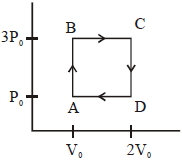
View full question & answer→MCQ 3581 Mark
$n-$ $moles$ of an ideal gas with constant volume heat capacity $C_v$ undergo an isobaric expansion by certain volume. The ratio of the work done in the process, to the heat supplied is
- A
$\frac{{nR}}{{{C_v} - nR}}$
- ✓
$\frac{{nR}}{{{C_v} + nR}}$
- C
$\frac{{4nR}}{{{C_v} + nR}}$
- D
$\frac{{4nR}}{{{C_v} - nR}}$
AnswerCorrect option: B. $\frac{{nR}}{{{C_v} + nR}}$
b
$\mathrm{w}=\mathrm{n} \mathrm{R} \Delta \mathrm{T}$
$\Delta \mathrm{H}=\left(\mathrm{C}_{\mathrm{v}}+\mathrm{n} \mathrm{R}\right) \Delta \mathrm{T}$
$\frac{\omega}{\Delta H}=\frac{n R}{C_{v}+n R}$
View full question & answer→MCQ 3591 Mark
A rigid diatomic ideal gas undergoes an adiabatic process at room temperature. The rational between temperature and volume for the process is $TV^x =$ constant, then $x$ is
Answerb
Equation of adiabatic process
$TV^{2/f} =$ constant
$\therefore \,\,\frac {2}{f}=\frac {2}{5}=x$
View full question & answer→MCQ 3601 Mark
The given diagram shows four processes i.e., isochoric, isobaric, isothermal and adiabatic. The correct assignment of the processes, in the same order is given by
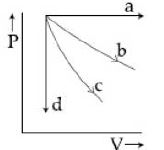
- A
$a\, d\, c\, b$
- B
$a\, d\, b\, c$
- C
$d\, a\, c\, b$
- ✓
$d\, a\, b\, c$
AnswerCorrect option: D. $d\, a\, b\, c$
d
isochoric $\rightarrow$ Process d
Isobaric $\rightarrow$ Process a
Adiabatic slope will be more than isothermal so
Isothermal $\rightarrow$ Process b
Adiabatic$\rightarrow$ Process $c$
Order $\rightarrow$ d a b c
View full question & answer→MCQ 3611 Mark
A gas can be taken from $A$ to $B$ via two different processes $ACB$ and $ADB$. When path $ACB$ is used $60\, J$ of heat flows into the system and $30\, J$ of work is done by the system. If path $ADB$ is used work down by the system is $10\, J$. the heat flow into the system in path $ADB$ is ..... $J$
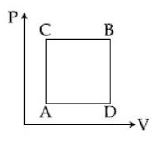
Answera
As temperature at point $A$ and $C$ is same.
$\therefore$ Internal energy change will be same.
$\mathrm{Q}-\mathrm{W}=\mathrm{Q}^{\prime}-\mathrm{W}^{\prime}$
$60-30=Q^{\prime}-10$
$Q^{\prime}=40 \mathrm{J}$
View full question & answer→MCQ 3621 Mark
Following figure shows two processes $A$ and $B$ for a gas. If $\Delta Q_A$ and $\Delta Q_B$ are the amount of heat absorbed by the system in two cases, and $\Delta U_A$ and $\Delta U_B$ are changes in internal energies, respectively, then
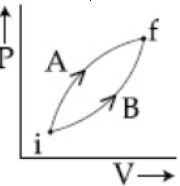
- A
$\Delta {Q_A}\, = \,\Delta {Q_B}\,;\,\Delta {U_A} = \Delta {U_B}$
- ✓
$\Delta {Q_A}\, > \,\Delta {Q_B}\,;\,\Delta {U_A} = \Delta {U_B}$
- C
$\Delta {Q_A}\, < \,\Delta {Q_B}\,;\,\Delta {U_A} < \Delta {U_B}$
- D
$\Delta {Q_A}\, > \,\Delta {Q_B}\,;\,\Delta {U_A} > \Delta {U_B}$
AnswerCorrect option: B. $\Delta {Q_A}\, > \,\Delta {Q_B}\,;\,\Delta {U_A} = \Delta {U_B}$
b
Initial and final states for both the processes are same,
$\therefore \Delta \mathrm{U}_{\mathrm{A}}=\Delta \mathrm{U}_{\mathrm{B}}$
Work done during process $A$ is greater than in process $B$. Because area is more
By First law of thermodynamics
$\Delta Q=\Delta U+W$
$\Rightarrow \Delta \mathrm{Q}_{\mathrm{A}}>\Delta \mathrm{Q}_{\mathrm{B}}$
View full question & answer→MCQ 3631 Mark
A sample of an ideal gas is taken through the cyclic process $abca$ as shown in the figure. The change in the internal energy of the gas along the path $ca$ is $-180\, J$. The gas absorbs $250\, J$ of heat along the path $ab$ and $60\, J$ along the path $bc$. The work done by the gas along the path $abc$ is ..... $J$
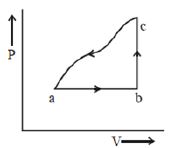
Answerd
| |
$\Delta\,E$ |
$\Delta\,W$ |
$\Delta\,Q$ |
| $ab$ |
|
|
$250$ |
| $bc$ |
|
$0$ |
$60$ |
| $ca$ |
$-180$ |
|
|
| |
$\Delta\,E$ |
$\Delta\,W$ |
$\Delta\,Q$ |
| $ab$ |
$120$ |
$130$ |
$250$ |
| $bc$ |
$60$ |
$0$ |
$60$ |
| $ca$ |
$-180$ |
|
|
View full question & answer→MCQ 3641 Mark
A diatomic gas with rigid molecules does $10\, J$ of work when expanded at constant pressure. What would be the heat energy absorbed by the gas, in this process ..... $J$.
Answerc
For a diatomic gas, $\mathrm{C}_{\mathrm{p}}=\frac{7}{2} \mathrm{R}$
since gas undergoes isobaric process
$\Rightarrow \Delta \mathrm{Q}=\mathrm{n} \frac{7}{2} \mathrm{R\Delta\,T}=\frac{7}{2}({nR\Delta\,T})=35 \mathrm{J}$
View full question & answer→MCQ 3651 Mark
Two Carnot engines $A$ and $B$ are operated in series. The first one, $A,$ receives heat at $T_1(= 600\,K)$ and rejects to a reservoir at temperature $T_2.$ The second engine $B$ receives heat rejected by the first engine and, in turns, rejects to a heat reservoir at $T_3 (=400\,K).$ Calculate the temperature $T_2$ if the work outputs of the two engines are equal ..... $K$
Answerd
$W_1 = W_2$
$\Rightarrow \,\,\,600-T_2\,=\,T_2\,-\,400$
$\Rightarrow T_2\,=\,500\,K$
View full question & answer→MCQ 3661 Mark
Half mole of an ideal monoatomic gas is heated at constant pressure of $1\, atm$ from $20\,^oC$ to $90\,^oC$. Work done by has is close to ..... $J$ (Gas constant $R = 8.31\, J/mol.K$)
Answerb
$W = nR\Delta T$
$= \frac{1}{2}\times8.31\times70$
$= 290.85\,J$
View full question & answer→MCQ 3671 Mark
For the given cyclic process $CAB$ as shown for a gas, the work done is ..... $J$
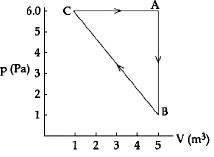
Answerb
Work done $=$ Area of loop
$= \frac{1}{2} (4) (5)$
$= 10\, J$
View full question & answer→MCQ 3681 Mark
In a process, temperature and volume of one mole of an ideal monoatomic gas are varied according to the relation $VT = K$, where $I$ is a constant. In this process the temperature of the gas is increased by $\Delta T$. The amount of heat absorbed by gas is ($R$ is gas constant)
- ✓
$\frac{1}{2}\,R\Delta T$
- B
$\frac{1}{2}\,KR\Delta T$
- C
$\frac{3}{2}\,R\Delta T$
- D
$\frac{{2K}}{3}\,\Delta T$
AnswerCorrect option: A. $\frac{1}{2}\,R\Delta T$
a
${\mathrm{VT}=\mathrm{K}} $
${\Rightarrow \quad \mathrm{V}\left(\frac{\mathrm{PV}}{\mathrm{nR}}\right)=\mathrm{k}} $
${\Rightarrow \quad \mathrm{PV}^{2}=\mathrm{K}} $
${\because \quad \mathrm{C}=\frac{\mathrm{R}}{1-\mathrm{x}}+\mathrm{C}_{\mathrm{v}} \text { (For polytropic process) }} $
${\mathrm{C}=\frac{\mathrm{R}}{1-2}+\frac{3 \mathrm{R}}{2}=\frac{\mathrm{R}}{2}} $
${\therefore \quad \Delta \mathrm{Q}=\mathrm{nC} \Delta \mathrm{T}}$
View full question & answer→MCQ 3691 Mark
Three Carnot engines operate in series between a heat source at a temperature $T_1$ and a heat sink at temperature $T_4$ (see figure). There are two other reservoirs at temperature $T_2$ and $T_3$, as shown, with $T_1 > T_2 > T_3 > T_4$. The three engines are equally efficient if
- A
${T_2} = {\left( {{T_1}{T_4}} \right)^{1/2}};\,{T_3} = {\left( {T_1^2{T_4}} \right)^{1/3}}$
- ✓
${T_2} = {\left( {T_1^2{T_4}} \right)^{1/3}};\,{T_3} = {\left( {{T_1}T_4^2} \right)^{1/3}}$
- C
${T_2} = {\left( {{T_1}T_4^2} \right)^{1/3}};\,{T_3} = {\left( {T_1^2{T_4}} \right)^{1/3}}$
- D
${T_2} = {\left( {T_1^3{T_4}} \right)^{1/4}};\,{T_3} = {\left( {{T_1}T_4^3} \right)^{1/4}}$
AnswerCorrect option: B. ${T_2} = {\left( {T_1^2{T_4}} \right)^{1/3}};\,{T_3} = {\left( {{T_1}T_4^2} \right)^{1/3}}$
b
$n_{1}=n_{2}=n_{3}$
$\Rightarrow \quad 1-\frac{T_{2}}{T_{1}}=1-\frac{T_{3}}{T_{2}}=1-\frac{T_{4}}{T_{3}}$
$\Rightarrow \quad \frac{T_{2}}{T_{1}}=\frac{T_{3}}{T_{2}}=\frac{T_{4}}{T_{3}}$
$\Rightarrow \quad \mathrm{T}_{2} \mathrm{T}_{3}=\mathrm{T}_{1} \mathrm{T}_{4}$ and $\frac{\mathrm{T}_{3}^{2}}{\mathrm{T}_{2}}=\mathrm{T}_{4}$
Solve for $\mathrm{T}_{2}$ and $\mathrm{T}_{3}$
View full question & answer→MCQ 3701 Mark
One mole of an ideal monoatomic gas is compressed isothermally in a rigid vessel to double its pressure at room temperature, $27\,^oC$.The work done on the gas will be
- A
$300R\,ln\,6$
- B
$300R$
- C
$300R\,ln\,7$
- ✓
$300R\,ln\,2$
AnswerCorrect option: D. $300R\,ln\,2$
d
$Work\,done\,on\,gas = nRT\,\ell n\left( {\frac{{{p_f}}}{{{p_l}}}} \right)$
$ = R\left( {300} \right)\ell n\left( 2 \right)\left( {\frac{{{p_f}}}{{{p_i}}} = 2\,given} \right)$
View full question & answer→MCQ 3711 Mark
Two moles of an ideal monoatomic gas occupies a volume $V$ at $27^o C$. The gas expands adiabatically to a volume $2\ V$. Calculate $(a)$ the final temperature of the gas and $(b)$ change in its internal energy.
- A
$(a)$ $195 $ $K$ $(b)$ $-2.7$ $kJ$
- ✓
$(a)$ $189$ $K$ $(b)$ $-2.7$ $kJ$
- C
$(a)$ $195$ $K$ $(b)$ $2.7$ $kJ$
- D
$(a)$ $189$ $ K$ $(b)$ $2.7$ $kJ$
AnswerCorrect option: B. $(a)$ $189$ $K$ $(b)$ $-2.7$ $kJ$
b
In an adiabatic process
$T{V^{\gamma - 1}}=constant$ or ${T_1}{V_1}^{\gamma - 1} = {T_2}{V_2}^{\gamma - 1}$
For monoatomic gas $\gamma = \frac{5}{3}$
$\left( {300} \right){V^{2/3}} = {T_2}{\left( {2V} \right)^{2/3}} \Rightarrow {T_2} = \frac{{300}}{{{{\left( 2 \right)}^{2/3}}}}$
${T_2} = 189\,K\,\left( {final\,temperature} \right)$
Change in internal energy $\Delta U = n\frac{f}{2}R\,\Delta T$
$ = 2\left( {\frac{3}{2}} \right)\left( {\frac{{25}}{3}} \right)\left( { - 111} \right) = - 2.7\,kJ$
View full question & answer→MCQ 3721 Mark
A Carnot's engine works as a refrigerator between $250\, K$ and $300\, K$. It receives $500\, cal$ heat from the reservoir at the lower temperature. The amount of work done in each cycle to operate the refrigerator is ..... $J$
- ✓
$420$
- B
$2100$
- C
$772$
- D
$2520$
Answera
Given: Temperature of cold body, $T_2= 250\,K$ temperature of hot body; $T_1 = 300\, K$ Heat received, $Q_2= 500\, cal$ work done, $W =$ ?
Effociency$ = 1 - \frac{{{T_2}}}{{{T_1}}} = \frac{W}{{{Q_2} + W}}$
$ \Rightarrow 1 - \frac{{250}}{{300}} = \frac{W}{{{Q_2} + W}}$
$W = \frac{{{Q_2}}}{5} = \frac{{500 \times 4.2}}{5}\,\,J = 420\,J$
View full question & answer→MCQ 3731 Mark
One mole of an ideal monoatomic gas is taken along the path $ABCA$ as shown in the $PV$ diagram. The maximum temperature attained by the gas along the path $BC$ is given by
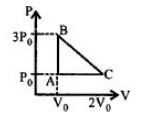
- ✓
$\frac{{25}}{8}\,\frac{{{P_0}{V_0}}}{R}$
- B
$\frac{{25}}{4}\,\frac{{{P_0}{V_0}}}{R}$
- C
$\frac{{25}}{16}\,\frac{{{P_0}{V_0}}}{R}$
- D
$\frac{{5}}{8}\,\frac{{{P_0}{V_0}}}{R}$
AnswerCorrect option: A. $\frac{{25}}{8}\,\frac{{{P_0}{V_0}}}{R}$
a
Equation of the $BC$
$p = {p_0} - \frac{{2{P_0}}}{{{V_0}}}\left( {V - 2{V_0}} \right)$
using=$PV=nRT$
Temperature,$T = \frac{{{P_0}V - \frac{{2{P_0}{V^2}}}{{{V_0}}} + 4{P_0}V}}{{1 \times R}}$
$\left( {n = 1\,mole\,given} \right)$
$T = \frac{{{P_0}}}{R}\left[ {5V - \frac{{2{V^2}}}{{{V_0}}}} \right]$
$\frac{{dT}}{{dV}} = 0 \Rightarrow 5 - \frac{{4V}}{{{V_0}}} = 0 \Rightarrow V = \frac{5}{4}{V_0}$
$T = \frac{{{P_0}}}{R}\left[ {5 \times \frac{{5{V_0}}}{4} - \frac{2}{{{V_0}}} \times \frac{{25}}{{16}}V_0^2} \right] = \frac{{25}}{8}\frac{{{P_0}{V_0}.}}{R}$
View full question & answer→MCQ 3741 Mark
Two Carnot engines $A$ and $B$ are operated in series. Engine $A$ receives heat from a reservoir at $600\,K$ and rejects heat to a reservoir at temperature $T$. Engine $B$ receives; heat rejected by engine $A$ and in turn rejects it to a reservoir at $100\,K$. If the efficiencies of the two engines $A$ and $B$ are represented by ${\eta _A}$ and ${\eta _B}$ respectively, then what is the value of $\frac{{{\eta _A}}}{{{\eta _B}}}$
- A
$\frac{{12}}{7}$
- B
$\frac{{12}}{5}$
- C
$\frac{{5}}{12}$
- ✓
$\frac{{7}}{12}$
AnswerCorrect option: D. $\frac{{7}}{12}$
d
Efficiency of engine $A,{n_A} = \frac{{{T_1} - {T_2}}}{{{T_1}}}$
and ${n_B} = \frac{{{T_2} - {T_3}}}{{{T_2}}};{T_2} = \frac{{{T_1} + {T_3}}}{2} = 350\,K$
$or\frac{{{n_A}}}{{{n_B}}} = \frac{{\frac{{600 - 350}}{{600}}}}{{\frac{{350 - 100}}{{350}}}} = \frac{7}{{12}}$
View full question & answer→MCQ 3751 Mark
An engine operates by taking $n\,moles$ of an ideal gas through the cycle $ABCDA$ shown in figure. The thermal efficiency of the engine is : (Take $C_v =1 .5\, R$, where $R$ is gas constant)
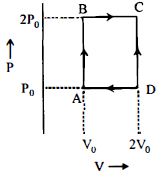
- A
$0.24$
- ✓
$0.15$
- C
$0.32$
- D
$0.08$
AnswerCorrect option: B. $0.15$
b
$Work - done\left( W \right) = {P_0}{V_0}$
According to principle of calorimetry
Heat given$ = {Q_{AB}} = {Q_{BC}}$
$ = n{C_V}d{T_{AB}} + n{C_p}d{T_{BC}}$
$ = \frac{3}{2}\left( {nR{T_B} - nR{T_A}} \right) + \frac{5}{2}\left( {nR{T_C} - nR{T_B}} \right)$
$ = \frac{3}{2}\left( {2{P_0}{V_0} - {P_0}{V_0}} \right) + \frac{5}{2}\left( {4{P_0}{V_0} - 2{P_{.0}}{V_0}} \right)$
$ = \frac{{13}}{2}{P_0}{V_0}$
Thermal efficiency of engine $\left( \eta \right)$
$ = \frac{W}{{{Q_{given}}}} = \frac{2}{{13}} = 0.15$
View full question & answer→MCQ 3761 Mark
$200\,g$ water is heated from $40\,^oC$ to $60\,^oC.$ Ignoring the slight expansion of water, the change in its internal energy is close to ...... $kJ$ (Given specific heat of water $=4184\,J/kgK$ )
- A
$167.4$
- B
$8.4$
- C
$4.2$
- ✓
$16.7$
AnswerCorrect option: D. $16.7$
d
Volume of water does not change, no work is done on or by the system $(W=0)$
According to first law of thermodynamics
$Q = \Delta U + W$
For Isochoric process $Q = \Delta U$
$\Delta U = \mu cdT = 2 \times 4184 \times 20 = 16.7\,kJ.$
View full question & answer→MCQ 3771 Mark
The ratio of work done by an ideal monoatomic gas to the heat supplied to it in an isobaric process is
- ✓
$0.4$
- B
$1.5$
- C
$0.6$
- D
$0.67$
Answera
Efficiency of heat engine is given by
$\eta = \frac{W}{Q} = 1 - \frac{{{C_V}}}{{{C_P}}} = \frac{R}{{{C_P}}} = \frac{R}{{\frac{{5R}}{2}}} = \frac{2}{5}$
$\left( {{C_P} - {C_V} = R} \right)$
For monoatomic gas ${C_P} = \frac{5}{2}R.$
View full question & answer→MCQ 3781 Mark
'$n$' moles of an ideal gas undergoes a process $A \rightarrow B$ as shown in the figure. The maximum temperature of the gas during the process will be
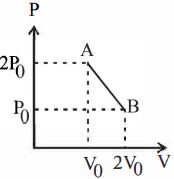
- A
$\frac{{9{P_0}{V_0}}}{{2nR}}$
- B
$\;\frac{{9{P_0}{V_0}}}{{nR}}$
- ✓
$\;\frac{{9{P_0}{V_0}}}{{4nR}}$
- D
$\;\frac{{3{P_0}{V_0}}}{{2nR}}$
AnswerCorrect option: C. $\;\frac{{9{P_0}{V_0}}}{{4nR}}$
c
The euatione for the line is
$P = \frac{{ - {P_0}}}{{{V_0}}}V + 3P$
$[slope = \frac{{ - {P_0}}}{{{V_0}}},c = 3{P_0}]$
$P{V_0} + {P_0}V = 3{P_0}{V_0}\,\,\,\,\,\,\,\,\,\,\,...\left( i \right)$
$But\,\,\,\,\,\,\,PV = nRT\,$
$\therefore P = \frac{{nRT}}{V}\,\,\,\,\,\,\,\,\,\,\,\,\,\,...\left( {ii} \right)$
$From\left( i \right)\& \left( {ii} \right)\frac{{nRT}}{V}{V_0} + {P_0}V = 3{P_0}{V_0}$
$\therefore nRT{V_0} + {P_0}{V^2} = 3{P_0}{V_0}$
$...\left( {iii} \right)$
For temperature to be maximum $\frac{{dT}}{{dV}} = 0$
Differentiating $e.q.(iii)\,by\,'v'\,we\,get$
$nR{V_0}\frac{{dT}}{{dV}} + {P_0}\left( {2v} \right) = 3{P_0}{V_0}$
$\therefore nR{V_0}\frac{{dT}}{{dV}} = 3{P_0}{V_0} - 2{P_0}V$
$\frac{{dT}}{{dV}} = \frac{{3{P_0}{V_0} - 2{P_0}V}}{{nR{V_0}}} = 0$
$V = \frac{{3{V_0}}}{2}\,\,\,\,\,\,\,\,\,\therefore P = \frac{{3{P_0}}}{2}$ $[From (i)]$
$\therefore \,{T_{\max }} = \frac{{9{P_0}{V_0}}}{{4nR}}\,\,\left[ {From\,\left( {iii} \right)} \right]$
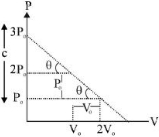
View full question & answer→MCQ 3791 Mark
A Carnot freezer takes heat from water at $0\,^oC$ inside it and rejects it to the room at a temperature of $27\,^oC$. The latent heat of ice is $336 \times 10^3\, J\,kg^{-1}$. lf $5\, kg$ of water at $0\,^oC$ is converted into ice at $0\,^oC$ by the freezer, then the energy consumed by the freezer is close to
- A
$1.51 \times {10^5}\,J$
- B
$1.68 \times {10^6}\,J$
- C
$1.71 \times {10^7}\,J$
- ✓
$1.67 \times {10^5}\,J$
AnswerCorrect option: D. $1.67 \times {10^5}\,J$
d
$\Delta H = mL = 5 \times 336 \times {10^3} = {Q_{sink}}$
$\frac{{{Q_{sink}}}}{{{Q_{source}}}} - \frac{{{T_{sink}}}}{{{T_{source}}}}$
$\therefore {Q_{source}} = \frac{{{T_{source}}}}{{{T_{sink}}}} \times {Q_{sink}}$
Energy consumed by freezer
$\therefore {W_{output}} = {Q_{source}} - {Q_{sink}}$
$ = {Q_{sink}}\left( {\frac{{{T_{source}}}}{{{T_{sink}}}} - 1} \right)$
$Given:\,{T_{source}} = {27^ \circ }C + 273 = 300K,$
${T_{sink}} = {0^ \circ }C + 273 = 273\,K$
${W_{output}} = 5 \times 336 \times {10^3}\left( {\frac{{300}}{{273}} - 1} \right) = 1.67 \times {10^5}J$
View full question & answer→MCQ 3801 Mark
An ideal gas goes through a reversible cycle $a\to b\to c\to d$ has the $V - T$ diagram shown below. Process $d\to a$ and $b\to c$ are adiabatic.... The corresponding $P - V$ diagram for the process is (all figures are schematic and not drawn to scale)
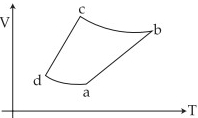
Answerb
In $VT$ graph
$ab-process\,\,\,:\,\,\,Isobaric,\,\,temperature\,increases.$
$bc\,process\,:\,Adiabatic\,pressure\,decreases.$
$cd\,process\,:\,Isobaric\,volume\,decreases.$
$da\,process\,:\,Adiabatic,\,pressure\,increases.$
The above processes correctly respresented in $P-V$ diagram $(b)$ .
View full question & answer→MCQ 3811 Mark
A solid body of constant heat capacity $1\ J/^o C$ is being heated by keeping it in contact with reservoirs in two ways :
$(i)$ Sequentially keeping in contact with $2$ reservoirs such that each reservoir supplies same amount of heat.
$(ii)$ Sequentially keeping in contact with $8$ reservoirs such that each reservoir supplies same amount of heat.
In both the cases body is brought from initial temperature $100^o C$ to final temperature $200^o C$. Entropy change of the body in the two cases respectively is :
- ✓
$ln $ $2$,$ln $ $2$
- B
$ln$ $2$,$2ln$ $2$
- C
$2$ $ln$ $2$,$8ln$ $2$
- D
$ln$ $2$,$4ln$ $2$
AnswerCorrect option: A. $ln $ $2$,$ln $ $2$
a
The entropy change of the body in the two cases is same as entropy is a state function.
View full question & answer→MCQ 3821 Mark
Consider a spherical shell of radius $R$ at temperature $T$. The black body radiation inside it can be considered as an ideal gas of photons with internal energy per unit volume$E=$ $\frac{U}{V} \propto {T^4}$ and pressure $P = \frac{1}{3}\left( {\frac{U}{V}} \right)$ If the shell now undergoes an adiabatic expansion the relation between $T$ and $R$ is
- A
$T \propto {e^{ - 3R}}\;\;\;\;\;\;\;\;\;\;\;\;$
- ✓
$\;T \propto \frac{1}{R}$
- C
$\;T \propto \frac{1}{{{R^3}}}$
- D
$\;T \propto {e^{ - R}}$
AnswerCorrect option: B. $\;T \propto \frac{1}{R}$
b
$As,\,P = \frac{1}{3}\left( {\frac{U}{V}} \right)$
$But\frac{U}{V} = K{T^4}$
$So,P = \frac{1}{3}K{T^4}$
$or\,\frac{{uRT}}{V} = \frac{1}{3}K{T^4}\,\,\,\left[ {As\,PV = u\,RT} \right]$
$\frac{4}{3}\pi {R^3}{T^3} = constant$
$Therfore,T \propto \frac{1}{R}$
View full question & answer→MCQ 3831 Mark
During an adiabatic compression, $830\, J$ of work is done on $2\, moles$ of a diatomic ideal gas to reduce its volume by $50\%$. The change in its temperahture is nearly..... $K$ $(R\, = 8.3\, J\,K^{-1}\, mol^{-1} )$
Answerc
$Given:Work\,done,W=830J$
no, of moles of gas, $\mu =2$
For diatomic gas $\gamma = 1.4$
Work done during an adiabatic change
$W = \frac{{\mu R\left( {{T_1} - {T_2}} \right)}}{{\gamma - 1}}$
$ \Rightarrow 830 = \frac{{2 \times 8.3\left( {\Delta T} \right)}}{{1.4 - 1}} = \frac{{2 \times 8.3\left( {\Delta T} \right)}}{{0.4}}$
$ \Rightarrow \Delta T = \frac{{830 \times 0.4}}{{2 \times 8.3}} = 20\,K$
View full question & answer→MCQ 3841 Mark
A gas is compressed from a volume of $2\,m^3$ to a volume of $1\, m^3$ at a constant pressure of $100\, N/m^2$. Then it is heated at constant volume by supplying $150\, J$ of energy. As a result, the internal energy of the gas
- ✓
increases by $250\, J$
- B
decreases by $250\, J$
- C
increases by $50\, J$
- D
decreases by $50\, J$
AnswerCorrect option: A. increases by $250\, J$
a
As we know, $\Delta Q=\Delta u+\Delta w$
(Ist law of thermodynamics) $\Rightarrow \Delta \mathrm{Q}=\Delta \mathrm{u}+\mathrm{P} \Delta \mathrm{v}$
or $150=\Delta u+100(1-2)$
$=\Delta u-100$
$\therefore \Delta u=150+100=250 \mathrm{J}$
Thus the internal energy of the gas increases by $250 \mathrm{J}$
View full question & answer→MCQ 3851 Mark
One mole of a diatomic ideal gas undergoes a cyclic process $ABC$ as shown in figure. The process $BC$ is adiabatic. The temperatures at $A, B$ and $C$ are $400\ K, 800\ K $ and $600\ K$ respectively. Choose the correct statement
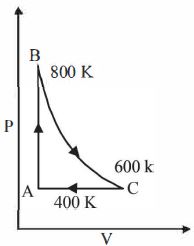
- A
The change in internal energy in the process $CA$ is $700\ R$
- B
The change in internal energy in the process $AB$ is $ -350R$
- ✓
The change in internal energy in the process $BC$ is $-500R$
- D
The change in internal energy in whole cyclic process is $250R $
AnswerCorrect option: C. The change in internal energy in the process $BC$ is $-500R$
c
In cyclic process, change in total internal energy is zero.
$\Delta {U_{cyclic}} = 0$
$\Delta {U_{BC}} = n{C_v}\Delta T = 1 \times \frac{{5R}}{2}\Delta T$
$Where,{C_v} = molar\,specific\,heat\,at\,constant\,volume.$
$For\,BC,\Delta T = - 200K$
$\therefore \,\,\Delta {U_{BC}} = - 500R$
View full question & answer→MCQ 3861 Mark
The equation of state for a gas is given by $PV = nRT + \alpha V$, where $n$ is the number of moles and $\alpha $ is a positive constant. The initial temperature and pressure of one mole of the gas contained in a cylinder are $T_o$ and $P_o$ respectively. The work done by the gas when its temperature doubles isobarically will be
AnswerCorrect option: A. $\frac{{{P_0}{T_0}R}}{{{P_0} - \alpha }}$
a
${P_0}{V_0} = nR{T_0}$
${P_0}V = NRT$
${T_f} = 2{T_0}$
$W = \int {PdV} $
$ = \int {\left( {\frac{{nRT}}{V} + \alpha } \right)dV} $
$PV = nRT + \alpha V$
$\int {PdV = \int\limits_{{T_0}}^{2{T_0}} {nRdT + \int\limits_{{V_1}}^{{V_1}} {\alpha dV} } } $
$ = nR{T_0} + \alpha \,{V_i}$
$ = nR{T_0} + \alpha \left( {\frac{{nR{T_0}}}{{{P_0}}}} \right)$
$ = nR{T_0} \left( {1 + \frac{\alpha }{{{P_0}}}} \right)$
$PV = nRT + \alpha V$
$\int {PdV = \int {nRdT + \int {\alpha dV} } } $
$W = nR{T_0} + \alpha \left[ {\frac{{nR{T_0}}}{{{P_0} - \alpha }}} \right]$
$W = nR{T_0}\left[ {1 + \frac{\alpha }{{{P_0} - \alpha }}} \right]$
$ = n{R_0}{T_0}\left[ {\frac{{{P_0}}}{{{P_0} - \alpha }}} \right]$
$ = \frac{{nR{T_0}{P_0}}}{{{P_0} - \alpha }}$
View full question & answer→MCQ 3871 Mark
A Carnot engine absorbs $1000\,J$ of heat energy from a reservoir at $127\,^oC$ and rejects $600\,J$ of heat energy during each cycle. The efficiency of engine and temperature of sink will be
- A
$20\%$ and $- 43\,^oC$
- ✓
$40\%$ and $- 33\,^oC$
- C
$50\%$ and $- 20\,^oC$
- D
$70\%$ and $- 10\,^oC$
AnswerCorrect option: B. $40\%$ and $- 33\,^oC$
b
Given: $Q_1=1000 J$
$Q_2=600 J$
${T_1} = {127^ \circ }C = 400\,K$
${T_2} = ?$
$\eta = ?$
Efficiency of carnot engine,
$\eta = \frac{W}{Q_1} \times 100\% $
$or,\,\,\eta = \frac{{{Q_2} - {Q_1}}}{{{Q_1}}} \times 100\% $
$or,\,\,\,\eta = \frac{{1000 - 600}}{{1000}} \times 100\% $
$\eta = 40\% $
$Now,for\,carnot\,cycle\frac{{{Q_2}}}{{{Q_1}}} = \frac{{{T_2}}}{{{T_1}}}$
$\frac{{600}}{{1000}} = \frac{{{T_2}}}{{400}}$
${T_2} = \frac{{600 \times 400}}{{1000}} = 240\,K = 240 - 273$
$\therefore {T_2} = - {33^ \circ }C$
View full question & answer→MCQ 3881 Mark
Given that $1\,g$ of water in liquid phase has volume $1\,cm^3$ and in vapour phase $1671\, cm^3$ at atmospheric pressure and the latent heat of vaporization of water is $2256\,J/g;$ the change in the internal energy in joules for $1\,g$ of water at $373\,K$ when it changes from liquid phase to vapour phase at the same temperature is ....... $J$
AnswerCorrect option: C. $2089$
c
$W = P\left( {dV} \right)$$ = 0.01 \times {10^5}\left( {1671 - 1} \right) \times {10^{ - 6}} = 167\,J$
$Q = \Delta U + W$
$\Delta U = Q - W = mL - 167$$ = 2256 - 167 = 2089\,J$
View full question & answer→MCQ 3891 Mark
An ideal gas at atmospheric pressure is adiabatically compressed so that its density becomes $32$ times of its initial value. If the final pressure of gas is $128$ atmosphers, the value of $\gamma$ the gas is
Answerb
Volume of the gas
$v=\frac{m}{d}$ and
using $P V^{7}=$ constant
$\frac{P^{\prime}}{P}=\frac{V}{V^{\prime}}=\left(\frac{d^{\prime}}{d}\right)^{\gamma}$
$\alpha 128=(32)^{\gamma}$
$\gamma=\frac{7}{5}=1.4$
View full question & answer→MCQ 3901 Mark
A certain amount of gas is taken through a cyclic process $(A\,B\,C\,D\,A)$ that has two isobars, one isochore and one isothermal. The cycle can be represented on a $P-V$ indicator diagram as
Answerc
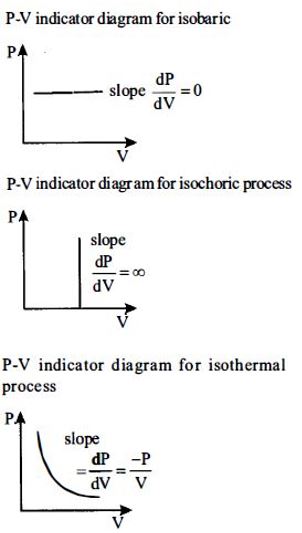
View full question & answer→MCQ 3911 Mark
The above $P-V$ diagram represents the thermodynamic cycle of an engine, operating with an ideal monatomic gas. The amount of heat, extracted from the source in a single cycle is
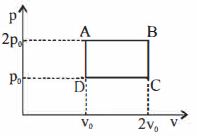
AnswerCorrect option: C. $\left( {\frac{{13}}{2}} \right)$ $ P_0V_0$
c
$Heat\,given\,to\,system = {\left( {n{C_V}\Delta T} \right)_{A \to B}} + {\left( {n{C_P}\Delta T} \right)_{B \to C}}$
$ = {\left[ {\frac{3}{2}\left( {nR\Delta T} \right)} \right]_{A \to B}} + {\left[ {\frac{5}{2}\left( {nR\Delta T} \right)} \right]_{B \to C}}$
$ = {\left[ {\frac{3}{2} \times {V_0}\Delta P} \right]_{A \to B}} + \left[ {\frac{5}{2} \times 2{P_0} \times {V_0}} \right]$
$ = \frac{{13}}{2}{P_0}{V_0}$
View full question & answer→MCQ 3921 Mark
A sample of gas expands from $V_1$ to $V _2$. In which of the following, the work done will be greatest ?
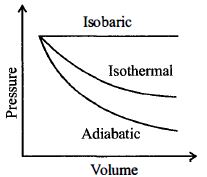
Answerb
Work done $=$ Area bounded by $PV$ graph and volume axis
Among the three process, bounded area by $PV$ graph and volume axis is greatest for isobaric process, hence work done is greatest for isobaric process
View full question & answer→MCQ 3931 Mark
One mole of a monatomic ideal gas undergoes the cyclic process $J \rightarrow K \rightarrow L \rightarrow M \rightarrow J$, as shown in the $P - T$ diagram.
Match the quantities mentioned in $List-I$ with their values in $List-II$ and choose the correct option. [ $R$ is the gas constant]
| $List-I$ |
$List-II$ |
| ($P$) Work done in the complete cyclic process |
($1$) $R T_0-4 \ R T_0 \ln 2$ |
| ($Q$) Change in the internal energy of the gas in the process $JK$ |
($2$) $0$ |
| ($R$) Heat given to the gas in the process $KL$ |
($3$) $3 \ R T_0$ |
| ($S$) Change in the internal energy of the gas in the process $MJ$ |
($4$) $-2 \ R T_0 \ln 2$ |
| |
($5$) $-3 \ R T_0 \ln 2$ |
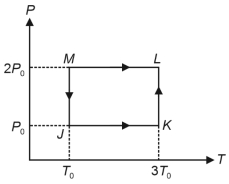
- A
$P \rightarrow 1 ; Q \rightarrow 3 ; R \rightarrow 5 ; S \rightarrow 4$
- ✓
$P \rightarrow 4 ; Q \rightarrow 3 ; R \rightarrow 5 ; S \rightarrow 2$
- C
$P \rightarrow 4 ; Q \rightarrow 1 ; R \rightarrow 2 ; S \rightarrow 2$
- D
$P \rightarrow 2 ; Q \rightarrow 5 ; R \rightarrow 3 ; S \rightarrow 4$
AnswerCorrect option: B. $P \rightarrow 4 ; Q \rightarrow 3 ; R \rightarrow 5 ; S \rightarrow 2$
b
$J \left( P _0, V _0, T _0\right)$
$K \left( P _0, 3 V _0, 3 T _0\right)$
$M \left(2 P _0, \frac{ V _0}{2}, T _0\right)$
$L \left(2 P _0, \frac{3 V _0}{2}, 3 T _0\right)$
$P _0 V _0= nRT _0$
$JK \rightarrow \text { isobaric } \Rightarrow W = P _0\left(2 V _0\right)=2 nRT \text {. }$
$\Delta U =\frac{3}{2} nR \left(2 T _0\right)=3 nRT _0$
$KL \rightarrow \text { isothermal } \rightarrow W = nR (3 T ) \ln \left(\frac{1}{2}\right)=-3 nRT _0 \ln 2$
$\Delta U =0 \Rightarrow Q =-3 nRT _0 \ln 2$
$LM \rightarrow \text { isobaric }=2 P _0\left(- V _0\right)=-2 nRT _0$
$MJ \rightarrow \text { isothermal } \Rightarrow nRT _0 \ell n 2 ; \Delta U =0$
$WD _{ xat }=-2 nRT _0 \ln 2$
$P \rightarrow 4, Q \rightarrow 3, R \rightarrow 5, S \rightarrow 2$
View full question & answer→MCQ 3941 Mark
Consider the following volume-temperature $( V - T )$ diagram for the expansion of $5$ moles of an ideal monoatomic gas.
Considering only $P-V$ work is involved, the total change in enthalpy (in Joule) for the transformation of state in the sequence $X \rightarrow Y \rightarrow Z$ is $\qquad$
[Use the given data: Molar heat capacity of the gas for the given temperature range, $C _{ v , m }=12 J K ^{-1} mol ^{-1}$ and gas constant, $R =8.3 J K ^{-1} mol ^{-1}$ ]
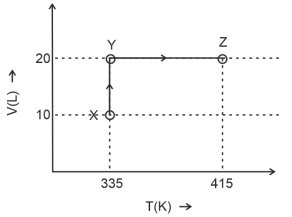
- A
$8020$
- B
$8030$
- C
$8220$
- ✓
$8120$
AnswerCorrect option: D. $8120$
d
For ideal gas
$\Delta H=n C_P \Delta T$
$\because \quad C_P=C_V+R=12+8.3=20.3 J / K \text {-mole }$
$\therefore \Delta H=5 \times 20.3 \times(415-335)$
$\Delta H=8120 \text { Joule }$
View full question & answer→MCQ 3951 Mark
One mole of an ideal gas expands adiabatically from an initial state $\left(T_A, V_0\right)$ to final state $\left(T_f, 5 V_0\right)$. Another mole of the same gas expands isothermally from a different initial state ( $T_{\mathrm{B}}, \mathrm{V}_0$ ) to the same final state $\left(T_{\mathrm{f}}, 5 V_0\right)$. The ratio of the specific heats at constant pressure and constant volume of this ideal gas is $\gamma$. What is the ratio $T_{\mathrm{A}} / T_{\mathrm{B}}$ ?
- ✓
$5^{\gamma-1}$
- B
$5^{1-\gamma}$
- C
$5^\gamma$
- D
$5^{-1+\gamma}$
AnswerCorrect option: A. $5^{\gamma-1}$
a
$\mathrm{T}_{\mathrm{A}} \mathrm{V}_0^{\gamma-1}=\mathrm{T}_{\mathrm{f}}\left(5 \mathrm{~V}_0\right)^{\gamma-1}$
$\frac{\mathrm{T}_{\mathrm{A}}}{\mathrm{T}_{\mathrm{f}}}=5^{\gamma-1}=\frac{\mathrm{T}_{\mathrm{A}}}{\mathrm{T}_{\mathrm{B}}}$
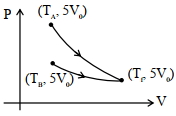
View full question & answer→MCQ 3961 Mark
A closed container contains a homogeneous mixture of two moles of an ideal monatomic gas $(\gamma=5 / 3)$ and one mole of an ideal diatomic gas $(\gamma=7 / 5)$. Here, $\gamma$ is the ratio of the specific heats at constant pressure and constant volume of an ideal gas. The gas mixture does a work of $66$ Joule when heated at constant pressure. The change in its internal energy is. . . . . . .Joule.
Answerd
At constant pressure
$W=n R \Delta T=66$
$\Delta U=n\left(C_V\right)_{\text {mix }} \Delta T$
$\left(C_v\right)_{\text {mii }}=\frac{n_1 C_{v_1}+n_2 C_{v_2}}{n_1+n_2}$
$\left(C_v\right)_{\text {mii }}=\frac{2 \times \frac{3}{2} R+1 \times \frac{5}{2} R}{3}$
$\left(C_v\right)_{\text {min }}=\frac{11}{6} R$
$\Delta U=\frac{11}{6}(n R \Delta T)$
$\Delta U=\frac{11}{6} \times 66=121 J$
View full question & answer→MCQ 3971 Mark
One mole of an ideal gas undergoes two different cyclic processes I and II, as shown in the $P-V$ diagrams below. In cycle I, processes $a, b, c$ and $d$ are isobaric, isothermal, isobaric and isochoric, respectively. In cycle II, processes $a^{\prime}, b^{\prime}, c^{\prime}$ and $d^{\prime}$ are isothermal, isochoric, isobaric and isochoric, respectively. The total work done during cycle I is $W_I$ and that during cycle II is $W_{I I}$. The ratio $W_I / W_{I I}$ is . . . .
(image)
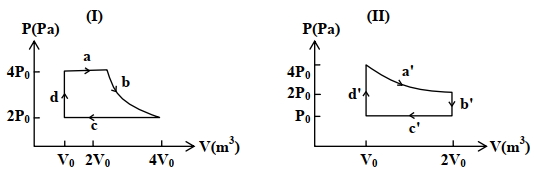
Answerb
$\frac{\mathrm{W}_{\mathrm{I}}}{\mathrm{W}_{\mathrm{II}}}=\frac{4 \mathrm{P}_0 \mathrm{~V}_0+8 \mathrm{P}_0 \mathrm{~V}_0 \ell \mathrm{n} 2-6 \mathrm{P}_0 \mathrm{~V}_0-0}{4 \mathrm{P}_0 \mathrm{~V}_0 \ln 2-0-\mathrm{P}_0 \mathrm{~V}_0+0}$
$=\frac{8 \ell \mathrm{n} 2-2}{4 \ell \mathrm{n} 2-1}=2$
View full question & answer→MCQ 3981 Mark
In the given $P$-V diagram, a monoatomic gas $\left(\gamma=\frac{5}{3}\right)$ is first compressed adiabatically from state $A$ to state $B$. Then it expands isothermally from state $B$ to state $C$. [Given: $\left(\frac{1}{3}\right)^{0.6} \simeq 0.5, \ln 2 \simeq 0.7$ ].
Which of the following statement($s$) is(are) correct?
$(A)$ The magnitude of the total work done in the process $A \rightarrow B \rightarrow C$ is $144 kJ$.
$(B)$ The magnitude of the work done in the process $B \rightarrow C$ is $84 kJ$.
$(C)$ The magnitude of the work done in the process $A \rightarrow B$ is $60 kJ$.
$(D)$ The magnitude of the work done in the process $C \rightarrow A$ is zero.
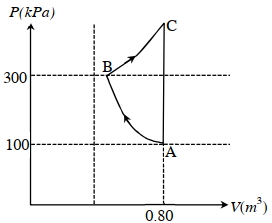
- A
$A,B,C$
- ✓
$B,C,D$
- C
$A,B$
- D
$A,C$
AnswerCorrect option: B. $B,C,D$
b
For adiabaric process $( A \rightarrow B )$
$P_A V_x^t=P_x V_x^t$
$10^2 \times(0.8)^{\frac{2}{2}}=3 \times 10^2\left(V_n\right)^{\frac{2}{1}}$
$\Rightarrow V_x=0.8 \times\left(\frac{1}{3}\right)^{0.2}=0.4$
Wodk doue in process $A \rightarrow B$
$W_{c x}=\frac{P_s V_0-P_x V_x}{\gamma-1}$
$\Rightarrow W_{\text {sx }}=\frac{10^2 \times 0.8-3 \times 10^2 \times 0.4}{\frac{5}{3}-1}$
$\Rightarrow W_{\text {As }}=-60 lJ =\Rightarrow\left|W_{\lambda \Omega}\right|=60 lJ$
Work done in process $B \rightarrow C$ (Isothermal process)
$W_{x=}=n R T / n \frac{V_8}{V_x}=P_x V_x \ell m \frac{V_8}{V_x}$
$\Rightarrow W_{x c}=3 \times 10^2 \times 0.4 \ln \frac{0.8}{0.4}$
$\Rightarrow W_{s c}=34 kJ$
Wodk doue in process $C \rightarrow A$
$W_{C_A}=P \Delta V=0 \quad(\because \Delta V=0)$
So toral work done in the process $A \rightarrow B \rightarrow C$
$W_{A B C}=W_{A \triangle}+W_{y C}+W_{C A}=-60+84+0$
$W_{A B C}=24 kJ$
So comect options are $(B,C.D)$
View full question & answer→MCQ 3991 Mark
An ideal gas of density $\rho=0.2 kg m ^{-3}$ enters a chimney of height $h$ at the rate of $\alpha=0.8 kg s ^{-1}$ from its lower end, and escapes through the upper end as shown in the figure. The cross-sectional area of the lower end is $A_1=0.1 m ^2$ and the upper end is $A_2=0.4 m ^2$. The pressure and the temperature of the gas at the lower end are $600 Pa$ and $300 K$, respectively, while its temperature at the upper end is $150 K$. The chimney is heat insulated so that the gas undergoes adiabatic expansion. Take $g=10 ms ^{-2}$ and the ratio of specific heats of the gas $\gamma=2$. Ignore atmospheric pressure.
Which of the following statement($s$) is(are) correct?
- A
The pressure of the gas at the upper end of the chimney is $300 Pa$.
- ✓
The velocity of the gas at the lower end of the chimney is $40 ms ^{-1}$ and at the upper end is $20 ms ^{-1}$.
- C
The height of the chimney is $590 m$.
- D
The density of the gas at the upper end is $0.05 kg m ^{-3}$.
AnswerCorrect option: B. The velocity of the gas at the lower end of the chimney is $40 ms ^{-1}$ and at the upper end is $20 ms ^{-1}$.
b
$\frac{ dm }{ dt }=\rho_1 A _1 v _1=0.8 kg / sA$
$v _1=\frac{0.8}{0.2 \times 0.1}=40 m / s$
$g=10 m / s ^2$
$\gamma=2$
Gas undergoes adiabatic expansion,
$p ^{1 \gamma} T ^\gamma=\text { Constant }$
$\frac{ P _2}{ P _1}=\left(\frac{ T _1}{ T _2}\right)^{\frac{ T }{1-\gamma}}$
$P _2=\left(\frac{300}{150}\right)^{\frac{2}{-1}} \times 600$
$P _2=\frac{600}{4}=150 Pa$
Now $\rho=\frac{ PM }{ RT } \Rightarrow \rho \propto \frac{ P }{ T }$
$\frac{\rho_1}{\rho_2}=\left(\frac{ P _1}{ P _2}\right)\left(\frac{ T _1}{ T _2}\right)=\left(\frac{150}{600}\right)\left(\frac{300}{150}\right)=\frac{1}{2}$
$\rho_2=\frac{\rho_1}{2}=0.1 kg / m ^3$
$\text { Now } \rho_2 A _2 V _2=0.8 \Rightarrow v _2=\frac{0.8}{0.1 \times 0.4}=20 m / s$
$\text { Now } W _{\text {on gas }}=\Delta K +\Delta U +\text { (Internal energy) }$
$P _1 A _1 \Delta x _1- P _2 A _2 \Delta x _2=\frac{1}{2} \Delta mV_{2 } ^ { 2 } -\frac{1}{2} \Delta mV V _1^2+\Delta mgh +\frac{ f }{2}\left( P _2 \Delta V _2- P _1 \Delta V _1\right)$
$\Rightarrow 2 P _1 \frac{\Delta V _1}{\Delta m }-2 P _2 \frac{\Delta V _2}{\Delta m }=\frac{ V _2^2- V _1^2}{2}+ gh$
$\Rightarrow \frac{2 \times 600}{0.2}-\frac{2 \times 150}{0.1}=\frac{20^2-40^2}{2}+10 h$
$h =360 m$
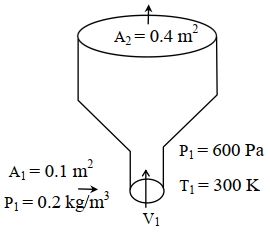
View full question & answer→MCQ 4001 Mark
$List I$ describes thermodynamic processes in four different systems. $List II$ gives the magnitudes (either exactly or as a close approximation) of possible changes in the internal energy of the system due to the process.
| $List-I$ |
$List-II$ |
| ($I$) $10^{-3} kg$ of water at $100^{\circ} C$ is converted to steam at the same temperature, at a pressure of $10^5 Pa$. The volume of the system changes from $10^{-6} m ^3$ to $10^{-3} m ^3$ in the process. Latent heat of water $=2250 kJ / kg$. |
($P$) $2 kJ$ |
| ($II$) $0.2$ moles of a rigid diatomic ideal gas with volume $V$ at temperature $500 K$ undergoes an isobaric expansion to volume $3 V$. Assume $R=8.0 Jmol ^1 K^{-1}$. |
($Q$) $7 kJ$ |
| ($III$) On mole of a monatomic ideal gas is compressed adiabatically from volume $V=\frac{1}{3} m^3$ and pressure $2 kPa$ to volume $\frac{v}{8}$ |
($R$) $4 kJ$ |
| ($IV$) Three moles of a diatomic ideal gas whose molecules can vibrate, is given $9 kJ$ of heat and undergoes isobaric expansion. |
($S$) $5 kJ$ |
| |
($T$) $3 kJ$ |
Which one of the following options is correct?
- A
$I \rightarrow T , II \rightarrow R , III \rightarrow S , IV \rightarrow Q$
- B
$I \rightarrow S , II \rightarrow P , III \rightarrow T , IV \rightarrow P$
- ✓
$I \rightarrow P, II \rightarrow R , III \rightarrow T , IV \rightarrow Q$
- D
$I \rightarrow Q , II \rightarrow R , III \rightarrow S , IV \rightarrow T$
AnswerCorrect option: C. $I \rightarrow P, II \rightarrow R , III \rightarrow T , IV \rightarrow Q$
c
$(I)\Delta U =\Delta Q -\Delta W$
$=\left\{\left(10^{-3} \times 2250\right)-\frac{10^5\left(10^{-1}-10^{-4}\right)}{10^5}\right\} VJ$
$=(2.25-0.0999) VJ$
$=(2.1501) kJ$
$(II)$
$\Delta U = nC \Delta T$
$=\frac{5}{2} \pi R_{ T }$
$=\frac{5}{2} \cdot(0.2)(8)(1500-500) J$
$=4 kJ$
$(III)$
$P_1 V_2=P_2 V_2^2$
$\Rightarrow 2\left(\frac{1}{3}\right)^{s, 1}=P_2\left(\frac{1}{24}\right)^s$
$\Rightarrow P_2=64 kPa$
$\Delta U=n C_2 \Delta T=\frac{3}{2} \cdot\left(P_2 V_2-P_1 V_1\right)$
$=\frac{3}{2}\left(64 \times \frac{1}{24}-2 \times \frac{1}{3}\right) kJ$
$=3 VJ$
$(IV)\Delta U = HC C _{ V } \Delta T$
$= n \cdot \frac{7}{2} RAT$
$=\frac{7}{9} \Delta Q$
$=7 kJ$
View full question & answer→MCQ 4011 Mark
An ideal gas undergoes a four step cycle as shown in the $P-V$ diagram below. During this cycle, in which step heat is absorbed by the gas
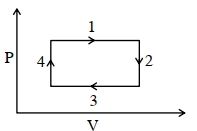
- A
steps $1$ and $2$
- B
steps $1$ and $3$
- ✓
steps $1$ and $4$
- D
steps $2$ and $4$
AnswerCorrect option: C. steps $1$ and $4$
c
Process $1$
$P =$ constant, Volume increases and temperature also increases
$\Rightarrow \quad W =$ positive,$\Delta U =$ positive
$\Rightarrow \quad$ Heat is positive and supplied to gas
Process - $2$
$V =$ constant, Pressure decrease
$\Rightarrow$ Temperature decreases
$W =\int pdV =0$
$\Delta T$ is negative and $\Delta U =\frac{ f }{2} nR \Delta T$
$\Rightarrow \quad \Delta U$ in negative
$\Delta Q =\Delta U + W$
$\therefore \quad \Delta Q \rightarrow$ Heat is negative and rejected by gas
Process $3$
$P =$ constant, Volume decreases
$\Rightarrow$ Temperature also decreases
$W = P \Delta V =$ negative
$\Delta U =\frac{ f }{2} nR \Delta T =$ negative
$\Delta Q = W +\Delta U =$ negative
Heat is negative and rejected by gas.
Process $4$
$V =$ constant, Pressure increases
$W =\int pdV =0$
$PV = nRT \Rightarrow$ Temperature increase
$\Rightarrow \quad \Delta U =\frac{ f }{2} nR \Delta T$ is positive
$\Delta Q =\Delta U + W$
$=$ positive
Ans. $(C)$ step $1$ and step $4$
View full question & answer→MCQ 4021 Mark
A soft plastic bottle, filled with water of density $1 gm / cc$, carries an inverted glass test-tube with some air (ideal gas) trapped as shown in the figure. The test-tube has a mass of $5 gm$, and it is made of a thick glass of density $2.5 gm / cc$. Initially the bottle is sealed at atmospheric pressure $p_0=10^5 Pa$ so that the volume of the trapped air is $v_0=3.3 cc$. When the bottle is squeezed from outside at constant temperature, the pressure inside rises and the volume of the trapped air reduces. It is found that the test tube begins to sink at pressure $P_0+\Delta p$ without changing its orientation. At this pressure, the volume of the trapped air is $v_0-\Delta v$.
Let $\Delta v=X$ cc and $\Delta p=Y \times 10^3 Pa$.
($1$) The value of $X$ is
($2$) The value of $Y$ is
Give the answer or quetion ($1$) and ($2$)
- A
$10,20$
- B
$30,20$
- ✓
$30,10$
- D
$15,10$
AnswerCorrect option: C. $30,10$
c
($1$) When it starts sinking
$F _{ B }= mg$
$\rho_0\left( V _{\text {glass }}+ V _{\text {gas }}\right)= m$
$1\left(2+ V _{\text {gas }}\right)=5 \Rightarrow V _{\text {gas }}=3 cc$
Hence $\Delta V =0.3 cc$.
($2$) Isothermal process for air
$P _1 V _1= P _2 V _2$
$10^5(3.3)= P _2(3)$
$P _2=1.1 \times 10^5$
$\Delta P = P _2- P _1=1.1 \times 10^5-10^5$
$=0.1 \times 10^5$
$=10 \times 10^3 \text { Pascal }$
$= Y \times 10^3 \text { Pascal }$
So $Y=10$
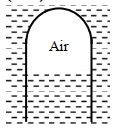
View full question & answer→MCQ 4031 Mark
A thermally insulating cylinder has a thermally insulating and frictionless movable partition in the middle, as shown in the figure below. On each side of the partition, there is one mole of an ideal gas, with specific heat at constant volume, $C_v=2 R$. Here, $R$ is the gas constant. Initially, each side has a volume $V_0$ and temperature $T_0$. The left side has an electric heater, which is turned on at very low power to transfer heat $Q$ to the gas on the left side. As a result the partition moves slowly towards the right reducing the right side volume to $V_0 / 2$. Consequently, the gas temperatures on the left and the right sides become $T_L$ and $T_R$, respectively. Ignore the changes in the temperatures of the cylinder, heater and the partition.
($1$) The value of $\frac{T_R}{T_0}$ is
$(A)$ $\sqrt{2}$ $(B)$ $\sqrt{3}$ $(C)$ $2$ $(D)$ $3$
($2$) The value of $\frac{Q}{R T_0}$ is
$(A)$ $4(2 \sqrt{2}+1)$ $(B)$ $4(2 \sqrt{2}-1)$ $(C)$ $(5 \sqrt{2}+1)$ $(D)$ $(5 \sqrt{2}-1)$
Give the answer or qution ($1$) and ($2$)
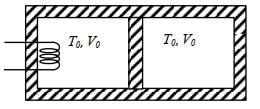
- A
$A,C$
- B
$A,D$
- ✓
$A,B$
- D
$A,B,C$
Answerc
$\text { Finally } V _{ L }=\frac{3 V _0}{2}, V _{ R }=\frac{ V _0}{2}$
$C _{ V }=\frac{ R }{\gamma-1}=2 R \Rightarrow \gamma-1=\frac{1}{2}$
$\gamma=\frac{3}{2}$
$T _0 V _0^{\gamma-1}= T _{ R }\left(\frac{ V _0}{2}\right)^{\gamma-1}$
$\frac{ T _{ R }}{ T _0}=\sqrt{2}$
$\rho\left(\frac{ V _0}{2}\right)^\gamma= P _0 V _0^\gamma \Rightarrow P = P _0 \times 2^{\frac{3}{2}}$
$\frac{ PV }{ T _{ L }}=\frac{ P _0 V _0}{ T _0} \Rightarrow T _{ L }=2^{\frac{3}{2}} \times \frac{3}{2} T _0=3 \sqrt{2} T _0$
$Q = nC C _{ V } \Delta T _1+ nC V _{ V } \Delta T _2$
$=1 \times 2 R \times(3 \sqrt{2}-1) T _0+1 \times 2 R \times(\sqrt{2}-1) T _0$
$\frac{ Q }{ R }=2(3 \sqrt{2}-1)+2(\sqrt{2}-1)=8 \sqrt{2}-4$
View full question & answer→MCQ 4041 Mark
Consider one mole of helium gas enclosed in a container at initial pressure $P_1$ and volume $V_1$. It expands isothermally to volume $4 V_1$. After this, the gas expands adiabatically and its volume becomes $32 V_1$. The work done by the gas during isothermal and adiabatic expansion processes are $W_{\text {iso }}$ and $W_{\text {adia, }}$ respectively. If the ratio $\frac{W_{\text {iso }}}{W_{\text {adia }}}=f \ln 2$, then $f$ is. . . . . . . .
- ✓
$1.78$
- B
$1.80$
- C
$1.85$
- D
$1.90$
AnswerCorrect option: A. $1.78$
a
$\frac{ P _1}{4}\left(4 V _1\right)^{5 / 3}= P _2\left(32 v _1\right)^{5 / 3}$
$P _2=\frac{ P _1}{4}\left(\frac{1}{8}\right)^{5 / 3}=\frac{ P _1}{128}$
$W _{ adi }=\frac{ P _1 V _1- P _2 V _2}{\gamma-1}=\frac{ P _1 V _1-\frac{P_1}{128}\left(32 V _1\right)}{\frac{5}{3}-1}$
$=\frac{P_1 V_1(3 / 4)}{2 / 3}=\frac{9}{8} P_1 V_1$
$W _{ iso } \quad= P _1 V _1 \operatorname{In}\left(\frac{4 V _1}{ V _1}\right)=2 P _1 V _1 \ln 2$
$\frac{ W _{ iso }}{ W _{\text {zdio }}}=\frac{2 P _1 V _1 \ln 2}{\frac{9}{8} P _1 V _1}=\frac{16}{9} \ln 2= f \ln 2$
$f =\frac{16}{9}=1.7778 \approx 1.78$
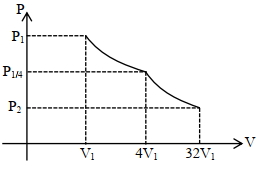
View full question & answer→MCQ 4051 Mark
A thermally isolated cylindrical closed vessel of height $8 m$ is kept vertically. It is divided into two equal parts by a diathermic (perfect thermal conductor) frictionless partition of mass $8.3 kg$. Thus the partition is held initially at a distance of $4 m$ from the top, as shown in the schematic figure below. Each of the two parts of the vessel contains $0.1$ mole of an ideal gas at temperature $300 K$. The partition is now released and moves without any gas leaking from one part of the vessel to the other. When equilibrium is reached, the distance of the partition from the top (in $m$ ) will be. . . . . . (take the acceleration due to gravity $=10 ms ^{-2}$ and the universal gas constant $=8.3 J mol ^{-1} K ^{-1}$ ).
Answerd
Assuming temperature remains constant at $300 K$
From $P _1 V _1= P _2 V _2$
$\frac{ P _1\left(\frac{ V _0}{2}\right)}{ T }=\frac{ P _1^{\prime}\left(\frac{ V _0}{2}- Ax \right)}{ T }$
$\begin{array}{l}\left( P _1^{\prime}- P _2^{\prime}\right) A = mg \\ {\left[\frac{ P _1\left(\frac{ V _0}{2}\right)}{\frac{ V _0}{2}- Ax }-\frac{ P _2\left(\frac{ V _0}{2}\right)}{\frac{ V _0}{2}+ Ax }\right] A = mg } \\ nRT \left[\frac{1}{4- x }-\frac{1}{4+ x }\right]= mg \\ (0.1)(8.3)\left[\frac{4+ x -4+ x }{16- x ^2}\right]= mg \\ 3\left(\frac{2 x }{16- x ^2}\right)=1 \\ 6 x =16- x ^2 \\ x ^2+6 x -16=0 \\ x =2 \\ \text { distance }=4+2=6 m \end{array}$
View full question & answer→MCQ 4061 Mark
A mixture of ideal gas containing $5$ moles of monatomic gas and $1$ mole of rigid diatomic gas is initially at pressure $P _0$, volume $V _0$ and temperature $T _0$. If the gas mixture is adiabatically compressed to a volume $V _0 / 4$, then the correct statement(s) is/are,
(Give $2^{1.2}=2.3 ; 2^{3.2}=9.2 ; R$ is gas constant)
$(1)$ The final pressure of the gas mixture after compression is in between $9 P _0$ and $10 P _0$
$(2)$ The average kinetic energy of the gas mixture after compression is in between $18 RT _0$ and $19 RT _0$
$(3)$ The work $| W |$ done during the process is $13 RT _0$
$(4)$ Adiabatic constant of the gas mixture is $1.6$
- A
$1,2,3$
- B
$1,2,4$
- ✓
$1,3,4$
- D
$1,4$
AnswerCorrect option: C. $1,3,4$
c
$n _1=5 \text { moles } C _{ v _1}=\frac{3 R }{2} \quad P _0 V _0 T _0$
$n _2=1 \text { mole } C _{ v _2}=\frac{5 R }{2}$
$\left(C_v\right)_m=\frac{n_1 C_{v_1}+n_2 C_{v_1}}{n_1+n_2}=\frac{5 \times \frac{3 R}{2}+1 \times \frac{5 R}{2}}{6}=\frac{5 R}{3}$
$\gamma _{ m }=\frac{\left( c _{ P }\right)_{ m }}{\left( c _{ v }\right)_{ m }}=\frac{8}{5}$
$\therefore$ Option $4$ is correct
$\left( C _{ P }\right)_{ m }=\frac{5 R }{3}+ R =\frac{8 R }{3}$
$(1)$ $P _0 V _0^\gamma= P \left(\frac{ V _0}{4}\right)^\gamma \Rightarrow P = P _0(4)^{8 / 5}=9.2 P _0$ which is between $9 P _0$ and $10 P _0$
$(2)$
Average $K.E.=5 \times \frac{3}{2} R T+1 \times \frac{5 R T}{2}$
$=10 R T$
To calculate $T$
$\frac{ P _0 V _0}{ T _0}=9.2 P _0 \times \frac{ V _0}{4 \times T }$
$50$
$T=\frac{9.2}{4} T_0$
Now average $KE =10 R \times 9.2 \frac{ T _0}{4}=23 RT _0$
$(3)$ $W =\frac{ P _1 V _1- P _2 V _2}{\gamma-1}$
$=\frac{ P _0 V _0-9.2 P _0 \times \frac{ V _0}{4}}{3 / 5}=-13 RT _0$
View full question & answer→MCQ 4071 Mark
One mole of a monoatomic ideal gas goes through a thermodynamic cycle, as shown in the volume versus temperature ($V-T$) diagram. The correct statement($s$) is/are :
[ $R$ is the gas constant]
$(1)$ Work done in this thermodynamic cycle $(1 \rightarrow 2 \rightarrow 3 \rightarrow 4 \rightarrow 1)$ is $| W |=\frac{1}{2} RT _0$
$(2)$ The ratio of heat transfer during processes $1 \rightarrow 2$ and $2 \rightarrow 3$ is $\left|\frac{ Q _{1 \rightarrow 2}}{ Q _{2 \rightarrow 3}}\right|=\frac{5}{3}$
$(3)$ The above thermodynamic cycle exhibits only isochoric and adiabatic processes.
$(4)$ The ratio of heat transfer during processes $1 \rightarrow 2$ and $3 \rightarrow 4$ is $\left|\frac{Q_{U \rightarrow 2}}{Q_{3 \rightarrow 4}}\right|=\frac{1}{2}$
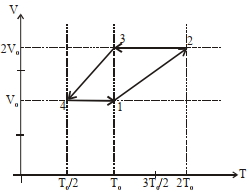
- A
$1,3$
- ✓
$1,2$
- C
$1,4$
- D
$1,3,4$
Answerb
Process $1 \rightarrow 2$ is isobaric with $P =\frac{ RT _0}{ V _0}$
Process $2 \rightarrow 3$ is isochoric with $V =2 V _0$
Process $3 \rightarrow 4$ is isobaric with $P =\frac{ RT _0}{2 V _0}$
Process $4 \rightarrow 1$ is isochoric with $V = V _0$
Work in cycle $=\frac{ RT _0}{ V _0} \cdot V _0-\frac{ RT _0}{2 V _0} \cdot V _0=\frac{ RT _0}{2}$
$Q _{1-2}= nC _{ p } \Delta T = n \cdot \frac{5 R }{2} \cdot T _0$
$Q _{2-3}= nC _{ V } \Delta T = n \cdot \frac{3 R }{2} \cdot T _0$
$\therefore\left|\frac{ Q _{1-2}}{ Q _{2-3}}\right|=\frac{5}{3}$
$Q _{3-4}= nC _{ p } \Delta T = n \cdot \frac{5 R }{2} \cdot \frac{ T _0}{2}$
$\therefore\left|\frac{ Q _{1-2}}{ Q _{3-4}}\right|=2$
Ans.$1, 2$
View full question & answer→MCQ 4081 Mark
Answer the following by appropriately matching the lists based on the information given in the paragraph.
In a thermodynamics process on an ideal monatomic gas, the infinitesimal heat absorbed by the gas is given by $T \Delta X$, where $T$ is temperature of the system and $\Delta X$ is the infinitesimal change in a thermodynamic quantity $X$ of the system. For a mole of monatomic ideal gas
$X=\frac{3}{2} R \ln \left(\frac{T}{T_A}\right)+R \ln \left(\frac{V}{V_A}\right)$. Here, $R$ is gas constant, $V$ is volume of gas, $T_A$ and $V_A$ are constants.
The $List-I$ below gives some quantities involved in a process and $List-II$ gives some possible values of these quantities.
| List-$I$ |
List-$II$ |
| $(I)$ Work done by the system in process $1 \rightarrow 2 \rightarrow 3$ |
$(P)$ $\frac{1}{3} R T_0 \ln 2$ |
| $(II)$ Change in internal energy in process $1 \rightarrow 2 \rightarrow 3$ |
$(Q)$ $\frac{1}{3} RT _0$ |
| $(III)$ Heat absorbed by the system in process $1 \rightarrow 2 \rightarrow 3$ |
$(R)$ $R T _0$ |
| $(IV)$ Heat absorbed by the system in process $1 \rightarrow 2$ |
$(S)$ $\frac{4}{3} RT _0$ |
| |
$(T)$ $\frac{1}{3} RT _0(3+\ln 2)$ |
| |
$(U)$ $\frac{5}{6} RT _0$ |
If the process carried out on one mole of monatomic ideal gas is as shown in figure in the PV-diagram with $P _0 V _0=\frac{1}{3} RT _0$, the correct match is,
$(1)$$I \rightarrow Q, II \rightarrow R , III \rightarrow P , IV \rightarrow U$
$(2)$ $I \rightarrow S , II \rightarrow R , III \rightarrow Q , IV \rightarrow T$
$(3)$ $I \rightarrow Q , II \rightarrow R , III \rightarrow S , IV \rightarrow U$
$(4)$ $I \rightarrow Q , II \rightarrow S , III \rightarrow R , IV \rightarrow U$
($2$) If the process on one mole of monatomic ideal gas is an shown is as shown in the $TV$-diagram with $P _0 V _0=\frac{1}{3} RT _0$, the correct match is
$(1)$ $I \rightarrow S, II \rightarrow T, III \rightarrow Q , IV \rightarrow U$
$(2)$ $I \rightarrow P , II \rightarrow R, III \rightarrow T , IV \rightarrow S$
$(3)$ $I \rightarrow P, II \rightarrow, III \rightarrow Q, IV \rightarrow T$
$(4)$ $I \rightarrow P, II \rightarrow R, III \rightarrow T, IV \rightarrow P$
Give the answer or quetion $(1)$ and $(2)$
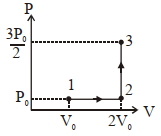
Answera
$(I)$ Degree of freedom $f=3$
Work done in any proces $5$ Area under P-V graph $\Rightarrow$ Work dooe in $1 \rightarrow 2 \rightarrow 3= P _1 V$,
$=\frac{ RI _0}{3} \Rightarrow(Q)$
$(II)$ Change in intemal energy $1 \rightarrow 2 \rightarrow 3$
$\Delta U =\Delta C \Delta T$
$=\frac{f}{2} n R A T$
$=\frac{f}{2}\left(P_t V_t-P_2 V_i\right)$
$=\frac{3}{2}\left(\frac{3 P_0}{2} 2 V _4- P _0 V _0\right)$
$=3 P _0 V _0$
$\Delta U = RT _{ b } \Rightarrow( R )$
$(III)$ Heat absorbed in $1 \rightarrow 2 \rightarrow 3$
for any process, $I^4$ law of thermodymmics
$\Delta Q =\Delta W +\infty$
$\Delta Q = RT _4+\frac{R T_3}{3}$
$\Delta Q =\frac{4 RT }{3} \Rightarrow( s )$
$(IV)$ Heat absorbed in process $1 \rightarrow 2$
$\Delta Q=\Delta U+W$
$=\frac{f}{2}\left(P_t V_f-P_V V_0\right)+W$
$=\frac{3}{2}\left(P_a 2 V_0-P_0 V_0\right)+P_a V_0$
$=\frac{5}{2} P_0 V_a$
$=\frac{5}{2}\left(\frac{R I_0}{3}\right)$
$\Delta Q-\frac{5 R I_0}{6} \Rightarrow(U)$
($2$) Process $1 \rightarrow 2$ is isothermal (temmerature constaut)
Process $2 \rightarrow 3$ is isochoric (volme constant)
$(I)$ Work done in $1 \rightarrow 2 \rightarrow 3$
$W = W _{1 \rightarrow 2}+ W _{2 \rightarrow 1}$
$=n R T \ln \left(\frac{V_t}{V_i}\right)+ W _{2 \rightarrow 1}$
$=\frac{R I_0}{3} \ln \left(\frac{2 V_4}{V_0}\right)+0$
$W =\frac{R T_1}{3} \ln 2 \Rightarrow \text { (P) }$
$\text { (II) } \Delta U \text { in } 1 \rightarrow 2 \rightarrow 3$
$\Delta U=\frac{f}{2} n R\left(T_4-T_i\right)$
$=\frac{3}{2} R\left( T _0-\frac{T_4}{5}\right)$
$=\frac{3}{2} R\left(\frac{2 T_0}{3}\right)$
$\Delta U=R_0 \quad(R)$
$(III)$ For any system first law of thermodynamics for $1 \rightarrow 2 \rightarrow 3$
$\Delta Q=\Delta U+W$
$\Delta Q=R T_0+\frac{R T_1}{3} \ln 2$
$\Delta Q=\frac{R I_0}{3}(3+\ln 2) \Rightarrow \text { (T) }$
$(IV)$ For process $1 \rightarrow 2$ (isothermal)
$\Delta Q =\Delta U + W$
$=\frac{ f }{2} RR \left( I _e- T _{ i }\right)+ RRT \ln \left( V _e / V _{ i }\right)$
$=0+ R \left(\frac{ T _{ e }}{3}\right) \ln \left(\frac{2 v _{ e }}{ V _{ a }}\right)$
$\Delta Q =\frac{R T_4}{3} \ln 2 \Rightarrow( P )$
View full question & answer→MCQ 4091 Mark
One mole of a monatomic ideal gas undergoes a cyclic process as shown in the figure (where $V$ is the volume and $T$ is the temperature). Which of the statements below is (are) true?
(image)
$(A)$ Process $I$ is an isochoric process $(B)$ In process $II$, gas absorbs heat
$(C)$ In process $IV$, gas releases heat $(D)$ Processes $I$ and $III$ are $not$ isobaric
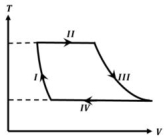
- A
$A,B,C$
- B
$A,B,D$
- ✓
$B,C,D$
- D
$A,C$
AnswerCorrect option: C. $B,C,D$
c
$(A)$ Volume $\mathrm{V}$ is decreasing in process $\mathrm{I}$.
$(B)$ $\Delta \mathrm{U}=0, \mathrm{~W}>0$
$\Delta \mathrm{Q}>0$
Process II is isothermal expansion.
$(C)$ $\Delta \mathrm{U}=0, \mathrm{~W}<0$
$\Delta \mathrm{Q}<0$
Process $III$ is isothermal compression.
$(D)$ For an isobaric process $T-\mathrm{V}$ graph must be linear.
View full question & answer→MCQ 4101 Mark
A reversible cyclic process for an ideal gas is shown below. Here, $P , V$, and $T$ are pressure, volume and temperature, respectively. The thermodynamic parameters $q, w, H$ and $U$ are heat, work, enthalpy and internal energy, respectively.
The correct option ($s$) is (are)
$(A)$ $q_{A C}=\Delta U_{B C}$ and $W_{A B}=P_2\left(V_2-V_1\right)$ $(B)$ $W _{ BC }= P _2\left( V _2- V _1\right)$ and $q _{ BC }= H _{ AC }$ $(C)$ $\Delta H _{ CA }<\Delta U _{ CA }$ and $q _{ AC }=\Delta U _{ BC }$ $(D)$ $q_{B C}=\Delta H_{A C}$ and $\Delta H_{C A}>\Delta U_{C A}$
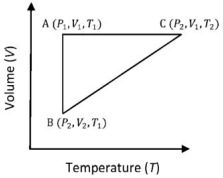
Answerc
$AB =\text { Isothermal process, } \Delta E \text { or } \Delta U =0$
$AC =\text { Isochoric process, } \theta_{ v }=\Delta U$
$BC =\text { Isobaric process, } \theta_{ P }=\Delta H$
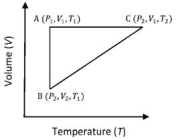
View full question & answer→MCQ 4111 Mark
One mole of a monatomic ideal gas undergoes an adiabatic expansion in which its volume becomes eight times its initial value. If the initial temperature of the gas is $100 K$ and the universal gas constant $R =8.0 Jmol ^{-1} K ^{-1}$, the decrease in its internal energy, in Joule, is. . . . .
Answerc
Adiabatic Expansion
$PV ^\gamma=\text { constant }$
$T . V ^{\gamma-1}=\text { constant }$
$T _2= T _1\left(\frac{ V _1}{ V _2}\right)^{\gamma-1} \text { where } \gamma=\frac{5}{3}$
$T _2= T _1\left(\frac{1}{8}\right)^{2 / 3}=\frac{ T _1}{4}=25 K$
$\Delta U =\frac{ f }{2} nR \Delta T =\frac{3}{2} \times 1 \times 8 \times 75=900 J$
View full question & answer→MCQ 4121 Mark
A reversible cyclic process for an ideal gas is shown below. Here, $P, V$, and $T$ are pressure, volume and temperature, respectively. The thermodynamic parameters $q, w, H$ and $U$ are heat, work, enthalpy and internal energy, respectively.
(image)
The correct option ($s$) is (are)
$(A)$ $q_{A C}=\Delta U_{B C}$ and $W_{A B}=P_2\left(V_2-V_1\right)$
$(B)$ $\mathrm{W}_{\mathrm{BC}}=\mathrm{P}_2\left(\mathrm{~V}_2-\mathrm{V}_1\right)$ and $\mathrm{q}_{\mathrm{BC}}=\mathrm{H}_{\mathrm{AC}}$
$(C)$ $\Delta \mathrm{H}_{\mathrm{CA}}<\Delta \mathrm{U}_{\mathrm{CA}}$ and $\mathrm{q}_{\mathrm{AC}}=\Delta \mathrm{U}_{\mathrm{BC}}$
$(D)$ $\mathrm{q}_{\mathrm{BC}}=\Delta \mathrm{H}_{\mathrm{AC}}$ and $\Delta \mathrm{H}_{\mathrm{CA}}>\Delta \mathrm{U}_{\mathrm{CA}}$
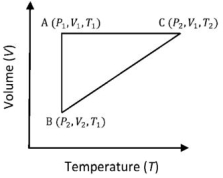
- A
$A,B,C$
- ✓
$B,C$
- C
$A,C$
- D
$A,B$
Answerb
(image)
$\mathrm{AB}=\text { Isothermal process, } \Delta \mathrm{E} \text { or } \Delta \mathrm{U}=0$
$\mathrm{AC}=\text { Isochoric process, } \theta_{\mathrm{v}}=\Delta \mathrm{U}$
$\mathrm{BC}=\text { Isobaric process, } \theta_{\mathrm{P}}=\Delta \mathrm{H}$
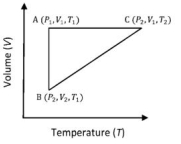
View full question & answer→MCQ 4131 Mark
An ideal gas is undergoing a cyclic thermodynamic process in different ways as shown in the corresponding $P$ $V$ diagrams in column $3$ of the table. Consider only the path from state $1$ to $2 . W$ denotes the corresponding work done on the system. The equations and plots in the table have standard notations as used in thermodynamic processes. Here $\gamma$ is the ratio of heat capacities at constant pressure and constant volume. The number of moles in the gas is $n$.
(image)
($1$) Which of the following options is the only correct representation of a process in which $\Delta U=\Delta Q-P \Delta V$ ?
$[A] (II) (iv) (R)$ $[B] (II) (iii) (P)$ $[C] (II) (iii) (S)$ $[D] (III) (iii) (P)$
($2$) Which one of the following options is the correct combination?
$[A] (III) (ii) (S)$ $[B] (II) (iv) (R)$ $[C] (II) (iv) (P)$ $[D] (IV) (ii) (S)$
($3$) Which one of the following options correctly represents a thermodynamic process that is used as a correction in the determination of the speed of sound in an ideal gas?
$[A] (III) (iv) (R)$ $[B] (I) (ii)$ $(\mathrm{Q})$ $[C] (IV) (ii) (R)$ $[D] (I) (iv) (Q)$
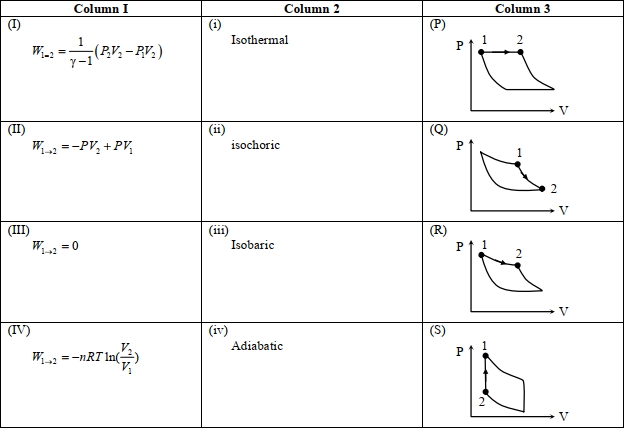
- A
$B,A,C$
- ✓
$B,A,D$
- C
$B,A$
- D
$B,D$
AnswerCorrect option: B. $B,A,D$
b
($1$) The process must be isobaric.
($2$) The correct combination is for isochoric process.
($3$) The process must be adiabatic, which is used in Laplace correction over Newton's law for sound speed in air.
View full question & answer→MCQ 4141 Mark
One mole of an ideal gas at $300 \mathrm{~K}$ in thermal contact with surroundings expands isothermally from $1.0 \mathrm{~L}$ to $2.0 \mathrm{~L}$ against a constant pressure of $3.0 \mathrm{~atm}$. In this process, the change in entropy of surroundings $\left(\Delta S_{\text {surr }}\right)$ in $\mathrm{J} \mathrm{K}^{-1}$ is $(1 \mathrm{~L} \mathrm{~atm}=101.3 \mathrm{~J})$
- A
$5.763$
- B
$1.013$
- ✓
$-1.013$
- D
$-5.763$
AnswerCorrect option: C. $-1.013$
c
The correct option is $C -1.013$
Since it is an isothermal process, $\Delta U=0$
$d q=-d W=P_{\text {ext }}\left(V_2-V_1\right)=3 L-\text { atm }=3 \times 101.3 J$
$\Delta S_{\text {surrounding }}-\frac{3 \times 101.3}{300} J K ^{-1}=-1.013 J K ^{-1}$
$\therefore \Delta S_{\text {surr }}=-1.013 J K ^{-1}$
View full question & answer→MCQ 4151 Mark
A gas is enclosed in a cylinder with a movable frictionless piston. Its initikl thermodynamic state at pressure $P_i=10^5 \mathrm{~Pa}$ and volume $V_i=10^{-3} \mathrm{~m}^3$ chanıes to i final state at $P_f=(1 / 32) \times 10^5 \mathrm{~Pa}$ and $V_f=8 \times 10^{-3} \mathrm{~m}^3$ in an adiabatic quasi-static process, such that $P^3 V^5=$ constant. Consider another thermodynamic process that brings the system from the same initial state to the same final state in two steps: an isobaric expansion at $P$, followed by an isochoric (isovolumetric) process at volume $V_f$. The amount of heat supplied to the system in the two-step process is approximately
- A
$112 \mathrm{~J}$
- B
$294 \mathrm{~J}$
- ✓
$588 \mathrm{~J}$
- D
$83 \mathrm{~J}$
AnswerCorrect option: C. $588 \mathrm{~J}$
c
In adiabatic process ideal gas equation: $PV ^{\vee}=$ Constant from given data, $P ^3 V^5=$ constant
So, $P V^{\frac{5}{3}}=k$
where, $Y=\frac{5}{3}$
Total work done during process $1$ and $2$,
$W_a=\frac{P_t V_t-P_i V_i}{1-y}$
$\rightarrow W_a=\frac{132 \times 10^{-5} \times 8 \times 10^{-3}-10^5 \times 10-3}{1-5 / 3}$
$W_a=112.5 J$
In adiabatic process the internal energy of system $\triangle Q=0$
$\text { so, } \Delta U=-W \Rightarrow-112.5 J$
Total heat supply between 1 and 2
$q_1+q_2=\Delta U+P_i\left(V_f-V_i\right)$
$=-112.5+10^5(8-1) \times 10^{-3}$
$=587.5 J$
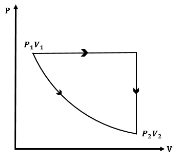
View full question & answer→MCQ 4161 Mark
An ideal monoatomic gas is confined in a horizontal cylinder by a spring loaded piston (as shown in the figure). Initially the gas is at temperature $T _1$, pressure $P_1$ and volume $V_1$ and the spring is in its relaxed state. The gas is then heated very slowly to temperature $T_2$, pressure $P _2$ and volume $V _2$. During this process the piston moves out by a distance $x$. Ignoring the friction between the piston and the cylinder, the correct statement$(s)$ is(are)
$(A)$ If $V_2=2 V_1$ and $T_2=3 T_1$, then the energy stored in the spring is $\frac{1}{4} P_1 V_1$
$(B)$ If $V_2=2 V_1$ and $T_2=3 T_1$, then the change in internal energy is $3 P_1 V_1$
$(C)$ If $V_2=3 V_1$ and $T_2=4 T_1$, then the work done by the gas is $\frac{7}{3} P_1 V_1$
$(D)$ If $V_2=3 V_1$ and $T_2=4 T_1$, then the heat supplied to the gas is $\frac{17}{6} P_1 V_1$
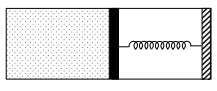
- ✓
$B$ or $A, B, C$
- B
$B$ or $A, B, D$
- C
$B$ or $B, C, D$
- D
$A$ or $A, C, D$
AnswerCorrect option: A. $B$ or $A, B, C$
a
$P \text { (pressure of gas) }=P_1+\frac{k x}{A}$
$W =\int PdV = P _1\left( V _2- V _1\right)+\frac{ kx ^2}{2}= P _1\left( V _2- V _1\right)+\frac{\left( P _2- P _1\right)\left( V _2- V _1\right)}{2}$
$\Delta U = nC _{ V } \Delta T =\frac{3}{2}\left( P _2 V _2- P _1 V _1\right)$
$Q = W +\Delta U$
$\text { Case I: } \Delta U =3 P _1 V _1, W =\frac{5 P _1 V _1}{4}, Q =\frac{17 P _1 V _1}{4}, U _{\text {spring }}=\frac{ P _1 V _1}{4} $
$\text { Case II: } \Delta U =\frac{9 P _1 V _1}{2}, W =\frac{7 P _1 V _1}{3}, Q =\frac{41 P _1 V _1}{6}, U _{\text {spring }}=\frac{ P _1 V _1}{3}$
View full question & answer→MCQ 4171 Mark
A thermodynamic system is taken form an initial state $i$ with internal energy $U_1=100 \ J$ to the final state along two different paths iaf and ibf, as schematically shown in the fire. The work done by the system along the paths $af$, ib and bf are $W _{ af }=200 \ J , W _{ ID }=50 \ J$ and $W _{ br }=100 \ J$ respectively. The heat supplied to the system along the path iaf, ib and bf are $Q_{\mid a t l} Q_{b r}$ and $Q_{10}$ respectively. If the internal energy of the sytem in the state $b$ is $U_b=$ $200 \ J$ and $Q_{l a t}=500 \ J$, the ratio $Q_{b J} / Q_{10}$ is:
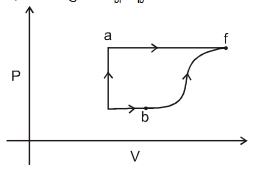
Answerb
$w _{\text {lot }}=150 \ J $
$w _{\text {lat }}=200 \ J $
$Q _{\text {lat }}=500 \ J So U _{\text {lat }}=300 \ J$
So : $U_t=400 \ J$
$U_b=100 \ J $
$Q_b=100+50=150 \ J $
$Q_{b t}=300+150=450 \ J$
So the required ratio $\frac{Q_{b f}}{Q_{i b}}=\frac{450-150}{150}=2$
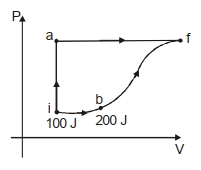
View full question & answer→MCQ 4181 Mark
One mole of a monatomic ideal gas is taken along two cyclic processes $E \rightarrow F \rightarrow G \rightarrow E$ and $E \rightarrow F \rightarrow H \rightarrow$ E as shown in the $PV$ diagram. The processes involved are purely isochoric, isobaric, isothermal or adiabatic. $Image$
Match the paths in List $I$ with the magnitudes of the work done in List $II$ and select the correct answer using the codes given below the lists.
| List $I$ |
List $I$ |
| $P.$ $\quad G \rightarrow E$ |
$1.$ $\quad 160 P_0 V_0 \ln 2$ |
| $Q.$ $\quad G \rightarrow H$ |
$2.$ $\quad 36 P _0 V _0$ |
| $R.$ $\quad F \rightarrow H$ |
$3.$ $\quad 24 P _0 V _0$ |
| $S.$ $\quad F \rightarrow G$ |
$4.$ $\quad 31 P_0 V_0$ |
Codes: $ \quad \quad P \quad Q \quad R \quad S $
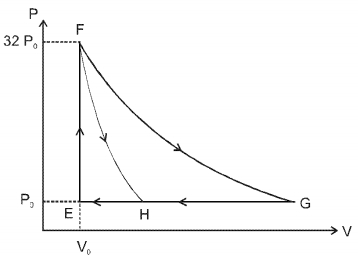
- ✓
$\quad 4 \quad 3 \quad 2 \quad 1 $
- B
$\quad 4 \quad 3 \quad 1 \quad 2 $
- C
$\quad 3 \quad 1 \quad 2 \quad 4 $
- D
$\quad 1 \quad 3 \quad 2 \quad 4 $
AnswerCorrect option: A. $\quad 4 \quad 3 \quad 2 \quad 1 $
a
In $F \rightarrow G$ work done in isothermal proces is $n R T \ln \left(\frac{V_f}{V_i}\right)=32 P_0 V_0 \ln \left(\frac{32 V_0}{V_0}\right)$
$=32 P_0 V_0 \ln 2^5=160 P_0 V_0 \ln 2 $
$\ln G \rightarrow E, \Delta W=P_0 \Delta V=P_0\left(31 V_0\right)=31 P_0 V_0$
In $G \rightarrow H$ work done is less than $31 P_0 V_0$ i.e., $24 P_0 V_0$
In $F \rightarrow H$ work done is $36 P _0 V _0$
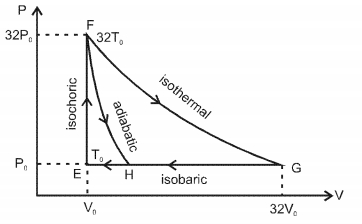
View full question & answer→MCQ 4191 Mark
$5.6$ liter of helium gas at $STP$ is adiabatically compressed to $0.7$ liter. Taking the initial temperature to be $T _1$, the work done in the process is
- ✓
$\frac{9}{8} R T_1$
- B
$\frac{3}{2} R T_1$
- C
$\frac{15}{8} R T_1$
- D
$\frac{9}{2} R T_1$
AnswerCorrect option: A. $\frac{9}{8} R T_1$
a
$V_1=5.6 l, T_1=273 K, P_1=1 a t m$
$\gamma=\frac{5}{3}(F \text { or monoa } \rightarrow \text { micgas })$
The number of moles of gas is $n=\frac{5.6 l}{22.4 l}=\frac{1}{4}$
Finally (after adiabatic compression)
$V_2=0.7 l$
For adiabatic compression $T_1 V_1^{\gamma-1}=T_2 V_2^{\gamma-1}$
$\therefore T_2=T_1\left(\frac{V_1}{V_2}\right)^{\gamma-1}=T_1\left(\frac{5.6}{0.7}\right)^{\frac{5}{3}-1}=T_1(8)^{2 / 3}$
$=4 T_1$
We know that work done in adiabatic process is
$W=\frac{n R \Delta T}{\gamma-1}=\frac{9}{8} R T_1$
View full question & answer→MCQ 4201 Mark
One mole of a monatomic ideal gas is taken through a cycle $ABCDA$ as shown in the $P-V$ diagram. Column $II$ gives the characteristics involved in the cycle. Match them with each of the processes qiven in Column $I$
| Column $I$ |
Column $II$ |
| $(A)$ Process $A \rightarrow B$ |
$(p)$ Internal energy decreases. |
| $(B)$ Process $B \rightarrow C$ |
$(q)$ Internal energy increases. |
| $(C)$ Process $C \rightarrow D$ |
$(r)$ Heat is lost. |
| $(D)$ Process $D \rightarrow A$ |
$(s)$ Heat is gained. |
| |
$(t)$ Work is done on the gas. |
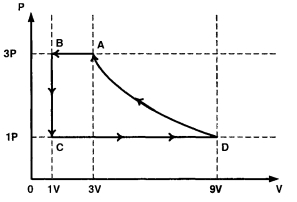
- A
$(A) \rightarrow p, q, r \ and \ s,(B) \rightarrow q,(C) \rightarrow p, q, r \ and \ s,(D) \rightarrow p, q, r \ and \ s$
- ✓
$(A) \rightarrow p, r, \ and \ t,(B) \rightarrow p \ and \ r (C) \rightarrow q, \ and \ s,(D) \rightarrow r \ and \ t$
- C
$(A) \rightarrow p, q, \ and \ t,(B) \rightarrow s \ and \ q (C) \rightarrow q, \ and \ t,(D) \rightarrow s \ and \ r$
- D
$(A) \rightarrow q, r, \ and \ t,(B) \rightarrow r \ and \ t (C) \rightarrow r, \ and \ s,(D) \rightarrow p \ and \ q$
AnswerCorrect option: B. $(A) \rightarrow p, r, \ and \ t,(B) \rightarrow p \ and \ r (C) \rightarrow q, \ and \ s,(D) \rightarrow r \ and \ t$
b
for $(A): A B$ is Isobaric compression
W is $- Ve ; \Delta U$ is $- Ve ; \Delta Q$ is - Ve
for $(B)$ : $C$ is Isochoric
$W = O ; \Delta U$ is $- Ve ; \Delta Q$ is - Ve
for $(C)$ : $CD$ is Isobaric expansion
$W$ is $+V e ; \Delta U$ is $+V e ; \Delta Q$ is $+V e$
for $(D)$ : $DA$ is Isothermal
W is $- Ve ; \Delta U=0 ; \Delta Q$ is - Ve
View full question & answer→MCQ 4211 Mark
A diatomic ideal gas is compressed adiabatically to $\frac{1}{32}$ of its initial volume. If the initial temperature of the gas is $T_1$ (in Kelvin) and the final temperature is $a T_1$, the value of $a$ is
Answerc
$ \mathrm{TV}^{\gamma-1}=\text { constant } $
$ \mathrm{TV}^{7 / 5-1}=\mathrm{aT}\left(\frac{\mathrm{v}}{32}\right)^{7 / 5-1} $
$ \therefore \mathrm{a}=4 .$
View full question & answer→MCQ 4221 Mark
One mole of an ideal gas in initial state $\mathrm{A}$ undergoes a cyclic process $A B C A$, as shown in the figure. Its pressure at $A$ is $\mathrm{P}_0$. Choose the correct option$(s)$ from the following
$(A)$ Internal energies at $\mathrm{A}$ and $\mathrm{B}$ are the same
$(B)$ Work done by the gas in process $\mathrm{AB}$ is $\mathrm{P}_0 \mathrm{~V}_0 \ln 4$
$(C)$ Pressure at $C$ is $\frac{P_0}{4}$
$(D)$ Temperature at $\mathrm{C}$ is $\frac{\mathrm{T}_0}{4}$
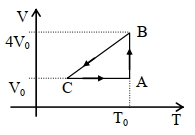
- A
$(B,D)$
- B
$(A,D)$
- ✓
$(A, B)$
- D
$(B,C)$
AnswerCorrect option: C. $(A, B)$
c
Process $\mathrm{AB}$ is isothermal process
View full question & answer→MCQ 4231 Mark
One mole of an ideal gas is taken from a to $b$ along two paths denoted by the solid and the dashed lines as shown in the graph below. If the work done along the solid line path is $\mathrm{w}_{\mathrm{s}}$ and that along the dotted line path is $w_d$, then the integer closest to the ratio $w_d / w_5$ is
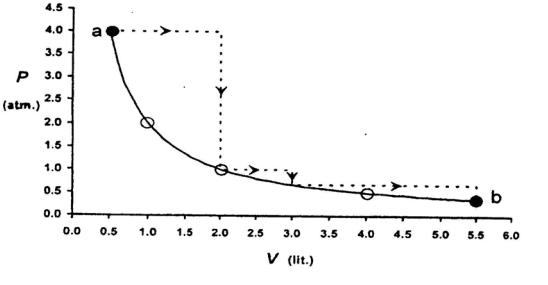
Answerc
$w_d=4 \times 1.5+1 \times 1+2.5 \times 2 / 3=8.65$
Process is isothermal
$ \mathrm{w}_{\mathrm{s}}=2 \times 2.303 \log \frac{5.5}{0.5}=2 \times 2.303 \times \log 11=2 \times 2.303 \times 1.0414=4.79 $
$ \frac{\mathrm{w}_{\mathrm{d}}}{\mathrm{w}_{\mathrm{s}}}=\frac{8.65}{4.79}=1.80=2$
View full question & answer→MCQ 4241 Mark
The figure shows the $P-V$ plot of an ideal gas taken through a cycle $ABCDA$. The part $ABC$ is a semi-circle and $CDA$ is half of an ellipse. Then,
$(A)$ the process during the path $\mathrm{A} \rightarrow \mathrm{B}$ is isothermal
$(B)$ heat flows out of the gas during the path $\mathrm{B} \rightarrow \mathrm{C} \rightarrow \mathrm{D}$
$(C)$ work done during the path $\mathrm{A} \rightarrow \mathrm{B} \rightarrow \mathrm{C}$ is zero
$(D)$ positive work is done by the gas in the cycle $ABCDA$
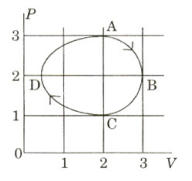
- ✓
$(B,D)$
- B
$(C,D)$
- C
$(A,B)$
- D
$(A,C)$
AnswerCorrect option: A. $(B,D)$
a
The correct options are
$B$ heat flows out of the gas during the path $B \rightarrow C \rightarrow D$.
D positive work is done by the gas in the cycle ABCDA.
Isolthermal process is represented by straight line on $PV$-diagram.
If $W$ is work done by the gas, $\Delta Q=\Delta U+W$
For process $B \rightarrow C \rightarrow D$
$\Delta U$ is negative and $W$ by gas is also negative, so $\Delta Q$ is also negative, hence heat flows out of gas during this process.
A to $B$, work done by gas is +ve. $B$ to $C$ work done by gas is -ve. But +ve work is more, so net work is not zero in process $A \rightarrow B \rightarrow C$
Area enclosed by $P-V$ graph is equal to positive work done by gas in cyclic process.
View full question & answer→MCQ 4251 Mark
An ideal gas is expanding such that $\mathrm{PT}^2=$ constant. The coefficient of volume expansion of the gas is
- A
$\frac{1}{\mathrm{~T}}$
- B
$\frac{2}{\mathrm{~T}}$
- ✓
$\frac{3}{\mathrm{~T}}$
- D
$\frac{4}{\mathrm{~T}}$
AnswerCorrect option: C. $\frac{3}{\mathrm{~T}}$
c
$\gamma=\frac{1}{V}\left(\frac{d V}{d T}\right) $
$ \mathrm{PT}^2=\text { constant } $
$ \frac{\mathrm{nRT}}{\mathrm{V}} \mathrm{T}^2=\text { constant } $
$ \therefore \quad \gamma=\frac{3}{\mathrm{~T}}$
View full question & answer→MCQ 4261 Mark
Column $I$ Contains a list of processes involving expansion of an ideal gas. Match this with Column $II$ describing the thermodynamic change during this process. Indicate your answer by darkening the appropriate bubbles of the $4 \times 4$ matrix given in the $ORS$.
| Column $I$ |
Column $II$ |
| $(A)$ An insulated container has two chambers separated by a valve. Chamber $I$ contains an ideal gas and the Chamber $II$ has vacuum. The valve is opened. |
$(p)$ The temperature of the gas decreases |
| $(B)$ An ideal monoatomic gas expands to twice its original volume such that its pressure $\mathrm{P} \propto \frac{1}{\mathrm{~V}^2}$, where $\mathrm{V}$ is the volume of the gas |
$(q)$ The temperature of the gas increases or remains constant |
| $(C)$ An ideal monoatomic gas expands to twice its original volume such that its pressure $\mathrm{P} \propto \frac{1}{\mathrm{~V}^{4 / 3}}$, where $\mathrm{V}$ is its volume |
$(r)$ The gas loses heat |
| $(D)$ An ideal monoatomic gas expands such that its pressure $\mathrm{P}$ and volume $\mathrm{V}$ follows the behaviour shown in the graph $Image$ |
$(s)$ The gas gains heat |
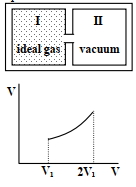
- ✓
$(A) \rightarrow q,(B) \rightarrow p \& r,(C) \rightarrow p \& s,(D) \rightarrow q \& s$
- B
$(A) \rightarrow p,(B) \rightarrow s \& r,(C) \rightarrow p \& q,(D) \rightarrow q \& r$
- C
$(A) \rightarrow p,(B) \rightarrow p \& s,(C) \rightarrow p \& s,(D) \rightarrow q \& p$
- D
$(A) \rightarrow r,(B) \rightarrow p \& r,(C) \rightarrow s \& s,(D) \rightarrow r \& s$
AnswerCorrect option: A. $(A) \rightarrow q,(B) \rightarrow p \& r,(C) \rightarrow p \& s,(D) \rightarrow q \& s$
View full question & answer→MCQ 4271 Mark
A thermally insulated rigid container contains an ideal gas heated by a filament of resistance $100 \,\Omega$ through a current of $1\,A$ for $5$ min then change in internal energy is...... $kJ$
Answerd
(d) Volume of the ideal gas is constant so $W = P\Delta V = 0$
using FLOT $\Delta Q = \Delta U$==> $\Delta U = {I^2}Rt$$ = {1^2} \times 100 \times 5 \times 60$
$ = 30 \times {10^3} = 30KJ$
View full question & answer→MCQ 4281 Mark
An ideal gas expands isothermally from a volume ${V_1}$ to ${V_2}$ and then compressed to original volume ${V_1}$adiabatically. Initial pressure is ${P_1}$ and final pressure is ${P_3}$. The total work done is $W$. Then
- A
${P_3} > {P_1},\,\,W > 0$
- B
${P_3} < {P_1},\,\,W < 0$
- ✓
${P_3} > {P_1},\,\,W < 0$
- D
${P_3} = {P_1},\,\,W = 0$
AnswerCorrect option: C. ${P_3} > {P_1},\,\,W < 0$
c
(c)From graph it is clear that ${P_3} > {P_1}$.
Since area under adiabatic process $(BCED)$ is greater than that of isothermal process $(ABDE)$. Therefore net work done
$W = {W_i} + ( - {W_A})$$⇒$ $W < 0$
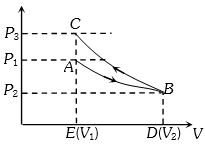
View full question & answer→MCQ 4291 Mark
In a given process for an ideal gas, $dW = 0$ and $dQ < 0.$ Then for the gas
- ✓
The temperature will decrease
- B
- C
The pressure will remain constant
- D
The temperature will increase
AnswerCorrect option: A. The temperature will decrease
a
(a) From FLOT
==> $dU = dQ - dW \Rightarrow dU = dQ( < 0)$ $(\because \;\;dW = 0)$
$ \Rightarrow dU < 0$ So temperature will decrease.
View full question & answer→MCQ 4301 Mark
A monoatomic ideal gas, initially at temperature ${T_1},$ is enclosed in a cylinder fitted with a frictionless piston. The gas is allowed to expand adiabatically to a temperature. ${T_2}$ by releasing the piston suddenly. If ${L_1}$ and ${L_2}$ are the lengths of the gas column before and after expansion respectively, then ${T_1}/{T_2}$ is given by
- A
${\left( {\frac{{{L_1}}}{{{L_2}}}} \right)^{2/3}}$
- B
$\frac{{{L_1}}}{{{L_2}}}$
- C
$\frac{{{L_2}}}{{{L_1}}}$
- ✓
${\left( {\frac{{{L_2}}}{{{L_1}}}} \right)^{2/3}}$
AnswerCorrect option: D. ${\left( {\frac{{{L_2}}}{{{L_1}}}} \right)^{2/3}}$
d
(d) ${T_1}{V_1}^{\gamma - 1} = {T_2}{V_2}^{\gamma - 1}$$ \Rightarrow \frac{{{T_1}}}{{{T_2}}} = {\left( {\frac{{{V_2}}}{{{V_1}}}} \right)^{\,\gamma - 1}}$$ = {\left( {\frac{{{L_2}A}}{{{L_1}A}}} \right)^{\,\frac{5}{3} - 1}} = {\left( {\frac{{{L_2}}}{{{L_1}}}} \right)^{\,\frac{2}{3}}}$
View full question & answer→MCQ 4311 Mark
During the melting of a slab of ice at $273\, K$ at atmospheric pressure
- A
Positive work is done by ice-water system on the atmosphere
- B
Positive work is done on the ice-water system by the atmosphere
- C
The internal energy of the ice-water system increases
- ✓
$(B)$ and $(C)$ both
AnswerCorrect option: D. $(B)$ and $(C)$ both
d
(d) There is a decrease in volume during melting on an ice slab at $273K$.
Therefore, negative work is done by ice-water system on the atmosphere or positive work is done on the ice-water system by the atmosphere.
Hence option $(b)$ is correct. Secondly heat is absorbed during melting (i.e.$\Delta Q$ is positive) and as we have seen, work done by ice-water system is negative ($\Delta W$ is negative).
Therefore, from first law of thermodynamics $\Delta U = \Delta Q - \Delta W.$
Change in internal energy of ice-water system, $\Delta U$ will be positive or internal energy will increase.
View full question & answer→MCQ 4321 Mark
The isothermal Bulk modulus of an ideal gas at pressure $P$ is
Answera
(a) ${E_\theta } = P$
View full question & answer→MCQ 4331 Mark
Two cylinders $A$ and $B$ fitted with pistons contain equal amounts of an ideal diatomic gas at $300 K$ . The piston of $A$ is free to move while that of $B$ is held fixed. The same amount of heat is given to the gas in each cylinder. If the rise in temperature of the gas in $A$ is $30 K$ , then the rise in temperature of the gas in $B$ is ..... $K$
Answerd
(d) In both cylinders $ A$ and $B$ the gases are diatomic ($\gamma = 1.4$). Piston $A$ is free to move i.e. it is isobaric process.
Piston $B$ is fixed i.e. it is isochoric process.
If same amount of heat $\Delta Q$ is given to both then
${(\Delta Q)_{{\rm{isobaric}}}} = {(\Delta Q)_{{\rm{isochoric}}}}$==> $\mu \,{C_p}{(\Delta T)_A} = \mu \,{C_v}{(\Delta T)_B}$
==>${(\Delta T)_B} = \frac{{{C_p}}}{{{C_v}}}{(\Delta T)_A} = \gamma {(\Delta T)_A} = 1.4 \times 30 = 42\,K.$
View full question & answer→MCQ 4341 Mark
Two identical containers $A$ and $B$ with frictionless pistons contain the same ideal gas at the same temperature and the same volume $V$. The mass of the gas in $A$ is ${m_A}$ and that in $B$ is ${m_B}$. The gas in each cylinder is now allowed to expand isothermally to the same final volume $2V$. The changes in the pressure in $A$ and $B$ are found to be $\Delta P$ and $1.5 \Delta P$ respectively. Then
- A
$4{m_A} = 9{m_B}$
- B
$2{m_A} = 3{m_B}$
- ✓
$3{m_A} = 2{m_B}$
- D
$9{m_A} = 3{m_B}$
AnswerCorrect option: C. $3{m_A} = 2{m_B}$
c
(c) Process is isothermal. There fore, $T =$ constant,
$\left( {P \propto \frac{1}{V}} \right)$ volume is increasing, therefore pressure will decreases.
In chamber $A$ :
$\Delta P = {P_i} - {P_f} = \frac{{{\mu _A}RT}}{V} - \frac{{{\mu _A}RT}}{{2V}} = \frac{{{\mu _A}RT}}{{2V}}$…..$(i)$
In chamber $B$ :
$1.5\Delta P = {P_i} - {P_f} = \frac{{{\mu _B}RT}}{V} - \frac{{{\mu _B}RT}}{{2V}} = \frac{{{\mu _B}RT}}{{2V}}$…..$(ii)$
from equations $(i)$ and $(ii)$ $\frac{{{\mu _A}}}{{{\mu _B}}} = \frac{1}{{1.5}} = \frac{2}{3}$
==> $\frac{{{m_A}/M}}{{{m_B}/M}} = \frac{2}{3}$==> $3{m_A} = 2{m_B}.$
View full question & answer→MCQ 4351 Mark
When an ideal diatomic gas is heated at constant pressure, the fraction of the heat energy supplied which increases the internal energy of the gas, is
- A
$\frac{2}{5}$
- B
$\frac{3}{5}$
- C
$\frac{3}{7}$
- ✓
$\frac{5}{7}$
AnswerCorrect option: D. $\frac{5}{7}$
d
(d) Fraction of supplied energy which in creases the internal energy is given by
$f = \frac{{\Delta U}}{{{{(\Delta Q)}_P}}} = \frac{{{{(\Delta Q)}_V}}}{{{{(\Delta Q)}_P}}} = \frac{{\mu {C_V}\Delta T}}{{\mu {C_P}\Delta T}} = \frac{1}{\gamma }$
For diatomic gas $\gamma = \frac{7}{5}$==> $f = \frac{5}{7}$
View full question & answer→MCQ 4361 Mark
First law of thermnodynamics is given by
- ✓
$dQ = dU + PdV$
- B
$dQ = dU \times PdV$
- C
$dQ = (dU + dV)\,P$
- D
$dQ = PdU + dV$
AnswerCorrect option: A. $dQ = dU + PdV$
a
(a)$\Delta Q = \Delta U + \Delta W$ and $\Delta W = P\Delta V$
View full question & answer→MCQ 4371 Mark
The internal energy of an ideal gas depends upon
Answerc
(c) The internal energy of ideal gas depends only upon temperature of gas not on other factors.
View full question & answer→MCQ 4381 Mark
In changing the state of thermodynamics from $A$ to $B$ state, the heat required is $Q$ and the work done by the system is $W.$ The change in its internal energy is
- A
$Q + W$
- ✓
$Q -W$
- C
$Q$
- D
$\frac{{Q - W}}{2}$
AnswerCorrect option: B. $Q -W$
b
(b) $\Delta Q = \Delta U + \Delta W$
==> $\Delta U = \Delta Q - \Delta W = Q - W$ (using proper sign)
View full question & answer→MCQ 4391 Mark
Heat given to a system is $35$ joules and work done by the system is $15$ joules. The change in the internal energy of the system will be ..... $J$
- A
$-50 $
- ✓
$20 $
- C
$30 $
- D
$50 $
Answerb
(b) $\Delta U = \Delta Q - W = 35 - 15 = 20\;J$
View full question & answer→MCQ 4401 Mark
The temperature of an ideal gas is kept constant as it expands. The gas does external work. During this process, the internal energy of the gas
- A
- B
- ✓
- D
Depends on the molecular motion
Answerc
(c)Internal energy depends only on the temperature of the gas.
View full question & answer→MCQ 4411 Mark
If the amount of heat given to a system be $35$ joules and the amount of work done by the system be $ - 15$ joules, then the change in the internal energy of the system is .... $joules$
Answerd
(d) $\Delta Q = \Delta W + \Delta U \Rightarrow 35 = - 15 + \Delta U \Rightarrow \Delta U = 50J$
View full question & answer→MCQ 4421 Mark
Work done on or by a gas, in general depends upon the
- A
- B
- C
Both initial and final states only
- ✓
Initial state, final state and the path
AnswerCorrect option: D. Initial state, final state and the path
d
(d)Work done $ = \int_{\,1}^{\,2} {\,PdV} $, which is state dependent as well as path dependent.
View full question & answer→MCQ 4431 Mark
A system performs work $\Delta W$ when an amount of heat is$\Delta Q$ added to the system, the corresponding change in the internal energy is $\Delta U$. A unique function of the initial and final states (irrespective of the mode of change) is
AnswerCorrect option: D. $\Delta U$
d
(d) Change in internal energy ($\Delta$U) depends upon initial an find state of the function while $\Delta$Q and $\Delta$W are path dependent also.
View full question & answer→MCQ 4441 Mark
A container of volume $1{m^3}$is divided into two equal compartments by a partition. One of these compartments contains an ideal gas at $300 K$. The other compartment is vacuum. The whole system is thermally isolated from its surroundings. The partition is removed and the gas expands to occupy the whole volume of the container. Its temperature now would be ..... $K$
- ✓
$300 $
- B
$239 $
- C
$200 $
- D
$100 $
AnswerCorrect option: A. $300 $
a
(a)This is the case of free expansion and in this case $\Delta W = 0$, $\Delta U = 0$ so temperature remains same i.e. $300 K.$
View full question & answer→MCQ 4451 Mark
When the amount of work done is $333\, cal$ and change in internal energy is $167\, cal$, then the heat supplied is ....... $cal$
Answerc
(c) $\Delta Q = \Delta U + \Delta W = 167 + 333 = 500\;cal$
View full question & answer→MCQ 4461 Mark
First law thermodynamics states that
Answerd
(d)Heat always refers to energy in transit from one body to another because of temperature difference.
View full question & answer→MCQ 4471 Mark
A thermo-dynamical system is changed from state $({P_1},\,{V_1})$ to $({P_2},\,{V_2})$ by two different process. The quantity which will remain same will be
- A
$\Delta \,Q$
- B
$\Delta \,W$
- C
$\Delta Q + \Delta W$
- ✓
$\Delta Q - \Delta W$
AnswerCorrect option: D. $\Delta Q - \Delta W$
d
Change in internal energy does not depend upon path so $\Delta U = \Delta Q - \Delta W$ remain constant.
View full question & answer→MCQ 4481 Mark
In thermodynamic process, $200$ Joules of heat is given to a gas and $100$ Joules of work is also done on it. The change in internal energy of the gas is ........ $J$
- A
$100 $
- ✓
$300 $
- C
$419 $
- D
$24 $
AnswerCorrect option: B. $300 $
b
(b) $\Delta Q = \Delta U + \Delta W$; $\Delta Q = 200J$ and $\Delta W = - 100J$
==> $\Delta U = \Delta Q - \Delta W = 200 - ( - 100) = 300J$
View full question & answer→MCQ 4491 Mark
A perfect gas contained in a cylinder is kept in vacuum. If the cylinder suddenly bursts, then the temperature of the gas
Answera
(a) During free expansion of a perfect gas no, work is done and also no heat is supplied from outside. Therefore, no change in internal energy. Hence, temperature remain Hconstant.
View full question & answer→MCQ 4501 Mark
If $150 J$ of heat is added to a system and the work done by the system is $110 J$, then change in internal energy will be .......... $J$
- A
$260 $
- B
$150 $
- C
$110 $
- ✓
$40 $
Answerd
(d) $\Delta Q = \Delta U + \Delta W$$ \Rightarrow \Delta U = \Delta Q - \Delta W = 150 - 110 = 40\;J$
View full question & answer→MCQ 4511 Mark
For free expansion of the gas which of the following is true
- ✓
$Q = W = 0$ and $\Delta \,{E_{{\mathop{\rm int}} }} = 0$
- B
$Q = 0,\,W > 0$ and $\Delta {E_{{\mathop{\rm int}} }} = - W$
- C
$W = 0,\,Q > 0,$ and $\Delta \,{E_{{\mathop{\rm int}} }} = Q$
- D
$W > 0,\,Q < 0$ and $\Delta {E_{{\mathop{\rm int}} }} = 0$
AnswerCorrect option: A. $Q = W = 0$ and $\Delta \,{E_{{\mathop{\rm int}} }} = 0$
View full question & answer→MCQ 4521 Mark
Which of the following can not determine the state of a thermodynamic system
- A
- B
- C
- ✓
Any one of pressure, volume or temperature
AnswerCorrect option: D. Any one of pressure, volume or temperature
d
(d)State of a thermodynamic state cannot determine by a single variable ($P$ or $V$ or $T$)
View full question & answer→MCQ 4531 Mark
In a thermodynamic system working substance is ideal gas, its internal energy is in the form of
- ✓
- B
Kinetic and potential energy
- C
- D
Answera
(a) Ideal gas possess only kinetic energy.
View full question & answer→MCQ 4541 Mark
A system is provided with $200 \,cal$ of heat and the work done by the system on the surrounding is $40 \,J$. Then its internal energy
- A
Increases by $600 J$
- B
Decreases by $800 J$
- ✓
Increases by $800 J$
- D
Decreases by $50 J$
AnswerCorrect option: C. Increases by $800 J$
c
(c) $\Delta Q = \Delta U + \Delta W$
$\Delta Q = 200cal = 200 \times 4.2 = 840J$ and $\Delta W = 40J$
==>$\Delta U = \Delta Q - \Delta W = 840 - 40 = 800J$
View full question & answer→MCQ 4551 Mark
In a thermodynamic process, pressure of a fixed mass of a gas is changed in such a manner that the gas molecules gives out $20 J$ of heat and $10 J$ of work is done on the gas. If the initial internal energy of the gas was $40 J,$ then the final internal energy will be ........ $J$
Answerc
(c) $\Delta Q = \Delta U + \Delta W = ({U_f} - {U_i}) + \Delta W$
==> $30 = ({U_f} - 40) + 10$==> ${U_f} = 60J$
View full question & answer→MCQ 4561 Mark
Heat is not being exchanged in a body. If its internal energy is increased, then
- ✓
Its temperature will increase
- B
Its temperature will decrease
- C
Its temperature will remain constant
- D
AnswerCorrect option: A. Its temperature will increase
a
(a)With rise in temperature, internal energy also increases.
View full question & answer→MCQ 4571 Mark
Out of the following which quantity does not depend on path
MCQ 4581 Mark
First law of thermodynamics is a special case of
- A
- ✓
Law of conservation of energy
- C
- D
AnswerCorrect option: B. Law of conservation of energy
b
(b)Heat supplied to a gas raise its internal energy and does some work against expansion, so it is a special case of law of conservation of energy.
View full question & answer→MCQ 4591 Mark
If ${C_V} = 4.96cal/mole\, K$, then increase in internalenergy when temperature of $2$ moles of this gas is increased from $340 K$ to $342 K$ ....... $cal$
- A
$27.80$
- ✓
$19.84$
- C
$13.90$
- D
$9.92$
AnswerCorrect option: B. $19.84$
b
(b) $\Delta U = \mu {C_V}\Delta T = 2 \times 4.96 \times (342 - 340) = 19.84\;cal$
View full question & answer→MCQ 4601 Mark
Temperature is a measurement of coldness or hotness of an object. This definition is based on
- ✓
Zeroth law of thermodynamics
- B
First law of thermodynamics
- C
Second law of thermodynamics
- D
AnswerCorrect option: A. Zeroth law of thermodynamics
a
So, the thermometer shows the temperature that it has and it actually has the temperature of the object. So, temperature measurement is actually a measurement of degree of hotness or coldness based on the zeroth law of thermodynamics.
View full question & answer→MCQ 4611 Mark
If heat given to a system is $6 \,kcal$ and work done is $ 6 kJ.$ Then change in internal energy is ....... $kJ$
- ✓
$19.1$
- B
$12.5 $
- C
$25 $
- D
$0$
AnswerCorrect option: A. $19.1$
a
(a)$\Delta Q = \Delta U + \Delta W$==> $\Delta U = \Delta Q - \Delta W$
$ = 6 \times 4.18 - 6 = 19.08kJ$$ \approx 19.1\,kJ$
View full question & answer→MCQ 4621 Mark
A monoatomic gas of $n-$moles is heated from temperature $T_1$ to $T_2$ under two different conditions $(i)$ at constant volume and $(ii)$ at constant pressure. The change in internal energy of the gas is
- A
More for $(i)$
- B
More for $(ii)$
- ✓
- D
Independent of number of moles
Answerc
(c) Change in internal energy $\Delta U = \mu \,{C_V}\Delta T$
it doesn’t depend upon type of process. Actually it is a state function
View full question & answer→MCQ 4631 Mark
The state of a thermodynamic system is represented by
- A
- B
- ✓
Pressure, volume and temperature
- D
AnswerCorrect option: C. Pressure, volume and temperature
c
(c) The state of a system is defined by ascribing values to a sufficient number of variables. In mechanics, the state of a body is specified by means of a few measurable quantities, such as the position of centre of mass, its velocity and acceleration etc. In thermodynamics, however we disregard these mechanical coordinates and instead consider the interior of the system, find out directly or indirectly by experiments same measurable quantities upon which the internal state of the system for all thermodynamic purposes, the state of a system can be represented by specifying its pressure $p,$ volume $v$ and the temperature $T$ provided the system is in equilibrium.
View full question & answer→MCQ 4641 Mark
If a system undergoes contraction of volume then the work done by the system will be
Answerc
(c) $\Delta W = P\Delta V;$ here $\Delta V$ is negative so $\Delta W$ will be negative
View full question & answer→MCQ 4651 Mark
An electric heater supplies heat to a system at a rate of $100\;W.$ If system performs work at a rate of $75$ Joules per second. At what rate (in $J/s$) is the internal energy increasing?
Answerd
Heat is supplied to the system at a rate of $100 W$
Heat supplied, $Q=100 J / s$
The system performs at a rate of $75 J / s$
Work done, $W=75 J / s$
From the first law of thermodynamics, we have
$Q=U+W$
Where, $U=$ Internal energy
$\therefore U= Q -W$
$=100-75$
$=25 J / s$
$=25 W$
Therefore, the internal energy of the given electric heater increases at a rate of $25\; W$
View full question & answer→MCQ 4661 Mark
Two gases are said to be in thermal equilibrium when they have same
Answerc
(c)
two gases are said to be in thermal equilibrium what they have equal temperature
View full question & answer→MCQ 4671 Mark
Which of the following laws of thermodynamics defines the term internal energy?
Answerb
(b)
Internal energy is the sum of all the energies of a molecule in the frame of reference of the system.
According to $1^{\text {st }}$ law,
$\Delta Q=\Delta U+\Delta W$
where $\Delta U$ is internal energy, $\Delta W$ is the work done and $\Delta Q$ is the heat transferred.
$\Delta U=\Delta Q-\Delta W$
View full question & answer→MCQ 4681 Mark
In a thermodynamic process pressure of a fixed mass of a gas is changed in such a manner that the gas releases $20 \,J$ of heat when $8 \,J$ of work was done on the gas. If the initial internal energy of the gas was $30 \,J$, then the final internal energy will be ........ $J$
Answerb
(b)
We know by $1^{\text {st }}$ Law of Thermodynamics
$\Delta Q=\Delta U+\Delta W$
$-20 J =\Delta U-8 \,J$
$\because \Delta U=U_{\text {final }}-U_{\text {initial }}$
$\Delta U=-12 \,J$
So, $U_{\text {final }}=U_{\text {initial }}+\Delta U$
$=30+(-12)=18 \,J$
View full question & answer→MCQ 4691 Mark
A sample of an ideal gas undergoes an isothermal expansion. If $d Q, d U$ and $d W$ represent the amount of heat supplied, the change in internal energy and the work done respectively, then
- A
$d Q=+ ve , d U=0, d W=+ ve$
- ✓
$d Q=+v e, d U=+v e, d W=+v e$
- C
$d Q=+ ve , d U=+ ve , d W=0$
- D
$d Q=-v e, d U=-v e, d W=-v e$
AnswerCorrect option: B. $d Q=+v e, d U=+v e, d W=+v e$
b
(b)
$d Q=\text { positive, } d U=\text { zero, } d W=\text { positive }$
$\because d Q=d U+d W$
View full question & answer→MCQ 4701 Mark
The rate of recombination or generation are governed by the law(s) of
Answerc
(c)
Carriers flow from higher to lower concentration like heat.
View full question & answer→MCQ 4711 Mark
A gas expands under constant pressure $P$ from volume ${V_1}$ to ${V_2}$. The work done by the gas is
AnswerCorrect option: A. $P({V_2} - {V_1})$
a
(a) Work done $ = P\Delta V = P({V_2} - {V_1})$
View full question & answer→MCQ 4721 Mark
When heat in given to a gas in an isobaric process, then
AnswerCorrect option: C. Both $ (a)$ and $(b)$
c
(c)When heat is supplied at constant pressure, a part of it goes in the expansion of gas and remaining part is used to increase the temperature of the gas which in turn increases the internal energy.
View full question & answer→MCQ 4731 Mark
A gas is compressed at a constant pressure of $50N/{m^2}$ from a volume of $10{m^3}$ to a volume of $4{m^3}$. Energy of $100 J$ then added to the gas by heating. Its internal energy is
- ✓
Increased by $400 J$
- B
Increased by $200 J$
- C
Increased by $100 J$
- D
Decreased by $200 J$
AnswerCorrect option: A. Increased by $400 J$
a
(a) From FLOT
$\Delta Q = \Delta U + \Delta W$$ = \Delta U + P\Delta V$
$ \Rightarrow \;100 = \Delta U + 50 \times (4 - 10) \Rightarrow \Delta U = 400\;J$
View full question & answer→MCQ 4741 Mark
Work done by air when it expands from $50\, litres$ to $150\, litres$ at a constant pressure of $2$ atmosphere is
AnswerCorrect option: A. $2 \times {10^4}$ joules
a
(a) $W = P \times \Delta V = 2 \times {10^5}(150 - 50) \times {10^{ - 3}} = 2 \times {10^4}J$
View full question & answer→MCQ 4751 Mark
Work done by $0.1$ mole of a gas at ${27^o}C$ to double its volume at constant pressure is ....... $cal$ ($R = 2 \,cal\, mol^{-1}$ $^oC^{-1}$)
Answerc
(c) $W = P\Delta V = nR\Delta T = 0.1 \times 2 \times 300 = 60\;cal$
View full question & answer→MCQ 4761 Mark
A gas expands $0.25{m^3}$ at constant pressure ${10^3}N/{m^2}$, the work done is
- A
$2.5\, ergs$
- ✓
$250\, J$
- C
$250\, W$
- D
$250 \,N$
AnswerCorrect option: B. $250\, J$
b
(b) $\Delta W = P\Delta V = {10^3} \times 0.25 = 250\;J$
View full question & answer→MCQ 4771 Mark
An ideal gas has volume ${V_0}$ at ${27^o}C.$ It is heated at constant pressure so that its volume becomes $2{V_0}.$ The final temperature is
- A
${54^o}C$
- B
${32.6^o}C$
- ✓
$327\;^\circ C$
- D
$150 K$
AnswerCorrect option: C. $327\;^\circ C$
c
(c) $\frac{{{T_2}}}{{{T_1}}} = \frac{{{V_2}}}{{{V_1}}} = 2 \Rightarrow {T_2} = 2 \times {T_1} = 2 \times 300 = 600\;K = {327^o}C$
View full question & answer→MCQ 4781 Mark
If $300 ml$ of a gas at ${27^o}C$ is cooled to ${7^o}C$ at constant pressure, then its final volume will be ...... $ml$
Answerc
(c) $V \propto T$ at constant pressure
==> $\frac{{{V_1}}}{{{V_2}}} = \frac{{{T_1}}}{{{T_2}}}$ ==> ${V_2} = \frac{{{V_1}{T_2}}}{{{T_1}}} = \frac{{300 \times 280}}{{300}} = 280\,ml.$
View full question & answer→MCQ 4791 Mark
Which of the following is a slow process
Answera
isothermal processes are necessarily slow as they require heat transfer to remain at the same temperature which is done by being in thermal equilibrium with some reservoir. $A$ process will be isothermal only if it happens on timescales larger than the timescale required for effective heat transfer.
View full question & answer→MCQ 4801 Mark
How much work to be done in decreasing the volume of and ideal gas by an amount of $2.4 \times {10^{ - 4}}{m^3}$ at normal temperature and constant normal pressure of .......$joule$ $1 \times {10^5}N/{m^2}$
Answerd
(d) $W = P\Delta V = 2.4 \times {10^{ - 4}} \times 1 \times {10^5}=24J$
View full question & answer→MCQ 4811 Mark
A Container having $1$ mole of a gas at a temperature $27°C$ has a movable piston which maintains at constant pressure in container of $1 \,atm.$ The gas is compressed until temperature becomes $127°C$. The work done is ........ $J$ ($C_P$ for gas is $7.03\, cal/mol-K)$
- A
$703 $
- ✓
$814 $
- C
$121 $
- D
$2035 $
AnswerCorrect option: B. $814 $
b
(b) At constant pressure
$W = P\Delta V = \mu R\Delta T$$ = 1 \times 8.31 \times 100$$ = 831 \approx 814J$
View full question & answer→MCQ 4821 Mark
In a reversible isochoric change
- ✓
$\Delta W = 0$
- B
$\Delta Q = 0$
- C
$\Delta T = 0$
- D
$\Delta U = 0$
AnswerCorrect option: A. $\Delta W = 0$
a
(a) $\Delta V = 0 \Rightarrow P\Delta V = 0 \Rightarrow \Delta W = 0$
View full question & answer→MCQ 4831 Mark
The work done in which of the following processes is zero
Answerc
(c) $W = P\Delta V = 0$ (As$\Delta V = 0$)
View full question & answer→MCQ 4841 Mark
In which thermodynamic process, volume remains same
Answerd
An isochoric process is one in which the volume is held constant, meaning that the work done by the system will be $zero.$ It follows that, for the simple system of two dimensions, any heat energy transferred to the system externally will be absorbed as internal energy.
View full question & answer→MCQ 4851 Mark
In an isochoric process if ${T_1} = {27^o}C$ and ${T_2} = {127^o}C,$ then ${P_1}/{P_2}$ will be equal to
Answerd
(d) At constant volume $P \propto T$==> $\frac{{{P_1}}}{{{P_2}}} = \frac{{{T_1}}}{{{T_2}}}$
==>$\frac{{{P_1}}}{{{P_2}}} = \frac{{300}}{{400}} = \frac{3}{4}$
View full question & answer→MCQ 4861 Mark
- A
In an isobaric process, $\Delta p = 0$
- B
In an isochoric process, $\Delta W = 0$
- C
In an isothermal process, $\Delta T = 0$
- ✓
In an isothermal process, $\Delta Q = 0$
AnswerCorrect option: D. In an isothermal process, $\Delta Q = 0$
d
(d)In isothermal process $\Delta Q \ne 0.$
View full question & answer→MCQ 4871 Mark
Which relation is correct for isometric process
- ✓
$\Delta Q = \Delta U$
- B
$\Delta W = \Delta U$
- C
$\Delta Q = \Delta W$
- D
AnswerCorrect option: A. $\Delta Q = \Delta U$
a
(a)For isochoric process $\Delta V = 0==>\Delta W = 0$
From FLOT $\Delta Q = \Delta U + \Delta W$ ==>$\Delta Q = \Delta U$
View full question & answer→MCQ 4881 Mark
- A
$\Delta W=-\Delta U$
- ✓
$\Delta Q=\Delta U$
- C
$\Delta Q=\Delta W$
- D
$\Delta Q=-\Delta U$
AnswerCorrect option: B. $\Delta Q=\Delta U$
b
(b)
For an isometric process, (i.e., isochoric) workdone = zero So $\Delta Q=\Delta U$
View full question & answer→MCQ 4891 Mark
For an ideal gas, in an isothermal process
- A
Heat content remains constant
- B
Heat content and temperature remain constant
- ✓
Temperature remains constant
- D
AnswerCorrect option: C. Temperature remains constant
c
(c)In isothermal process temperature remains constant.
View full question & answer→MCQ 4901 Mark
Can two isothermal curves cut each other
Answera
(a) If isothermal curves cut each other then at equilibrium two temperature will be there which is impossible.
View full question & answer→MCQ 4911 Mark
In an isothermal expansion
- A
Internal energy of the gas increases
- B
Internal energy of the gas decreases
- ✓
Internal energy remains unchanged
- D
Average kinetic energy of gas molecule decreases
AnswerCorrect option: C. Internal energy remains unchanged
c
(c) In isothermal expansion temperature remains constant, hence no change in internal energy.
View full question & answer→MCQ 4921 Mark
For an isothermal expansion of a perfect gas, the value of $\frac{{\Delta P}}{P}$ is equal
- A
$ - {\gamma ^{1/2}}\frac{{\Delta V}}{V}$
- ✓
$ - \frac{{\Delta V}}{V}$
- C
$ - \gamma \frac{{\Delta V}}{V}$
- D
$ - {\gamma ^2}\frac{{\Delta V}}{V}$
AnswerCorrect option: B. $ - \frac{{\Delta V}}{V}$
b
(b)Differentiate $PV = $constant w.r.t $V$
==> $P\Delta V + V\Delta P = 0$==> $\frac{{\Delta P}}{P} = - \frac{{\Delta V}}{V}$
View full question & answer→MCQ 4931 Mark
The gas law $\frac{{PV}}{T} = $ constant is true for
- A
- B
- ✓
Both isothermal and adiabatic changes
- D
Neither isothermal nor adiabatic changes
AnswerCorrect option: C. Both isothermal and adiabatic changes
c
(c) For an ideal gas$:$
$P V=n R T$
$\frac{P V}{T}=n R=$ constant
Which is valid for all processes, which includes isothermal or adiabatic.
Hence option $\mathrm{C}$ is correct.
View full question & answer→MCQ 4941 Mark
If a gas is heated at constant pressure, its isothermal compressibility
- ✓
- B
Increases linearly with temperature
- C
Decreases linearly with temperature
- D
Decreases inversely with temperature
Answera
(a)${E_\theta } = P$, if $P = $constant, ${E_\theta } = $constant
View full question & answer→MCQ 4951 Mark
Work done per mol in an isothermal change is
- A
$RT{\log _{10}}\frac{{{V_2}}}{{{V_1}}}$
- B
$RT{\log _{10}}\frac{{{V_1}}}{{{V_2}}}$
- ✓
$RT{\log _e}\frac{{{V_2}}}{{{V_1}}}$
- D
$RT{\log _e}\frac{{{V_1}}}{{{V_2}}}$
AnswerCorrect option: C. $RT{\log _e}\frac{{{V_2}}}{{{V_1}}}$
c
(c)For isothermal process $PV = RT \Rightarrow P = \frac{{RT}}{V}$
$\therefore $W$ = PdV = \int_{\,{V_1}}^{\,{V_2}} {\frac{{RT}}{V}dV = RT} {\log _e}\frac{{{V_2}}}{{{V_1}}}$
View full question & answer→MCQ 4961 Mark
In isothermal expansion, the pressure is determined by
- A
- ✓
- C
Both temperature and compressibility
- D
Answerb
(b) For such a case, pressure $ = \frac{1}{{{\rm{Compressibility}}}}$
View full question & answer→MCQ 4971 Mark
The isothermal bulk modulus of a perfect gas at normal pressure is
- ✓
$1.013 \times {10^5}N/{m^2}$
- B
$1.013 \times {10^6}N/{m^2}$
- C
$1.,013 \times {10^{ - 11}}N/{m^2}$
- D
$1.013 \times {10^{11}}N/{m^2}$
AnswerCorrect option: A. $1.013 \times {10^5}N/{m^2}$
a
(a)${E_\theta } = P = 1.013 \times {10^5}N/{m^2}$
View full question & answer→MCQ 4981 Mark
In an isothermal change, an ideal gas obeys
Answera
(a)In isothermal process, compressibility ${E_\theta } = \rho $
View full question & answer→MCQ 4991 Mark
In isothermic process, which statement is wrong
Answerc
(c)In isothermal process, exchange of energy takes place between system and surrounding to maintain the system temperature constant.
View full question & answer→MCQ 5001 Mark
The specific heat of a gas in an isothermal process is
Answera
(a)In isothermal process temperature remains constant. i.e., $\Delta T = 0$. Hence according to $C = \frac{Q}{{m\Delta T}}$==>${C_{iso}} = \infty $
View full question & answer→