MCQ
A Carnot’s engine is made to work between $200°C$ and $0°C$ first and then between $0°C$ and $-200°C.$ The ratio of efficiencies of the engine in the two cases is
  • A
    $1.73 : 1$
  • $1:1.73$
  • C
    $1:1$
  • D
    $1:2$

Answer

Correct option: B.
$1:1.73$
b
(b) In first case ${\eta _1} = 1 - \frac{{{T_2}}}{{{T_1}}} = 1 - \frac{{(273 + 0)}}{{(273 + 200)}} = \frac{{200}}{{473}}$
In second case ${\eta _2} = 1 - \frac{{(273 - 200)}}{{(273 + 0)}} = \frac{{200}}{{273}}$
==> $\frac{{{\eta _1}}}{{{\eta _2}}} = \frac{1}{{\left( {\frac{{473}}{{273}}} \right)}} = 1:1.73$

Need a full question paper?

Generate a complete, print-ready paper with questions like this in minutes — across 16+ boards, with answer keys.

Start Generating Free

Similar questions

Rana moves with uniform velocity on a bike. He throws a stone in air, the stone falls:
A body of mass $m$ is allowed to fall with the help of string with downward acceleration $\frac{g}{6}$ to a distance $x$. The work done by the string is .............
A source of sound $A$ emitting waves of frequency $1800\,Hz$ is falling towards ground with a terminal speed $v.$ The observer $B$ on the ground directly beneath the source receives waves of frequency $2150\,Hz.$ The source $A$ receives waves, reflected from ground of frequency nearly ..... $Hz$ (Speed of sound $= 343\,m/s$ )
Check up the only correct statement in the following :-
A thin circular ring of mass $M$ and radius $R$ is rotating with a constant angular velocity $2 \; rads ^{-1}$ in a horizontal plane about an axis vertical to its plane and passing through the center of the ring. If two objects each of mass $m$ be attached gently to the opposite ends of a diameter of ring, the ring will then rotate with an angular velocity (in $rads ^{-1}$ )
If three uniform spheres, each having mass M and radius r, are kept in such a way that each touches the other two, the magnitude of the gravitational force on any sphere due to the other two is:
$A$ block of mass $m$ is kept in an elevation which starts moving downward with an acceleration $a$ as shown in figure. The block is observed by two observers $A$ and $B$ for $a$ time interval $t_0$. According to observer $B$, the net work done on the block is
Number of degrees present in one radian is:
All the graphs below are intended to represent the same motion. One of them does it incorrectly. Pick it up.
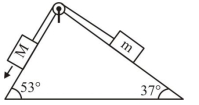
In the given arrangement of a doubly inclined plane two blocks of masses $\mathrm{M}$ and $\mathrm{m}$ are placed. The blocks are connected by a light string passing over an ideal pulley as shown. The coefficient of friction between the surface of the plane and the blocks is $0.25$ . The value of $\mathrm{m}$, for which $\mathrm{M}=10$ $\mathrm{kg}$ will move down with an acceleration of $2 \mathrm{~m} / \mathrm{s}^2$, is : (take $\mathrm{g}=10 \mathrm{~m} / \mathrm{s}^2$ and $\left.\tan 37^{\circ}=3 / 4\right)$