MCQ
A thin circular ring of mass $M$ and radius $R$ is rotating with a constant angular velocity $2 \; rads ^{-1}$ in a horizontal plane about an axis vertical to its plane and passing through the center of the ring. If two objects each of mass $m$ be attached gently to the opposite ends of a diameter of ring, the ring will then rotate with an angular velocity (in $rads ^{-1}$ )
  • A
    $\frac{M}{(M+m)}$
  • B
    $\frac{( M +2 m )}{2 M }$
  • $\frac{2 M }{( M +2 m )}$
  • D
    $\frac{2( M +2 m )}{ M }$

Answer

Correct option: C.
$\frac{2 M }{( M +2 m )}$
c
Applying conservation of angular momentum

$M R^{2} \omega=\left(M R^{2}+2 m R^{2}\right) \omega^{\prime}$

$\omega^{\prime}=\frac{2 M }{ M +2 m }$

Need a full question paper?

Generate a complete, print-ready paper with questions like this in minutes — across 16+ boards, with answer keys.

Start Generating Free

Similar questions

A carnot engine has the same efficiency between $800 K$ to $500 K$ and $x\, K$ to $600 K.$ The value of $x$ is ...... $K$
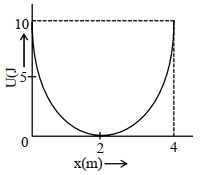
A mass of $5\, {kg}$ is connected to a spring. The potential energy curve of the simple harmonic motion executed by the system is shown in the figure. A simple pendulum of length $4\, {m}$ has the same period of oscillation as the spring system. What is the value of acceleration due to gravity on the planet where these experiments are performed? (In ${m} / {s}^{2}$)
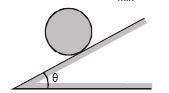
A hollow sphere of mass $m$ filled with a non-viscous liquid of same mass $m$ is released on a slope inclined at angle $q$ with the horizontal. The friction between the sphere and the slope is sufficient to prevent sliding and frictional forces between the inner surface of the sphere and the liquid is negligible. After descending a certain height ratio of translational and rotational kinetic energies is found to be $x:y$, find the numerical value of expression $(x+y)_{min}.$
Three liquids of densities d, 2d and 3d are mixed in equal proportion of weights. If density of water is d, then the specific gravity of the mixture is:
Pressure is a scalar quantity because:
To raise the temperature of a certain mass of gas by $50^{\circ} C$ at a constant pressure, $160$ calories of heat is required. When the same mass of gas is cooled by $100^{\circ} C$ at constant volume, $240$ calories of heat is released. How many degrees of freedom does each molecule of this gas have (assume gas to be ideal) $?$
In the experiment for the determination of the speed of sound in air using the resonance column method, the length of the air column that resonates in the fundamental mode, with a tuning fork is $0.1\,m$. when this length is changed to $0.35\,m,$ the same tuning fork resonates with the first overtone. Calculate the end correction  .... $m$
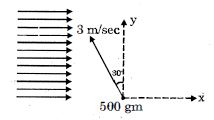
FIgure shows a sphere of mass $500\ g$ moving in a steady flow of air in the $x- $ direction. The  air-stream  exerts an essentially constant force of $0.9\  N$ on the sphere in the $x-$ direction. If at $t = 0$ the sphere is moving a s shown in the figure, determine the time required for the sphere to cross the $y-$ axis again  ........ $\sec$
Same gas is filled in two vessels of the same volume at the same temperature. If the ratio of the number of molecules is $1: 4$, then

$A.$ The $r.m.s$. velocity of gas molecules in two vessels will be the same.

$B.$ The ratio of pressure in these vessels will be $1: 4$

$C.$ The ratio of pressure will be $1: 1$

$D.$ The $r.m.s.$ velocity of gas molecules in two vessels will be in the ratio of $1: 4$

A $2 \mathrm{~kg}$ brick begins to slide over a surface which is inclined at an angle of $45^{\circ}$ with respect to horizontal axis. The co-efficient of static friction between their surfaces is: