A cell of emf 'E' and internal resistance 'r' is connected across a variable load resistor R. Draw the plots of the terminal voltage V versus (i) R and (ii) the current I.
It is found that when R = 4$\Omega$, the current is 1 A and when R is increased to 9$\Omega$, the current reduces to 0.5 A. Find the values of the emf E and internal resistance r.
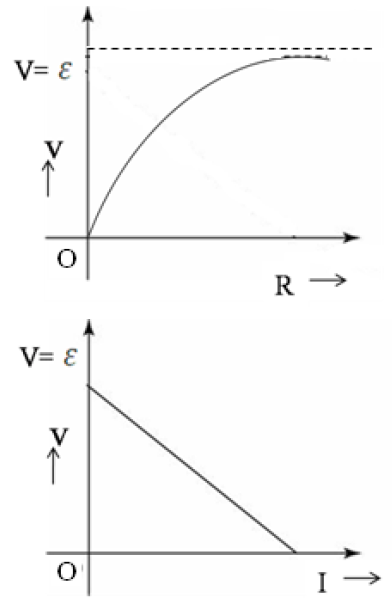
CBSE DELHI - SET 1 2015
Download our app for free and get startedPlay store

$\text{I} = \frac{\text{E}}{\text{R} +\text{r}}$
$1 = \frac{\text{E}}{4 + \text{r}}$
$ = >\text{E} = 4 +\text{r}$ ..... (i)
Also,
$0.5 =\frac{\text{E}}{9+ \text{r}}$
E = 4.5+ 0.5 r ..... (ii)
From equation (i) & (ii)
4 + r = 4.5 + 0.5
$\therefore\text{r} = 1\Omega$
Using this value of r, we get.
E = 5V.
art

Download our app
and get started for free

Experience the future of education. Simply download our apps or reach out to us for more information. Let's shape the future of learning together!No signup needed.*

Similar Questions

  • 1
    Write the mathematical relation for the resistivity of a material in terms of relaxation time, number density and mass and charge of charge carriers in it. Explain, using this relation, why the resistivity of a metal increases and that of a semi-conductor decreases with rise in temperature.
    View Solution
  • 2
    Why are alloys used for making standard resistance coils?
    View Solution
  • 3
    A wire of length 1m and radius 0.1mm has a resistance of $100\Omega.$ Find the resistivity of the material.
    View Solution
  • 4
    1. The potential difference applied across a given resistor is altered so that the heat produced per second increases by a factor of 9. By what factor does the applied potential difference change?
    2. In the figure shown, an ammeter A and a resistor of $4\Omega$ are connected to the terminals of the source. The emf of the source is 12 V having an internal resistance of $2\Omega$. Calculate the voltmeter and ammeter readings.
    View Solution
  • 5
    A resistance of $R$ draws current from a potentiometer. The potentiometer wire, $AB,$ has a total resistance of $R_o$. A voltage $V$ is supplied to the potentiometer. Derive an expression for the voltage across $R$ when the sliding contact is in the middle of potentiometer wire.
    View Solution
  • 6
    A potentiometer wire of length 1 m has a resistance of 5 $\Omega$. It is connected to a 8 V battery in series with a resistance of 15 $\Omega$. Determine the emf of the primary cell which gives a balance point at 60 cm.
    View Solution
  • 7
    A 10 m long wire of uniform cross-section and 20 $\Omega$ resistance is used in a potentiometer. The wire is connected in series with a battery of 5V along with an external resistance of 480 $\Omega$. If an unknown emf E is balanced at 6.0 m length of the wire, calculate:
    1. The potential gradient of the potentiometer wire.
    2. The value of unknown emf  E.
    View Solution
  • 8
    What are the advantages of the null$-$point method in a Wheatstone bridge? What additional measurements would be required to calculate $R_{unknown}$ by any other method?
    View Solution
  • 9
    Define relaxation time of the free electrons drifting in a conductor. How is it related to the drift velocity of free electrons? Use this relation to deduce the expression for the electrical resistivity of the material. 
    View Solution
  • 10
    A potential difference $V$ is applied across a conductor of length $L$ and diameter $D.$ How is the drift velocity, $V_d,$ of charge carriers in the conductor affected when $(i) \ V$ is halved, $(ii) \ L$ is doubled and $(iii) \ D$ is halved? Justify your answer in each case.
    View Solution