Question
  1. When an AC source is connected to an ideal capacitor, show that the average power supplied by the source over a complete cycle is zero.
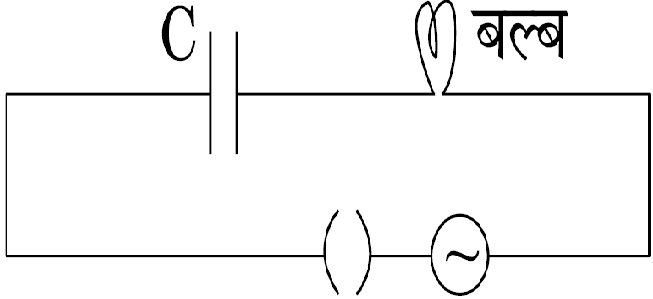
  2. A bulb is connected in series with a variable capacitor and an A.C. source as shown. What happens to the brightness of the bulb when the key is the capacitor is gradually reduced?
Answer

  1. Let the applied voltage be
$\text{V}= \text{V}_{o}\sin\omega\text{t}$
The current through an ideal capacitor, would then be
$\text{I} = \text{I}_{o}\sin(\omega\text{t} + \frac{\pi}{2}) = \text{I}_{0}\cos\omega\text{t}$
$\therefore\text{P}_{inst} = \text{VI}$
$\therefore\text{P}_{AV} = \frac{1}{\text{T}}\int^{T}_{0}\text{VIdt}$
$\therefore\text{P}_{AV} = \frac{\text{V}_{0}\text{I}_{0}}{2}\langle\sin2\omega\text{t}\rangle$
$=0.$
  1. $\text{X}_{c} = \frac{1}{\omega\text{C}}$
$\therefore\text{X}_{c}$ increases as C decreases. Hence, with decreasing C, the brightness of the bulb would decrease.

Need a full question paper?

Generate a complete, print-ready paper with questions like this in minutes — across 16+ boards, with answer keys.

Start Generating Free

Similar questions

Figure shows the graph of velocity versus time for a particle going along the $X-$axis. Find:
  1. The acceleration.
  2. The distance travelled in $0$ to $10s.$
  3. The displacement in $0$ to $10s.$
  1. How are electromagnetic waves produced? Explain.
  2. A plane electromagnetic wave is travelling through a medium along the +ve z-direction. Depict the electromagnetic wave showing the directions of the oscillating electric and magnetic fields.
(a) Stars located very far away, which cannot be seen with the eye, can be seen through a telescope. Why?
(b) The magnifying power of two telescopes is the same but the apertures of their objective lenses are different. What will be the change in the final images formed by them?
A 60\ kg man skating with a speed of $10m/s$ collides with a $40\ kg$ skater at rest and they cling to each other. Find the loss of kinetic energy during the collision.
Consider the situation shown in figure. What are the signs of $q_1$ and $q_2\ ?$ If the lines are drawn in proportion to the charge, what is the ratio $\frac{\text{q}_1}{\text{q}_2}?$
Consider a uniform electric field $E = 3 \times 10^3 î N/C$.
  1. What is the flux of this field through a square of $10 \ cm$ on a side whose plane is parallel to the $yz$ plane?
  2. What is the flux through the same square if the normal to its plane makes a $60^\circ $ angle with the $x-$ axis ?
Using Bohr's total postulates, derive the expression for the total energy of the electron in the stationary states of hydrogen atom.
Get the total electric flux associated with a closed cylinder placed in a uniform electric field.
Two moving coil meters, $M_1$ and $M_2$ have the following particulars:
$R_1 = 10 \Omega, N_1 = 30,$
$A_1 = 3.6 \times 10^{–3} m^2, B_1 = 0.25 T$
$R_2 = 14 \Omega, N_2 = 42,$
$A_2 = 1.8 \times 10^{–3} m^2, B_2 = 0.50 T$
$($The spring constants are identical for the two meters$).$
Determine the ratio of $(a)$ current sensitivity and $(b)$ voltage sensitivity of $M_2$ and $M_1.$
A particle goes in a circle of radius 2.0cm. A concave mirror of focal length 20cm is placed with its principal axis passing through the centre of the circle and perpendicular to its plane. The distance between the pole of the mirror and the centre of the circle is 30cm. Calculate the radius of the circle formed by the image.