A cell of internal resistance $r$ drives current through an external resistance $R$ . The power delivered by the cell to the external resistance will be maximum when:
JEE MAIN 2019, Medium
Download our app for free and get started
Current $i=\frac{E}{r+R}$
Power generated in $R$
$P=i^{2} R$
$P=\frac{E^{2} R}{(r+R)^{2}}$
For maximum power $\frac{\mathrm{dP}}{\mathrm{dR}}=0$
$E^{2}\left[\frac{(r+R)^{2} \times 1-R \times 2(r+R)}{(r+R)^{4}}\right]=0$
$\Rightarrow r=R$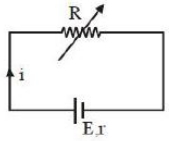

Download our appand get started for free
Experience the future of education. Simply download our apps or reach out to us for more information. Let's shape the future of learning together!No signup needed.*
Similar Questions
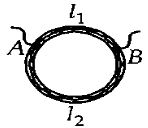
- 1A ring is made of a wire having a resistance $R_0 = 12 \,\,\Omega$. Find the points $A$ and $B,$ as shown in the figure, at which a current carrying conductor should be connected so that the resistance $R$ of the sub circuit between these points is equal to $\frac{8}{3}\,\Omega$.View Solution
- 2Two wires $A$ and $B$ are made up of the same material and have the same mass. Wire A has radius of $2.0 \mathrm{~mm}$ and wire $B$ has radius of $4.0 \mathrm{~mm}$. The resistance of wire B is $2 \Omega$. The resistance of wire $\mathrm{A}$ is_______. $\Omega$.View Solution
- 3In a potentiometer circuit there is a cell of $e.m.f.$ $2\, volt$, a resistance of $5\, ohm$ and a wire of uniform thickness of length $1000\, cm$ and resistance $15\, ohm$. The potential gradient in the wire isView Solution
- 4View SolutionAn electric heater kept in vacuum is heated continuously by passing electric current. Its temperature
- 5A cell of constant $e.m.f.$ first connected to a resistance ${R_1}$ and then connected to a resistance ${R_2}$. If power delivered in both cases is then the internal resistance of the cell isView Solution
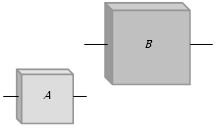
- 6$A$ and $B$ are two square plates of same metal and same thickness but length of $B$ is twice that of $A$. Ratio of resistances of $A$ and $B$ isView Solution
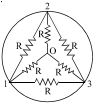
- 7Inside $a$ super conducting ring six identical resistors each of resistance $R$ are connected as shown in figure. The equivalent resistance $(s)$View Solution
- 8Three resistances $4\,\Omega $ each of are connected in the form of an equilateral triangle. The effective resistance between two corners isView Solution
- 9We have a galvanometer of resistance $25\,\Omega $. It is shunted by a $2.5\,\Omega $ wire. The part of total current that flows through the galvanometer is given asView Solution
- 10An electric kettle takes $4\, A$ current at $220\, V$. How much time will it take to boil $1\, kg$ of water from room temperature $20\,^\circ C$ ? The temperature of boiling water is $100\,^\circ C$ .................. $minutes$View Solution