In a potentiometer circuit there is a cell of $e.m.f.$ $2\, volt$, a resistance of $5\, ohm$ and a wire of uniform thickness of length $1000\, cm$ and resistance $15\, ohm$. The potential gradient in the wire is
Medium
Download our app for free and get started
Potential gradient $x = \frac{V}{L} = \frac{{iR}}{L}$
$ \Rightarrow $ $x = \frac{2}{{(15 + 5)}} \times \frac{{15}}{{10}} = \frac{3}{{2000}}\,volt/cm$

Download our appand get started for free
Experience the future of education. Simply download our apps or reach out to us for more information. Let's shape the future of learning together!No signup needed.*
Similar Questions
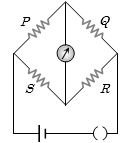
- 1In the Wheatstone's bridge shown, $P = 2\,\Omega ,$ $Q = 3\,\Omega ,$ $R = 6\,\Omega $ and $S = 8\,\Omega $. In order to obtain balance, shunt resistance across '$S$' must be .............. $\Omega$View Solution
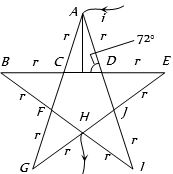
- 2In the following star circuit diagram (figure), the equivalent resistance between the points $A$ and $H$ will be ..............$r$View Solution
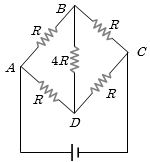
- 3Five resistors of given values are connected together as shown in the figure. The current in the arm $BD$ will beView Solution
- 4View SolutionWhich device can convert all electrical energy into heat
- 5A cylindrical copper rod has length $L$ and resistance $R$. If it is melted and formed into another rod of length $2 L$, then the resistance will be ....... $R$View Solution
- 6View SolutionReferring to the figure below, the effective resistance of the network is
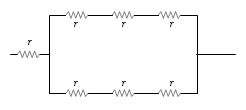
- 7When $5\ V$ potential difference is applied across a wire of length $0.1\ m$, the drift speed of electrons is $2.5 \times 10^{-4}$ $ms^{-1}$ . If the electron density in the wire is $8 \times 10^{28}$ $m^{-3}$ the resistivity of the material is close toView Solution
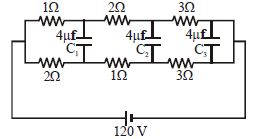
- 8Charge on the capacitor in the given circuit in steady state condition is :- ............... $\mu C$View Solution
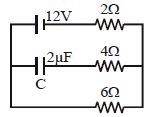
- 9Two resistances ${R_1}$ and ${R_2}$ are made of different materials. The temperature coefficient of the material of ${R_1}$ is $\alpha $ and of the material of ${R_2}$ is $ - \beta $. The resistance of the series combination of ${R_1}$ and ${R_2}$ will not change with temperature, if ${R_1}/{R_2}$ equalsView Solution
- 10View SolutionIn given circuit