A cell of internal resistance $r$ is connected across an external resistance $n r$. Then the ratio of the terminal voltage to the emf of the cell is
AIIMS 2019, Medium


Download our appand get started for free
Experience the future of education. Simply download our apps or reach out to us for more information. Let's shape the future of learning together!No signup needed.*
Similar Questions
- 1Resistances ${R_1}$ and ${R_2}$ are joined in parallel and a current is passed so that the amount of heat liberated is ${H_1}$ and ${H_2}$ respectively. The ratio $\frac{{{H_1}}}{{{H_2}}}$ has the valueView Solution
- 2Drift velocity ${v_d}$ varies with the intensity of electric field as per the relationView Solution
- 3View SolutionAn energy source will supply a constant current into the load if its internal resistance is
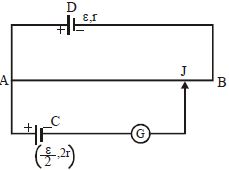
- 4In the figure, the potentiometer wire $AB$ of length $L$ and resistance $9r$ is joined to the cell $D$ of $emf$ $\varepsilon $ and internal resistance $r$. The cell $C's$ $emf$ is $\frac{\varepsilon }{2}$and its internal resistance is $2r$. The galvanometer $G$ will show no deflection when the length $AJ$ isView Solution
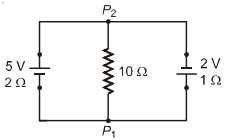
- 5A $5\ V$ battery with internal resistance $2\,\Omega$ and a $2\,V$ battery with internal resistance ln are connected to a $10\,\Omega$ resistor as shown in the figure.View Solution
- 6The resistance ofeach arm of the Wheatstone's bridge is $10\; ohm$. A resistance of $10 \;ohm$ is connected in series with a galvanometer then the equivalent resistance across the battery will beView Solution
- 7View SolutionThe conductivity of a superconductor is
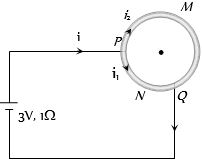
- 8A wire of resistance $10$ $\Omega$ is bent to form a circle. $P$ and $Q$ are points on the circumference of the circle dividing it into a quadrant and are connected to a Battery of $3\, V$ and internal resistance $1$ $\Omega$ as shown in the figure. The currents in the two parts of the circle areView Solution
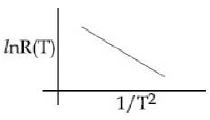
- 9View SolutionIn an experiment, the resistance of a material is plotted as a function of temperature (in some range). As shown in the figure, it is a straight line. One may conclude that:
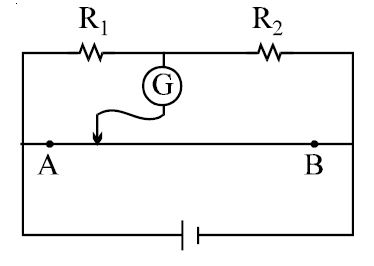
- 10In the figure shown for gives values of $R_1$ and $R_2$ the balance point for Jockey is at $40\,cm$ from $A$. When $R_2$ is shunted by a resistance of $10\, \Omega$ , balance shifts to $50\,cm.$ $R_1$ and $R_2$ are $(AB = 1 \,m)$View Solution