Resistances ${R_1}$ and ${R_2}$ are joined in parallel and a current is passed so that the amount of heat liberated is ${H_1}$ and ${H_2}$ respectively. The ratio $\frac{{{H_1}}}{{{H_2}}}$ has the value
Easy


Download our appand get started for free
Experience the future of education. Simply download our apps or reach out to us for more information. Let's shape the future of learning together!No signup needed.*
Similar Questions
- 1In a potentiometer, the null point is received at $7^{th}$ wire. If now we have to change the null point at $9^{th}$ wire, what should we do ?View Solution
- 2View SolutionThe net resistance of a voltmeter should be large to ensure that
- 3The current density is a solid cylindrical wire of radius $R ,$ as a function of radial distance $r$ is given by $J ( r )= J _{0}\left(1-\frac{ r }{ R }\right) .$ The total current in the radial region $r =0$ to $r =\frac{ R }{4}$ will beView Solution
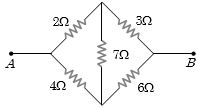
- 4Five resistances are connected as shown in the figure. The effective resistance between the points $A$ and $B$ isView Solution
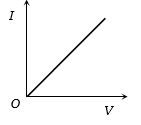
- 5$I-V$ characteristic of a copper wire of length $L$ and area of cross-section $A$ is shown in figure. The slope of the curve becomesView Solution
- 6The temperature coefficient of resistance of tungsten is $4.5 \times 10^{-3}{ }^{\circ} C ^{-1}$ and that of germanium is $-5 \times 10^{-2}{ }^{\circ} C ^{-1}$. A tungsten wire of resistance $100 \,\Omega$ is connected in series with a germanium wire of resistance $R$. The value of $R$ for which the resistance of combination does not change with temperature is .......... $\Omega$View Solution
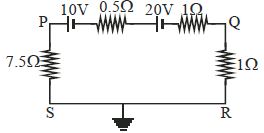
- 7View SolutionIn the circuit shown in figure, which of the statement is incorrect ?
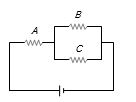
- 8Three identical resistances $A$, $B$ and $C$ are connected as shown in the given figure. The heat produced will be maximumView Solution
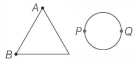
- 9A uniform metallic wire of length $L$ is mounted in two configurations. In configuration $1$ (triangle), it is an equilateral triangle and a voltage $V$ is applied to corners $A$ and $B$. In configuration $2$ (circle), it is bent in the form of a circle and the potential $V$ is applied at diametrically opposite points $P$ and $Q$. The ratio of the power dissipated in configuration $1$ to configuration $2$ isView Solution
- 10Two batteries with e.m.f $12\ V$ and $13\ V$ are connected in parallel across a load resistor of $10\,\Omega$ . The internal resistances of the two batteries are $1\,\Omega$ and $2\,\Omega$ respectively. The voltage across the load lies betweenView Solution