Question
A certain elastic conducting material is stretched into a circular loop. It is placed with its plane perpendicular to a uniform magnetic field $B =0.8\,T$. When released the radius of the loop starts shrinking at a constant rate of $2\,cm ^{-1}$. The induced emf in the loop at an instant when the radius of the loop is $10\,cm$ will be $........mV$.
Answer

$EMF =\frac{ d }{ dt }\left( B \pi r ^2\right)$

$=2 B \pi r \frac{ dr }{ dt }=2 \times \pi \times 0.1 \times 0.8 \times 2 \times 10^{-2}$ $=2 \pi \times 1.6= 1 0 . 0 6 \text { [round off } 1 0 . 0 6 = 1 0 ]$

Need a full question paper?

Generate a complete, print-ready paper with questions like this in minutes — across 16+ boards, with answer keys.

Start Generating Free

Similar questions

A man runs towards mirror at a speed of $15\,m/s.$What is the speed of his image.....$m/s$
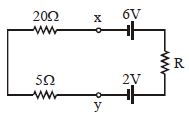
The current flowing in the given circuit is $0.1\,A$ . The potential difference between the points $X$ and $Y$ is ................ $\mathrm{V}$
The displacement $(x)$ of a particle depends on time $t$ as $x=\alpha t^2-\beta t^3$. Choose the incorrect statements from the following.
What is the power gain in $CE$ amplifier, where input resistance is $3\,k\Omega $ and load resistance $24\,k\Omega $ , given  $\beta  = 20$ ?
If in the experiment of Wheatstone's bridge, the positions of cells and galvanometer are interchanged, then balance points will
An observer receives waves directly from a source of sound distant $120\,m$ in a big hall.  He also receives waves reflected from the mid-point of $25\,m$ high ceiling. The wavelength of sound for constructive interference to take place between two waves,  must be :
A train accelerates from rest at a constant rate $\alpha$ for distance $x_1$ and time $t_1$. After that it retards to rest at constant rate $\beta$ for distance $x_2$ and time $t_2$. Which of the following relations is correct?
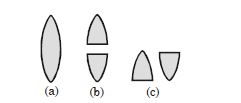
An equiconvex glass lens lens $(a)$ has a focal length $f$ and power $P$ . It is cut into two symmetrical halves $(b)$ by a plane containing the principal axis. The two pieces are recombined as shown in figure $(c)$ . The power of new combination is
The energy of a hydrogen atom in its ground state is $ - 13.6\;eV$. The energy of the level corresponding to the quantum number $n = 2$ (first excited state) in the hydrogen atom is......$eV$
Two waves executing simple harmonic motion travelling in the same direction with same amplitude and frequency are superimposed. The resultant amplitude is equal to the $\sqrt{3}$ times of amplitude of individual motions. The phase difference between the two motions is $.....(degree)$