MCQ
A certain metallic surface is illuminated with monochromatic light of wavelength, $\lambda$. The stopping potential for photo-electric current for this light is $3 V_0$  . If the same surface is illuminated with light of wavelength $2\lambda$, the stopping potential is $V_0$. The threshold wavelength for this surface for photo- electric effect is
  • A
    $6\lambda$
  • $4\lambda$
  • C
    $\frac{\lambda }{4}$
  • D
    $\frac{\lambda }{6}$

Answer

Correct option: B.
$4\lambda$
b
Case $(i)$, $e 3 V_{0}=\frac{h c}{\lambda}-\phi_{0}$     ......... $(i)$

Case $(ii)$, $e V_{0}=\frac{h c}{2 \lambda}-\phi_{0}$     .........$(ii)$

From $(i)$ and $(ii)$ we get,

$\frac{3 h c}{2 \lambda}-3 \phi_{0}=\frac{h c}{\lambda}-\phi_{0}$

or $\frac{3 h \lambda}{2 \lambda}-\frac{h c}{\lambda}=3 \phi_{0}-\phi_{0}$

or $\frac{h c}{2 \lambda}=2 \phi_{0}$ or $\phi_{0}=\frac{h c}{4 \lambda}$

$\therefore $ Threshold wavelength

$\lambda_{0}=\frac{h c}{\phi_{0}}=\frac{h c}{h c} \times 4 \lambda=4 \lambda$

Need a full question paper?

Generate a complete, print-ready paper with questions like this in minutes — across 16+ boards, with answer keys.

Start Generating Free

Similar questions

A 60 watt bulb operates on 220V supply. The current flowing through the bulb is
Two concentric coils each of radius equal to 2π cm are placed at right angles to each other. 3 ampere and 4 ampere are the currents flowing in each coil respectively. The magnetic induction in $\mathrm{weber/m}^2$ at the centre of the coils will be $\left(\mu_0=4 \pi \times 10^{-7} \mathrm{wb} / \mathrm{A} . \mathrm{m}\right)$
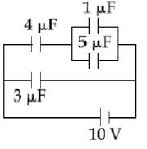
In the given circuit, the charge on $4\, \mu F$ capacitor will be.....$\mu C$
The truth table shown in figure is for
A 0 0 1 1
B 0 1 0 1
y 1 0 0 1
In one model of the electron, the electron of mass $m_e$ is thought to be a uniformly charged shell of radius $R$ and total charge $e$, whose electrostatic energy $E$ is equivalent to its mass $m_e$ via Einstein's mass energy relation $E=m_e c^2$. In this model, $R$ is approximately $\left(m_e=9.1 \times 10^{-31} \,kg , c=3 \times 10^8 \,ms ^{-1}\right.$, $1 / 4 \pi \varepsilon_0=9 \times 10^9 \,Fm ^{-1}$, magnitude of the electron charge $=1.6 \times 10^{-19} \,C$ )
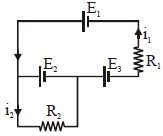
The current $i_1$ and $i_2$ through the resistor $R_1 (= 10\,\Omega )$ and $R_2 (=30 \,\Omega )$ in the circuit diagram with $E_1 = 3\,V, E_2 = 3\,V$ and $E_3 = 2\,V$ are respectively:
Ratio of amplitude of interfering waves is $3 : 4$. Now ratio of their intensities will be
In a semiconductor, the concentration of electrons is $8 \times 10^{12} cm^3$ and that of the holes is $5 \times 10^{12} cm^3$. The semiconductor is
The distance of the eye-lens from the retina is x. For a normal eye, the maximum focal length of the eye-lens:
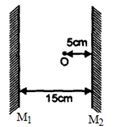
Two plane mirrors are parallel to each other and an object $O$ is placed between them. Then the distance of the first three images from the mirror $M_2$ ​ will be (in $cm$)