MCQ
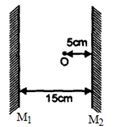
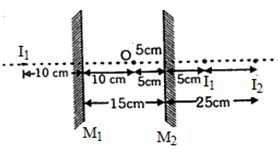
Two plane mirrors are parallel to each other and an object $O$ is placed between them. Then the distance of the first three images from the mirror $M_2$ ​ will be (in $cm$)
  • A
    $5, 10,15$
  • B
    $5, 15, 30$
  • $5, 25, 35$
  • D
    $5, 15, 25$

Answer

Correct option: C.
$5, 25, 35$
c

Need a full question paper?

Generate a complete, print-ready paper with questions like this in minutes — across 16+ boards, with answer keys.
Start Generating Free

Similar questions

Two spheres A and B of radius 4cm and 6cm are given charges of 80 μC and 40 μC respectively. If they are connected by a fine wire, the amount of charge flowing from one to the other is
On what basis is the classification of electromagnetic waves done?
A student uses the resistance of a known resistor $(1 \,\Omega)$ to calibrate a voltmeter and an ammeter using the circuits shown below. The student measures the ratio of the voltage to current to be $1 \times 10^3 \,\Omega$ in circuit $(a)$ and $0.999 \,\Omega$ in circuit $(b)$. From these measurements, the resistance (in $\Omega$ ) of the voltmeter and ammeter are found to be close to
Switch $S$ of the circuit shown in figure. is closed at $t = 0$. If e denotes the induced emf in $L$ and i, the current flowing through the circuit at time $t $, which of the following graphs is correct
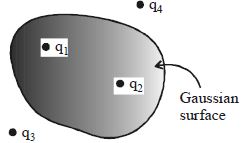
Assertion : Four point charges $q_1,$ $q_2$, $q_3$ and $q_4$ are as shown in figure. The flux over the shown Gaussian surface depends only on charges $q_1$ and $q_2$.

Reason : Electric field at all points on Gaussian surface depends only on charges $q_1$ and $q_2$ .
Scientists are working hard to develop nuclear fusion reactor. Nuclei of heavy hydrogen, ${ }_1^2 \mathrm{H}$, known as deuteron and denoted by $\mathrm{D}$, can be thought of as a candidate for fusion reactor. The $D-D$ reaction is ${ }_1^2 \mathrm{H}+{ }_1^2 \mathrm{H} \rightarrow{ }_2^3 \mathrm{He}+n+$ energy. In the core of fusion reactor, a gas of heavy hydrogen is fully ionized into deuteron nuclei and electrons. This collection of ${ }_1^2 \mathrm{H}$ nuclei and electrons is known as plasma. The nuclei move randomly in the reactor core and occasionally come close enough for nuclear fusion to take place. Usually, the temperatures in the reactor core are too high and no material wall can be used to confine the plasma. Special techniques are used which confine the plasma for a time $t_0$ before the particles fly away from the core. If $n$ is the density (number/volume) of deuterons, the product $n t_0$ is called Lawson number. In one of the criteria, a reactor is termed successful if Lawson number is greater than $5 \times 10^{14} \mathrm{~s} / \mathrm{cm}^3$.

It may be helpful to use the following: Boltzmann constant $k=8.6 \times 10^{-5} \mathrm{eV} / \mathrm{K}$; $\frac{e^2}{4 \pi \varepsilon_0}=1.44 \times 10^9 \mathrm{eVm}$.

$1.$ In the core of nuclear fusion reactor, the gas becomes plasma because of

$(A)$ strong nuclear force acting between the deuterons

$(B)$ Coulomb force acting between the deuterons

$(C)$ Coulomb force acting between deuteron-electron pairs

$(D)$ the high temperature maintained inside the reactor core

$2.$ Assume that two deuteron nuclei in the core of fusion reactor at temperature $T$ are moving towards each other, each with kinetic energy $1.5 \mathrm{kT}$, when the separation between them is large enough to neglect Coulomb potential energy. Also neglect any interaction from other particles in the core. The minimum temperature $T$ required for them to reach a separation of $4 \times 10^{-15} \mathrm{~m}$ is in the range

$(A)$ $1.0 \times 10^9 \mathrm{~K}$ $(B)$ $2.0 \times 10^9 \mathrm{~K}$ $(C)$ $3.0 \times 10^9 \mathrm{~K}$ $(D)$ $4.0 \times 10^9 \mathrm{~K}$

$3.$ Results of calculations for four different designs of a fusion reactor using $D-D$ reaction are given below. Which of these is most promising based on Lawson criterion?

$(A)$ deuteron density $=2.0 \times 10^{12} \mathrm{~cm}^{-3}$, confinement time $=5.0 \times 10^{-3} \mathrm{~s}$

$(B)$ deuteron density $=8.0 \times 10^{14} \mathrm{~cm}^{-3}$, confinement time $=9.0 \times 10^{-1} \mathrm{~s}$

$(C)$ deuteron density $=4.0 \times 10^{23} \mathrm{~cm}^{-3}$, confinement time $=1.0 \times 10^{-11} \mathrm{~s}$

$(D)$ deuteron density $=1.0 \times 10^{24} \mathrm{~cm}^{-3}$, confinement time $=4.0 \times 10^{-12} \mathrm{~s}$

Give the answer question $1,2,$ and $3.$
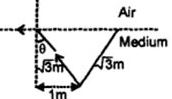
refractive index of medium is
The fact that the conductance of some metals rises to infinity at some temperature below a few Kelvin is called
In the circuit diagram shown in figure given below, the current flowing through resistance $3\, \Omega$ is $\frac{ x }{3}\,A$. The value of $x$ is $...........$
A light wave travelling linearly in a medium of dielectric constant $4,$ incident on the horizontal interface separating medium with air. The angle of incidence for which the total intensity of incident wave will be reflected back into the same medium will be (Given : relative permeability of medium $\mu_{ s }=1)$