A chain of length $L$ rests on a rough table. If $\mu $ be the coefficient of friction, the maximum friction of the chain that can hang over the table will be
Medium


Download our appand get started for free
Experience the future of education. Simply download our apps or reach out to us for more information. Let's shape the future of learning together!No signup needed.*
Similar Questions
- 1Abody is placed on a rough inclined plane of inclination $\theta$ .As the angle $\theta$ is increased from $0^o$ to $90^o$ the contact force between the block and the planeView Solution
- 2View SolutionIt is easier to roll a barrel than pull it along the road. This statement is
- 3A car is moving on a horizontal curved road with radius $50\,m$. The approximate maximum speed of car will be $............\,ms^{-1}$, if friction between tyres and road is $0.34.\left[\right.$ Take $\left.g =10 ms ^{-2}\right]$View Solution
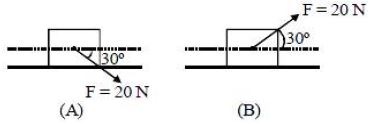
- 4A block of mass $5\, kg$ is $(i)$ pushed in case $(A)$ and $(ii)$ pulled in case $(B)$, by a force $F = 20\, N$, making an angle of $30^o$ with the horizontal, as shown in the figures. The coefficient of friction between the block and floor is $\mu = 0.2$. The difference between the accelerations of the block, in case $(B)$ and case $(A)$ will be ........ $ms^{-2}$ .$(g = 10\, ms^{-2})$View Solution
- 5A car of mass $1000\, kg$ negotiates a banked curve of radius $90\, m$ on a frictionless road. If the banking angle is $45^o $, the speed of the car is ....... $ms^{-1}$View Solution
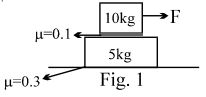
- 6When $F = 2N$, the frictional force between $10 kg$ block and $5 kg$ block is ...... $N$View Solution
- 7A body of mass $'m '$ is tied to one end of a spring and whirled round in a horizontal plane with a constant angular velocity. The elongation in the spring is $1\, cm$. If the angular velocity is doubled, the elongation in the spring is $5\, cm$. The original length of the spring is ......... $cm$View Solution
- 8View SolutionWhich one of the following statements is correct
- 9View SolutionWhen a body is lying on a rough inclined plane and does not move, the force of friction
- 10A lift is moving downwards with an acceleration equal to acceleration due to gravity. $A$ body of mass $M$ kept on the floor of the lift is pulled horizontally. If the coefficient of friction is $\mu $, then the frictional resistance offered by the body isView Solution