MCQ
A chain reaction is continuous due to
  • A
    Large mass defect
  • B
    Large energy
  • Production of more neutrons in fission
  • D
    None of these

Answer

Correct option: C.
Production of more neutrons in fission
c
(c) Due to the production of neutrons, a chain of nuclear fission is established which continues until the whole of the source substance is consumed.

Need a full question paper?

Generate a complete, print-ready paper with questions like this in minutes — across 16+ boards, with answer keys.
Start Generating Free

Similar questions

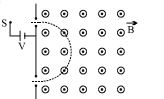
A mass spectrometer is a device which select particle of equal mass. An iron with electric charge $q > 0$ and mass $m$ starts at rest from a source $S$ and is accelerated through a potential difference $V$. It passes $\rho$ through a hole into a region of constant magnetic field $\vec B\,$ perpendicular to the plane of the paper as shown in the figure. The particle is deflected by the magnetic field and emerges through the bottom hole at a distance $d$ from the top hole. The mass of the particle is 
A wire is suspended by one end. At the other end a weight equivalent to $20\, N$ force is applied. If the increase in length is $1.0\, mm$, the increase in energy of the wire will be .......  $joule$
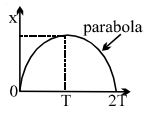
The $x-t$ graph of a particle moving along a straight line is shown in figure The speed-time graph of the particle is correctly shown by
The path difference between two interference waves at a point on a screen is $11.5\, times$ the wavelength. The point is
If the radius of a soap bubble is four times that of another, then the ratio of their excess pressures will be
At which of the following temperature would the molecules of a gas have twice the average kinetic energy they have at $20°C$
The magnetic moment of a magnet of length $10\, cm$  and pole strength $ 4.0\, Am$  will be......$A{m^2}$
The following travelling electromagnetic wave $E_x=0$ $E_y=E_0 \sin (k x+\omega t), E_z=-2 E_0 \sin (k x-\omega t)$ is
A wire of a certain material is stretched slowly by ten percent. Its new resistance and specific resistance become respectively
In a sinusoidal wave, the time required for a particular point to move from maximum displacement to zero displacement is $0.170\,$second. The frequency of the wave is .... $Hz$