A charge of $10\, e.s.u.$ is placed at a distance of $2\, cm$ from a charge of $40\, e.s.u.$ and $4\, cm$ from another charge of $20\, e.s.u.$ The potential energy of the charge $10\, e.s.u.$ is (in $ergs$)
Easy


Download our appand get started for free
Experience the future of education. Simply download our apps or reach out to us for more information. Let's shape the future of learning together!No signup needed.*
Similar Questions
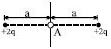
- 1A negative point charge placed at the point $A$ isView Solution
- 2View SolutionThe charge given to any conductor resides on its outer surface, because
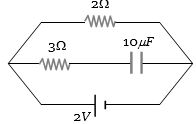
- 3The charge on a capacitor of capacitance $10\,\mu F$ connected as shown in the figure is.......$\mu C$View Solution
- 4Two small equal point charges of magnitude $q$ are suspended from a common point on the ceiling by insulating mass less strings of equal lengths. They come to equilibrium with each string making angle $\theta $ from the vertical. If the mass of each charge is $m,$ then the electrostatic potential at the centre of line joining them will be $\left( {\frac{1}{{4\pi { \in _0}}} = k} \right).$View Solution
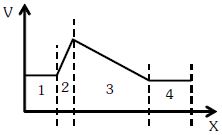
- 5In which region magnitude of $x$ -component of electric field is maximum, if potential $(V)$ versus distance $(X)$, graph is as shown?View Solution
- 6A small sphere of mass $m =\ 0.5\, kg$ carrying a positive charge $q = 110\ \mu C$ is connected with a light, flexible and inextensible string of length $r = 60 \ cm$ and whirled in a vertical circle. If a vertically upwards electric field of strength $E = 10^5 NC^{-1}$ exists in the space, The minimum velocity of sphere required at highest point so that it may just complete the circle........$m/s$ $(g = 10\, ms^{-2})$View Solution
- 7The radius of nucleus of silver (atomic number $=$ $47$) is $3.4 \times {10^{ - 14}}\,m$. The electric potential on the surface of nucleus is $(e = 1.6 \times {10^{ - 19}}\,C)$View Solution
- 8An elementary particle of mass $m$ and charge $ + e$ is projected with velocity $v$ at a much more massive particle of charge $Ze,$ where $Z > 0.$What is the closest possible approach of the incident particleView Solution
- 9View SolutionIn a charged capacitor, the energy resides
- 10The electrostatic potential due to an electric dipole at a distance ' $r$ ' varies as :View Solution