The radius of nucleus of silver (atomic number $=$ $47$) is $3.4 \times {10^{ - 14}}\,m$. The electric potential on the surface of nucleus is $(e = 1.6 \times {10^{ - 19}}\,C)$
Easy
Download our app for free and get started
(a) $V = \frac{1}{{4\pi {\varepsilon _0}}}.\frac{{(Ze)}}{r} = 9 \times {10^9} \times \frac{{47 \times 1.6 \times {{10}^{ - 19}}}}{{3.4 \times {{10}^{ - 14}}}} = 1.99 \times {10^6}\,V$

Download our appand get started for free
Experience the future of education. Simply download our apps or reach out to us for more information. Let's shape the future of learning together!No signup needed.*
Similar Questions
- 1Assertion : A parallel plate capacitor is connected across battery through a key. A dielectric slab of dielectric constant $K$ is introduced between the plates. The energy which is stored becomes $K$ times.View Solution
Reason : The surface density of charge onthe plate remains constant or unchanged.
- 2The equation of an equipotential line in an electric field is $y = 2x$, then the electric field strength vector at $(1, 2)$ may beView Solution
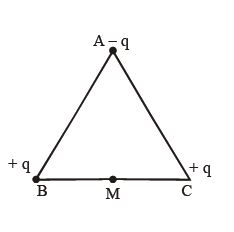
- 3Charges $-q,\, q,\,q$ are placed at the vertices $A$, $B$, $C$ respectively of an equilateral triangle of side $'a'$ as shown in the figure. If charge $-q$ is released keeping remaining two charges fixed, then the kinetic energy of charge $(-q)$ at the instant when it passes through the mid point $M$ of side $BC$ isView Solution
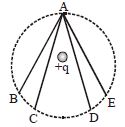
- 4In the electric field of a point charge $q$, a certain charge is carried from point $A$ to $B, C, D$ and $E$. Then the work doneView Solution
- 5A parallel plate capacitor has a uniform electric field ' $\overrightarrow{\mathrm{E}}$ ' in the space between the plates. If the distance between the plates is ' $\mathrm{d}$ ' and the area of each plate is ' $A$ ', the energy stored in the capacitor is : $\left(\varepsilon_{0}=\right.$ permittivity of free space)View Solution
- 6Two metal spheres of radii ${R_1}$ and ${R_2}$ are charged to the same potential. The ratio of charges on the spheres isView Solution
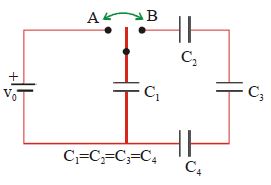
- 7The four identical capacitors in the circuit shown below are initially uncharged. The switch is then thrown first to position $A$, and then to position $B$. After this is done:View Solution
Note: $V_{1,2,3,4}$ are the potential differences across $C_{1,2,3,4}$ and $Q_{1,2,3,4}$ are the final charges stored in $C_{1,2,3,4}$ respectively.
- 8Two metallic plates form a parallel plate capacitor. The distance between the plates is $'d'.$ A metal sheet of thickness $\frac{d}{2}$ and of area equal to area of each plate is introduced between the plates. What will be the ratio of the new capacitance to the original capacitance of the capacitor $?$View Solution
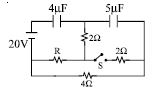
- 9Find heat produced in the capacitors on closing the switch $S$View Solution
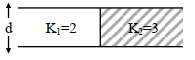
- 10A capacitor of $10 \mu \mathrm{F}$ capacitance whose plates are separated by $10 \mathrm{~mm}$ through air and each plate has area $4 \mathrm{~cm}^2$ is now filled equally with two dielectric media of $\mathrm{K}_1=2, \mathrm{~K}_2=3$ respectively as shown in figure. If new force between the plates is $8 \mathrm{~N}$. The supply voltage is . . . .. . .V.View Solution