A charge of $5\,C$ experiences a force of $5000\,N$ when it is kept in a uniform electric field. .........$V$ is the potential difference between two points separated by a distance of $1\,cm$
Easy


Download our appand get started for free
Experience the future of education. Simply download our apps or reach out to us for more information. Let's shape the future of learning together!No signup needed.*
Similar Questions
- 1A charge $ + q$ is fixed at each of the points $x = {x_0},\,x = 3{x_0},\,x = 5{x_0}$..... $\infty$, on the $x - $axis and a charge $ - q$ is fixed at each of the points $x = 2{x_0},\,x = 4{x_0},x = 6{x_0}$,..... $\infty$. Here ${x_0}$ is a positive constant. Take the electric potential at a point due to a charge $Q$ at a distance $r$ from it to be $Q/(4\pi {\varepsilon _0}r)$. Then, the potential at the origin due to the above system of charges isView Solution
- 2An uncharged parallel plate capacitor having a dielectric of constant $K$ is connected to a similar air cored parallel capacitor charged to a potential $V$. The two capacitors share charges and the common potential is $V$. The dielectric constant $K$ isView Solution
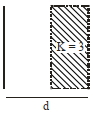
- 3A parallel plate capacitor with plate area $A$ and plate separation $d =2 \,m$ has a capacitance of $4 \,\mu F$. The new capacitance of the system if half of the space between them is filled with a dielectric material of dielectric constant $K =3$ (as shown in figure) will be .........$ \mu \,F$View Solution
- 4A $2\,\mu F$ capacitor is charged to $100$ $volt$ and then its plates are connected by a conducting wire. The heat produced is........$J$View Solution
- 5Three condensers each of capacitance $2F$ are put in series. The resultant capacitance is.........$F$View Solution
- 6A point dipole $\vec p = - {p_0}\hat x$ is kept at the origin. The potential and electric field due to this dipole on the $y-$ axis at a distance $d$ are, respectively : (Take $V = 0$ at infinity)View Solution
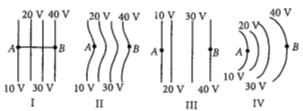
- 7The diagrams below show regions of equipotentials.A positive charge is moved from $A$ to $B$ in each diagram.View Solution
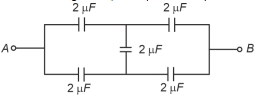
- 8In the following circuit, the equivalent capacitance between terminal $A$and terminal $B$ is :View Solution
- 9Two charged conducting spheres of radii $a$ and $b$ are connected to each other by a conducting wire. The ratio of charges of the two spheres respectively is:View Solution
- 10View SolutionThe angle between the electric lines of force and the equipotential surface is