A charge $ + q$ is fixed at each of the points $x = {x_0},\,x = 3{x_0},\,x = 5{x_0}$..... $\infty$, on the $x - $axis and a charge $ - q$ is fixed at each of the points $x = 2{x_0},\,x = 4{x_0},x = 6{x_0}$,..... $\infty$. Here ${x_0}$ is a positive constant. Take the electric potential at a point due to a charge $Q$ at a distance $r$ from it to be $Q/(4\pi {\varepsilon _0}r)$. Then, the potential at the origin due to the above system of charges is
IIT 1998, Diffcult
Download our app for free and get started
(d)$V = \frac{q}{{4\pi {\varepsilon _0}{x_0}}}\left[ {1 + \frac{1}{3} + \frac{1}{5} + ...} \right] - \frac{q}{{4\pi {\varepsilon _0}{x_0}}}\left[ {\frac{1}{2} + \frac{1}{4} + \frac{1}{6} + ...} \right]$
$ = \frac{q}{{4\pi {\varepsilon _0}{x_0}}}\left[ {1 - \frac{1}{2} + \frac{1}{3} - \frac{1}{4} + ....} \right] = \frac{q}{{4\pi {\varepsilon _0}{x_0}}}{\log _e}2$
$ = \frac{q}{{4\pi {\varepsilon _0}{x_0}}}\left[ {1 - \frac{1}{2} + \frac{1}{3} - \frac{1}{4} + ....} \right] = \frac{q}{{4\pi {\varepsilon _0}{x_0}}}{\log _e}2$

Download our appand get started for free
Experience the future of education. Simply download our apps or reach out to us for more information. Let's shape the future of learning together!No signup needed.*
Similar Questions
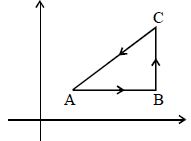
- 1As shown in figure, on bringing a charge $Q$ from point $A$ to $B$ and from $B$ to $C$, the work done are $2\, joule$ and $-3\, joule$ respectively. The work done to bring the charge from $C$ to $A$ isView Solution
- 2Two charges of magnitude $5\, nC$ and $-2\, nC$, one placed at points $(2\, cm, 0, 0)$ and $(x\, cm, 0, 0)$ in a region of space, where there is no other external field. If the electrostatic potential energy of the system is $ - 0.5\,\mu J$. The value of $x$ is.....$cm$View Solution
- 3Three charges $q, \sqrt 2q, 2q$ are placed at the corners $A, B$ and $C$ respectively of the square $ABCD$ of side $'a'$ then potential at point $'D'$View Solution
- 4Three charges $q, \sqrt 2q, 2q$ are placed at the corners $A, B$ and $C$ respectively of the square $ABCD$ of side $'a'$ then potential at point $'D'$View Solution
- 5The distance between the plates of a parallel plate capacitor is $d$. A metal plate of thickness $d/2$ is placed between the plates. The capacitance would then beView Solution
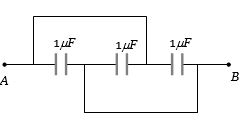
- 6The equivalent capacitance in the circuit between $A$ and $B$ will be.....$\mu \,F$View Solution
- 7Two identical thin rings, each of radius $R $ meter are coaxially placed at distance $R$ meter apart. If $Q_1$ and $Q_2$ coulomb are respectively the charges uniformly spread on the two rings, the work done in moving a charge $q$ from the centre of one ring to that of the other isView Solution
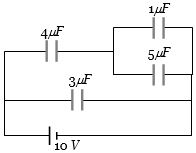
- 8The charge on $4\, \mu F$ capacitor in the given circuit is .... in $\mu C$View Solution
- 9Two positive charges of magnitude $q$ are placed at the ends of a side $1$ of a square of side $2a$. Two negative charges of the same magnitude are kept at the other corners. Starting from rest, if a charge $Q$, moves from the middle of side $1$ to the centre of square, its kinetic energy at the centre of square isView Solution
- 10View SolutionTwo identical conductors of copper and aluminium are placed in an identical electric fields. The magnitude of induced charge in the aluminium will be