A charge particle moving in magnetic field $B$, has the components of velocity along $B$ as well as perpendicular to $B$. The path of the charge particle will be
JEE MAIN 2023, Medium



Download our appand get started for free
Experience the future of education. Simply download our apps or reach out to us for more information. Let's shape the future of learning together!No signup needed.*
Similar Questions
- 1A square loop of side $l$ is kept in a uniform magnetic field $B$ such that its plane makes an angle $\alpha$ with $\vec{B}$. The loop carries a current $i$. The torque experienced by the loop in this position isView Solution
- 2View SolutionThe magnetic moment of a circular coil carrying current is
- 3At what distance on the axis, from the centre of a circular current carrying coil of radius $r$, the magnetic field becomes $1 / 8$ th of the magnetic field at centre?View Solution
- 4View SolutionIf a charged particle goes unaccelerated in a region containing electric and magnetic fields
- 5In an ionised sodium atom, an electron is moving in a circular path of radius $r$ with angular velocity $\omega $. The magnetic induction in $wb/m^2$ produced at the nucleus will beView Solution
- 6View SolutionIf a positive ion is moving, away from an observer with same acceleration, then the lines of force of magnetic induction will be
- 7View SolutionThe phosphor bronze strip is used in a moving coil galvanometer because
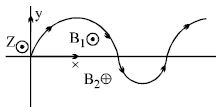
- 8At $t = 0$ a charge $q$ is at the origin and moving in the $y-$ direction with velocity $\overrightarrow v = v\,\hat j .$ The charge moves in a magnetic field that is for $y > 0$ out of page and given by $B_1 \hat z$ and for $y < 0$ into the page and given $-B_2 \hat z .$ The charge's subsequent trajectory is shown in the sketch. From this information, we can deduce thatView Solution
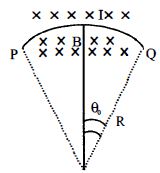
- 9A wire carrying current $I$ is tied between points $P$ and $Q$ and is in the shape of a circular arc of radius $R$ due to a uniform magnetic field $B$ (perpendicular to the plane of the paper, shown by $\times \times \times $) in the vicinity of the wire. If the wire subtends an angle $2\theta_0$ at the centre of the circle (of which it forms an arc) then the tension in the wire isView Solution
- 10A particle of mass $M$ and charge $Q$ moving with velocity $\mathop v\limits^ \to $ describes a circular path of radius $R$ when subjected to a uniform transverse magnetic field of induction $B$. The work done by the field when the particle completes one full circle isView Solution