In an ionised sodium atom, an electron is moving in a circular path of radius $r$ with angular velocity $\omega $. The magnetic induction in $wb/m^2$ produced at the nucleus will be
Medium


Download our appand get started for free
Experience the future of education. Simply download our apps or reach out to us for more information. Let's shape the future of learning together!No signup needed.*
Similar Questions
- 1A long solenoid is fabricated to closely winding wire of radius $0.5\,mm$ over a cylindrical frame so that the successive turns nearly touch each other, the magnetic field at the centre of solenoid if it carries a current of $5\,A$View Solution
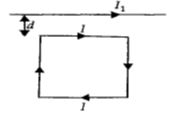
- 2A square loop, carrying a steady current $I,$ is placed in a horizontal plane near a long straight conductor carrying a steady current $I_1$ at a distance $d$ from the conductor as shown in figure. The loop will experienceView Solution
- 3A particle moving with velocity v having specific charge $(q/m)$ enters a region of magnetic field $B$ having width $d=\frac{{3mv}}{{5qB}}$ at angle $53^o$ to the boundary of magnetic field. Find the angle $\theta$ in the diagram......$^o$View Solution

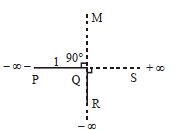
- 4An infinitely long conductor $PQR$ is bent to from a right angle as shown. A current $I$ flows through $PQR$ . The magnetic field due to this current at the point $M$ is $H_1$ . Now, another infinitely long straight conductor $QS$ is connected at $Q$ so that the current in $PQ$ remaining unchanged. The magnetic field at $M$ is now $H_2$ . The ratio $H_1/H_2$ is given byView Solution
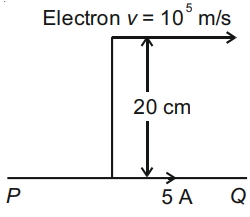
- 5An infinitely long straight conductor carries a current of $5 \,\mathrm{~A}$ as shown. An electron is moving with a speed of $10^{5} \, \mathrm{~m} / \mathrm{s}$ parallel to the conductor. The perpendicular distance between the electron and the conductor is $20 \, \mathrm{~cm}$ at an instant. Calculate the magnitude of the force experienced by the electron at that instant in $\times 10^{-20} \,N$View Solution
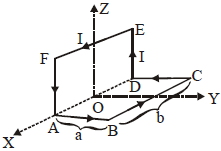
- 6A wire carrying current $I$ is bent in the shape $A\,B\,C\,D\,E\,F\,A$ as shown, where rectangle $A\,B\,C\,D\,A$ and $A\,D\,E\,F\,A$ are perpendicular to each other. If the sides of the rectangles are of lengths $a$ and $b,$ then the magnitude and direction of magnetic moment of the loop $A\,B\,C\,D\,E\,F\,A\,$ isView Solution
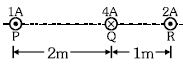
- 7Three long current carrying wires $P, Q$ and $R$ placed perpendicular to plane of the paper. Magnetic force per unit length on wire $'R'$ isView Solution
- 8A galvanometer having a resistance of $20\,\Omega $ and $30\, divisions$ on both sides has figure of merit $0.005\, ampere /division$. The resistance that should be connected in series such that it can be used as a voltmeter upto $15\, volt$ is ........... $\Omega$View Solution
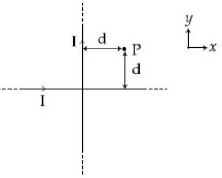
- 9Two very long, straight and insulated wires are kept at $90^o$ angle from each other In $xy -$ plane as shown in the figure. These wires carry current of equal magnitude $I$, whose directions are shown in the figure. The net magnetic field at point $P$ will beView Solution
- 10Work done by magnetic field of $1\,tesla$ on a particle of chargs $1\,C$ moving with speed $5\,m/s$ in one second........$J$View Solution