A charge $+q$ is distributed over a thin ring of radius $r$ with line charge density $\lambda=q \sin ^{2} \theta /(\pi r)$. Note that the ring is in the $X Y$ - plane and $\theta$ is the angle made by $r$ with the $X$-axis. The work done by the electric force in displacing a point charge $+ Q$ from the centre of the ring to infinity is
KVPY 2019, Medium
Download our app for free and get started
$(b)$ As charge distribution is over a circle, potential due to charge over ring is
$V=\frac{k}{r} \cdot q_{ total }$
$\text { where, }$
$q_{\text {total }} =\int \limits_{0}^{2 \pi} \frac{q \sin ^{2} \theta}{\pi r}(r d \theta)$
$=\frac{q}{\pi} \int \limits_{0}^{2 \pi} \frac{1-\cos 2 \theta}{2} \cdot d \theta$
$=\frac{q}{\pi}\left[\left(\frac{\theta}{2}-\frac{\sin 2 \theta}{4}\right)\right]_{0}^{2 \pi}=q$
So, potential at centre of ring $=V$
$=\frac{k q _{\text {total }}}{r}$
$\Rightarrow \quad V =\frac{k q}{r}$
Also, work done in taking a charge $Q$ from centre of ring to infinity $=$ potential energy of system
$=V \cdot Q=\frac{k q Q}{r}=\frac{q Q}{4 \pi \varepsilon_{0} r}$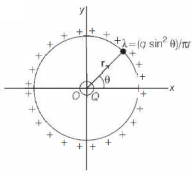

Download our appand get started for free
Experience the future of education. Simply download our apps or reach out to us for more information. Let's shape the future of learning together!No signup needed.*
Similar Questions
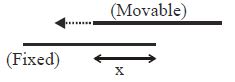
- 1A parallel-plate capacitor consists of a fixed plate and a movable plate that is allowed to slide in the direction parallel to the plates. Let $x$ be the distance of overlap, as shown in the figure. The separation between the plates is fixed. Assume that the plates are electrically isolated, so that their charges $±Q$ are constant. Force on the movable plate is proportional toView Solution
- 2If potential (in volts) in a region is expressed as $V (x,y,z) =6xy-y+2yz $ the electric field (in $N/C$) at point $(1, 1, 0)$ isView Solution
- 3In a uniform electric field, a cube of side $1\ cm$ is placed. The total energy stored in the cube is $8.85\mu J$ . The electric field is parallel to four of the faces of the cube. The electric flux through any one of the remaining two faces is.View Solution
- 4View SolutionConsider a neutral conducting sphere. A positive point charge is placed outside the sphere. The net charge on the sphere is then,
- 5The electric potential at the surface of an atomic nucleus $(Z = 50)$ of radius $9.0×{10^{ - 13}}\, cm$ isView Solution
- 6$STATEMENT-1$ For practical purposes, the earth is used as a reference at zero potential in electrical circuits.andView Solution
$STATEMENT-2$ The electrical potential of a sphere of radius $R$ with charge $\mathrm{Q}$ uniformly distributed on the surface is given by $\frac{\mathrm{Q}}{4 \pi \varepsilon_0 R}$.
- 7View SolutionConsidering a group of positive charges, which of the following statements is correct?
- 8If an electron moves from rest from a point at which potential is $50\, volt$ to another point at which potential is $70\, volt$, then its kinetic energy in the final state will beView Solution
- 9An electron with an initial speed of $4.0 \times 10^6 \,ms ^{-1}$ is brought to rest by an electric field. The mass and charge of an electron are $9 \times 10^{-31} \,kg$ and $1.6 \times 10^{-19} \,C$, respectively. Identify the correct statement.View Solution
- 10A parallel-plate capacitor is connected to a resistanceless circuit with a battery until the capacitor is fully charged. The battery is then disconnected from the circuit and the plates of the capacitor are moved to half of their original separation using insulated gloves. Let $V_{new}$ be the potential difference across the capacitor plates when the plates have moved. Let $V_{old}$ be the potential difference across the capacitor plates when they were connected to the battery $\frac{V_{new}}{V_{old}}=$......View Solution