The electric potential at the surface of an atomic nucleus $(Z = 50)$ of radius $9.0×{10^{ - 13}}\, cm$ is
Easy


Download our appand get started for free
Experience the future of education. Simply download our apps or reach out to us for more information. Let's shape the future of learning together!No signup needed.*
Similar Questions
- 1Two metal spheres of radii ${R_1}$ and ${R_2}$ are charged to the same potential. The ratio of charges on the spheres isView Solution
- 2Charges of $ + \frac{{10}}{3} \times {10^{ - 9}}C$ are placed at each of the four corners of a square of side $8\,cm$. The potential at the intersection of the diagonals isView Solution
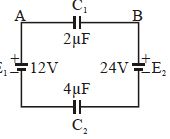
- 3Two capacitors $C_1$ and $C_2$ are connected in a cirucit as shown in figure. The potential difference $(V_A -V_B)$ is.....$V$View Solution
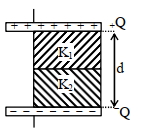
- 4A parallel - plate capacitor with plate area $A$ has separation $d$ between the plates. Two dielectric slabs of dielectric constant ${K}_{1}$ and ${K}_{2}$ of same area $\frac A2$ and thickness $\frac d2$ are inserted in the space between the plates. The capacitance of the capacitor will be given by :View Solution
- 5View SolutionThe electric potential inside a conducting sphere
- 6A capacitor $4\,\mu F$ charged to $50\, V$ is connected to another capacitor of $2\,\mu F$ charged to $100 \,V$ with plates of like charges connected together. The total energy before and after connection in multiples of $({10^{ - 2}}\,J)$ isView Solution
- 7At the centre of a half ring of radius $R=10 \mathrm{~cm}$ and linear charge density $4 \mathrm{n} \mathrm{C} \mathrm{m}^{-1}$, the potential is $x \pi V$. The value of $x$ is . . . . .View Solution
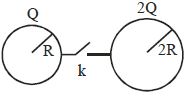
- 8Two spheres of radius $R$ and $2R$ having charge $Q$ and $2Q$ respectively are placed far away from each other. How much charge will flow when key $'k'$ is pressed ?View Solution
- 9Three concentric spherical shells have radii $a, b$ and $c (a < b < c)$ and have surface charge densities $\sigma ,-\;\sigma $ and $\;\sigma \;$ respectively. If $V_A,V_B$ and $V_C$ denote the potentials of the three shells, then, for $c = a +b,$ we haveView Solution
- 10Two positive charges of magnitude $q$ are placed at the ends of a side $1$ of a square of side $2a$. Two negative charges of the same magnitude are kept at the other corners. Starting from rest, if a charge $Q$, moves from the middle of side $1$ to the centre of square, its kinetic energy at the centre of square isView Solution