Question
A charge Q is uniformly distributed on a thin spherical shell. What is the field at the centre of the shell? If a point charge is brought close to the shell, will the field at the centre change? Does your answer depend on whether the shell is conducting or nonconducting?

Answer

The field at the centre of the shell is zero. As all the charge given to a conductor resides on the surface, the field at any point inside the conducting sphere is zero. Also, the charge distribution at the surface is uniform so, all the electric field vectors due to these charges at the centre are equal and opposite. So, they cancel each other, resulting in a zero net value of the field.
When a charge is brought near the shell, due to induction, opposite polarity charges induce on the surface nearer to the charge and the same polarity charges appear on the face farther from the charge. In this way, a field is generated inside the shell. Hence, the field at the centre is non-zero.
Yes, our answer changes in case of a non-conducting spherical shell. As the charge given to the surface of a non-conducting spherical shell spreads non-uniformly, there is a net electric field at the centre of the sphere.
Need a full question paper?

Generate a complete, print-ready paper with questions like this in minutes — across 16+ boards, with answer keys.

Start Generating Free

Similar questions

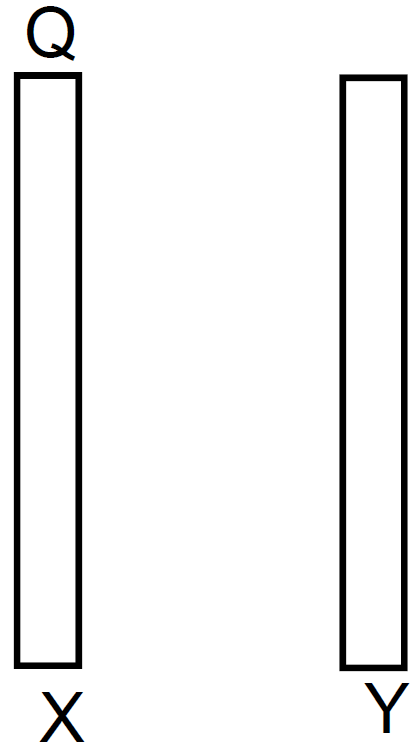
Two conducting plates X and Y, each having large surface area A (on one side), are placed parallel to each other as shown in figure. The plate X is given a charge Q whereas the other is neutral. Find:
  1. The surface charge density at the inner surface of the plate X.
  2. The electric field at a point to the left of the plates.
  3. The electric field at a point in between the plates.
  4. The electric field at a point to the right of the plates.
Answer the following Questions.
  1. Find expressions for the force and torque on an electric dipole kept in a uniform electric field.
OR

An electric dipole is held in a uniform electric field. (i) Using suitable diagram show that it does not undergo any translatory motion, and (ii) derive an expression for torque acting on it and specify its direction.
  1. Derive an expression for the work done in rotating a dipole from the angle $\theta_0$ to $\theta_1$ in a uniform electric field E.
​​​​​​​OR
  1. Define torque acting on a dipole of dipole moment $\vec{\text{p}}$ placed in a uniform electric field $\vec{\text{E}}.$ Express it in the vector form and point out the direction along which it acts.
  2. What happens if the field is non-uniform?
  3. What would happen if the external field $\vec{\text{E}}$ is increasing (i) parallel to $\vec{\text{p}}$ and (ii) anti-parallel to $\vec{\text{p}}?$
A uniform wheel of radius R is set into rotation about its axis at an angular speed $\omega.$ This rotating wheel is now placed on a rough horizontal surface with its axis horizontal. Because of friction at the contact, the wheel accelerates forward and its rotation decelerates till the wheel starts pure rolling on the surface. Find the linear speed of the wheel after it starts pure rolling.
A thin lens made of a material of refractive index $\mu_2$ has a medium of refractive index $\mu_1$ on one side and a medium of refractive index $\mu_3$ on the other side. The lens is biconvex and the two radii of curvature have equal magnitude R. A beam of light travelling parallel to the principal axis is incident on the lens. Where will the image be formed if the beam is incident from:
  1. The medium $\mu_1$
  2. From the medium $\mu_3?$
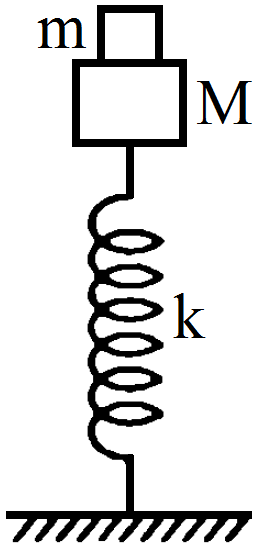
A small block of mass m is kept on a bigger block of mass M which is attached to a vertical spring of spring constant k as shown in the figure. The system oscillates vertically.
  1. Find the resultant force on the smaller block when it is displaced through a distance x above its equilibrium position.
  2. Find the normal force on the smaller block at this position. When is this force smallest in magnitude?
  3. What can be the maximum amplitude with which the two blocks may oscillate together?
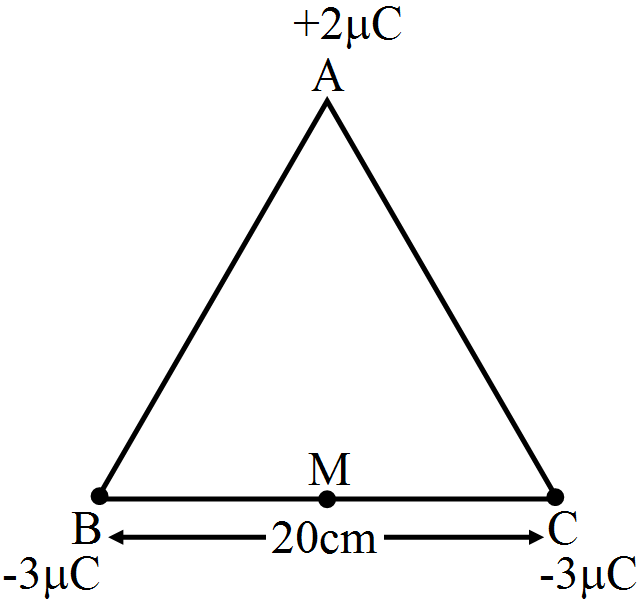
Three point charges of $+2\mu\text{C}, -3\mu\text{C}$ and $-3\mu\text{C}$ are kept at the vertices A, B and C respectively of an equilateral triangle of side 20cm as shown in figure. What should be the sign and magnitude of charge to be placed at the midpoint M of side BC so that charge at A remains in equilibrium?
Light of intensity $10^{–5}$ W $m^{–2}$ falls on a sodium photo-cell of surface area $2 cm^2.$ Assuming that the top 5 layers of sodium absorb the incident energy, estimate time required for photoelectric emission in the wave-picture of radiation. The work function for the metal is given to be about 2 eV. What is the implication of your answer?
Derive an expression for magnetic field intensity due to a magnetic dipole at a point on its axial line.
$i.$ Draw a ray diagram showing the image formation by a compound microscope. Hence obtain the expression for total magnification when the image is formed at least distance of distinct vision.
$iii.$ A compound microscope consists of an objective lens of focal length $2.0 \ cm$ and an eyepiece of focal length $6.0 \ cm$. If they are separated by a distance of $24 \ cm$, find the total magnification when the image is formed at infinity.
A point object 'O' is kept in a medium of refractive index $n_1$ in front of a convex spherical surface of radius of curvature R which separates the second medium of refractive index $n_2$ from the first one, as shown in the figure.
  1. Draw the ray diagram showing the image formation and deduce the relationship between the object distance and the image distance in terms of $n_1, n_2$ and R.
  2. When the image formed above acts as a virtual object for concave spherical, surface separating the medium $n_2$ from $n_1 (n_2> n_1)$, draw this ray diagram and write the similar (similar to (a) relation. Hence obtain the expression for the lens maker's formula.