Question
Two conducting plates X and Y, each having large surface area A (on one side), are placed parallel to each other as shown in figure. The plate X is given a charge Q whereas the other is neutral. Find:
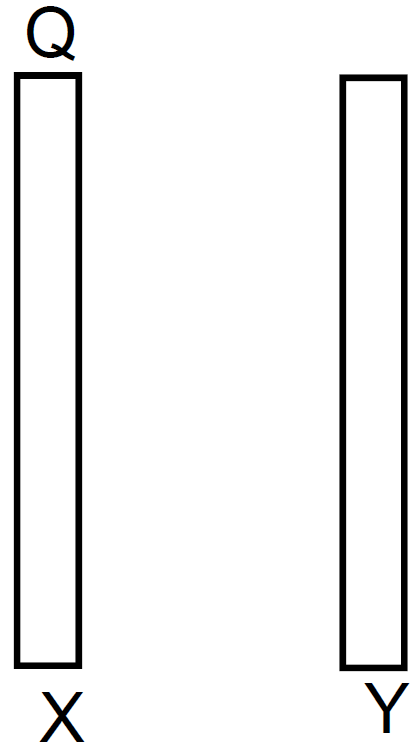
  1. The surface charge density at the inner surface of the plate X.
  2. The electric field at a point to the left of the plates.
  3. The electric field at a point in between the plates.
  4. The electric field at a point to the right of the plates.
Answer

  1. Given that the charge present on the plate is Q. The other plate will get the same charge Q due to convection.
Let the surface charge densities on both sides of the plate be $\sigma_1$ and $\sigma_2.$

Now, electric field due to a plate,

$\text{E}=\frac{\sigma}{2\in_0}$

So, the magnitudes of the electric fields due to this plate on each side $=\frac{\sigma_1}{2\in_0}$ and $\frac{\sigma_2}{2\in_0}$

The plate has two sides, each of area A. So, the net charge given to the plate will be equally distributed on both the sides.This implies that the charge developed on each side will be:

$\text{q}_1=\text{q}_2=\frac{\text{Q}}{2}$

This implies that the net surface charge density on each side $=\frac{\text{Q}}{2\text{A}}$
  1. Electric field to the left of the plates
On the left side of the plate surface, charge density,

$\sigma=\frac{\text{Q}}{2\text{A}}$

Hence, electric field $=\frac{\text{Q}}{2\text{A}\in_0}$

This must be directed towards the left, as 'X' is the positively-charged plate.
  1. Here, the charged plate 'X' acts as the only source of electric field, with positive in the inner side. Plate Y is neutral. So, a negative charge will be induced on its inner side. 'Y' attracts the charged particle towards itself. So, the middle portion E is towards the right and is equal to $\frac{\text{Q}}{2\text{A}\in_0}.$
  2. Similarly for the extreme right, the outer side of plate 'Y' acts as positive and hence it repels to the right with $\text{E}=\frac{\text{Q}}{2\text{A}\in_0}.$

Need a full question paper?

Generate a complete, print-ready paper with questions like this in minutes — across 16+ boards, with answer keys.

Start Generating Free

Similar questions

A parallel plate capacitor is to be designed with a voltage rating 1kV, using a material of dielectric constant 3 and dielectric strength about $10^7Vm^{–1}$. (Dielectric strength is the maximum electric field a material can tolerate without breakdown, i.e., without starting to conduct electricity through partial ionisation.) For safety, we should like the field never to exceed, say 10% of the dielectric strength. What minimum area of the plates is required to have a capacitance of 50pF?
In an experiment on photoelectric effect, the stopping potential is measured for monochromatic light beams corresponding to different wavelengths. The data collected are 11s follows:
wavelength (nm) 350 400 450 500 550
stopping potential(V): 1.45 1.00 0.66 0.38 0.16
Plot the stopping potential against inverse of wavelength $\big(\frac{1}{\lambda}\big) $ on a graph paper and find
  1. The Planck constant,
  2. The work function of the emitter and.
  3. The threshold wavelength.
The activity R of an unknown radioactive nuclide is measured at hourly intervals. The results found are tabulated as follows:
t(h) 0 1 2 3 4
R(MBq) 100 35.36 12.51 4.42 1.56
  1. Plot the graph of R versus t and calculate half-life from the graph.
  2. Plot the graph of 0 ln $\Big(\frac{\text{R}}{\text{R}_0}\Big)$ versus t and obtain the value of half-life from the graph.
The amount of charge that passes in time t through a cross-section of a wire is,
$Q(t) = At^2 + Bt + C.$
  1. Write the dimensional formulae for A, B and C.
  2. If the numerical values of A, B and C are 5, 3 and 1, respectively, in S.I units, find the value of the current at t = 5s.
A particle is fired vertically upward with a speed of 15km/s. With what speed will it move in intersteller space. Assume only earth's gravitational field.
With the help of a ray diagram, show the formation of image of a point object due to refraction of light at a spherical surface separating two media of refractive indices $n_1$ and $n_2 (n_2 > n_1)$ respectively. Using this diagram, derive the relation.
$\frac{\text{n}_2}{\text{v}}-\frac{\text{n}_1}{\text{u}}=\frac{\text{n}_1-\text{n}_2}{\text{R}}$
Write the sign conventions used. What happens to the focal length of convex lens when it is immersed in water?
The amplitude of the magnetic field part of a harmonic electromagnetic wave in vacuum is $B_0 = 510$ nT. What is the amplitude of the electric field part of the wave?
If the radius of the earth decreases by 1% without changing its mass, will the acceleration due to gravity at the surface of the earth increase or decrease? If so, by what per cent?
Find the expression for the energy stored in the capacitor. Also find the energy lost when the charged capacitor is disconnected from the source and connected in parallel with the uncharged capacitor. Where does this loss of energy appear?
Study the circuits (a) and (b) shown in Fig. and answer the following questions.
  1. Under which conditions would the rms currents in the two circuits be the same?
  2. Can the rms current in circuit (b) be larger than that in (a)?