MCQ
A charged gold leaf electroscope has its leaves apart by certain amount having enclosed air. When the electroscope is subjected to $X$-rays, then the leaves
  • A
    Further dilate
  • B
    Start oscillating
  • Collapse
  • D
    Remain unaltered

Answer

Correct option: C.
Collapse
c
(c)

A charged gold leaf electroscope has its leaves apart by certain amount having enclosed air. When an electroscope is subjected to $x$-rays, then the $x$-ray will ionize the air around the leaves into positive and negative charges. Hence, the charge created in the air and opposite to the gold leaf will move towards it. Thus, the opposite charges neutralize the charge on the leaf, causing the leaf to collapse.

Need a full question paper?

Generate a complete, print-ready paper with questions like this in minutes — across 16+ boards, with answer keys.
Start Generating Free

Similar questions

A particle is thrown vertically upwards with a velocity of $4\,ms^{-1}$. The ratio of its accelerations after $1\,s$ and $2\,s$ of its motion is
A $30\,\mu F$ capacitor is charged by a constant current of $30\, mA$. If the capacitor is initially uncharged, how long does it take for the potential difference to reach $400\, V$.....$s$
The ratio of the weights of a body on the Earth's surface to that on the surface of a planet is $9 : 4$. The mass of the planet is $\frac{1}{9}^{th}$ of that of the Earth. If $'R'$ is the radius of the Earth, what is the radius of the planet ? (Take the planets to have the same mass density)
A potential is given by $V(x)=k(x+a)^2 / 2$ for $x < 0$ and $V(x)=k(x-a)^2 / 2$ for $x > 0$. The schematic variation of oscillation period $T$ for a particle performing periodic motion in this potential as a function of its energy $E$ is
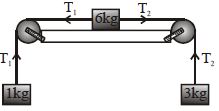
Three masses of $1\, kg$, $6\, kg$ and $3\, kg$ are connected to each other with threads and are placed on a tabel as shown in figure. ....... $ms^{-2}$ is the acceleration with which the block is moving. (Take $g = 10\, ms^2$)
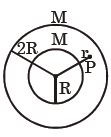
Two concentric hollow sphere of radius $R$ and $2R$ and same mass $M$ as shown in figure then gravitational field intensity at point $P$ is
Imagine earth to be a solid sphece of mass $M$ and radius $R$. If the value of acceleration due to gravity at a depth d below earth's surface is same as its value at a height $h$ above its surface and equal to $\frac{g}{4}$ (where $g$ is the value of acceleration due to gravity on the surface of earth), the ratio of $\frac{h}{d}$ will be
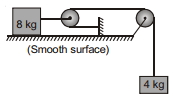
If pulleys shown in the diagram are smooth and massless and $a_1$ and $a_2$ are acceleration of blocks of mass $4 \,kg$ and $8 \,kg$ respectively, then
$A$ man spinning in free space changes the shape of his body, $eg.$ by spreading his arms or curling up. By doing this, he can change his
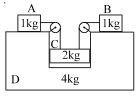
In the system shown in the figure there is no friction anywhere. The block $C$ goes down by $a$ distance $x_0 = 10\, cm$ with respect to wedge $D$ when system is released from rest. The velocity of $A$ with respect to $B$ will be $(g = 10\, m/s^2)$ ......... $m/s$