Question
A charged metallic sphere A is suspended by a nylon thread. Another charged metallic sphere B held by an insulating
Image
handle is brought close to A such that the distance between their centres is 10 cm, as shown in Fig. 1.4(a). The resulting repulsion of A is noted (for example, by shining a beam of light and measuring the deflection of its shadow on a screen). Spheres A and B are touched by uncharged spheres C and D respectively, as shown in Fig. 1.4(b). C and D are then removed and B is brought closer to A to a distance of 5.0 cm between their centres, as shown in Fig. 1.4(c). What is the expected repulsion of A on the basis of Coulomb’s law? Spheres A and C and spheres B and D have identical sizes. Ignore the sizes of A and B in comparison to the separation between their centres.
Answer

Let the original charge on sphere A be $q$ and that on B be $q^{\prime}$. At a distance $r$ between their centres, the magnitude of the electrostatic force on each is given by
$
F=\frac{1}{4 \pi \varepsilon_0} \frac{q q^{\prime}}{r^2}
$
neglecting the sizes of spheres A and B in comparison to $r$. When an identical but uncharged sphere $C$ touches $A$, the charges redistribute on A and $C$ and, by symmetry, each sphere carries a charge q/2. Similarly, after D touches B, the redistributed charge on each is $q^{\prime} / 2$. Now, if the separation between A and B is halved, the magnitude of the electrostatic force on each is
$
F^{\prime}=\frac{1}{4 \pi \varepsilon_0} \frac{(q / 2)\left(q^{\prime} / 2\right)}{(r / 2)^2}=\frac{1}{4 \pi \varepsilon_0} \frac{\left(q q^{\prime}\right)}{r^2}=F
$
Thus the electrostatic force on A, due to B, remains unaltered.

Need a full question paper?

Generate a complete, print-ready paper with questions like this in minutes — across 16+ boards, with answer keys.

Start Generating Free

Similar questions

Explain Lorentz force and state its characteristics.
Explain the series connection of capacitors.
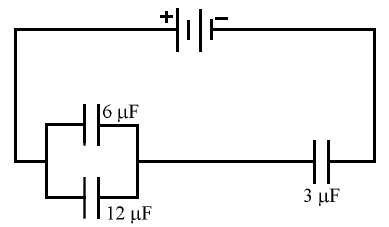
  1. In the following arrangement of capacitors, the energy stored in the 6 μF capacitor is E. Find the value of the following:
  2. Energy stored in 12 μF capacitor.
  3. Energy stored in 3 μF capacitor.
  4. Total energy drawn from the battery.
Calculate the energy released if $U^{238}$ -nucleus emits an $\alpha-$particle.
OR
Calculate the energy released in MeV in the following nuclear reaction.
$^{238}_{92}\text{U}\ \rightarrow\ ^{234}_{90}\text{Th}\ +\ ^4_2\text{He}\ +\ \text{Q}$
Given Atomic mass of $^{238}U = 238.05079u$
Atomic mass of $^{234}Th = 234.04363u$
Atomic mass of alpha particle $= 4.00260u$
$1u = 931.5MeV/ c^2$
IS the decay spontaneous? Give reason.
The voltage and current in a series AC circuit are given by, $\text{V}=\text{V}_0\cos\omega\text{t}$ and $\text{i}=\text{i}_0\sin\omega\text{t}.$ What is the power dissipated in the circuit?
Red light however bright it is, cannot produce the emission of electrons from a clean zinc surface, but even weak ultraviolet radiation can do so; why?
Two harmonic waves of monochromatic light$\text{y}_{1} = \text{a} \cos\omega\text{t}\text{ and } \text{y}_{2} = \text{a} \cos(\omega\text{t} + \Phi)$
are superimposed on each other. Show that maximum intensity in interference pattern is four times the intensity due to each slit. Hence write the conditions for constructive and destructive interference in terms of the phase angle$\Phi$.
A particle moves in a circle of diameter 1.0cm under the action of a magnetic field of 0.40T. An electric field of $200\ Vm^{-1}$ makes the path straight. Find the charge/ mass ratio of the particle.
The work function for the following metals is given:
Na: 2.75 eV; K: 2.30 eV; Mo: 4.17 eV; Ni: 5.15 eV. Which of these metals will not give photoelectric emission for a radiation of wavelength 3300 Å from a He-Cd laser placed 1 m away from the photocell? What happens if the laser is brought nearer and placed 50 cm away?
The magnetic field at a point inside a 2.0mH inductor coil becomes 0.80 of its maximum value in 20µs when the inductor is joined to a battery. Find the resistance of the circuit.